We think it’s time for investors to consider moving from a short-duration bias toward core (plus) bond portfolios. Valuations have become more attractive across fixed income, with all-in yields approaching compelling levels. We share our views on when and why.
Treasuries
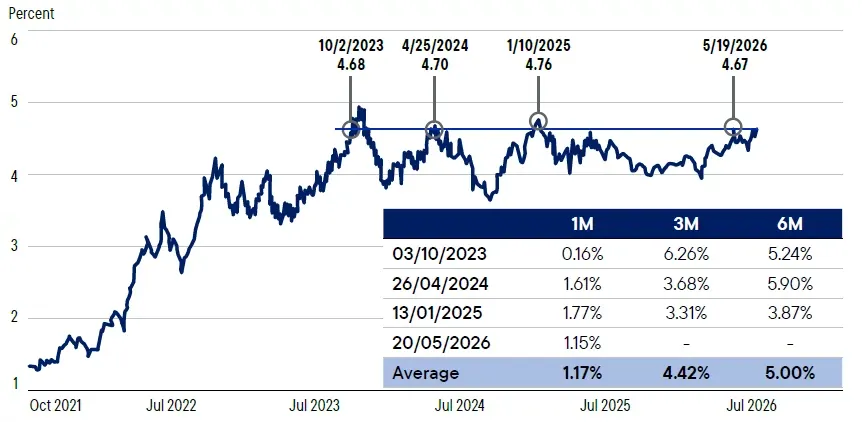
We believe the benchmark 10-year Treasury yield will remain broadly range-bound, and investors should consider investing when yields are close to or above the upper end of that range (~4.75%).
Recent history suggests that extending duration through core bond strategies at these yield levels has worked well (Exhibit 1).
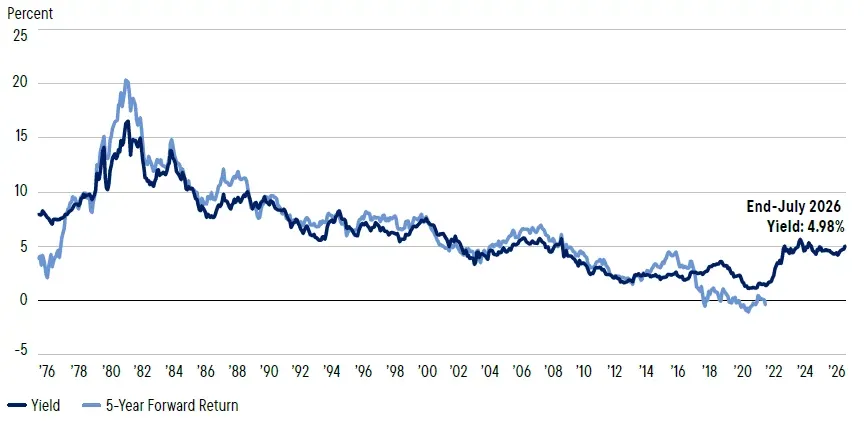
More broadly, higher starting yields have historically been a good predictor of higher forward returns (Exhibit 2).
The risk is that yields could move higher, but we see that risk as relatively limited given that the market already prices in a meaningful degree of monetary policy tightening and risk premium. A meaningful move above the recent range would require fairly dramatic assumptions on both fronts.
In short, we view the risk-reward as favorable over the coming months.
A more hawkish-than-expected Federal Reserve (Fed) remains a risk, but we believe that realized hikes could, in fact, cause longer-duration bonds to catch a bid.
For investors with lower risk tolerance, we continue to view short-duration bonds as very resilient. Our analysis shows that two-year Treasury yields would need to rise above 9% to post negative returns (assuming a one-year horizon)
See more: Operation Twist Exhibit 1: 10-Year Treasury Yield Levels and US Agg Bond Forward Returns
Exhibit 2: Bloomberg US Aggregate: Yield vs. Five-Year Forward Return
Investment-Grade (IG) Credit
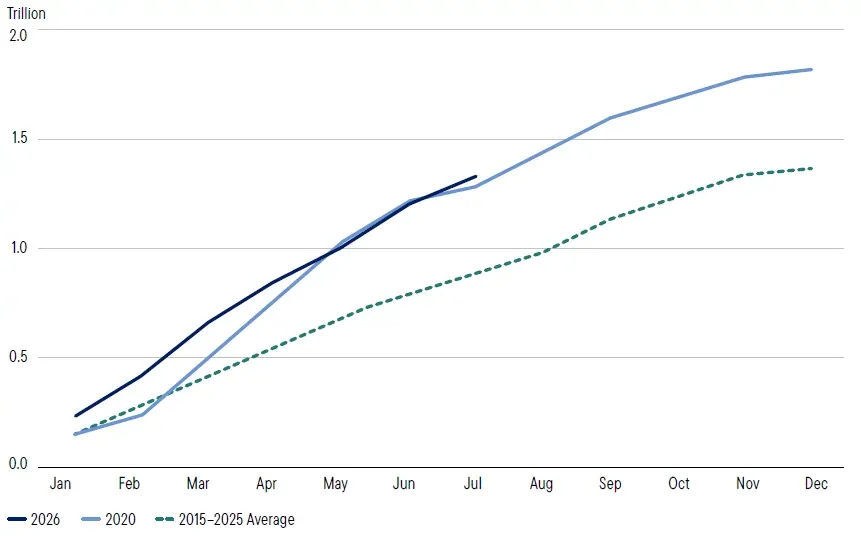
The major story in credit markets lately has been investment-grade bond supply, driven in part by hyperscaler borrowing. More than US$1.3 trillion of IG issuance came to market through the first seven months of the year—well above historical norms (Exhibit 3).
Our seasonality analysis suggests supply should slow in the second half of 2026. Based on the 2015–2025 period, average monthly IG issuance was around 30% lower in the second half of the year than in the first half.
If this pattern holds, even partially, this should provide some relief at a time when credit spreads have widened from their tights and are back around their April 2026 levels, closer to what we view as fair value.
The risk is that elevated debt issu-ance will not ease. For now, though, we see pockets of risk as isolated, not broad-based.
Exhibit 3: Investment Grade USD Bond Issuance
High-Yield
We continue to view an all-in yield on high-yield bonds north of 7% as attractive.
Spreads are no longer at their tights1 but remain historically low. However, low duration and an improved credit profile make the asset class more resilient than many assume.
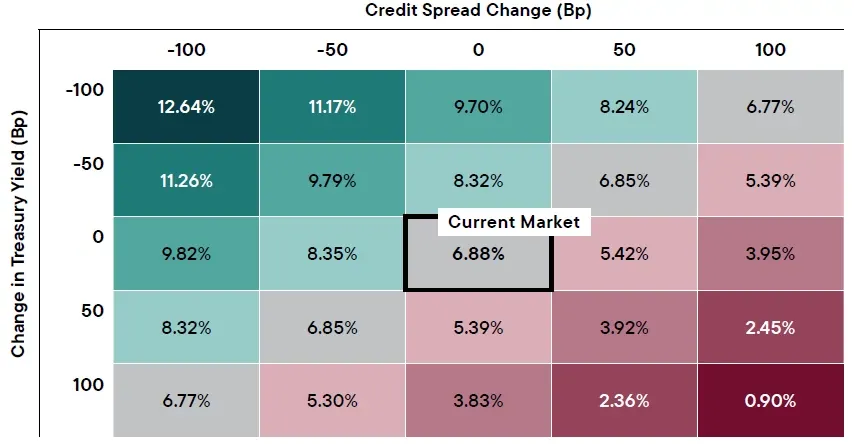
Exhibit 4 illustrates a range of total return scenarios for high yield. It would take a significant adverse move in yields and spreads for returns to turn negative.
We remain biased toward higher-rated issuers. Triple-C credit is more vulnerable and has underperformed this year—something we are moni-toring, but not yet a reason for concern about the broader high-yield market.
Exhibit 4: One-Year US High-Yield Return Scenarios
Agency Mortgage-Backed Securities (MBS)
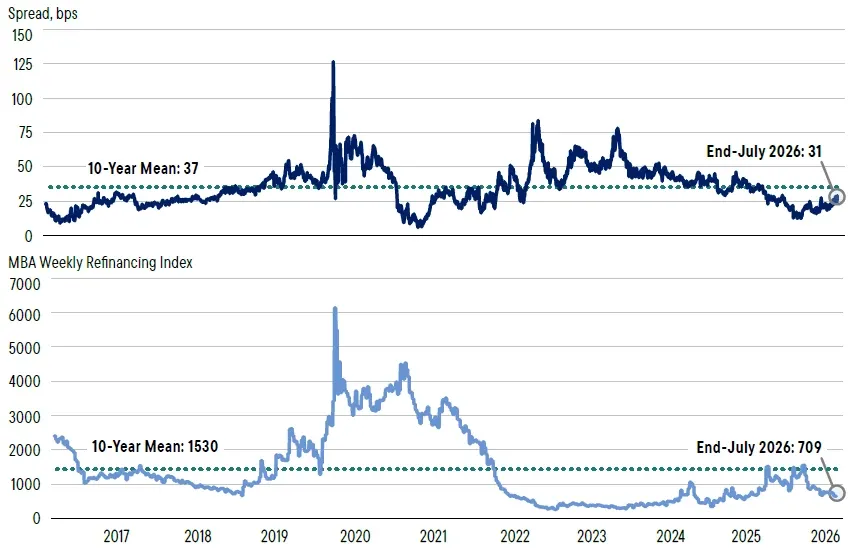
Fundamentals in the Agency MBS space remain solid. A key risk for Agency MBS investors—prepayment risk—remains contained. The bulk of US mortgage borrowers remain locked in sub-4% mortgage rates, while the current mortgage rate is closer to 6.7%. This keeps refinancing activity subdued, as the lower panel of Exhibit 5 shows, limiting refi-nancing-driven prepayment risk.
At the same time, the same exhibit shows that spreads, while below their 10-year mean, are off their tights, which the fundamental backdrop broadly supports.
Relatively high carry,2 rather than spread compression, is likely to be the major driver of returns in the second half of the year.
On the demand side, government-sponsored enterprise (GSE)3 buying has provided an important source of demand as Fed holdings continue to run off, while banks are finding the sector more attractive amid higher yields.
The biggest risk we see is increasing rate volatility (for example, amid less forward guidance from the Fed), which could reduce the relative appeal of Agency MBS given investors’ effectively short position in the embedded prepayment option, the value of which increases with volatility.
Exhibit 5 : Bloomberg US MBS Index: Spread and Refinancing Activity
End Notes
Yield spreads/tights: Yield spreads are the difference between corporate bond yields and comparable Treasury yields. “Tight” in reference to spreads indicates a small difference in yields.
Carry: The income generated from holding a fixed income security, primarily through interest payments.
Government-sponsored enterprise (GSE): A financial institution created by the US Congress to enhance the flow of credit to specific sectors of the economy, such as housing (e.g., Fannie Mae and Freddie Mac).
WHAT ARE THE RISKS?
All investments involve risks, including possible loss of principal.
The allocation of assets among different strategies, asset classes and investments may not prove beneficial or produce desired results.
Diversification does not guarantee a profit or protect against a loss.
Fixed income securities involve interest rate, credit, inflation and reinvestment risks, and possible loss of principal. As interest rates rise, the value of fixed income securities falls. Low-rated, high-yield bonds are subject to greater price volatility, illiquidity and possibility of default.
The investment style may become out of favor, which may have a negative impact on performance.