Finding Opportunities Amid Elevated Single-Stock Volatility
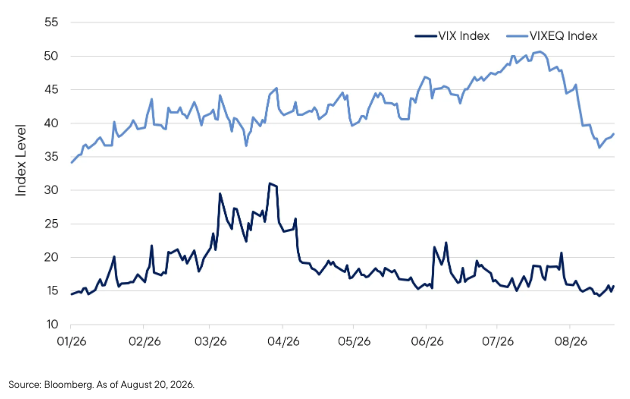
Beneath relatively muted index-level volatility, single-stock implied volatility remains high. In today’s low-correlation environment, individual stocks are moving more independently, keeping single-name volatility high even as those moves offset at the index level. Sector rotation and company-specific catalysts are contributing to that dispersion, with earnings becoming particularly important as investors look for evidence that significant artificial intelligence (AI) investment is beginning to translate into revenue growth and improved returns.
Muted Index Volatility Masks Increased Single-Stock Volatility
This creates an attractive entry point for generating additional income through equity linked notes (ELNs). Equity linked notes can improve the income opportunity, provide for capital appreciation opportunities, and expand the investment universe giving us selective exposure to market themes, including AI.
See more: Is There Really Carnage in Hyperscaler Credit?
Capitalizing on Select Dislocations Across the Investment-Grade (IG) Market
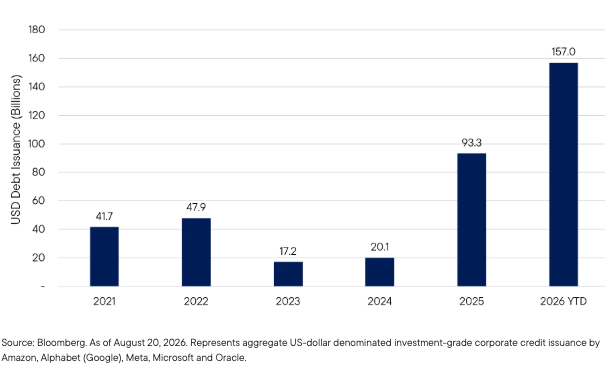
At the same time, a separate opportunity has developed in IG credit as the AI investment cycle reshapes corporate debt financing markets. The rapid expansion of AI-related capital spending by hyperscalers such as Alphabet, Meta, Microsoft, Amazon and Oracle has contributed to a significant increase in corporate debt issuance, including longer-maturity bonds. Heavy issuance has at times outpaced investor demand, pushing spreads wider and requiring issuers to offer higher coupons.
Hyperscaler Debt Issuance Rises Sharply as AI Spending Accelerates
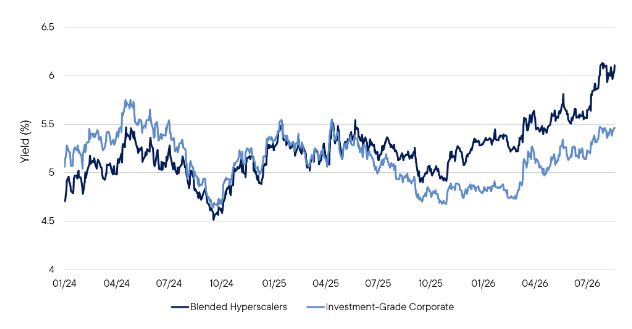
This repricing appears more technical than fundamental and our focus is on IG hyperscalers that have maintained strong balance sheets, high credit ratings and significant cash-generation capacity. Parts of their long-dated curves are trading at spreads more typical of lower-rated credit. In some areas, IG yields have moved close to high-yield levels despite materially different credit risk, while broader IG spreads and credit volatility remain relatively contained.
Investment-Grade Hyperscaler Yields Outpace Investment-Grade Corporate Yields
For income investors, this creates an attractive opportunity to add to high-quality bonds. Short-dated hyperscaler bonds remain relatively tight, while the long end offers more meaningful yield, carry and spread. We therefore have the potential to buy high-quality credit at lower prices and lock in higher coupons—using supply-driven dislocations to add income—without necessarily taking on materially greater fundamental credit risk.
Diversified Across Multiple Sources of Income
We believe the current market environment highlights the value of diversification across asset classes, sectors and securities. A flexible and dynamic approach allows us to pursue income across a broad opportunity set while maintaining a strong focus on capital appreciation and growth. By drawing on multiple sources of income across the portfolio, we can adapt as market conditions evolve while remaining selective in how and where we take risk.
A message from Advisor Perspectives and VettaFi: Discover something new! Click here to register for our upcoming webcasts.
WHAT ARE THE RISKS?
All investments involve risks, including possible loss of principal. Indexes are unmanaged and one cannot directly invest in them. They do not include fees, expenses or sales charges.
The allocation of assets among different strategies, asset classes and investments may not prove beneficial or produce desired results.
Diversification does not guarantee a profit or protect against a loss.
Equity securities are subject to price fluctuation and possible loss of principal. Investments in equity-linked notes often have risks similar to their underlying securities, which could include management risk, market risk and, as applicable, foreign securities and currency risks.
Investments in equity-linked notes often have risks similar to their underlying securities, which could include management risk, market risk and, as applicable, foreign securities and currency risks.
Fixed income securities involve interest rate, credit, inflation and reinvestment risks, and possible loss of principal. As interest rates rise, the value of fixed income securities falls. Low-rated, high-yield bonds are subject to greater price volatility, illiquidity and possibility of default.
Any companies and/or case studies referenced herein are used solely for illustrative purposes; any investment may or may not be currently held by any portfolio advised by Franklin Templeton. The information provided is not a recommendation or individual investment advice for any particular security, strategy, or investment product and is not an indication of the trading intent of any Franklin Templeton managed portfolio.
IMPORTANT LEGAL INFORMATION
This material is intended to be of general interest only and should not be construed as individual investment advice or a recommendation or solicitation to buy, sell or hold any security or to adopt any investment strategy. It does not constitute legal or tax advice. This material may not be reproduced, distributed or published without prior written permission from Franklin Templeton.
The views expressed are those of the investment manager and the comments, opinions and analyses are rendered as at publication date and may change without notice. The underlying assumptions and these views are subject to change based on market and other conditions and may differ from other portfolio managers or of the firm as a whole. The information provided in this material is not intended as a complete analysis of every material fact regarding any country, region or market. There is no assurance that any prediction, projection or forecast on the economy, stock market, bond market or the economic trends of the markets will be realized. The value of investments and the income from them can go down as well as up and you may not get back the full amount that you invested. Past performance is not necessarily indicative nor a guarantee of future performance. All investments involve risks, including possible loss of principal.
Any research and analysis contained in this material has been procured by Franklin Templeton for its own purposes and may be acted upon in that connection and, as such, is provided to you incidentally. Data from third party sources may have been used in the preparation of this material and Franklin Templeton ("FT") has not independently verified, validated or audited such data. Although information has been obtained from sources that Franklin Templeton believes to be reliable, no guarantee can be given as to its accuracy and such information may be incomplete or condensed and may be subject to change at any time without notice. The mention of any individual securities should neither constitute nor be construed as a recommendation to purchase, hold or sell any securities, and the information provided regarding such individual securities (if any) is not a sufficient basis upon which to make an investment decision. FT accepts no liability whatsoever for any loss arising from use of this information and reliance upon the comments, opinions and analyses in the material is at the sole discretion of the user.
Franklin Templeton has environmental, social and governance (ESG) capabilities; however, not all strategies or products for a strategy consider “ESG” as part of their investment process.
Products, services and information may not be available in all jurisdictions and are offered outside the U.S. by other FT affiliates and/or their distributors as local laws and regulation permits. Please consult your own financial professional or Franklin Templeton institutional contact for further information on availability of products and services in your jurisdiction.
Issued in the U.S. by Franklin Templeton, One Franklin Parkway, San Mateo, California 94403-1906, (800) DIAL BEN/342-5236, franklintempleton.com. Investments are not FDIC insured; may lose value; and are not bank guaranteed.
You need Adobe Acrobat Reader to view and print PDF documents. Download a free version from Adobe's website.
CFA® and Chartered Financial Analyst® are trademarks owned by CFA Institute.
© Franklin Templeton
More Tax Planning Topics >