When Revenue Acceleration Overwhelms Quality
Membership required
Membership is now required to use this feature. To learn more:
View Membership Benefits
Key Takeaways

- AI-driven scarcity is allowing companies perceived as lower quality to post the revenue growth, margin expansion and rising returns that investors associate with quality, lifting estimates, multiples and stock prices.
- This apparent quality can last for years, but history shows it is not necessarily structural. When capital spending slows or expectations catch up, smaller earnings beats and a slower pace of upward earnings revisions can expose how much of the improvement depends on scarcity related pricing power.
- Active managers need to recognize durable regime shifts without confusing cyclical improvement with structural quality. The opportunity is to separate companies whose economics have genuinely improved from those borrowing quality from the cycle.
Over the past two years, perceived lower-quality companies have not just outperformed higher-quality peers; many have begun to look like them.
That can happen in a generational investment cycle. When vigorous AI-related demand meets limited industry supply, companies gain pricing power. Revenue accelerates, fixed costs are absorbed and margins, returns and cash flow improve. Those are the same metrics investors normally associate with quality, so estimates rise, multiples expand and the stocks perform.
See more: The Evolving Nature of Equity Quality in the Age of AI
For a time, lower-quality companies can masquerade as high quality. The improvement in the numbers is real, but it may be superficial. Intense competition, limited differentiation, customer concentration and a lack of durable pricing power have not necessarily disappeared; they simply matter less while revenue and earnings surprises keep coming.
High-quality companies—profitable, growing, financially sound and disciplined in their use of capital—have historically earned a return premium. However, the past two years have been an exception with quality’s outperformance eroding from its most recent peak, leading to underperformance for the rolling periods ending in 2026 (Exhibit 1). The market often treats improving quality as durable quality until the earnings-revision cycle says otherwise.
Exhibit 1: Quality Has Been Challenged Recently
ClearBridge US Quality (long-short), rolling 24-month cumulative return
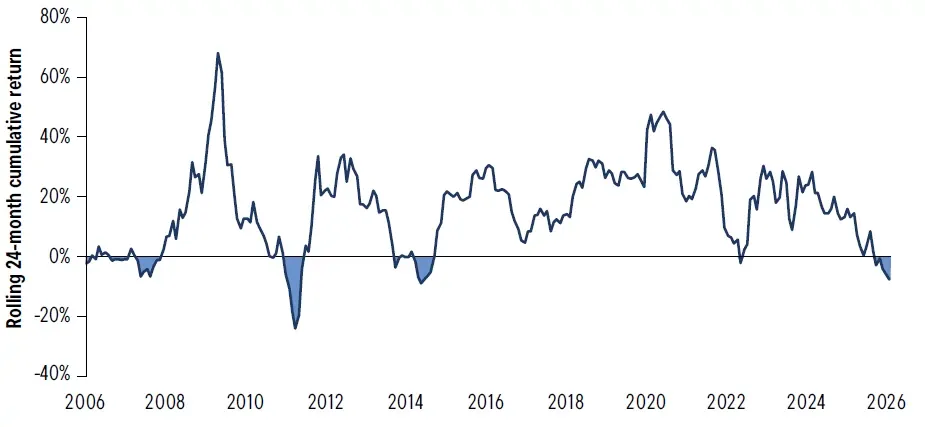

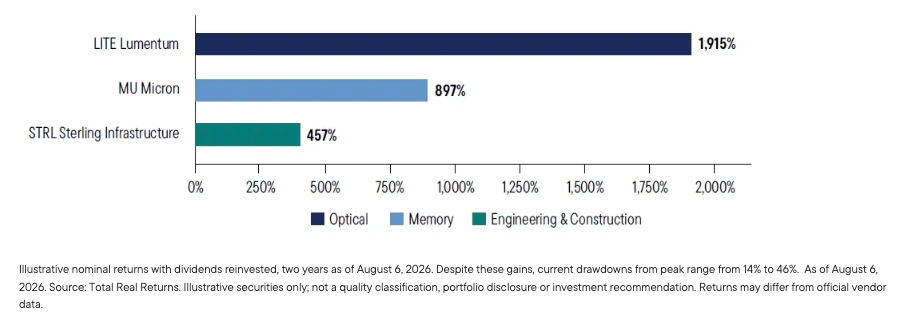
Exhibit 2: Scarcity Beneficiaries Delivered Extraordinary Two-Year Returns
Eventually, Expectations Catch Up
Strong operating results do not have to reverse for a stock to stop working, they only have to become less surprising. After several quarters of earnings beats, consensus estimates rise, investors pay a higher multiple and the bar moves closer to the company’s actual earnings power.
This is where the second derivative matters: revenue may still be growing, margins may still be expanding and earnings may still be topping estimates – but by less. A slower pace of upward estimate revisions, smaller upside surprises or flattening incremental margins can signal that investor expectations are catching up to reality.
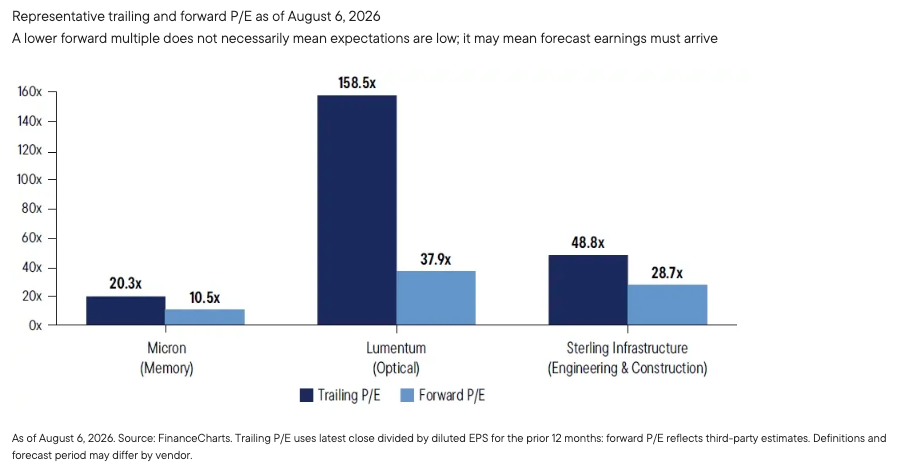
At that point, the market will start to ask what is structural. Can the company retain pricing power as supply improves? Is the margin gain tied to a durable competitive advantage or simply to scarcity? Can returns stay elevated when customers have more alternatives and input costs are harder to pass through? Importantly, a lower forward P/E does not necessarily mean expectations are low; it may mean that substantial earnings growth is already embedded in the forecast (Exhibit 3). A stock can disappoint even while earnings grow if it no longer clears the higher bar.
Exhibit 3: Consensus Already Assumes a Substantial Earnings Step-up
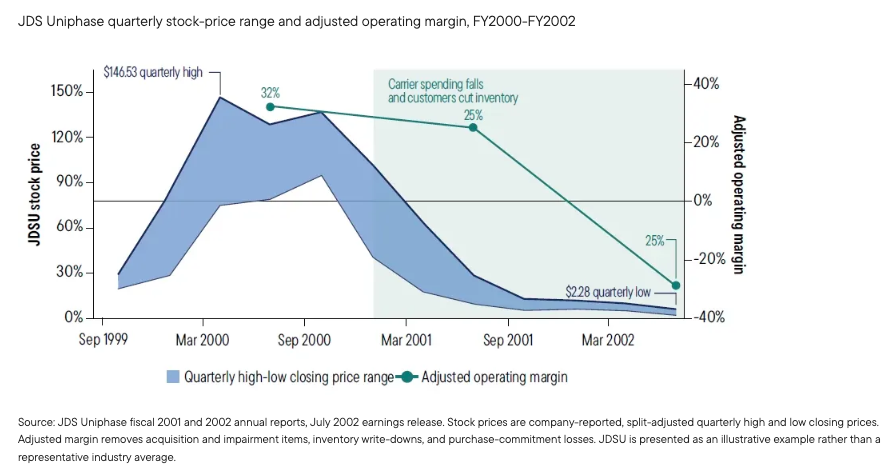
The optical networking boom of 1999–2001 offers a useful, if imperfect, comparison with today’s AI infrastructure buildout. Internet traffic was surging, telecom companies had easy access to capital and new equipment allowed them to send much more data over the fiber already in the ground, creating a rush of spending and unusually positive results for suppliers such as JDS Uniphase (JDSU). When carriers later cut spending after building more network than demand required, orders fell, customers worked down inventories and JDSU’s adjusted operating margin—after removing inventory write-downs, restructuring charges and other one-time items in each year—fell from 32% in fiscal 2000 to 25% in fiscal 2001 and -29% in fiscal 2002; its split-adjusted stock price fell from a quarterly high of US$146.53 to a quarterly low of US$2.28 (Exhibit 4). While JDSU’s decline was unusually severe, the broader telecom equipment sector also experienced significant revenue pressure, inventory corrections, restructuring actions and margin compression, supporting the broader cyclical comparison.
Exhibit 4: Optical Networking Profits Reversed When Carrier Spending Fell
The Lesson for Active Managers Runs Both Ways
Quality-oriented managers should not dismiss this episode as an irrational low-quality rally. Generational investment cycles can persist for years, and the compounding cost of missing a durable trend can be substantial.
Quality is an attribute, not a catalyst, and it cannot become a crutch. Durable competitive advantages usually give a company the best opportunity to reinvest, grow and raise returns in a defensible way. However, when those advantages are not producing growth, quality alone is unlikely to drive a stock higher. Active managers must adapt as the evidence changes, recognize generational regime shifts and consider new sources of growth and innovation as they emerge.
In some cases, the improvement is more than cosmetic. Sustained pricing power can strengthen balance sheets, fund reinvestment and raise through-cycle returns. Our analysis on AI’s physical constraints points to emerging earnings power across semiconductors, memory, networking, optical connectivity and power infrastructure.
The task is to separate durable compounders whose existing advantages are being amplified by AI-driven investment and the buildout of its physical infrastructure; cyclicals whose through-cycle economics are genuinely improving; and fragile beneficiaries whose higher margins and returns still depend on scarcity, pricing and repeated upside surprises.
Separating Real Quality from Superficial Quality
The eventual narrowing of earnings surprises is not only a risk; it is also a stock selection opportunity. When expectations catch up, the market becomes less willing to treat
every beneficiary as high quality. Active managers can then separate companies whose competitive position, pricing power, balance sheet and returns have structurally improved from those whose metrics were temporarily flattered by the cycle.
Static quality scores alone will not do it. Deep fundamental research into the durability of pricing power; incremental margins; cash conversion; customer concentration; recurring revenue; switching costs; reinvestment discipline; and how much of the improvement is already embedded in consensus estimates and valuation will matter. The key question is simple: what remains when revenue growth normalizes?
Suppliers across memory, optical connectivity and power equipment have now announced meaningful capacity expansions. Although those additions will take time, they matter because new supply can eventually ease scarcity and pricing power — the forces currently lifting revenue, margins and returns. At the same time, AI infrastructure spending is consuming most or all of several hyperscalers’ operating cash flow. Capital markets can fund spending ahead of cash generation for a time, but not without limit—or without growing evidence that the investment will earn an adequate return.
We do not profess to know when this generational investment cycle will slow. But as supply responses broaden, expectations rise and the funding burden grows, we believe the next upside surprise is more likely to be smaller than the initial shock. The next phase of the cycle should therefore reward discernment over exposure—not simply which companies benefited from scarcity, but which remain high quality after scarcity and surprise begin to fade.
JDS Uniphase (JDSU) was selected as the case study as it was a major telecommunications and optical networking company that became one of the most famous technology stocks during the late 1990s internet boom. The fundamental and stock performance of JDSU provides an example of what can happen to a company whose rise was driven by broad spending trends rather than fundamental strength when spending demand dissipates.
The three companies shown in Exhibit 2 and Exhibit 3; Micron, Lumentum and Sterling Infrastructure, were chosen as representative examples of companies in areas of the market (memory, optical and engineering/construction) that we believe are seeing improved financial results due to AI momentum rather than strong existing fundamentals and whose earnings forecasts are already beginning to discount that momentum.
A message from Advisor Perspectives and VettaFi: Discover something new! Click here to register for our upcoming webcasts.
WHAT ARE THE RISKS?
All investments involve risks, including possible loss of principal.
Equity securities are subject to price fluctuation and possible loss of principal.
Small- and mid-cap stocks involve greater risks and volatility than large-cap stocks.
Diversification does not guarantee profit or protect against risk of loss.
Investment strategies which incorporate the identification of thematic investment opportunities, and their performance, may be negatively impacted if the investment manager does not correctly identify such opportunities or if the theme develops in an unexpected manner. Focusing investments in the health care, information technology (IT) and/or technology-related industries carries much greater risks of adverse developments and price movements in such industries than a strategy that invests in a wider variety of industries.
Any companies and/or case studies referenced herein are used solely for illustrative purposes; any investment may or may not be currently held by any portfolio advised by Franklin Templeton. The information provided is not a recommendation or individual investment advice for any particular security, strategy, or investment product and is not an indication of the trading intent of any Franklin Templeton managed portfolio. Past performance does not guarantee future results.
IMPORTANT LEGAL INFORMATION
This material is intended to be of general interest only and should not be construed as individual investment advice or a recommendation or solicitation to buy, sell or hold any security or to adopt any investment strategy. It does not constitute legal or tax advice. This material may not be reproduced, distributed or published without prior written permission from Franklin Templeton.
The views expressed are those of the investment manager and the comments, opinions and analyses are rendered as at publication date and may change without notice. The underlying assumptions and these views are subject to change based on market and other conditions and may differ from other portfolio managers or of the firm as a whole. The information provided in this material is not intended as a complete analysis of every material fact regarding any country, region or market. There is no assurance that any prediction, projection or forecast on the economy, stock market, bond market or the economic trends of the markets will be realized. The value of investments and the income from them can go down as well as up and you may not get back the full amount that you invested. Past performance is not necessarily indicative nor a guarantee of future performance. All investments involve risks, including possible loss of principal.
Any research and analysis contained in this material has been procured by Franklin Templeton for its own purposes and may be acted upon in that connection and, as such, is provided to you incidentally. Data from third party sources may have been used in the preparation of this material and Franklin Templeton ("FT") has not independently verified, validated or audited such data. Although information has been obtained from sources that Franklin Templeton believes to be reliable, no guarantee can be given as to its accuracy and such information may be incomplete or condensed and may be subject to change at any time without notice. The mention of any individual securities should neither constitute nor be construed as a recommendation to purchase, hold or sell any securities, and the information provided regarding such individual securities (if any) is not a sufficient basis upon which to make an investment decision. FT accepts no liability whatsoever for any loss arising from use of this information and reliance upon the comments, opinions and analyses in the material is at the sole discretion of the user.
Franklin Templeton has environmental, social and governance (ESG) capabilities; however, not all strategies or products for a strategy consider “ESG” as part of their investment process.
Products, services and information may not be available in all jurisdictions and are offered outside the U.S. by other FT affiliates and/or their distributors as local laws and regulation permits. Please consult your own financial professional or Franklin Templeton institutional contact for further information on availability of products and services in your jurisdiction.
Issued in the U.S. by Franklin Templeton, One Franklin Parkway, San Mateo, California 94403-1906, (800) DIAL BEN/342-5236, franklintempleton.com. Investments are not FDIC insured; may lose value; and are not bank guaranteed.
You need Adobe Acrobat Reader to view and print PDF documents. Download a free version from Adobe's website.
CFA® and Chartered Financial Analyst® are trademarks owned by CFA Institute.
Membership required
Membership is now required to use this feature. To learn more:
View Membership Benefits