Key takeaways:
-
Concerns about higher yields aren’t limited to U.S. policymakers. While the U.S. Treasury announced a buyback expansion amid rising U.S. borrowing costs, credit investors have started questioning whether higher yields will affect corporate borrowers’ capacity to service debt via refinancing.
-
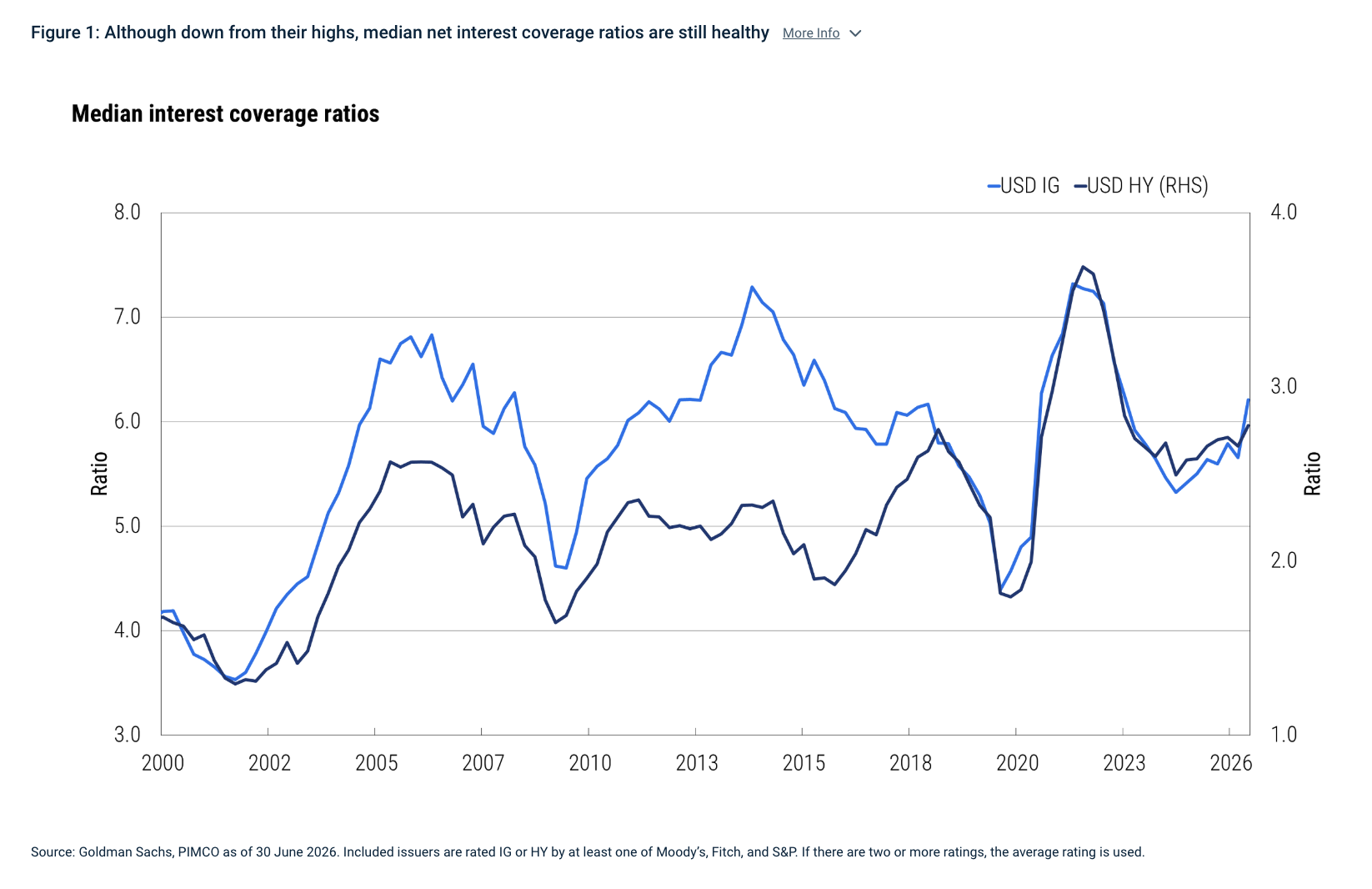
We see limited debt servicing risk for most corporate issuers. Even after normalizing from elevated levels since the pandemic, interest coverage ratios remain robust across both investment grade and high yield.
-
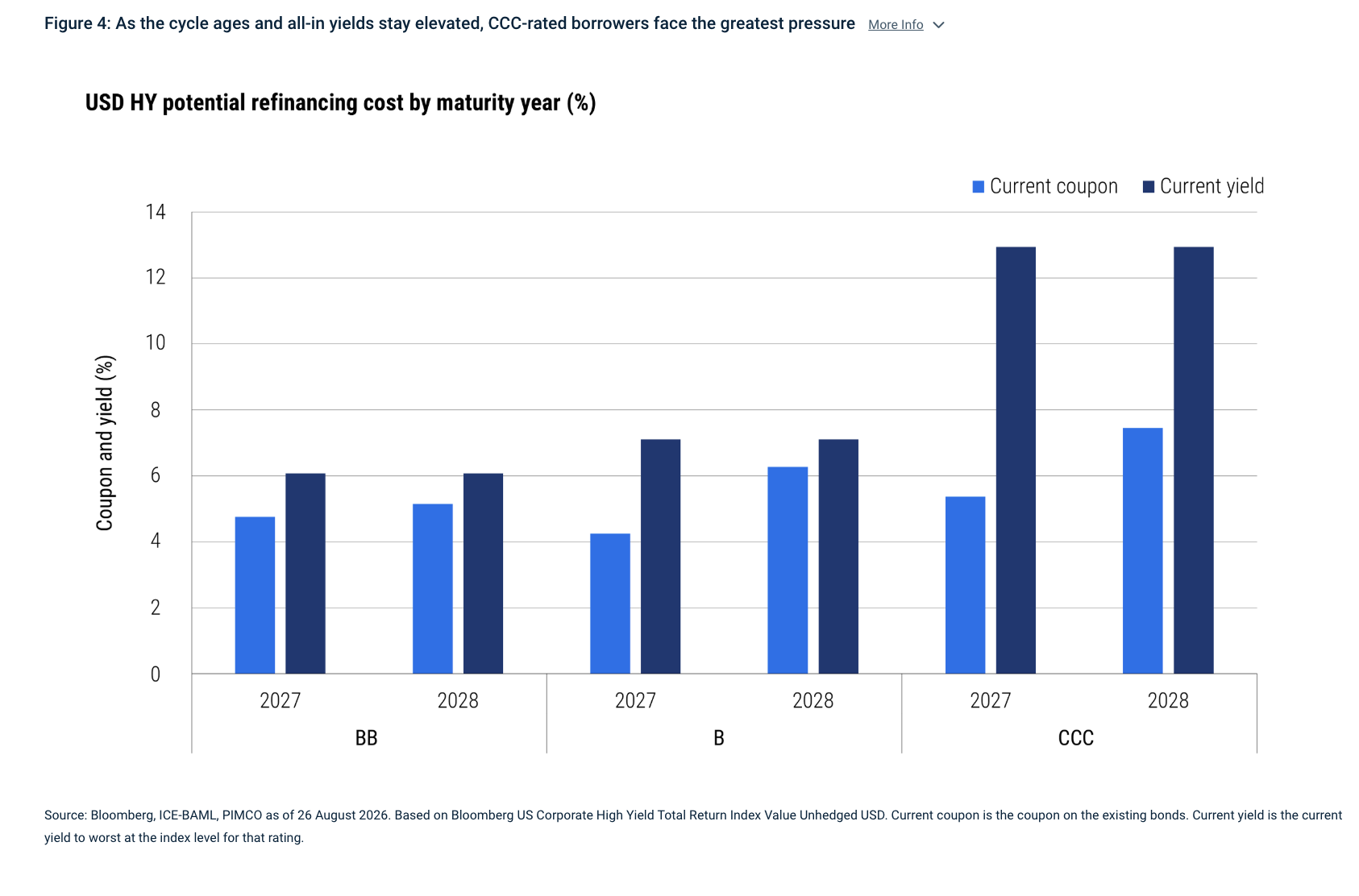
The risk profile is different for CCC rated borrowers. At the lowest end of the quality spectrum, however, interest rates on maturing debt could potentially double if refinanced at today’s index yields. These higher funding costs, combined with mounting late-cycle headwinds, could challenge firms with already weak balance sheets.
The backup in global yields since late February has reignited the debate over the potential knock-on effects for corporate borrowers, particularly through higher refinancing costs and weaker debt-servicing capacity. Many companies used the historically low-rate environment of 2020 and 2021 to re-lever their balance sheets at very low all-in funding costs. Those higher debt loads were manageable when coupons were low, but over the past few years, borrowers have been refinancing that debt at higher yields (for more on recent yield moves, see our 21 August PIMCO Perspectives, “What’s Pushing Long-Term Bond Yields Higher?”).
In our view, the risks are relatively benign. For example, Figure 1 shows that despite coming down from their post-COVID highs, median interest coverage ratios for U.S. dollar investment grade (USD IG) and high yield (HY) issuers are still roughly 6x and 3x, respectively. Of course, given that interest coverage ratios are based on accounting data, they are backward looking. Thus, the real uncertainty is how large the marginal costs might be to refinance maturing bonds in the future.
See more: U.S. Investors Looking for Global Fixed Income Exposure: Try Government Bonds, Selective Credit Picks
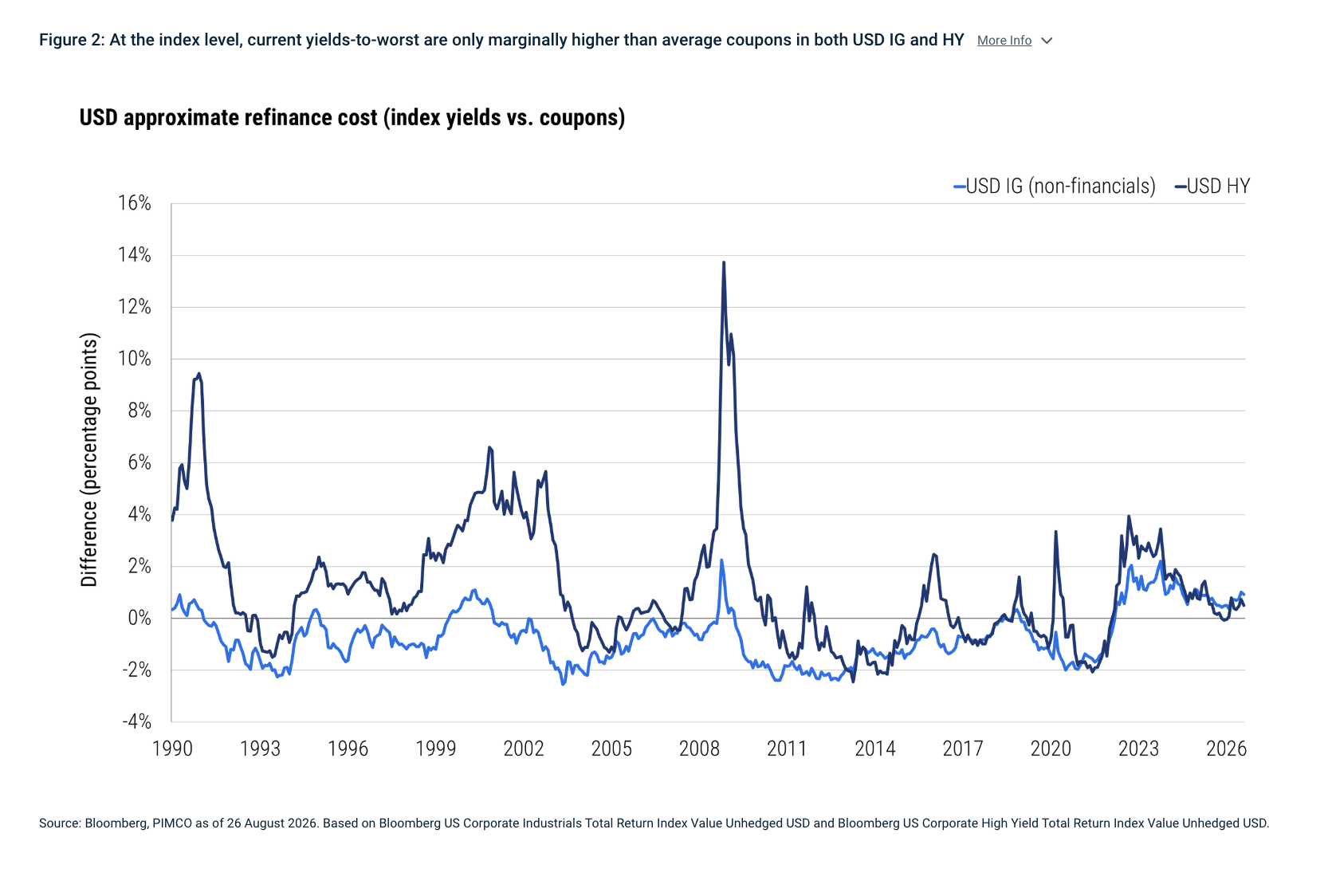
While it’s difficult to assess exactly how firms will optimize their capital structures on a forward basis, Figure 2 presents a rough approximation based on current market prices. This figure shows the difference between the current index yield and face-value weighted average coupons of the Bloomberg USD IG and HY indices, respectively. The clear takeaway is that the index-level difference is negligible.
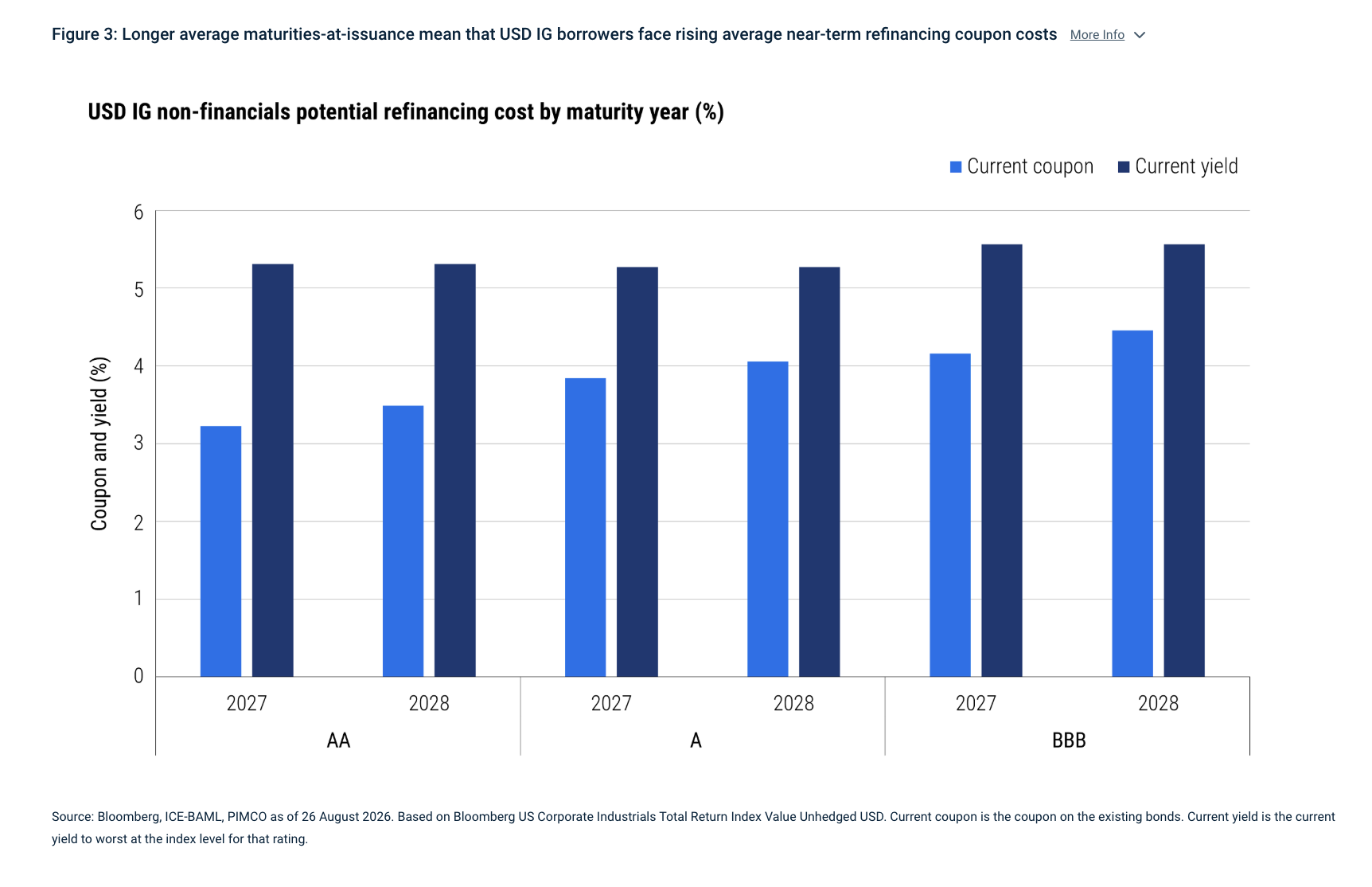
That isn’t to say that the effects of refinancing at higher yields across the quality spectrum will be evenly distributed. To approximate the funding costs across credit ratings, we calculate the face-weighted coupons for index-eligible bonds maturing in 2027 and 2028 and then compare them to the current yield for the given rating category. The results are shown in Figures 3 and 4 for IG and HY rated issuers.
Interestingly, these figures show that IG issuers with bonds maturing in 2027 and 2028 tend to face larger average marginal coupon increases than their BB rated peers. This may seem unintuitive, but the underlying reason is mechanical. HY firms generally issue at shorter maturity profiles relative to their IG-rated peers, whose investor base is far more comfortable with maturities across the entire curve, including long-dated bonds.
Therefore, given that we are six years past the July 2020 trough in U.S. Treasury five-year yields, most HY issuers have already had to refinance at higher market interest rates. By comparison, IG issuers that have longer-dated bonds maturing in 2027 and 2028 haven’t yet refinanced them in the current higher rate environment.
There is one pocket of the market, however, where pressures are more acute: CCC rated issuers. We estimate that current face-value weighted coupons for bonds maturing in 2027 and 2028 could double from current levels, if these issuers refinanced their maturing bonds at today’s index yields, as shown in Figure 4. Therefore, if growth continues to slow and late-cycle headwinds create a further drag on earnings growth, higher refinancing costs for these CCC firms present an acute pain point given their weaker balance sheets.
Michael Puempel and Gabriel Cazaubieilh contributed to this report.
Disclosures
Statements concerning financial market trends or portfolio strategies are based on current market conditions, which will fluctuate. Outlook and strategies are subject to change without notice.
Past performance is not a guarantee or a reliable indicator of future results. Forecasts, estimates and certain information contained herein are based upon proprietary research and should not be considered as investment advice. There is no guarantee that stated results will be achieved.
Bond investments are subject to market, interest rate, issuer, credit, inflation, and liquidity risks. Bond prices generally fall when interest rates rise, with longer-duration bonds typically more sensitive to rate changes. Reduced market liquidity may increase price volatility. Investors may receive more or less than their original investment upon redemption. High yield, lower-rated securities involve greater risk than higher-rated securities; portfolios that invest in them may be subject to greater levels of credit and liquidity risk than portfolios that do not. Corporate debt securities are subject to the risk of the issuer’s inability to meet principal and interest payments on the obligation and may also be subject to price volatility due to factors such as interest rate sensitivity, market perception of the creditworthiness of the issuer and general market liquidity.
The credit quality of a particular security or group of securities does not ensure the stability or safety of the overall portfolio. References to specific securities and their issuers are not intended and should not be interpreted as recommendations to purchase, sell or hold such securities. It is not possible to invest directly in an unmanaged index.
Yield to Worst (YTW) is the estimated lowest potential yield that can be received on a bond without the issuer actually defaulting. The YTW is calculated by making worst-case scenario assumptions by calculating the returns that would be received if provisions, including prepayment, call, or sinking fund, are used by the bond's issuer. The measure does not reflect the deduction of fees and expenses and is not necessarily indicative of a portfolio's worst possible performance.
PIMCO as a general matter provides services to qualified institutions, financial intermediaries and institutional investors. Individual investors should contact their own financial professional to determine the most appropriate investment options for their financial situation. This material contains the opinions of the author and such opinions are subject to change without notice. This material has been distributed for informational purposes only and should not be considered as investment advice or a recommendation of any particular security, strategy or investment product. Information contained herein has been obtained from sources believed to be reliable, but not guaranteed. No part of this material may be reproduced in any form, or referred to in any other publication, without express written permission. PIMCO is a trademark of Allianz Asset Management of America LLC in the United States and throughout the world.
CMR2026-0828-5882173
A message from Advisor Perspectives and VettaFi: Discover something new! Click here to register for our upcoming webcasts.
© PIMCO
More Asset Allocation Topics >