Fixed Income ETFs Surge to All-Time Highs Ahead of Pivotal Fed Decision

Demand for fixed income ETFs hit a historic high-water mark in September. Investors and advisors turned to fixed income ETFs at a record-breaking pace, driving 2026 net inflows of $446 billion past all-time levels with months to spare. The massive tide of capital arrives at a critical juncture: the Federal Reserve is convening for its September policy meeting. Rate hikes remain on the table and market participants are aggressively positioning across the yield curve via liquid, transparent ETF wrappers. The 10-year Treasury yield has spiked in mid-September, reaching 5%.
Key Takeaways
- Record Pace: Fixed income ETF net inflows have already shattered annual records, reaching $446 billion through September 11 and outpacing full-year 2025 totals.
- Paradigm Shift: Wealth managers are accelerating a migration out of traditional mutual funds into bond ETFs to capture intra-day liquidity, fee efficiency, and tax advantages.
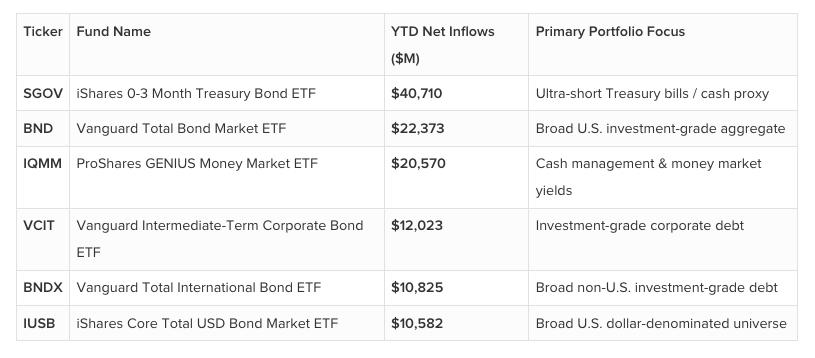
- Cash Alternatives Lead: Ultra-short cash proxies like the iShares 0-3 Month Treasury Bond ETF (SGOV) dominate year-to-date creation activity as yields remain elevated. SGOV has $41 billion of net inflows.
A Historic Velocity of Fixed Income ETF Demand
Demand for fixed income ETFs has transitioned from steady industry adoption to historic demand. In 2025, the category brought in a then-record $439 billion in net inflows, finishing the year with $1.49 trillion in total assets under management.
By September 11, 2026, fixed income ETFs eclipsed that full-year record in under nine months. The category has absorbed a staggering $446 billion in year-to-date net inflows, standing at $1.43 trillion in total assets. This rapid pace underscores the appetite for yield and defensive duration management. For many, macro uncertainty looms over central bank policy.
FIXED INCOME ETF NET INFLOWS 
The Structural Shift: Replacing Legacy Mutual Funds
A primary driver behind this historic influx is a fundamental behavior shift among financial advisors. Historically, wealth managers relied almost exclusively on active or passive open-end mutual funds for fixed income exposure. However, advisors have grown increasingly comfortable leveraging bond ETFs to build core model portfolios.