According to the latest SPIVA U.S. Scorecard report, broader isn’t always better for active managers. Following a volatile start to the year, the S&P 500 did rebound sharply in the second quarter to gain 10% through June 30 thanks to robust corporate earnings. Needless to say, the first half of 2026 proved to be a turbulent stretch for the capital markets. This presents opportunities for both active and passive strategies alike, but how well did the former do, according to the SPIVA report?
Unlike the narrow, mega-cap-driven rallies of recent years, market breadth expanded significantly. In financial media these days, it’s often referred to as a “broadening out.” Mid- and small-cap equities surged ahead, with the S&P MidCap 400 and S&P SmallCap 600 advancing 17% and 24%, respectively. In theory, this wider dispersion of performance should provide ideal hunting grounds for active managers. Yet, according to the mid-year SPIVA scorecard, active management found broad outperformance across most major equity categories elusive.
Key Takeaways:
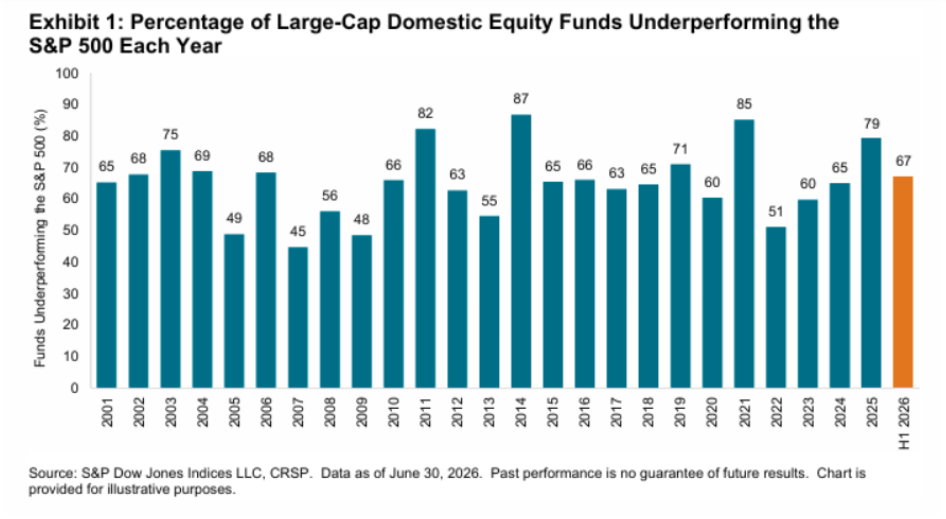
- Despite expanding market breadth and strong gains in small- and midcap equities, 67% of domestic active large-cap managers underperformed the S&P 500 in the first half of the year.
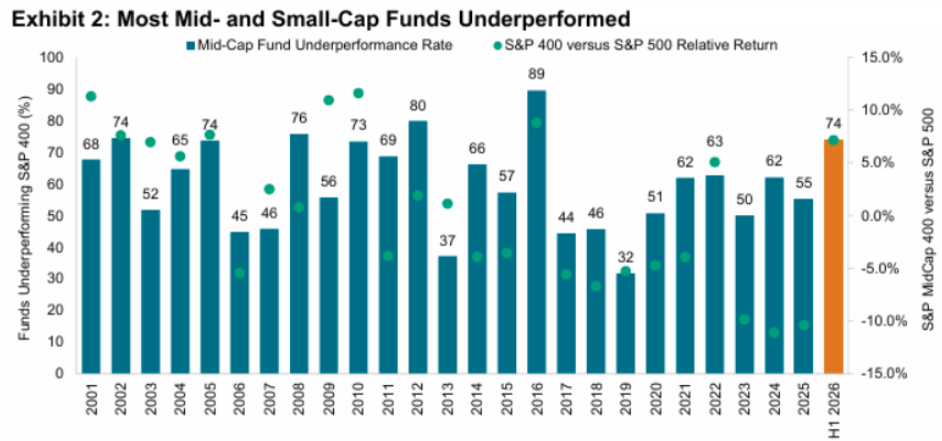
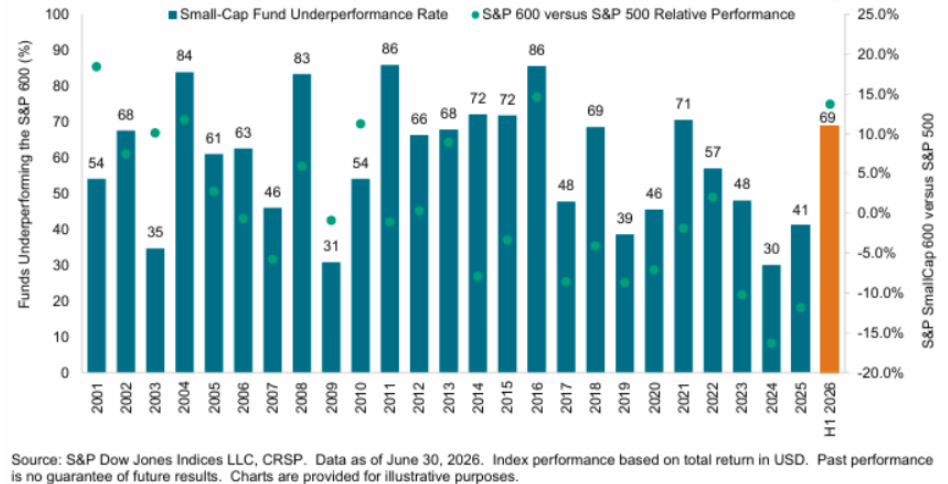
- Active domestic midcap and small-cap managers faced similar headwinds against benchmark efficiency, with 74% of midcap and 69% of small-cap funds failing to beat their respective style targets.
- International equities and fixed income provided rare bright spots for active management, led by strong relative outperformance in emerging markets, international small-caps, and core bond strategies.
See More: Back to School: IBUY
Domestic Equity Managers Fall Short
Even with broader market participation, active domestic large-cap managers lagged. In the first half of 2026, 67% of active large-cap U.S. equity funds underperformed the S&P 500. While this marks an improvement from the 79% underperformance rate recorded the previous year, it underscores that an environment marked by broader market participation isn’t enough for active stock pickers to overcome benchmark efficiency and high fee drag over time.
The story was equally challenging for mid- and small-cap managers. The S&P 400 and S&P 600 outpaced the S&P 500 by 7% and 14%, respectively. While this created strategic opportunities for large-cap managers to tilt down-market, mid- and small-cap managers lacked the tailwinds for tilting into larger, outperforming names. Consequently, 74% of midcap funds and 69% of small-cap funds underperformed their respective style benchmarks.
International, Fixed Income Offer Bright Spots
International markets continue to gain in popularity as investors seeking opportunities outside of U.S. borders. This is also where active managers found success versus U.S. equities. Active managers focused on international equities saw only 49% of U.S.-domiciled international funds and 53% of global funds lag their benchmarks.
Emerging markets (EM) provided ample opportunities for alpha. Boosted by an impressive 22% gain in the S&P Emerging Plus Index, active managers overweighting EM capitalized on strong regional momentum. The SPIVA scorecard revealed that just 38% of emerging market funds underperformed. Meanwhile, international small-cap managers enjoyed the highest success rates. Only 35% underperformed the S&P Developed Ex-U.S. Small-Cap index, benefiting from a lower performance hurdle and room to tilt into larger global market caps.
Fixed income shared the spotlight with international equities, as volatility in the first half caused investors to seek the shelter of bonds. Fixed income managers posted a cross-category average underperformance rate of 38%. General investment-grade (42% underperformed) and high-yield managers (49% underperformed) held their own, though general government bond managers struggled with 77% failing to match their benchmark.
Capitalizing on Core Index Efficiency
The latest SPIVA scorecard serves as a persistent reminder that active stock selection remains a difficult path. This holds true even when market breadth expands and style headwinds start to dissipate. Alternatively, for investors seeking low-cost, precise exposure to domestic equity benchmarks without manager risk, low-cost passive ETFs remain a foundational option.
Investors can participate directly in market upside across the market-cap spectrum using State Street’s core suite. This includes the SPDR Portfolio S&P 500 ETF (SPYM) for large-cap core. To capture the aforementioned broad market participation, the SPDR Portfolio S&P 400 Mid Cap ETF (SPMD) is ideal for midcap exposure, while the SPDR Portfolio S&P 600 Small Cap ETF (SPSM) can capture small-cap growth momentum.
For more news, information, and analysis, visit the Equity ETF Content Hub.
Originally posted on ETF Trends
A message from Advisor Perspectives and VettaFi: Discover something new! Click here to register for our upcoming webcasts.
Read more commentaries by VettaFi