What’s Really Driving the Rise in Treasury Yields?
Membership required
Membership is now required to use this feature. To learn more:
View Membership Benefits
Key takeaways:

- More than 70% of the increase in 10-year Treasury yields since the end of February has come from higher expected real short-term rates and the real term premium.
- Treasury supply is a longer-term fiscal risk, but recent auction data do not suggest that a sudden deterioration in demand is driving the current move.
- AI-related borrowing could create more competition for capital and keep term premia elevated. A future productivity boost could also raise the equilibrium real rate, extending the period of higher yields.
The rise in Treasury yields has prompted a familiar set of explanations. Some investors have pointed to government borrowing and persistent inflation, while others have focused on the possibility that artificial intelligence will lift economic growth and interest rates.
Each factor matters, but they do not fit the evidence equally well.
See more: AI Capex and the Limits of Crowding Out
Our analysis points to a different conclusion. The rise in U.S. Treasury yields has been driven mainly by higher real-rate expectations and a larger real term premium, rather than a material repricing of inflation. This has implications for Federal Reserve policy, the nature of the move and how long yields may remain elevated for.
The rise is mostly real
A useful way to think about the 10-year Treasury yield is as the sum of the expected average short-term interest rate over the next decade and a term premium.
The first component reflects where investors expect monetary policy and the economy to settle. The term premium is the additional compensation investors require for holding a longer-maturity bond whose price is exposed to interest-rate risk.
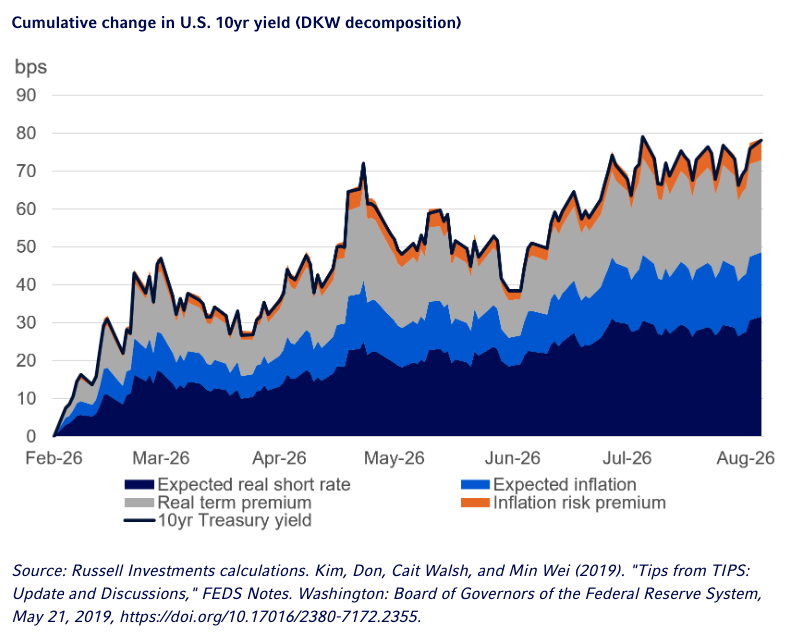
A model-based decomposition from D’Amico, Kim and Wei splits the 10-year yield into four components:
- expected real short-term rates;
- expected inflation;
- the real term premium; and
- the inflation risk premium.
According to this decomposition, since the end of February, more than 70% of the increase in the 10-year yield has come from the two real components: expected real short-term rates and the real term premium.
This move is not unique to the United States. Real yields have also risen in other developed markets, including the United Kingdom and Germany.
Understanding the composition of the move matters for investors. Notwithstanding the uncertainty around term premium estimates, having a sense of what’s driving yields and whether risk premiums are expanding (or contracting) allows investors to make better judgements about the forward-looking risk vs reward of government bonds, especially vs cash.
Real term premia drives rising yields
Treasury supply is not the main explanation
One regularly cited cause of rising Treasury yields has been the rise in government borrowing. After all, Treasury issuance has increased over recent years, making it reasonable to ask whether supply is beginning to overwhelm demand.
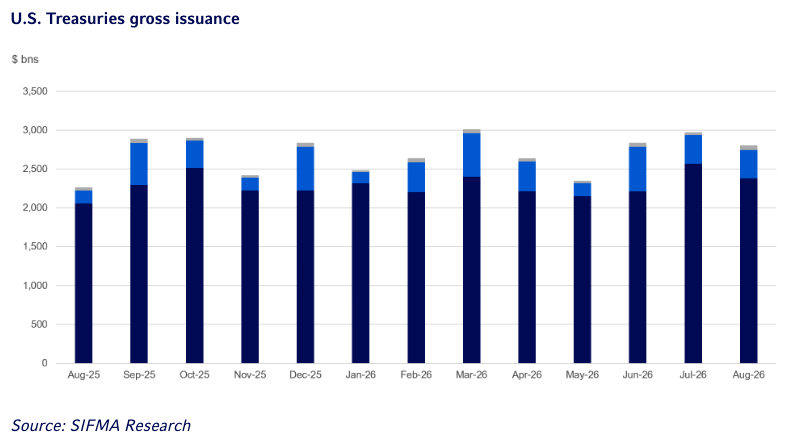
Yet, at present, auction data do not suggest that the market is under significant stress. Gross issuance of notes and bonds in the first half of this year has not been materially different from the second half of last year. Bid-to-cover ratios1, primary-dealer takedowns2 and auction tails3 have also generally remained well behaved, certainly compared to the second half of 2023 when supply concerns were previously rife, causing yields to rise sharply, and subsequently decline.
This does not make government borrowing irrelevant. A persistently large supply of debt can increase the compensation investors require to hold it, particularly if fiscal risks deteriorate. However, the recent rise in yields is not well explained by a sudden decline in the market’s ability to absorb Treasury auctions.
Gross Treasuries issuance holds steady
Policy expectations and uncertainty have both risen
The core drivers behind the rise in Treasury yields has been the repricing in both the expected path for monetary policy and the uncertainty around that path.
Since Kevin Warsh became Federal Reserve chair, the average absolute reaction of the two-year Treasury yield around Federal Open Market Committee meetings has been larger than under previous chairs, according to our analysis using the Federal Reserve Bank of San Francisco’s event study database.4
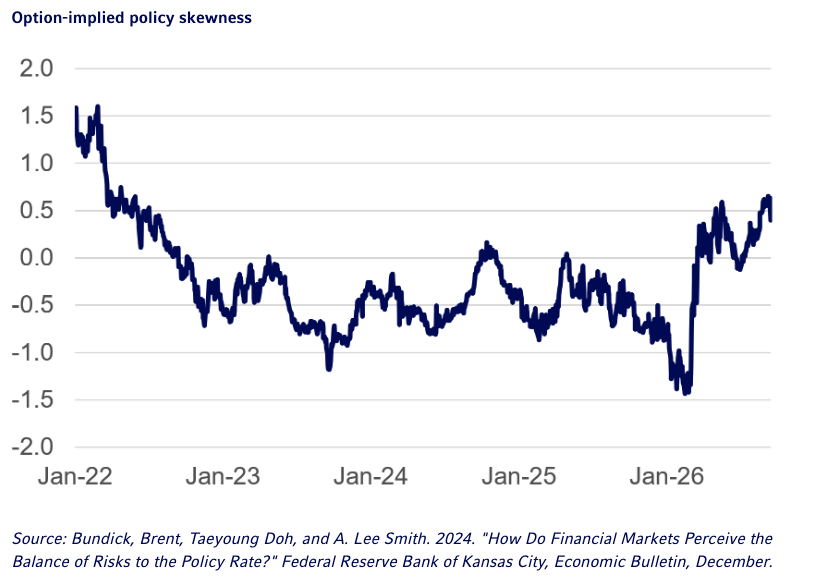
Interest-rate options also indicate a wider range of possible Federal Reserve outcomes, alongside a greater probability of higher interest rates. This skew has risen sharply since the start of the conflict in the Middle East. Persistent inflation and volatile energy prices have added to the uncertainty facing policymakers.
This combination has implications for longer-term yields. Investors may demand greater compensation to hold duration when the policy outlook is less predictable, even if their central expectation for interest rates changes only modestly.
The result is upward pressure on both expected real short-term rates and the real term premium. For duration investors, a more stable Federal Reserve outlook could remove some of this pressure. Until then, uncertainty itself may continue to support higher yields.
Policy skewness spikes with new Fed chair
AI is increasing competition for capital
The most interesting additional factor is the scale of AI-related corporate investment.
Large technology companies and emerging AI-computing providers are investing heavily in data centres, computing capacity and electricity infrastructure. At least some of this investment will need to be financed through debt markets.
U.S. dollar investment-grade corporate issuance is already around 30% higher year to date than at the same point last year. Goldman Sachs estimates that approximately 24% of dollar investment-grade supply so far this year is AI-related, compared with around 6% in the euro area.5
Goldman’s preliminary estimates for 2027 point to gross corporate issuance of approximately $2.4 trillion and net issuance of around $1.15 trillion.
Corporate bonds and Treasuries are far from perfect substitutes, but they compete for investor capital. When the supply of high-quality bonds increases sharply, investors may demand greater compensation across fixed-income markets.
In this sense, expected AI-related issuance may raise the real term premium before all the borrowing takes place. Investors anticipate the future supply of debt and adjust prices accordingly.
Could AI raise r*?
AI could also raise long-term interest rates through a more favourable channel.
If AI lifts trend productivity and expected economic growth, it could raise r*, the equilibrium real interest rate consistent with the economy operating at potential. A higher r* would eventually imply higher real interest rates across the yield curve, reflecting the economy’s stronger growth potential.
There is already evidence of productivity improvements at the task and firm level, and AI adoption is increasing. The aggregate data, however, cannot yet isolate the impact of AI.
Once estimates are adjusted for capital and labour utilisation, measured total factor productivity growth is currently negative. We therefore view the productivity channel as a plausible medium-term scenario rather than the explanation for the increase in yields seen so far.
TIPS offer a clearer view of the move
The real and inflation components of Treasury yields can also be examined by comparing Treasury Inflation-Protected Securities with nominal Treasuries.
This market-based decomposition tells a similar story to the model-based evidence. Compared with the February average, the 10-year real TIPS yield is around 65 basis points higher, while 10-year breakeven inflation is only around seven basis points higher.
On this simple measure, roughly 90% of the increase in the nominal yield since February has come from the real component.
That is notable given the recent rise and volatility in oil prices. Breakeven inflation often moves alongside oil prices, but its modest increase this time suggests that nominal bond markets are not pricing a substantial increase in medium-term inflation risk.
For investors, the TIPS market reinforces the conclusion that the recent move is about more than inflation. The increase in real yields has improved the prospective hold-to-maturity return available from inflation-protected bonds.
Investor implications
The recent rise in long-term Treasury yields is best understood as a rise in real yields. Higher policy-rate expectations and greater uncertainty around Federal Reserve communication have lifted both expected real short rates and real term premia. AI-related corporate borrowing is adding to competition for capital and could put further upward pressure on term premia. A future AI-driven productivity improvement could also raise r*, but the aggregate data do not yet show that effect.
At close to 2.5% for 10-year TIPS, the level of real yields is high compared to recent history, and the highest since 2007. When holding TIPS until they mature, investors can lock in an annual inflation-adjusted return of 2.5% over the next 10 years.
Higher real yields make nominal Treasury bonds and TIPS more attractive for investors. As Treasuries are competing with other investment opportunities like AI-related corporate bonds for capital, a decline in real yields to their pre-2023 levels is probably not in the offing.
Footnotes:
[1] The total value of bids received divided by the amount of debt sold; a higher ratio usually suggests stronger demand.
[2] The percentage of the auction bought by primary dealers – banks and brokers that regularly participate in government bond markets.
[3] The difference between the yield at which bonds are sold and the market’s expected yield beforehand; a larger positive difference usually signals weaker demand.
[4] Federal Reserve Bank of San Francisco USMPD. August 31st, 2026. Warsh’s Jackson Hole speech was added using the same methodology.
[5] Global Credit Trader - An Elusive Summer Slowdown (Goldman Sachs)
A message from Advisor Perspectives and VettaFi: Discover something new! Click here to register for our upcoming webcasts.
Membership required
Membership is now required to use this feature. To learn more:
View Membership BenefitsSponsored Content
Live Virtual Event: Join Now

Upcoming Virtual Events View All