Key takeaways
- Geopolitical shocks have not stopped emerging market equities from delivering strong returns, challenging dated views that they should be avoided whenever global risks increase.
- Today’s emerging markets look very different from the old risk playbook, with more diverse economies, global champions, stronger domestic growth drivers and a backdrop that looks increasingly supportive.
- For investors, the bigger risk may lie not in owning emerging markets in an uncertain world, but in waiting for certainty and an entry point that never comes.
War in Ukraine. Expanding conflict in the Middle East. Trade wars. Political uncertainty across multiple continents. By the old rulebook, emerging markets should have struggled in this environment: the first to sell off when headlines darkened, and the last to recover when risk appetite returned.
However, recent evidence has proved otherwise. Despite a near-constant stream of geopolitical turbulence over the past few years, many emerging market equities have delivered strong returns, including a rebound of over 30% for the MSCI Emerging Markets Index in 2025 alone and robust performance year-to-date in 2026—even factoring in the July selloff. So why does the old “Emerging markets are too risky right now” instinct keep showing up, and is it still pointing at the right risks?
See more: Why Clients Want Their Advisor Involved in Estate Planning
How Global Risks Shaped Views on Emerging Markets
This instinct is understandable and comes from real experience. For decades, emerging markets were tightly tied to oil and commodity prices, and when oil spiked or crashed emerging market currencies and stocks often moved in lockstep. On top of that, whenever global investors became nervous about a war, a Fed decision or a banking scare, money tended to flee emerging markets first and fastest. A crisis on the other side of the world could hit emerging market investments hard, even when the connection made little logical sense. That pattern may have trained a generation of investors to treat geopolitical headlines as a warning light for emerging markets. For a long time, it was a reasonable signal to watch. However, that link is not as straightforward today.
Geopolitics May Matter Less Than It Used To
Today’s geopolitical shocks are less likely to be purely emerging market events. Trade disputes, wars, energy shocks and supply-chain disruption now ripple through developed and emerging markets alike.
It is also worth separating the headline from the underlying weakness. Many past emerging market selloffs were made worse by unpredictable local politics, weak currencies, heavy external debt or fragile banking systems. Today, we find that the gap between emerging and developed markets and economies is smaller, with many developed markets facing political uncertainty and high debt levels while several emerging markets sport more prudent macro foundations. Additionally, while geopolitical shocks can still create short-term volatility, they do not necessarily turn into deeper emerging market crises; with these markets no longer moving as one broad risk trade, a political shock that may be material for one country, sector or currency may have little direct relevance on another.
Emerging Markets Have Changed
Many emerging market economies are now more diversified, less dependent on commodity exports and supported by deeper domestic capital markets than they were a generation ago. This makes them less vulnerable to the old pattern of foreign investors pulling money at the first sign of trouble.
India’s growth story, for example, is increasingly powered by domestic consumption and infrastructure investment, rather than global trade. Across the wider emerging market universe, the growth of services, manufacturing and domestically driven sectors has also made the asset class broader and more resilient.
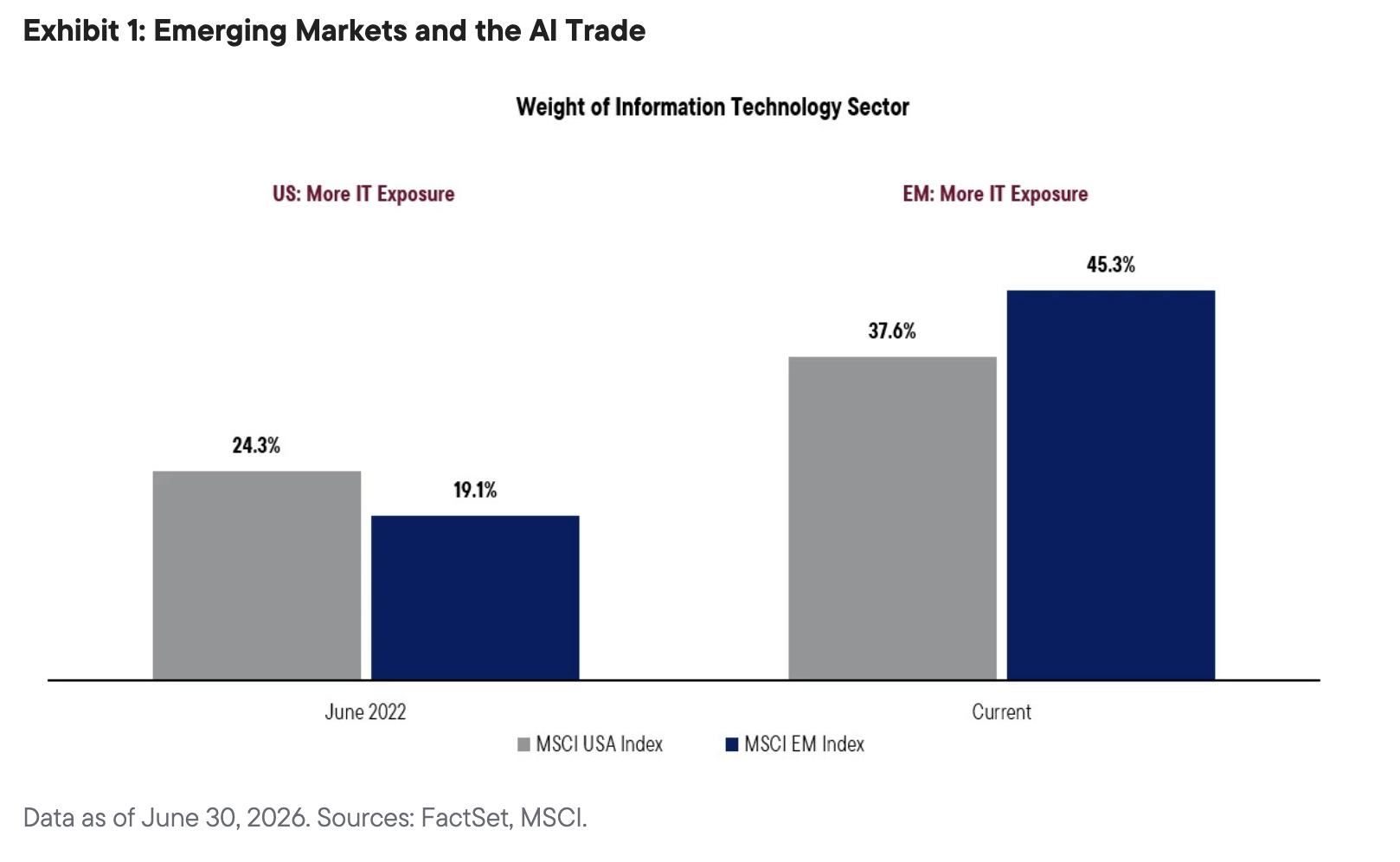
At the same time, emerging markets are becoming home to more leading global companies. Taiwan and South Korea provide meaningful exposure to advanced manufacturing and semiconductors, in our opinion, linking parts of the emerging market universe to global AI and broader technology demand rather than old-style commodity cycles (Exhibit 1). We believe this makes emerging markets harder to dismiss as one simple risk trade.
The Starting Point Looks Attractive
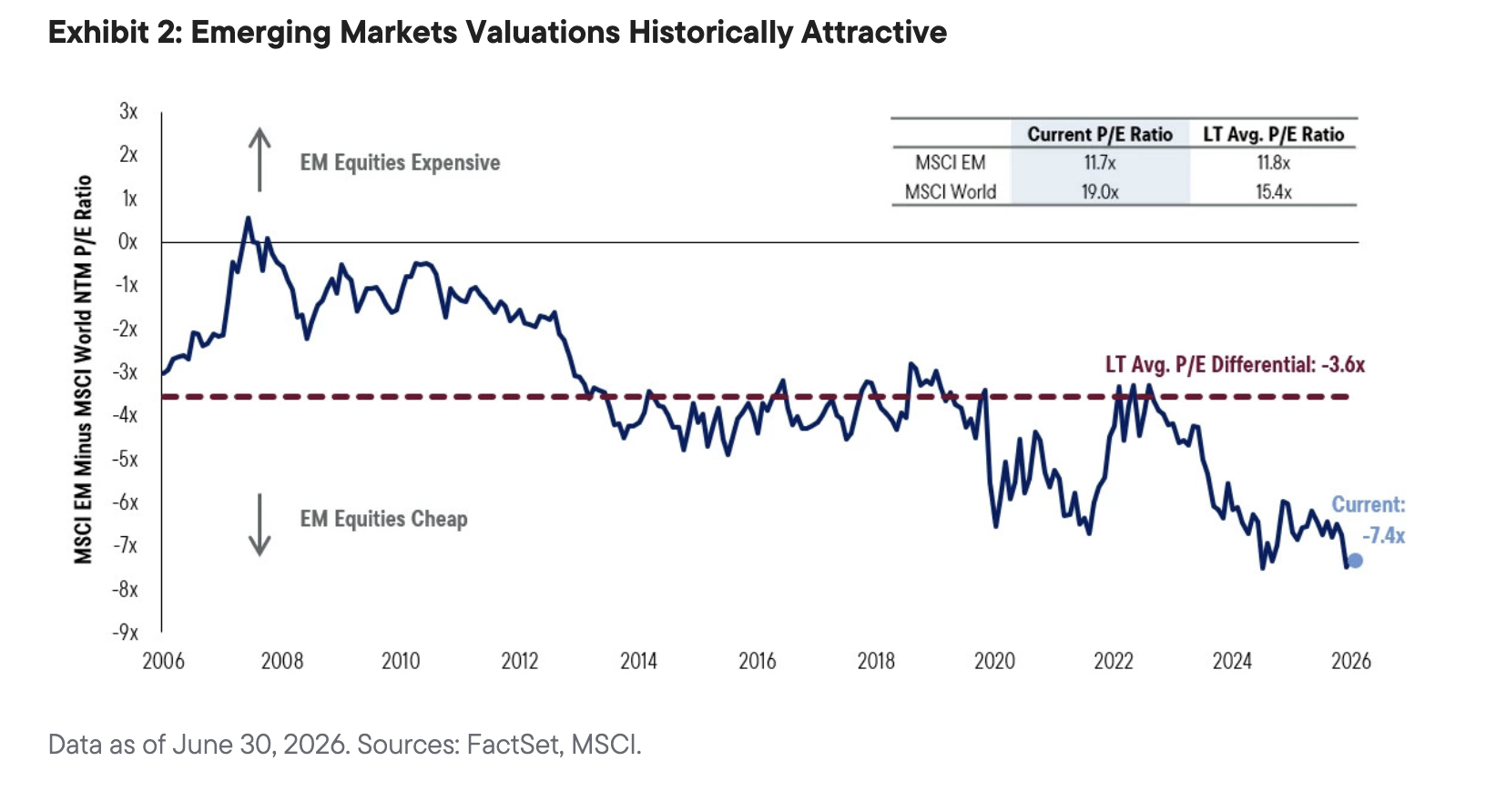
Even setting aside the decreasing geopolitical risk, we believe the investment backdrop for emerging markets looks attractive on its own terms. Emerging market stocks are currently priced at notably lower multiples compared to their global and US counterparts, trading at discounts of 45% and almost 50%, respectively,1 leaving more room for upside if general sentiment improves (Exhibit 2). Furthermore, if the US dollar continues to soften, the backdrop could become more accommodative to emerging market asset flows, further supporting prices.
Waiting For Certainty May Mean Missing Out
Geopolitical uncertainty is not a temporary condition to be waited out—it is the baseline. There has rarely been a multi-year period in modern market history free of war, trade disputes, election upheaval or diplomatic crisis somewhere in the world. Many emerging market countries are in a better position, both politically and economically, than they have been historically. Treating geopolitical calm as a precondition for emerging market investment does not remove risk; it may simply mean missing the opportunity. For investors, the bigger risk may not be owning emerging markets in an uncertain world but in waiting for a certainty and an entry point that never comes.
Aimee Truesdale, Managing Director, Portfolio Manager
Footnotes:
- Discounts calculated from NTM P/E for MSCI EM was 9.9x, MSCI World 18.0x, S&P 500 19.3x, FactSet, 18 September 2026.
INDEX DEFINITIONS
The MSCI Emerging Markets (EM) Index is a free float-adjusted market capitalization index that is designed to measure equity market performance in the global emerging markets. Please note an investor cannot invest directly in an index.
The MSCI World Index is an unmanaged index of common stocks of companies representative of the market structure of 22 developed market countries in North America, Europe, and the Asia/Pacific Region. The index is calculated without dividends, with net or with gross dividends reinvested, in both US dollars and local currencies. Please note an investor cannot invest directly in an index.
The MSCI USA Index is designed to broadly and fairly represent the full diversity of business activities in the United States. As of the close of May 31, 2002, the Index will aim to capture 85% of the free float adjusted market capitalization in each industry group. Please note an investor cannot invest directly in an index.
WHAT ARE THE RISKS?
All investments involve risks, including possible loss of principal.
Equity securities are subject to price fluctuation and possible loss of principal.
International investments are subject to special risks, including currency fluctuations and social, economic and political uncertainties, which could increase volatility. These risks are magnified in emerging markets. Investments in companies in a specific country or region may experience greater volatility than those that are more broadly diversified geographically.
Important Information
This material is intended to be of general interest only and should not be construed as individual investment advice or a recommendation or solicitation to buy, sell or hold any security or to adopt any investment strategy. It does not constitute legal or tax advice. This material may not be reproduced, distributed or published without prior written permission from Franklin Templeton.
The views expressed are those of the investment manager and the comments, opinions and analyses are rendered as at publication date and may change without notice. The underlying assumptions and these views are subject to change based on market and other conditions and may differ from other portfolio managers or of the firm as a whole. The information provided in this material is not intended as a complete analysis of every material fact regarding any country, region or market. There is no assurance that any prediction, projection or forecast on the economy, stock market, bond market or the economic trends of the markets will be realized. The value of investments and the income from them can go down as well as up and you may not get back the full amount that you invested. Past performance is not necessarily indicative nor a guarantee of future performance. All investments involve risks, including possible loss of principal.
Any research and analysis contained in this material has been procured by Franklin Templeton for its own purposes and may be acted upon in that connection and, as such, is provided to you incidentally. Data from third party sources may have been used in the preparation of this material and Franklin Templeton ("FT") has not independently verified, validated or audited such data. Although information has been obtained from sources that Franklin Templeton believes to be reliable, no guarantee can be given as to its accuracy and such information may be incomplete or condensed and may be subject to change at any time without notice. The mention of any individual securities should neither constitute nor be construed as a recommendation to purchase, hold or sell any securities, and the information provided regarding such individual securities (if any) is not a sufficient basis upon which to make an investment decision. FT accepts no liability whatsoever for any loss arising from use of this information and reliance upon the comments, opinions and analyses in the material is at the sole discretion of the user.
Franklin Templeton has environmental, social and governance (ESG) capabilities; however, not all strategies or products for a strategy consider “ESG” as part of their investment process.
Products, services and information may not be available in all jurisdictions and are offered outside the U.S. by other FT affiliates and/or their distributors as local laws and regulation permits. Please consult your own financial professional or Franklin Templeton institutional contact for further information on availability of products and services in your jurisdiction.
Issued in the U.S. by Franklin Templeton, One Franklin Parkway, San Mateo, California 94403-1906, (800) DIAL BEN/342-5236, franklintempleton.com. Investments are not FDIC insured; may lose value; and are not bank guaranteed.
You need Adobe Acrobat Reader to view and print PDF documents. Download a free version from Adobe's website.
CFA® and Chartered Financial Analyst® are trademarks owned by CFA Institute.
A message from Advisor Perspectives and VettaFi: Discover something new! Click here to register for our upcoming webcasts.
© ClearBridge Investments
More Volatility/Downside Protection Topics >