The bond market took center stage through September with inflation, oil supply chains and the Federal Reserve performing as an ensemble.
The August Consumer Price Index showed prices rose 3.4% on a year-over-year basis. Backed by a resilient US economy and stable job market, the Federal Open Market Committee (FOMC) raised the federal funds rate by 25 basis points at its September meeting, to 3.75%–4.00%, the first hike since 2023. Federal Reserve Chair Kevin Warsh did not indicate whether the move signaled a long-term policy pivot, saying the decision “removed a dose of accommodation.”
Investors may not have been convinced, sparking a global bond selloff. The 10-year Treasury yield rose to a multi-year high, and there’s the possibility of another rate hike in either October or December, as well as further action in 2027. Meanwhile oil prices, which have been a major inflation driver, climbed back above $100 per barrel as a key pipeline in Saudi Arabia was damaged by the Iran-aligned Houthi militia and Strait of Hormuz tanker traffic remains a shadow of its pre-war volume.
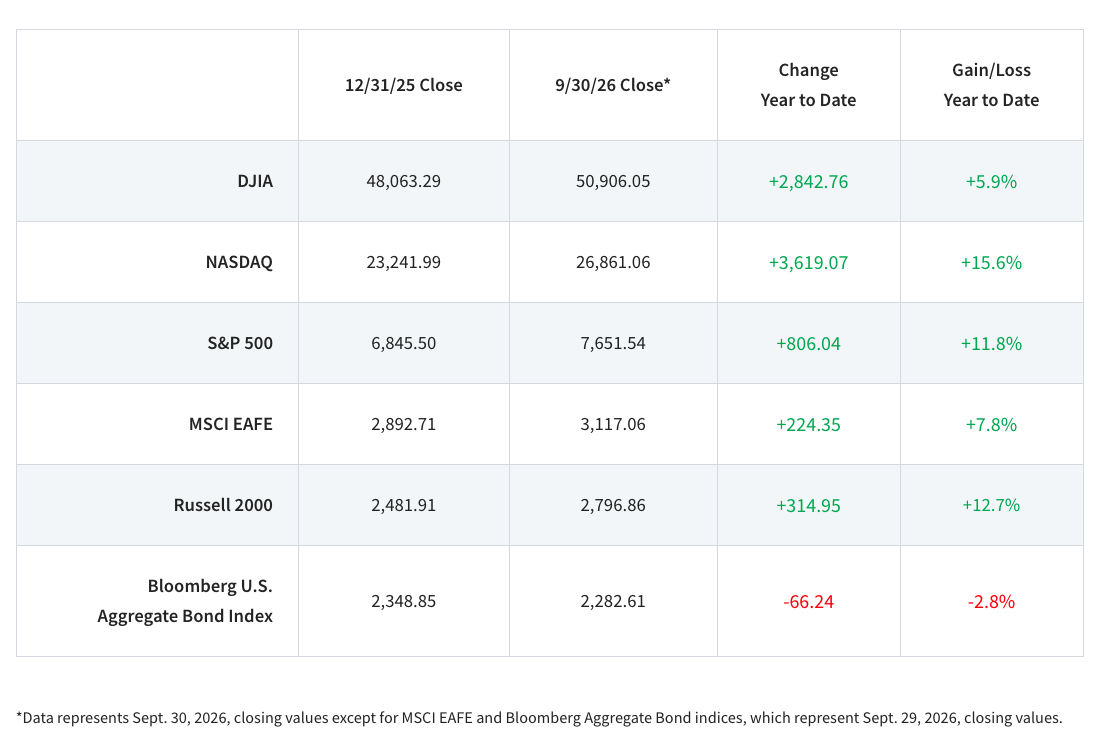
Against this backdrop, the S&P 500 appeared calm this month. A look under the hood, however, showed the two AI-involved sectors remaining strong and outperforming the other nine sectors. The weakest performance was concentrated in companies and sectors that are particularly sensitive to higher interest rates.
“September's relatively flat S&P 500 performance hid the increasing dispersion beneath the surface,” said Raymond James Chief Investment Officer Larry Adam. “With elevated Treasury yields, the market is rewarding companies with durable earnings growth while penalizing the most rate-sensitive sectors, a gap we expect to persist until the rate environment stabilizes.”
Before we get into the details, let’s look at where the major indices stand for the year.
Has jobs, lacks confidence
The August reports showed the job market remains healthy, with an estimated 162,000 jobs added and an unemployment rate of 4.1%. Hiring and separations also showed little movement during the month, pointing to continued stability in labor market turnover. The September preliminary Consumer Sentiment Index came in much weaker than expected, deteriorating significantly from August. Consumers’ concerns? Weak expectations for future business conditions, fuel prices and trade tensions.
Investors repositioning but staying invested
High oil prices and bond yields are both headwinds for equities, and absent the boom in AI capital expenditure, the headline indices would show this pressure more clearly. Investors rotated away from rate- and energy-sensitive stocks rather than retreating from the market – a sign of a healthy bull market. With the Fed’s rate hike, expect markets to be sensitive to inflation reports, job numbers and the price of debt.
Yields rise across the curve
Treasury yields rose broadly across maturities, with more concentration on the short end. Still, yields on the 10- and 30-year Treasuries reached multi-year highs. Investment-grade corporate debt rose roughly in tandem with Treasuries, keeping spreads flat, while municipal bond yields for AAA debt rose 50 to 85 basis points across the curve, pushing the 30-year AAA bond over 5% for the first time since 2011, and outpacing the rise of the Treasury yield. These moves increased the relative value of muni bonds to Treasuries from 70% to 77% for 10-year notes and 87% to 93% for 30-year bonds..
Middle East oil exports may be poised for partial recovery
Amid dual hurdles to Middle East oil exports – the restricted Strait of Hormuz and a damaged Saudi Arabian pipeline – there are tentative signs of progress at the end of September. Iran’s rhetoric about reopening Hormuz showed some softening, while the White House indicated its willingness to reengage with Iran diplomatically. Meanwhile, Saudi Arabia took steps to resume operations at the damaged pipeline, although supply recovery is unlikely to be smooth.
No breakdowns or breakthroughs at Trump-Xi meeting
The Trump-Xi meeting largely played out as expected, producing no major breakthroughs. More importantly, there were no breakdowns in the trade truce that has stabilized the bilateral relationship over the past year. The most impactful outcome was an agreement to extend the existing tariff and critical minerals truce (which was set to expire November 10) through January 10, while both sides agreed to continue economic negotiations, leaving the other issues around tariffs, technology, Taiwan and AI unresolved. The two countries are expected to have additional opportunities to engage around the November 18-19 APEC Summit and the December 14-15 G20 Summit. While tariff and trade risks remain, both governments appear to prefer managing those risks through recurring negotiations rather than returning to the escalation cycle seen previously.
US-Canada trade war accelerates
Trade negotiations between the US and Canada collapsed despite reportedly nearing an agreement that would have reduced steel and aluminum tariffs. Canada promptly imposed retaliatory tariffs of 15–50% on roughly $20 billion of US goods, while the Trump administration expanded its 50% Section 338 tariffs and announced targeted import bans. Although the dispute remains under negotiation, further escalations may precede real progress. By contrast, Mexico and the United States have accelerated bilateral discussions with the goal of reaching an interim agreement before the November 3 midterms, with Mexico reportedly seeking relief from US Section 232 tariffs while addressing US demands on automotive content and Chinese investment.
The bottom line
It’s rare for bonds to draw more attention than the equities market, so when it does happen, it’s easy to read an ill omen there. But while it’s true higher borrowing costs can drag at parts of the market, which we saw in the post-COVID inflation peak, the market and economy have remained resilient and investors are staying invested. Inflation, higher interest rates, energy prices, and geopolitics remain sources of uncertainty, but the underlying strength of the economy and corporate earnings continues to provide an important counterbalance.
Investing involves risk, and investors may incur a profit or a loss. All expressions of opinion reflect the judgment of the Raymond James Chief Investment Officer and are subject to change. There is no assurance the trends mentioned will continue or that the forecasts discussed will be realized. Past performance may not be indicative of future results. Economic and market conditions are subject to change. Diversification does not guarantee a profit nor protect against loss.
The Dow Jones Industrial Average is an unmanaged index of 30 widely held stocks. The NASDAQ Composite Index is an unmanaged index of all common stocks listed on the NASDAQ National Stock Market. The S&P 500 is an unmanaged index of 500 widely held stocks. The MSCI EAFE (Europe, Australasia and Far East) index is an unmanaged index that is generally considered representative of the international stock market. The Russell 2000 is an unmanaged index of small-cap securities. The Bloomberg Barclays US Aggregate Bond Index is a broad-based flagship benchmark that measures the investment grade, US dollar-denominated, fixed-rate taxable bond market. An investment cannot be made in these indexes. The performance mentioned does not include fees and charges, which would reduce an investor’s returns. Consumer Price Index (CPI) A consumer price index is a price index, the price of a weighted average market basket of consumer goods and services purchased by households. Consumer Sentiment is a consumer confidence index published monthly by the University of Michigan. The index is normalized to have a value of 100 in the first quarter of 1966.
Companies engaged in business related to a specific sector, including the technology sector, are subject to fierce competition and their products and services may be subject to rapid obsolescence. There are additional risks associated with investing in an individual sector, including limited diversification. Bond prices and yields are subject to change based upon market conditions and availability. If bonds are sold prior to maturity, you may receive more or less than your initial investment. Income from municipal bonds is not subject to federal income taxation; however, it may be subject to state and local taxes and, for certain investors, to the alternative minimum tax. Income from taxable municipal bonds is subject to federal income taxation, and it may be subject to state and local taxes.
Investing in oil or the energy sector involves special risks, including the potential adverse effects of state and federal regulation and may not be suitable for all investors. Investing in small-cap stocks generally involves greater risks, and therefore, may not be appropriate for every investor. The prices of small company stocks may be subject to more volatility than those of large company stocks. International investing involves additional risks such as currency fluctuations, differing financial accounting standards, and possible political and economic instability. These risks are greater in emerging markets.
Material created by Raymond James for use by its advisors.