Gold Stumbled in September, but Gold Miners Beat Every Sector in the S&P 500
Membership required
Membership is now required to use this feature. To learn more:
View Membership Benefits
If you only looked at the price of gold in September, you’d be forgiven for believing the bull market had run out of steam. The yellow metal fell 6.3% during the month, and some in the financial press were quick to say it had failed as a safe haven.
I’ve spent my entire professional life in gold and gold mining stocks, and I can tell you that one bad month rarely tells the whole story. When you look at the full third quarter, a very different picture emerges.
Gold mining stocks, as measured by the NYSE Arca Gold Miners Index, delivered a total return of 17.4% in the three months ended September 30. That was enough to beat every single sector in the S&P 500, including energy, which rode higher oil prices to a 17.2% gain. The S&P 500 itself returned just 2.3% in Q3.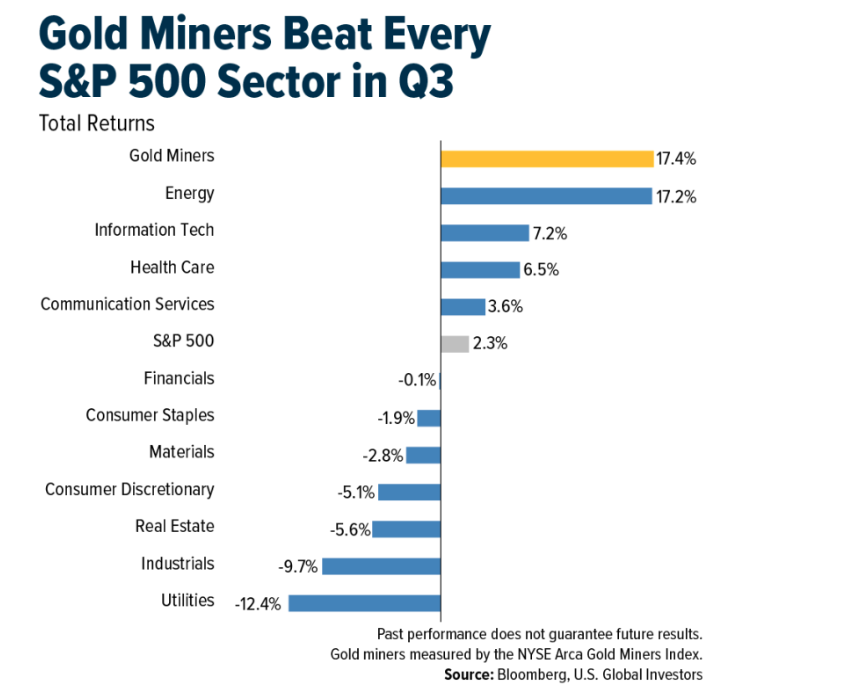
The Bond Market Took Center Stage
September was all about interest rates. On September 16, the Federal Reserve raised rates for the first time in more than three years and signaled more hikes could follow. Two days earlier, the 10-year Treasury yield crossed 5% for only the second time since the 2008 financial crisis.
See more: YTD Asset Class & Portfolio Performance Through September
This wasn’t just an American story. Bond yields climbed around the world. In the U.K., the 30-year government bond yield topped 6% this week, its highest level since 1998.
As we all know, gold doesn’t pay interest. When you can earn close to 5% on a two-year Treasury note, the cost of holding a metal that pays nothing goes up.
The number that matters most is called the real yield. That’s what a 10-year Treasury pays you after inflation. It closed September at 2.93%, its highest level since November 2008, jumping about half a percentage point in September alone and a full point since the start of the year.
The U.S. Dollar Index, meanwhile, rose more than 2% in September. Since gold is priced in dollars, a stronger greenback makes it more expensive for buyers overseas.
Put it all together, and you have a recipe for a tough month. September has historically been gold’s weakest month of the year, and this one was worse than any September in the past decade.
Gold Has Been Here Before
The Wall Street textbook says gold falls when real yields rise. Sometimes it does. In 2013, real yields jumped about 1.5 percentage points and gold lost 28%, one of its worst years in decades.
But the rule is far from ironclad. From 2005 through 2007, real yields hovered between 2% and nearly 3%, right around where they are today, and gold nearly doubled. In 2022, real yields swung from deeply negative to positive, a move of more than 2.5 percentage points, and gold finished the year essentially flat. Then it went on one of the greatest runs in its history while yields stayed high.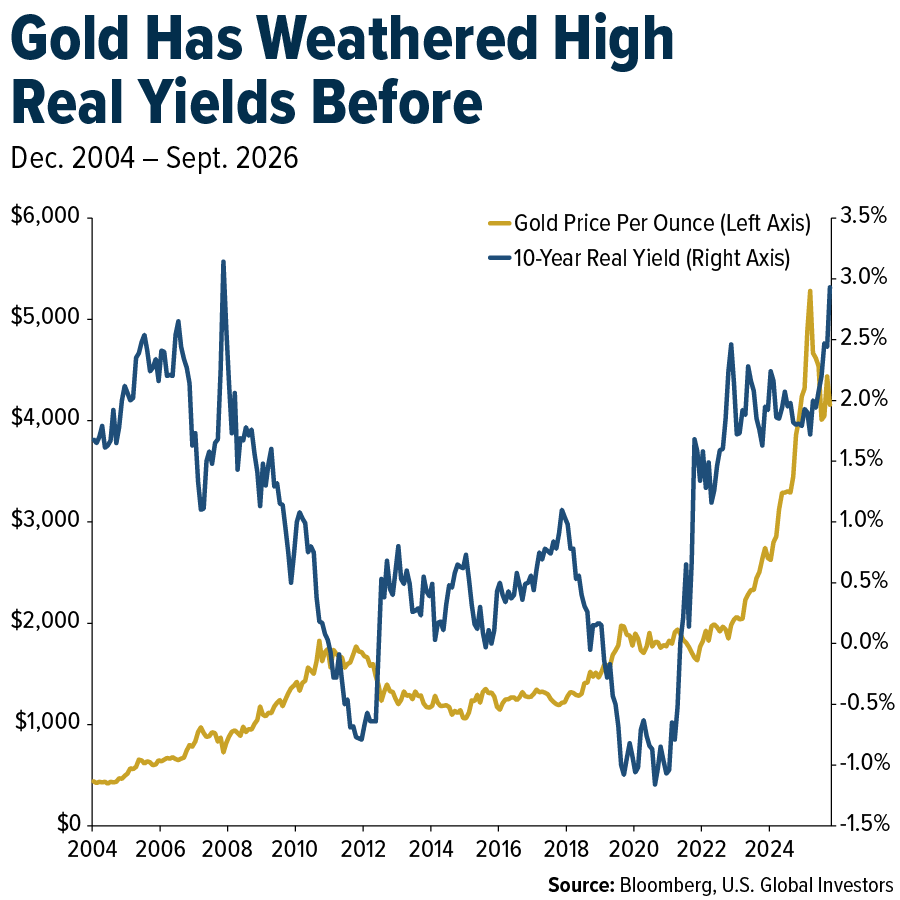
What separates those periods? Who’s doing the buying. In 2013, Western investors were dumping gold. Today, the biggest buyers are holding firm and adding more.
That helps explain why gold is down only 3.7% so far this year despite a full percentage point increase in real yields.
The Love Trade Didn’t Miss a Beat
Loyal readers know I’ve long said that gold is driven by two forces, the Fear Trade and the Love Trade. The Fear Trade is investors reacting to inflation, interest rates and government policy. The Love Trade is the cultural buying of gold as gifts and savings, especially in China and India.
The Fear Trade had a rough September. The Love Trade, along with central bank buying, kept right on going.
China’s central bank added more than 20 tonnes of gold in August, its biggest monthly purchase since 2023. That stretched its buying streak to 22 straight months. China also imported a record 1,141 tonnes of gold in the first eight months of the year, already more than in all of 2025. Poland keeps buying, and South Korea’s central bank plans to buy gold in December for the first time since 2013.
Why are governments doing this? Reserve security. After watching Russia’s reserves get frozen in 2022, many nations want an asset that another government can’t seize with the stroke of a pen.
The timing is also worth noting. This week marks China’s Golden Week holiday, which traditionally kicks off the country’s peak gold buying season.
Investors Bought the Dip
It’s not just central banks. Everyday investors who buy gold through exchange-traded funds (ETFs) held their ground too.
For most of the past year, the amount of gold held by ETFs moved right in step with the price. Then, in late August, the two went their separate ways. The gold price slipped from around $4,650 an ounce to $4,157, but ETF holdings kept climbing to about 100.9 million ounces, matching their highest level of the past year.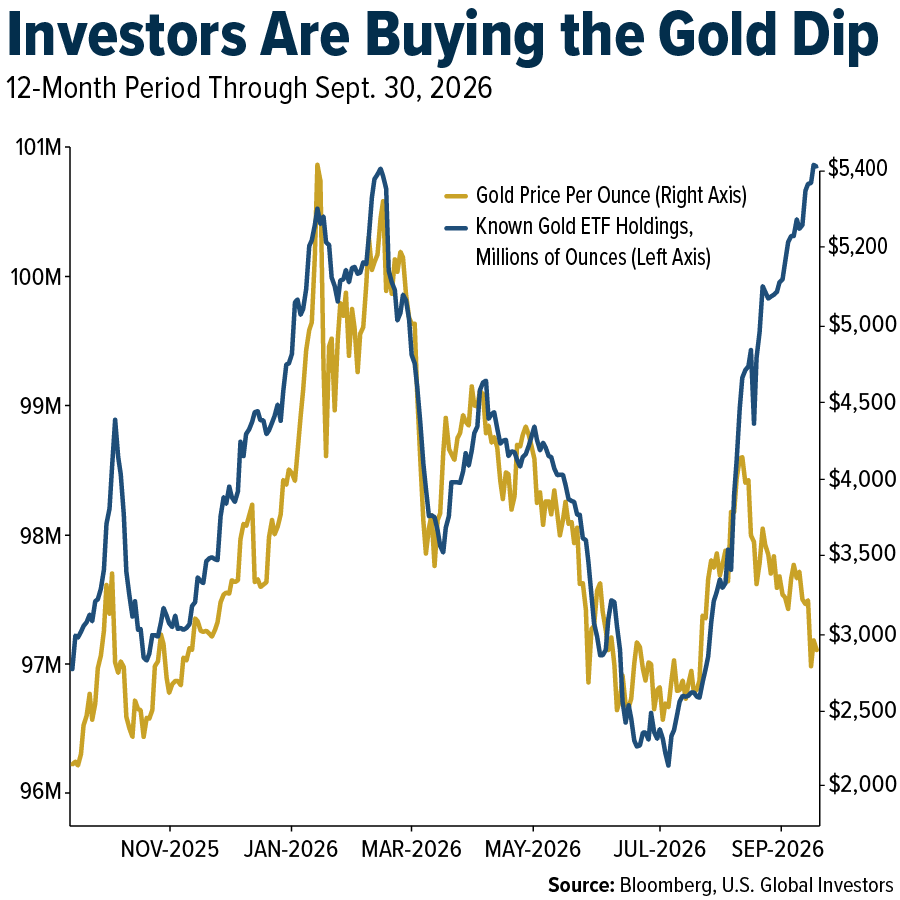
U.S.-listed gold ETFs took in $3.8 billion in September, following $7.9 billion in August. When prices fall and investors keep buying, that tells me conviction is still strong.
Gold Stocks Are Still Overlooked
Brings me back to gold miners. Their strong quarter wasn’t’ a one-off. Over the past five years, the NYSE Arca Gold Miners Index has returned about 240%, compared with about 137% for the price of gold itself.
Even so, most investors still aren’t paying attention. Mining stocks make up roughly 2% of global stock markets, their smallest share in 55 years. The 50 largest gold miners in the world, combined, are worth less than Nvidia alone.
That’s hard to square with the fundamentals. Free cash flow per share for miners has grown tenfold since 2020, and the sector’s earnings yield of about 12% is the highest of any sector, according to Jeff Clark of Paydirt Prospector.
Put simply, these companies are making a lot of money relative to what investors are paying for them.
The industry’s own insiders seem to agree. Large miners are bidding for one another again, including a $27 billion offer for Northern Star that was rejected this week as too low.
Meanwhile, the broader stock market is near record highs and leaning heavily on a handful of giant tech names. JPMorgan recently reminded investors that owning an index fund isn’t the same as being diversified. I couldn’t agree more.
Don’t Let One Bad Month Discourage You
The bond market will stay in the driver’s seat for now. The good news is that inflation came in cooler than expected in August, and traders have scaled back their bets on another Fed hike in October. I’ll be watching the jobs report and the Fed’s tone closely.
The calendar also turns more friendly from here. Over the past decade, gold has averaged a gain of about 1.6% in October, and December and January have been its two strongest months. Past performance is no guarantee of future results, of course, but it lines up with the Love Trade buying season now underway.
Gold has had a volatile year, and I expected more swings ahead. That’s exactly why I’ve always recommended a 10% weighting in gold, with 5% in physical gold and 5% in high-quality gold mining stocks, rebalanced regularly. Don’t let one tough month shake you out of a position that’s built for the long haul.
Airlines and Shipping
Strengths
- The best-performing airline stock for the week was TripAdvisor, up 1.2%. Alaska filed an 8-K retaining its long-term targets, although importantly pivoting its >$10 2027 earnings per share (EPS) target to a long-term target, removing an overhang. The detailed presentation outlined how Alaska is evolving its model for an industry increasingly defined by scale, relevance and loyalty, and how it is well positioned to take advantage of industry dynamics, according to Raymond James.
- Hapag-Lloyd has again raised its 2026 guidance range, with EBITDA now expected at $3.9-4.4B (versus $2.7-3.7B previously; Bloomberg consensus of $3.95B) and EBIT now at $1.25-1.75B (versus $0.1-1.1B previously; Bloomberg consensus of $1.34B). The upgrade is driven by the supportive market demand backdrop and continued positive development in spot freight rates, although management continues to caution that the outlook remains subject to a high degree of uncertainty, according to JPMorgan.
- Spirit Airlines received bankruptcy court approval to sell its final 27 aircraft for $668MM as the carrier continues to liquidate its remaining assets. Twenty-three A320ceos will be transferred to an entity controlled by holders of Spirit’s equipment notes for $567MM, while four aircraft will be sold to an FTAI Aviation affiliate for $101MM in cash, according to Morgan Stanley.
Weaknesses
- The worst-performing airline stock for the week was Sabre, down 9.6%. According to RBC, the FAA announced that it will delay certification of the MAX-10 variant as Boeing faces a software issue with the MAX. The issue, which emerged after a cockpit software update, could cause the automated flight guidance system to disengage during a missed landing.
- The Israeli Finance Ministry says it objects to the sale of ZIM Integrated Shipping Services to Germany’s Hapag-Lloyd and Israel’s FIMI Opportunity, according to a statement released Monday. “In our view, the risks involved in the current deal outweigh its benefits, as well as the risks associated with rejecting it,” the ministry says. The ministry cites “involvement of hostile shareholders” as one of several risk factors, including that “the governments of Qatar (12.3%) and Saudi Arabia (10.2%) hold shares in Hapag-Lloyd.”
- For Thai Air, heavy rainfall since September 24 has resulted in severe flooding across Bangkok, prompting authorities to declare a flood emergency. The flooding has significantly disrupted employee commuting conditions, leading to acute ground-handling labor shortages at Suvarnabhumi Airport (BKK). In response, Thai Airways has cancelled 30% of its daily flights and suspended cargo operations as management reallocates resources to address the operational challenges and accelerate the clearance of delayed baggage. The CEO indicated that about 80%-90% of employees have returned to work, and the company aims to restore normal flight operations within seven days.
Opportunities
- Goldman states that, regarding IndiGo, India’s largest airline, it believes: 1) IndiGo’s consistent market share gains, from 50% in FY20 to 65% in August 2026, are sustainable given the liquidity challenges faced by Air India; 2) industry fleet additions over the medium term are likely to be modest, which, in its view, will support yields; 3) IndiGo’s cost leadership will likely drive improved profitability; and 4) its international business has a long runway for growth. While there are near-term headwinds related to fuel costs, Goldman expects significant improvement in profitability in FY28.
- The Japan Maritime Daily reported that the Premier Alliance, comprising Ocean Network Express (ONE), HMM and Yang Ming, will switch its Asia-Europe services from the Cape of Good Hope route in South Africa to the Red Sea/Suez Canal route. The alliance decided to make the return after carefully examining the security situation in the region and intends to monitor conditions and proceed with a phased return on a service-by-service basis.
- Ryanair proposed a $1.6B, five-year investment across Latvia, Lithuania and Estonia that could double its regional traffic to 11MM annual seats and increase its number of based aircraft from 7 to 16, conditional on lower airport charges and taxes, according to Raymond James.
Threats
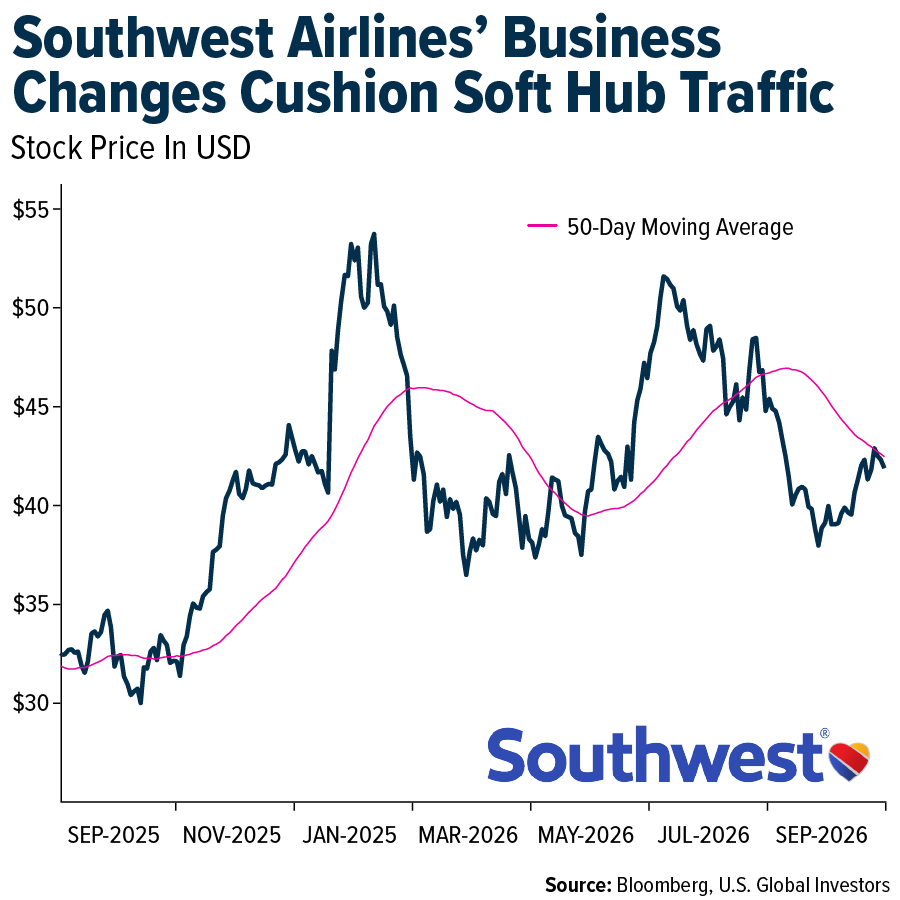
- Airport-level data continues to skew negatively for Southwest Airlines, with continued underperformance at hubs Dallas Love Field and Chicago Midway, as well as Las Vegas. However, Goldman notes that trends at Baltimore/Washington International, another key Southwest airport, were notably more positive in September.
- Morgan Stanley believes that, for Japanese shippers, 2Q F3/27 earnings will be the key event to watch in the near term. Longer term, they see increasing risks of supply/demand deterioration, potential IFIS forecast downgrades and overvaluation.
- Seat planning data points to a lackluster September for both Grupo Centro Norte and Grupo Sureste, at -1%/-2% YoY, while Grupo Pacifico could significantly underperform, with an 8% YoY reduction in available seats. Goldman also notes that, based on the most recent seat data, a similar trend could occur in October.
Luxury Goods and International Markets
Strengths
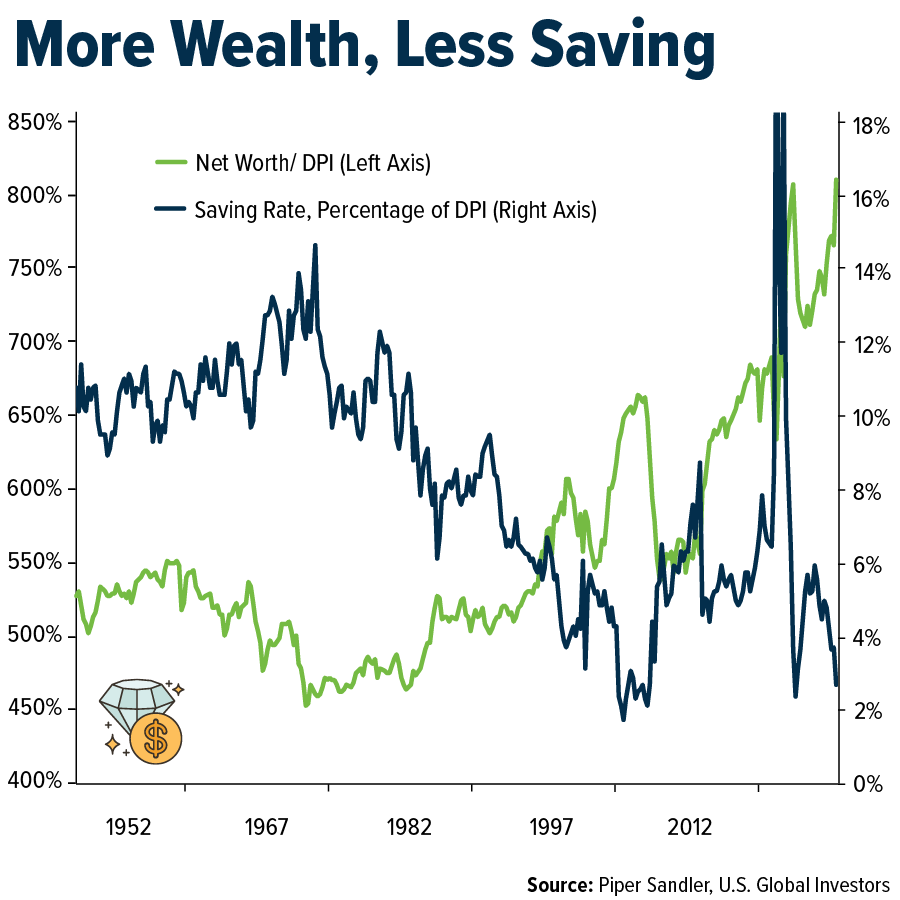
- The wealth effect is powering consumer spending. According to Piper Sandler, consumer spending is being supported by a low savings rate, enabled by record-high household net worth driven by gains in real estate and stocks. With household net worth near a record 830% of disposable income, the savings rate has fallen to a historically low 3%.
- China’s latest PMI data surprised positively, signaling an improvement in economic activity. The official Manufacturing PMI rose to 50.1 in September from 49.8 in August, returning to expansion territory for the first time since June, while the Services PMI increased to 50.2 from 49.3.
- Carnival Corporation, a cruise line, gained 16% over the past five trading days, making it the top performer in the S&P Global Luxury Index. Shares surged after the company reported stronger-than-expected third-quarter results, driven by robust demand, higher onboard spending and improved pricing. Management also raised its full-year earnings outlook.
Weaknesses
- U.S. consumer confidence deteriorated despite strong reported spending. September confidence fell to 81.9, its third consecutive monthly decline, amid concerns about household finances, inflation, and softer discretionary-spending intentions.
- In Europe, the euro-area Economic Sentiment Indicator declined to 97.9, below its long-term average, while consumer confidence fell to -16.5. Preliminary national inflation releases also pointed to a sharp, energy-led acceleration in September.
- Melco Resorts, a hotel and casino operator in Macau, declined 12% over the past five trading days, making it the worst performer in the S&P Global Luxury Index. Shares fell as renewed concerns over Macau’s gaming outlook, softer-than-expected visitation trends and continued weakness in Chinese consumer spending weighed on sentiment.
Opportunities
- China’s latest manufacturing and services PMI data surprised to the upside, signaling that economic activity is improving faster than expected. A stronger economy typically supports consumer confidence, employment, and spending, which is positive for the luxury sector given China’s importance as a key market for global luxury brands. If this momentum continues, improving demand from Chinese consumers could provide a tailwind for luxury goods companies after a period of softer growth.
- Tesla’s Full Self-Driving (FSD) system has recently received approval in Croatia, marking another step in its expansion across Europe. The approval increases the likelihood of broader regulatory acceptance, with investors watching for potential progress toward wider eurozone approval later this year. A broader rollout of FSD across Europe would expand Tesla’s addressable market. Tesla also reported better-than-expected sales for the latest quarter this week.
- Richemont was placed on JPMorgan’s Positive Catalyst Watch ahead of its first-half results. Analyst Chiara Battistini expects another strong performance, driven by continued momentum in the Jewellery Maisons segment, which includes Cartier and Van Cleef & Arpels. The positive outlook highlights Richemont’s resilience and its ability to outperform the broader luxury sector despite ongoing market challenges.
Threats
- Despite lower oil prices and improving Chinese PMI data, travel and luxury stocks remained under pressure as investors continued to worry about the sustainability of consumer spending, elevated interest rates, and the pace of recovery in Chinese luxury demand. Concerns over global growth and discretionary spending outweighed the benefit of falling energy prices.
- A serious onboard incident involving a flight from Dubai to Israel resulted in an emergency landing in Saudi Arabia after one pilot reportedly attacked another pilot. All passengers were reported safe, and the aircraft was landed safely by the remaining flight crew. The event highlights how geopolitical tensions and security concerns can disrupt travel, a key component of the luxury ecosystem. Any increase in travel uncertainty can negatively affect tourism, international spending, and demand for luxury goods and experiences.
- Reports indicate that the United States is deploying a third aircraft carrier strike group and roughly 9,000 to 10,000 additional sailors, Marines, and support personnel to the Middle East amid heightened tensions with Iran. The buildup would increase the U.S. military presence in the region and preserve additional operational options if hostilities escalate. For markets, the deployment highlights continuing geopolitical risks in the Middle East.
Energy and Natural Resources
Strengths
- The best-performing commodity for the week was sugar, up 7.73%. Raw sugar prices were on track for their biggest weekly gain since early September due to concerns about weather-related supply losses in the main producing regions of Brazil. U.S. oilfield activity continues to recover, led by oil drilling. Oil rigs have driven a 99-rig year-to-date increase, marking the first sustained improvement in the U.S. rig count since 2022. The rebound in drilling activity provides a more supportive operating environment for U.S. oilfield service companies, according to Raymond James.
- U.S. hot-rolled coil steel prices climbed to their highest level since May 2022. Spot HRC prices increased further over the past two weeks, extending a rally that began a year ago. Limited spot availability and healthy demand continue to support pricing, according to BMO.
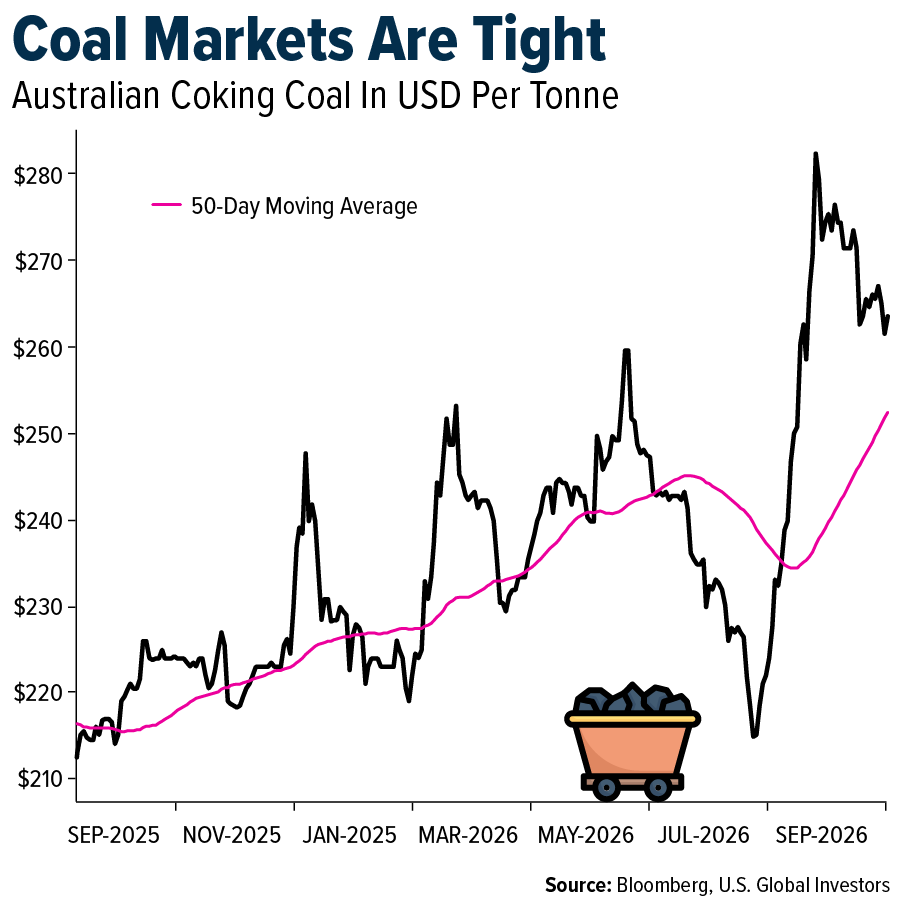
- Coal markets remain tight heading into the fourth quarter, with spot prices at $274 per ton. Thermal coal prices are supported by firmer winter demand, constrained Indonesian exports, and tight global gas markets, according to Morgan Stanley.
Weaknesses
- The worst performing commodity for the week was, corn down 5.87%. Longs liquidated their corn positions as perfect harvest weather is forecast starting next week to last for two weeks with near perfect conditions. Germany is taking steps to rebuild unusually low natural gas inventories ahead of winter. With storage at around 57% in late September, the government instructed state-owned SEFE to procure and inject 8 terawatt-hours of gas by December 15, highlighting concerns over the country’s low seasonal stockpiles.
- Iron ore extended its longest losing streak in more than a decade amid record seasonal inventories in China. Singapore futures fell toward $91 per ton and were on track for a 10th consecutive session of declines, as record-high Chinese port stockpiles and a softer seaborne market weighed on prices.
- Chinese lithium carbonate futures plunged 25% in September amid concerns over slowing battery demand growth. Prices fell below 120,000 yuan ($17,900) per ton from more than 160,000 yuan at the start of the month, as concerns over weakening battery demand weighed on the lithium market.
Opportunities
- BMO raised its long-term copper price forecast to $18,000 per ton by 2030, supported by tighter mine supply and stronger demand expectations. Persistent mine-supply constraints, evolving scrap-market dynamics, and growing copper demand linked to AI infrastructure have strengthened the outlook for higher long-term prices.
- Copper mining equities appear reasonably attractive despite elevated copper prices, according to Scotia. Miners are trading at an average implied premium to spot of just 2%, compared with 5% year-to-date, 15% in 2025, and 17% over the past three years. Their spot P/NAV of 1.08x also remains below the three-year average of 1.41x, suggesting valuations have not fully reflected the strength in underlying commodity prices.
- UBS raised its long-term iron ore price forecast to $93 per ton from $85, citing resilient demand and disciplined supply growth. The outlook reflects China’s shift toward manufacturing and exports, growing demand from the Global South, and supply constraints, including declining ore grades, mine depletion, and subdued industry capital spending.
Threats
- Persistently elevated diesel prices could add to inflationary pressures in the eurozone. Shrinking global refining capacity, disruptions to Russian refinery supply, risks to shipping through the Strait of Hormuz, and lower Chinese fuel exports could keep diesel prices elevated for an extended period, according to ECB Vice President Boris Vujcic.
- Chile faces mounting copper supply risks amid declining production and labor tensions at major mines. August copper output fell to its lowest level in more than 15 years, while workers at BHP’s Escondida and Antofagasta’s Centinela overwhelmingly backed strike action after rejecting contract offers. Weather disruptions, declining ore grades, and operational setbacks are adding further pressure to supply.
- Panama is considering only a temporary restart of the Cobre Panama copper mine ahead of its eventual closure. A government committee recommended negotiating a restart with First Quantum to fund an orderly closure, with no possibility of extending operations beyond that process. Any agreement would also require the mine to close without cost to the state, according to Bloomberg.
Bitcoin and Digital Assets
Strengths
- U.S. spot Bitcoin ETFs attracted approximately $2.4 billion in net inflows during the week, their largest weekly intake since October 2025, reversing roughly $5.8 billion in year-to-date outflows recorded by mid-July and pushing cumulative 2026 flows back into positive territory. Citigroup also raised its 12-month Bitcoin target from $82,000 to $113,000 and expects crypto investment products to attract approximately $5 billion over the next 12 months, pointing to renewed institutional demand for digital assets.
- Brazil’s state-controlled energy company Petrobras is testing Cardano in two research projects designed to improve the traceability of environmental claims associated with sustainable aviation fuel and its partly renewable Diesel R. The blockchain would record the origin and ownership of emissions benefits to prevent double counting, while also tracking fuel data across production, transportation and use. Although both projects remain in the research stage, the initiative highlights the expanding use of blockchain technology for real-world industrial applications and supply-chain transparency.

- Lloyds Banking Group and Visa completed a $750,000 cross-border transaction using USDC in a live pilot involving Aberdeen Investments and Archax. The transaction connected traditional bank accounts with blockchain-based settlement infrastructure, demonstrating how regulated financial institutions can use stablecoins to move funds between conventional and digital financial systems. The pilot highlights growing institutional adoption of stablecoins for real-world payments and settlement.
Weaknesses
- The U.S. crypto industry spent more than $13 million on lobbying during the first half of 2026, with roughly $8 million tied to efforts involving the Digital Asset Market Clarity Act. Despite the significant push, the legislation failed to advance in the Senate, prolonging uncertainty around a comprehensive U.S. regulatory framework for digital assets. Industry participants also faced reported disagreements over key policy provisions, highlighting the challenges of building a unified approach to crypto regulation.
- Kalshi, a CFTC-regulated prediction market where users trade contracts based on the outcomes of real-world events, ended its Liquidity Provider Incentive Program, which rewarded market makers for providing liquidity across selected markets. While the company plans to continue supporting liquidity through other mechanisms, removing direct incentives could test whether trading depth and participation remain strong without subsidies as prediction markets continue to expand.
- U.S. spot Bitcoin ETFs recorded $149 million in net outflows, ending a nine-day streak that had attracted approximately $3 billion into the funds in September. The reversal indicates that institutional flows remain uneven despite the broader recovery in ETF demand, highlighting the potential for short-term fluctuations in investor appetite.
Opportunities
- Open Standard launched Open USD (OUSD), a U.S. dollar-pegged stablecoin, across Ethereum, Solana, Base and Tempo, backed by founding partners Coinbase, Mastercard, Shopify, Stripe and Visa, which have committed more than $1 billion to establish liquidity. Unlike traditional stablecoin models, where economics are largely concentrated with the issuer, OUSD is designed to reward companies that help distribute the stablecoin and generate supply and transaction activity. With a network of more than 200 companies, the model could broaden stablecoin adoption across banking, cross-border payments, card settlement and institutional trading.
- The Financial Conduct Authority opened its authorization gateway for crypto firms seeking to operate in the U.K., giving companies until the end of February 2027 to apply ahead of the new regulatory regime taking effect in October 2027. More than 60 firms already registered under the FCA’s anti-money-laundering framework may have a head start in meeting the new licensing requirements. The move provides a clearer regulatory pathway for digital-asset businesses and could support greater institutional participation in the U.K. crypto market.
- Robinhood Wallet integrated Arcus’ request-for-quote system, allowing users to swap directly between crypto assets and tokenized U.S. stocks and ETFs from a self-custody wallet. The integration comes as tokenized real-world assets continue to expand across blockchain networks, with BNB Chain surpassing $1 billion in tokenized assets. Together, the developments highlight growing demand for bringing traditional financial assets onchain and could accelerate the convergence between conventional markets and blockchain-based infrastructure.
Threats
- The crypto industry suffered 247 security incidents in the third quarter, resulting in $1.26 billion in losses, according to CertiK, bringing year-to-date losses to $2.68 billion. September alone recorded 99 incidents and $768.5 million stolen, both the highest monthly levels of 2026. The security challenges continued into October, with NEAR Intents suffering a $3.8 million exploit, underscoring persistent vulnerabilities across digital-asset infrastructure.
- A U.S. Senate investigation found that 87% of the 757 wallets identified in the report as implicated in Iranian terrorism financing had predominantly transacted in USDT, raising concerns over the use of stablecoins to circumvent sanctions and facilitate illicit finance. The findings could increase regulatory and compliance scrutiny of stablecoin issuers as their role in global payments expands. Tether disputed the report’s characterization and said it helped freeze $550 million in USDT linked to Iran over the past year.
- The White House is considering new CFTC rules governing event contracts as prediction markets face growing disputes over whether certain products fall under federal derivatives oversight or state gambling laws. The regulatory debate could reshape how platforms such as Kalshi and Polymarket offer event-based contracts, potentially increasing compliance complexity and limiting product availability if stricter rules emerge.
Defense and Cybersecurity
Strengths
- Micron Technology delivered record fiscal fourth-quarter results driven by an insatiable artificial intelligence boom, posting revenue of $54.23 billion, a 379.1% surge year-over-year from $11.32 billion, alongside adjusted earnings per share of $33.42, up 1,003.0% year-over-year from $3.03. Looking ahead to the fiscal first quarter, the chipmaker guided for midpoint revenue of $61.50 billion and adjusted EPS of $38.15, representing sequential quarter-over-quarter increases of 13.4% and 14.2%, respectively. Backed by $32 billion in customer commitments across 26 long-term agreements, management signaled that severe memory shortages will outstrip supply through 2028, even as higher worker compensation temporarily narrows gross margins to a projected 86.3% floor in the coming quarter.
- Raytheon was awarded a five-year contract by the U.S. Navy worth up to $24.4 billion, with two optional additional years, to manufacture Standard Missile-6 anti-air and anti-surface munitions.
- The U.S. Navy awarded Boeing a landmark contract valued at more than $20 billion on September 29, 2026, for the full-scale engineering and manufacturing development of the F/A-XX sixth-generation carrier-based stealth fighter. The program selection secures the carrier air wing’s primary air-dominance platform, which will replace the F/A-18E/F Super Hornet fleet beginning in the 2030s.
Weaknesses
- Eight U.S. Marines sustained injuries on September 28, 2026, after an Iranian anti-ship cruise missile struck a commercial container vessel carrying a U.S. military detachment in the Strait of Hormuz.
- Russian forces launched a coordinated strike wave combining cruise and ballistic missiles against central and western Ukraine on September 30, 2026, inflicting structural damage on regional power transmission substations and triggering an explosive drone crash across the border in Moldova.
- The Google Threat Intelligence Group (GTIG) published research on October 1, 2026, revealing that nation-state threat actors are now weaponizing AI-discovered zero-day flaws within four days of public disclosure. The group tracked 141 in-the-wild exploitations across enterprise networks during 2026.
Opportunities
- Samsung Foundry issued long-term operational forecasts on October 1, 2026, projecting a 400% expansion in its customer base by 2029, anchored by volume commercial tape-outs on its 2nm Gate-All-Around (SF2) node and custom turnkey HBM4 base-die integration.
- NVIDIA authorized a record-breaking $150 billion share repurchase program to return excess cash to shareholders and systematically offset equity dilution.
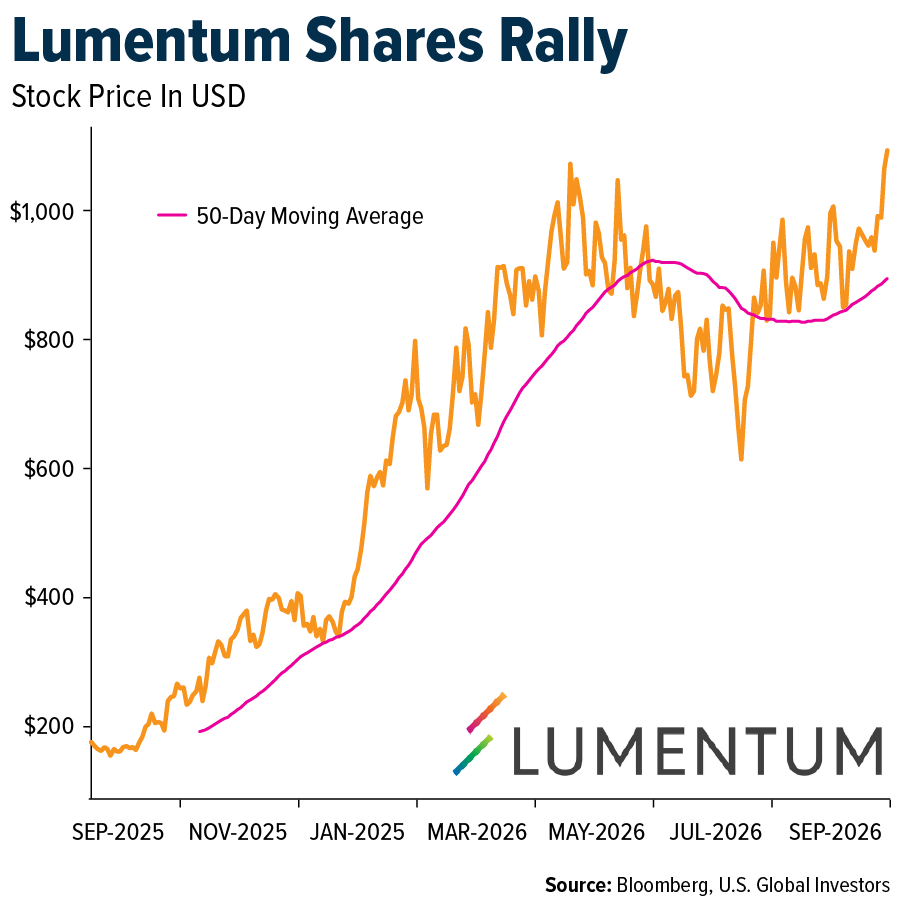
- Lumentum shares rallied nearly 8% on reports that Washington is considering restrictions on Chinese-made 3.2T optical transceivers. The proposed restrictions could position Lumentum as a key beneficiary by increasing demand for its critical networking components used in AI data centers.
Threats
- Nearly two-thirds of Swiss voters now oppose purchasing Lockheed Martin’s F-35 fighter jets, according to a recent poll. While opponents are collecting signatures to trigger a nationwide vote to block further funding, a referendum is unlikely to take place before 2028.
- President Donald Trump said increased military strikes against Iran are “possible” following the November midterm elections, as his administration struggles to resolve an eight-month war amid stalled diplomatic talks and mounting voter discontent over rising energy costs.
- The U.S. military has completed the total withdrawal of its forces from Iraq, concluding a 12-year counter-ISIS mission under a bilateral agreement amid heightened regional tensions and ongoing conflict between the United States and Iran.
Gold Market
This week gold futures closed the week at $4,171.70, down $149.5 per ounce, or 3.46%. Gold stocks, as measured by the NYSE Arca Gold Miners Index, ended the week lower by 5.47%. The S&P/TSX Venture Index came in off 4.39%. The U.S. Trade-Weighted Dollar rose 0.92%.
Strengths
- The best-performing precious metal for the week was gold, but it was still down 3.46%. Gold extended its decline this week as investors continued to rotate out of non-yielding assets amid elevated Treasury yields and expectations for further Fed tightening. ETF outflows, a stronger U.S. dollar and easing safe-haven demand reinforced downward pressure on bullion prices.
- B2Gold’s operational update confirms the Goose Mine crusher fix is tracking to plan, with 2026 guidance of 170,000–200,000 ounces intact. Exploration results also extend high-grade continuity at Llama and Nuvuyak and deliver a new discovery, Tattuk, down-plunge of Nuvuyak, according to Stifel.
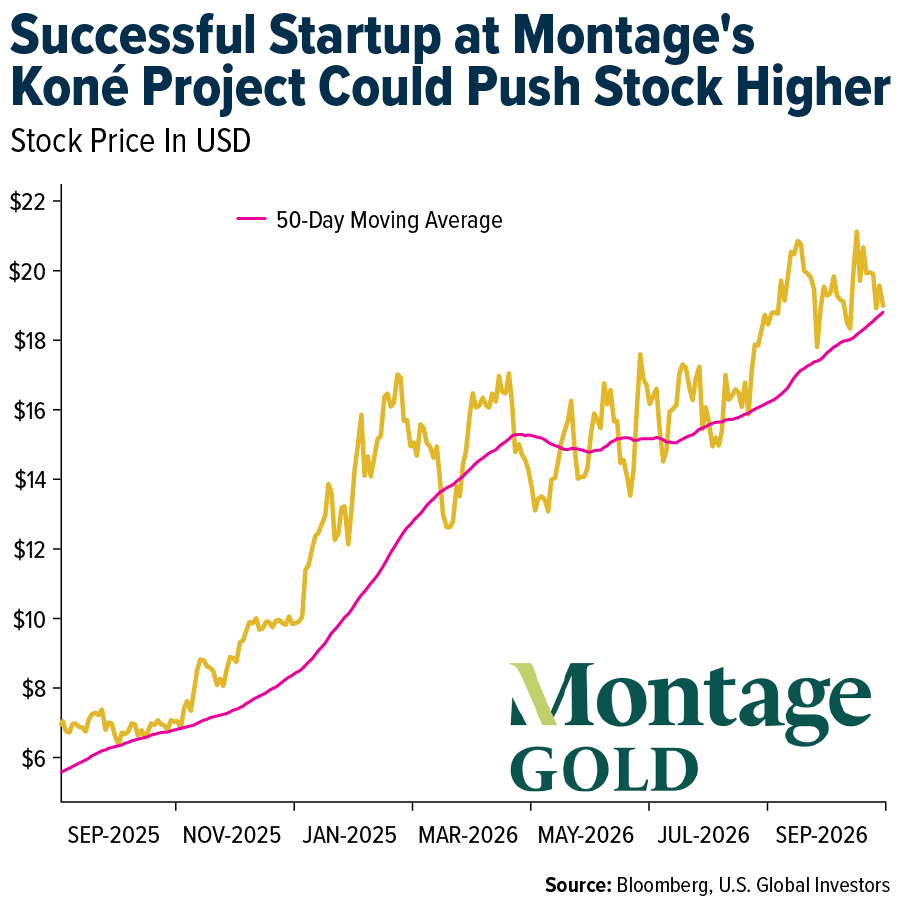
- The Koné mine, owned by Montage Gold, achieved its first gold pour on budget and ahead of schedule. More than 400,000 tons of ore have been processed since September 8, implying a throughput rate of 22,200 tons per day, nearly 75% of nameplate estimates, according to Canaccord.
Weaknesses
- The worst-performing precious metal for the week was palladium, down 7.95%. Palladium faces growing long-term pressure as rising EV adoption and increasing recycled supply are expected to push the market into persistent surpluses from 2027. While near-term supply risks may provide temporary support, Bloomberg Intelligence believes rallies above $1,400/oz are unlikely to be sustained.
- U.S. Treasury yields surged to multi-decade highs this week, with the 10-year yield breaking above 5% for the first time since 2007. Higher bond yields increased the opportunity cost of holding gold and contributed to continued weakness across precious metals markets.
- Silver posted its sharpest weekly decline since June, falling nearly 7% as investor sentiment weakened across precious metals. Bloomberg Intelligence also warned that slowing industrial demand growth and increasing substitution could narrow the market deficit in 2027, leaving silver more vulnerable to future price weakness.
Opportunities
- Growing concerns over extreme U.S. equity valuations are reinforcing the investment case for gold and gold equities. Crescat Capital continues to forecast a potential move toward $20,000 gold and believes junior mining stocks offer one of the most compelling risk-reward opportunities in the resource sector.
- Northern Aura Minerals agreed to bring mining fleet operations in-house across several Brazilian gold mines, targeting a reduction in all-in sustaining costs of $150–$200 per ounce beginning in 2027. The move could improve margins and cash flow generation while enhancing operational control across key assets.
- BMO’s recent China research found that China is highly countercyclical, buying strongly at $4,000/ounce and leading the firm to upgrade its real through-cycle price assumption accordingly. Despite accumulating almost as much gold onshore (30,000 tons) as the United States, BMO believes China, which drives approximately one-third of global demand, still has a long road of gold accumulation ahead as it looks to build further clout in the global economic and financial system.
Threats
- Gold prices continued to weaken as investors remained focused on the prospect of further Federal Reserve tightening. While August Core PCE rose just 0.2%, below expectations, traders still assign roughly a 40% probability of another rate hike next month, keeping pressure on gold through elevated real yields and a stronger U.S. dollar.
- Illegal gold exports from Peru rose more than 19% in the first half of 2026 and have now surpassed the country’s legal gold exports. The rapid expansion of illicit supply chains, including growing flows through Africa and the Middle East, raises regulatory, compliance and responsible-sourcing risks across the global gold industry.
- Uncertainty over the future of Cobre Panama continues to weigh on investors after Panamanian officials recommended negotiations that could ultimately lead to either a restart or an orderly closure of the mine. The lack of a definitive resolution leaves significant regulatory and operational risk for companies with exposure to the project.
A message from Advisor Perspectives and VettaFi: Discover something new! Click here to register for our upcoming webcasts.
U.S. Global Investors, Inc. is an investment adviser registered with the Securities and Exchange Commission (“SEC”). This does not mean that we are sponsored, recommended, or approved by the SEC, or that our abilities or qualifications in any respect have been passed upon by the SEC or any officer of the SEC.
This commentary should not be considered a solicitation or offering of any investment product. Certain materials in this commentary may contain dated information. The information provided was current at the time of publication. Some links above may be directed to third-party websites. U.S. Global Investors does not endorse all information supplied by these websites and is not responsible for their content. All opinions expressed and data provided are subject to change without notice. Some of these opinions may not be appropriate to every investor.
Holdings may change daily. Holdings are reported as of the most recent quarter-end. The following securities mentioned in the article were held by one or more accounts managed by U.S. Global Investors as of (09/30/2026):
Boeing
Southwest Airlines
Ryanair Holdings PLC
Tesla
Richemont
Micron Technology
Montage Gold Corp.
*The above-mentioned indices are not total returns. These returns reflect simple appreciation only and do not reflect dividend reinvestment.
The Dow Jones Industrial Average is a price-weighted average of 30 blue chip stocks that are generally leaders in their industry. The S&P 500 Stock Index is a widely recognized capitalization-weighted index of 500 common stock prices in U.S. companies. The Nasdaq Composite Index is a capitalization-weighted index of all Nasdaq National Market and SmallCap stocks. The Russell 2000 Index® is a U.S. equity index measuring the performance of the 2,000 smallest companies in the Russell 3000®, a widely recognized small-cap index.
The Hang Seng Composite Index is a market capitalization-weighted index that comprises the top 200 companies listed on Stock Exchange of Hong Kong, based on average market cap for the 12 months. The Taiwan Stock Exchange Index is a capitalization-weighted index of all listed common shares traded on the Taiwan Stock Exchange. The Korea Stock Price Index is a capitalization-weighted index of all common shares and preferred shares on the Korean Stock Exchanges.
The Philadelphia Stock Exchange Gold and Silver Index (XAU) is a capitalization-weighted index that includes the leading companies involved in the mining of gold and silver. The U.S. Trade Weighted Dollar Index provides a general indication of the international value of the U.S. dollar. The S&P/TSX Canadian Gold Capped Sector Index is a modified capitalization-weighted index, whose equity weights are capped 25 percent and index constituents are derived from a subset stock pool of S&P/TSX Composite Index stocks. The NYSE Arca Gold Miners Index is a modified market capitalization weighted index comprised of publicly traded companies involved primarily in the mining for gold and silver. The S&P/TSX Venture Composite Index is a broad market indicator for the Canadian venture capital market. The index is market capitalization weighted and, at its inception, included 531 companies. A quarterly revision process is used to remove companies that comprise less than 0.05% of the weight of the index, and add companies whose weight, when included, will be greater than 0.05% of the index.
The S&P 500 Energy Index is a capitalization-weighted index that tracks the companies in the energy sector as a subset of the S&P 500. The S&P 500 Materials Index is a capitalization-weighted index that tracks the companies in the material sector as a subset of the S&P 500. The S&P 500 Financials Index is a capitalization-weighted index. The index was developed with a base level of 10 for the 1941-43 base period. The S&P 500 Industrials Index is a Materials Index is a capitalization-weighted index that tracks the companies in the industrial sector as a subset of the S&P 500. The S&P 500 Consumer Discretionary Index is a capitalization-weighted index that tracks the companies in the consumer discretionary sector as a subset of the S&P 500. The S&P 500 Information Technology Index is a capitalization-weighted index that tracks the companies in the information technology sector as a subset of the S&P 500. The S&P 500 Consumer Staples Index is a Materials Index is a capitalization-weighted index that tracks the companies in the consumer staples sector as a subset of the S&P 500. The S&P 500 Utilities Index is a capitalization-weighted index that tracks the companies in the utilities sector as a subset of the S&P 500. The S&P 500 Healthcare Index is a capitalization-weighted index that tracks the companies in the healthcare sector as a subset of the S&P 500. The S&P 500 Telecom Index is a Materials Index is a capitalization-weighted index that tracks the companies in the telecom sector as a subset of the S&P 500.
The Consumer Price Index (CPI) is one of the most widely recognized price measures for tracking the price of a market basket of goods and services purchased by individuals. The weights of components are based on consumer spending patterns. The Purchasing Manager’s Index is an indicator of the economic health of the manufacturing sector. The PMI index is based on five major indicators: new orders, inventory levels, production, supplier deliveries and the employment environment. Gross domestic product (GDP) is the monetary value of all the finished goods and services produced within a country’s borders in a specific time period, though GDP is usually calculated on an annual basis. It includes all private and public consumption, government outlays, investments and exports less imports that occur within a defined territory.
The S&P Global Luxury Index is comprised of 80 of the largest publicly traded companies engaged in the production or distribution of luxury goods or the provision of luxury services that meet specific investibility requirements.
Please consider carefully a fund’s investment objectives, risks, charges and expenses. For this and other important information, obtain a fund prospectus by visiting our prospectus page or by calling 1-800-US-FUNDS (1-800-873-8637). Read it carefully before investing. Foreside Fund Services, LLC, Distributor. U.S. Global Investors is the investment adviser.
Bond funds are subject to interest-rate risk; their value declines as interest rates rise. Tax-exempt income is federal income tax free. A portion of this income may be subject to state and local income taxes, and if applicable, may subject certain investors to the Alternative Minimum Tax as well. The Near-Term Tax Free Fund may invest up to 20% of its assets in securities that pay taxable interest. Income or fund distributions attributable to capital gains are usually subject to both state and federal income taxes. The tax free funds may be exposed to risks related to a concentration of investments in a particular state or geographic area. These investments present risks resulting from changes in economic conditions of the region or issuer. Gold, precious metals, and precious minerals funds may be susceptible to adverse economic, political or regulatory developments due to concentrating in a single theme. The prices of gold, precious metals, and precious minerals are subject to substantial price fluctuations over short periods of time and may be affected by unpredicted international monetary and political policies. We suggest investing no more than 5% to 10% of your portfolio in these sectors. Foreign and emerging market investing involves special risks such as currency fluctuation and less public disclosure, as well as economic and political risk. By investing in a specific geographic region, a regional fund’s returns and share price may be more volatile than those of a less concentrated portfolio. The Emerging Europe Fund invests more than 25% of its investments in companies principally engaged in the oil & gas or banking industries. The risk of concentrating investments in this group of industries will make the fund more susceptible to risk in these industries than funds which do not concentrate their investments in an industry and may make the fund’s performance more volatile. Because the Global Resources Fund concentrates its investments in a specific industry, the fund may be subject to greater risks and fluctuations than a portfolio representing a broader range of industries. Stock markets can be volatile and share prices can fluctuate in response to sector-related and other risks as described in the fund prospectus.
Morningstar Ratings are based on risk-adjusted return. The Overall Morningstar Rating for a fund is derived from a weighted-average of the performance figures associated with its three-, five- and ten-year (if applicable) Morningstar Rating metrics. Past performance does not guarantee future results. For each fund with at least a three-year history, Morningstar calculates a Morningstar Rating? based on a Morningstar Risk-Adjusted Return measure that accounts for variation in a fund’s monthly performance (including the effects of sales charges, loads, and redemption fees), placing more emphasis on downward variations and rewarding consistent performance. The top 10% of funds in each category receive 5 stars, the next 22.5% receive 4 stars, the next 35% receive 3 stars, the next 22.5% receive 2 stars and the bottom 10% receive 1 star. (Each share class is counted as a fraction of one fund within this scale and rated separately, which may cause slight variations in the distribution percentages.)
Each of the mutual funds or services referred to in the U.S. Global Investors, Inc. website may be offered only to persons in the United States. This website should not be considered a solicitation or offering of any investment product or service to investors residing outside the United States. Certain materials on the site may contain dated information. The information provided was current at the time of publication. For current information regarding any of the funds mentioned in such materials, please visit the fund performance page. Some link(s) above may be directed to a third-party website(s). U.S. Global Investors does not endorse all information supplied by this/these website(s) and is not responsible for its/their content. All opinions expressed and data provided are subject to change without notice. Some of these opinions may not be appropriate to every investor.
Membership required
Membership is now required to use this feature. To learn more:
View Membership Benefits