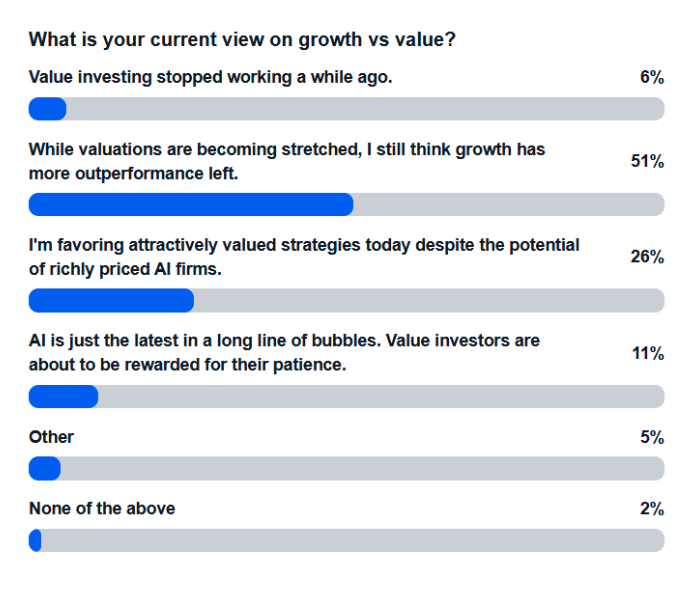
In a recent webcast, Ari Polychronopoulos, TMX VettaFi’s head of RAFI Indices™, and Brent Leadbetter, TMX VettaFi’s head of RAFI Distribution, discussed growing market concentration risk. When asked for attendees’ current view on growth versus value, a majority of respondents (51%) expressed cautious optimism, stating that while valuations are becoming stretched, they still believe growth has more outperformance left. Rather than attempting to precisely time exposure to growth or value, investors can pair fundamental indexing methodologies with growth strategies.
Key Takeaways:
- Investor optimism toward growth strategies remains, but asset managers must distinguish between true business expansion and price inflation.
- Traditional growth benchmarks often select components based on high valuation multiples rather than fundamental performance, exposing portfolios to overextended growth traps.
- By combining fundamental value strategies with growth allocations, investors can capture upside while grounding allocations in real economic output.
See More: Why RAFI Serves as an Effective Core & Stronger Value Allocation
Redefining Growth and Avoiding Price Traps
Discussing these poll results, Leadbetter noted that investor optimism toward growth remains reasonable. However, there must be discernment between genuine business expansion and mere valuation inflation. Traditional growth indexes frequently default to selecting companies simply because their share prices and valuation multiples are expensive. This often occurs irrespective of whether underlying fundamentals justify the premium.
“Actual growth managers look for growth,” Leadbetter explained. “They don’t look for expensive firms.”
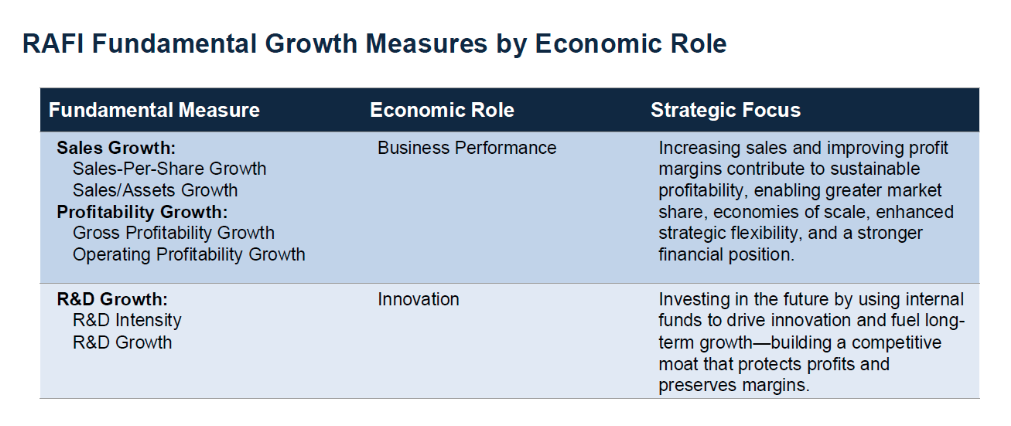
To fix this flaw, RAFI’s fundamental growth research focuses on selecting and weighting companies by actual operational metrics. This includes sales growth, profitability expansion, and research and development (R&D) investments. By anchoring growth to economic output rather than speculative price momentum, investors can participate in structural mega-trends like AI without inheriting overextended, low-growth traps.
Pairing Value With Growth Allocations
For advisors and investors alike looking to manage portfolio concentration while maintaining upside participation, blending a fundamental value strategy with growth exposure provides a balanced core solution. That said, the Schwab Fundamental U.S. Large Company ETF (FNDX) serves as an effective, low-cost anchor by selecting and weighting large U.S. companies based on fundamental scale (adjusted sales, adjusted cash flow, dividends plus buybacks, and book value plus intangibles) rather than market price. This creates a disciplined, rules-based process that systematically tilts away from speculative extremes by using a contra-trading buy-low, sell-high strategy.
While traditional cap-weighted growth funds heavily concentrate capital into expensive tech names, FNDX introduces a disciplined value tilt over time. Combining FNDX alongside high-conviction growth allocations tempers overall volatility, provides downside mitigation, and ensures portfolios remain grounded in real economic output while preserving long-term upside potential.
“When you’re selecting and weighting by fundamentals, regardless of the measure that you’re using, you are breaking that link between price and weight in your index construction process,” Ari explained. “You’re systematically selling what’s done well and buying what’s done poorly. And that’s really the key to understanding fundamental weighting.”
For more news, information, and strategy, visit the Smart Beta Content Hub.
VettaFi LLC (“VettaFi”) is the index provider for FNDX, for which it receives an index licensing fee. However, FNDX is not issued, sponsored, endorsed, or sold by VettaFi, and VettaFi has no obligation or liability in connection with the issuance, administration, marketing, or trading of FNDX.
Originally posted on ETF Trends
A message from Advisor Perspectives and VettaFi: Discover something new! Click here to register for our upcoming webcasts.
More Factor-Based Investing Topics >