The AI Investment Boom Goes Beyond America
Membership required
Membership is now required to use this feature. To learn more:
View Membership Benefits
Key takeaways

- The AI boom is bigger for U.S. demand than for U.S. GDP. Much of the equipment behind the AI buildout is imported, reducing the direct contribution to domestic production even as investment and rising equity wealth support the broader economy.
- America invests, while a global supply chain produces. U.S. AI spending is transmitting a substantial growth impulse abroad, particularly to Asian economies deeply embedded in semiconductor and technology manufacturing.
- The key risk is deceleration, not necessarily a bust. With AI now a key support to global investment, trade, industrial production, and financial conditions, even still-high capex could become less supportive of global growth if its pace of expansion slows.
In light of accelerating global fragmentation and geopolitical conflict, many governments and businesses are investing in resilience. That imperative has coincided with the emergence of AI, a technology that can expand the frontier of what is possible. As a result, technology security is becoming a pillar of national economic security strategy.
See more: Investors Need Convincing Despite Cooling Jobs and Strong AI Earnings
As we discuss in our latest Cyclical Outlook, “Growth Holds, Risks Widen,” the result has been an unprecedented wave of investment commitments to expand AI-related infrastructure. At the time of this writing, announced capital spending by large U.S. technology companies points to more than $1 trillion of investment in 2026, according to company filings, with roughly $1.5 trillion in additional outlays forecast thereafter.
But AI was never simply a U.S. investment story. The infrastructure buildout is supporting U.S. demand, production across the global technology supply chain, and increasingly investment in other economies. That has made AI an important source of support for both the U.S. and global expansions.
By the same token, it is also becoming an important cyclical risk. Crucially, AI investment does not have to collapse for its contribution to growth to fade. Because economic growth depends on the change in spending rather than its level, even still-high investment can provide a diminishing impulse if its growth rate slows.
Below, we highlight three observations about how the AI investment cycle is already reshaping the global economy.
AI is supporting the U.S. economy through more than just investment
First, AI investment is lifting U.S. domestic demand, but its high import content substantially reduces the direct impact on real U.S. GDP growth. Nevertheless, AI is also lifting the U.S. economy in other ways. Expectations for higher productivity have propelled the U.S. stock market and appear to have shifted consumer habits toward more spending – and this “wealth effect” is contributing to stronger demand.
Some background on how U.S. economic output is measured is useful here. GDP records where production occurs, not simply where investment spending occurs. A server or graphics card purchased by a U.S. data center raises U.S. investment regardless of where it was produced. But if that equipment is imported, the transaction also raises imports, which are subtracted in the expenditure calculation of GDP. In other words, the investment data capture the acquisition of productive capital, while the import adjustment ensures that foreign production is not counted as U.S. output.
The National Income and Product Accounts (NIPAs), published by the U.S. Bureau of Economic Analysis (BEA), do not identify AI investment as a stand-alone category. Instead, AI investment spans several components of nonresidential fixed investment, including information-processing equipment, software, R&D, data center structures, and power infrastructure. By combining the main AI-related investment categories with corresponding trade and inventory flows, we can estimate the net domestic growth impulse.
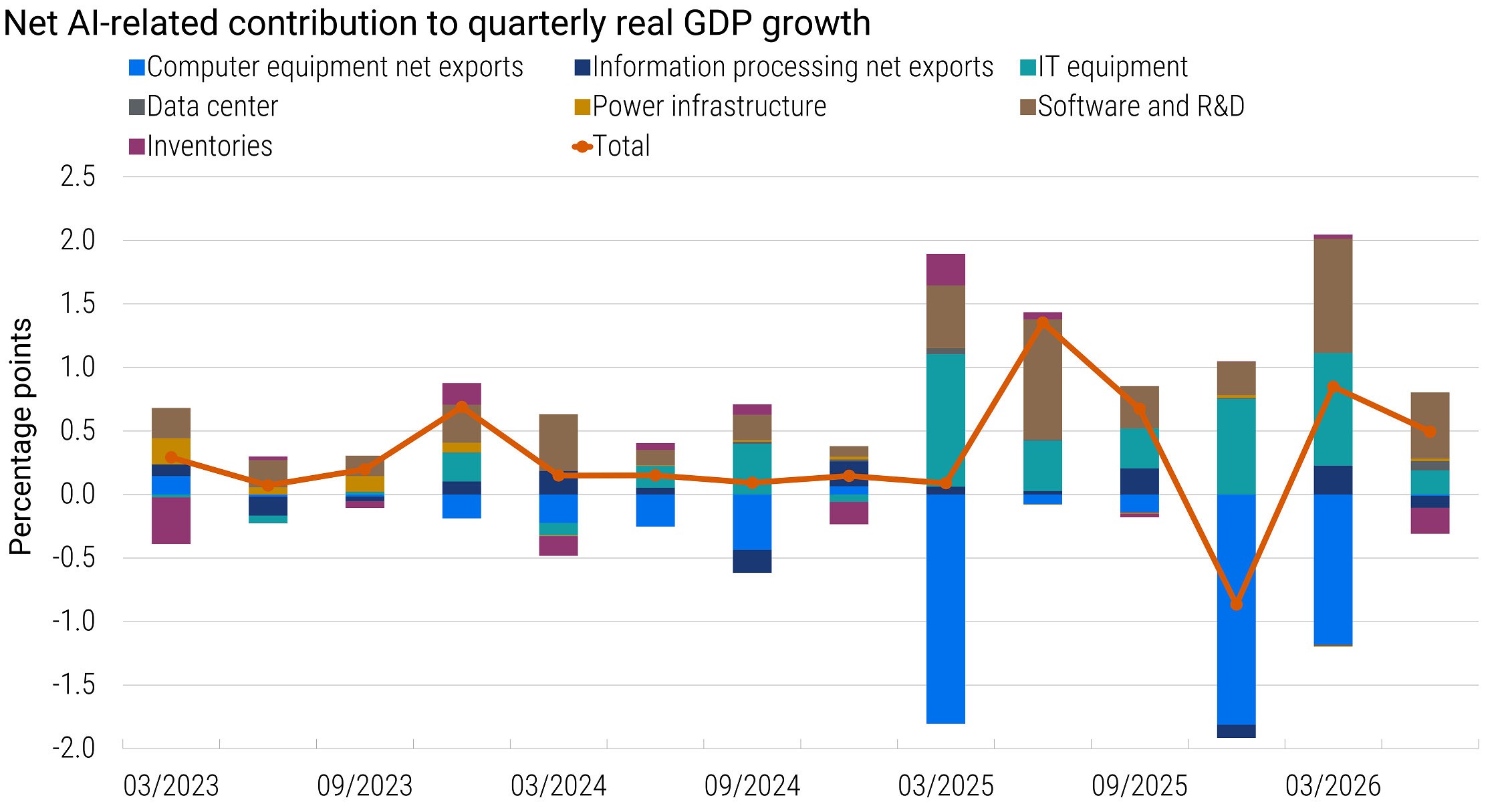
From these calculations, we estimate that AI-related investment has directly contributed only about 0.4 percentage point to annualized quarterly real U.S. GDP growth on average since the beginning of 2025, out of roughly 2% overall GDP growth over that period (see Figure 1) – a relatively minor amount.
Figure 1: AI’s contribution to real U.S. growth has fluctuated and is modestly net positive

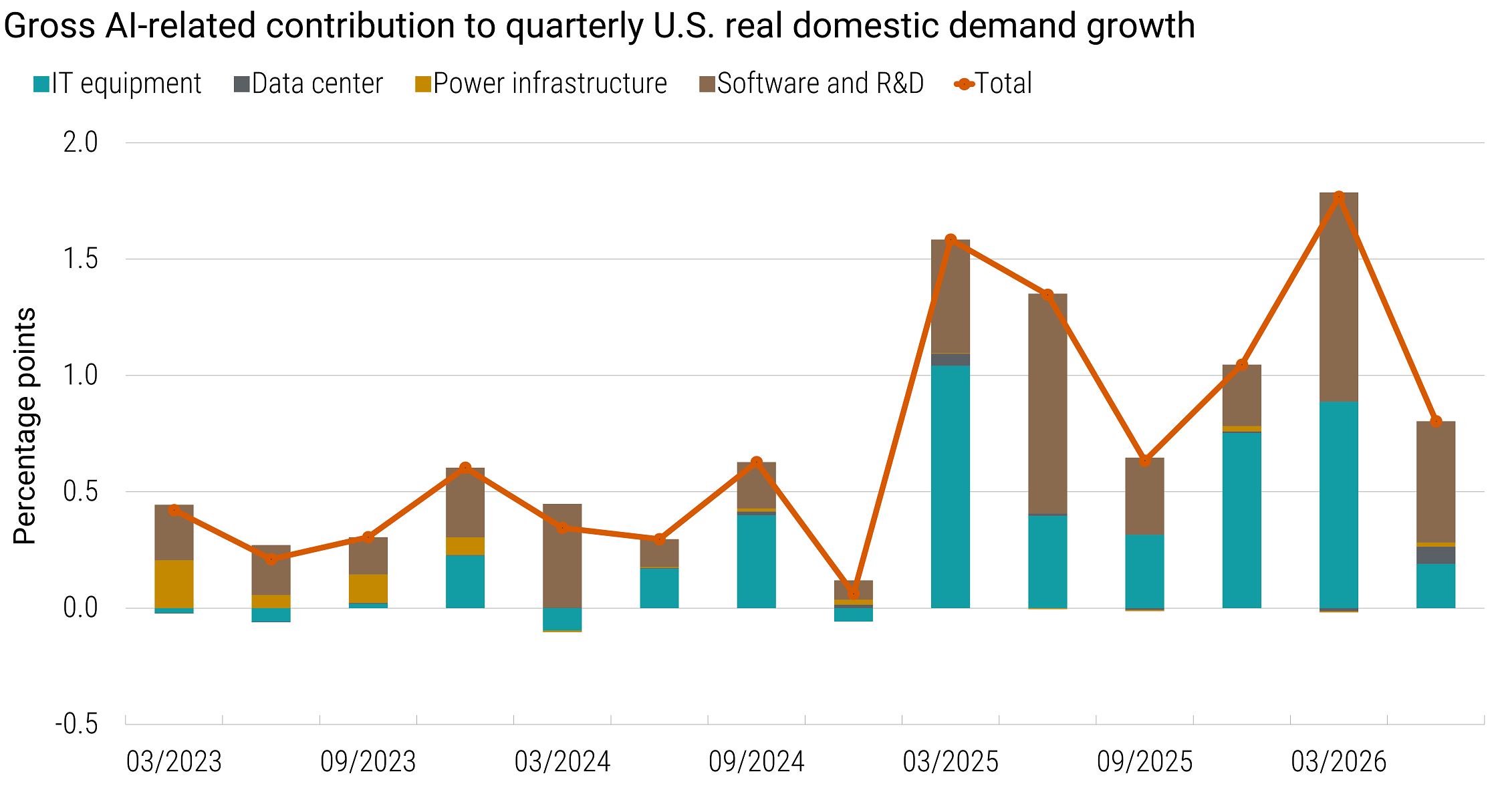
But that substantially understates the scale of the investment boom itself. We estimate AI-related investment has contributed roughly 1.2 percentage points to the 2.7% average annualized growth in U.S. domestic demand over the same period (see Figure 2). In other words, the boost to U.S. spending has been much larger than the boost to U.S. production because a significant share of that spending has been on imported goods.
Figure 2: AI has driven meaningful contributions to U.S. domestic demand

Direct investment is not the only channel through which the AI boom is supporting the U.S. economy. AI-related optimism also appears to be supporting growth through financial conditions. Expectations for higher future productivity and earnings have contributed to strong U.S. equity valuations, boosting household wealth and supporting consumption.
Using the Federal Reserve’s framework for estimating the growth impulse from financial conditions (see our 30 September 2026 Macro Signposts), we estimate that the equity wealth channel has provided roughly an additional 0.5–0.7 percentage point of support for growth – roughly 1x to 1.5x the growth impulse of the investment itself.
Taken together, these estimates suggest that AI-related forces have provided meaningful support to U.S. growth, even though the direct domestic investment effect is considerably smaller than the headline capex figures might imply.
America invests, Asia produces
Second, what leaks out of U.S. GDP through imports does not disappear from global GDP. The processors, servers, and networking equipment imported to construct U.S. data centers represent production and income somewhere else.
Robust U.S. demand (see Figure 3) has consequently provided a powerful impulse to economies embedded in the AI hardware supply chain. Our updated trade data show particularly large AI-related export exposures equivalent to roughly 30% of GDP for Taiwan and more than 15% for South Korea (see Figure 4), illustrating how large the technology cycle has become relative to the underlying economies. Mexico has also become an important part of the North American supply chain.
These measures capture gross export exposure relative to GDP, rather than the domestic value-added contribution of AI-related exports. Nevertheless, they illustrate the scale of the global supply chain exposure to the investment boom.
Figure 3: U.S. and other developed markets are importing AI-related components
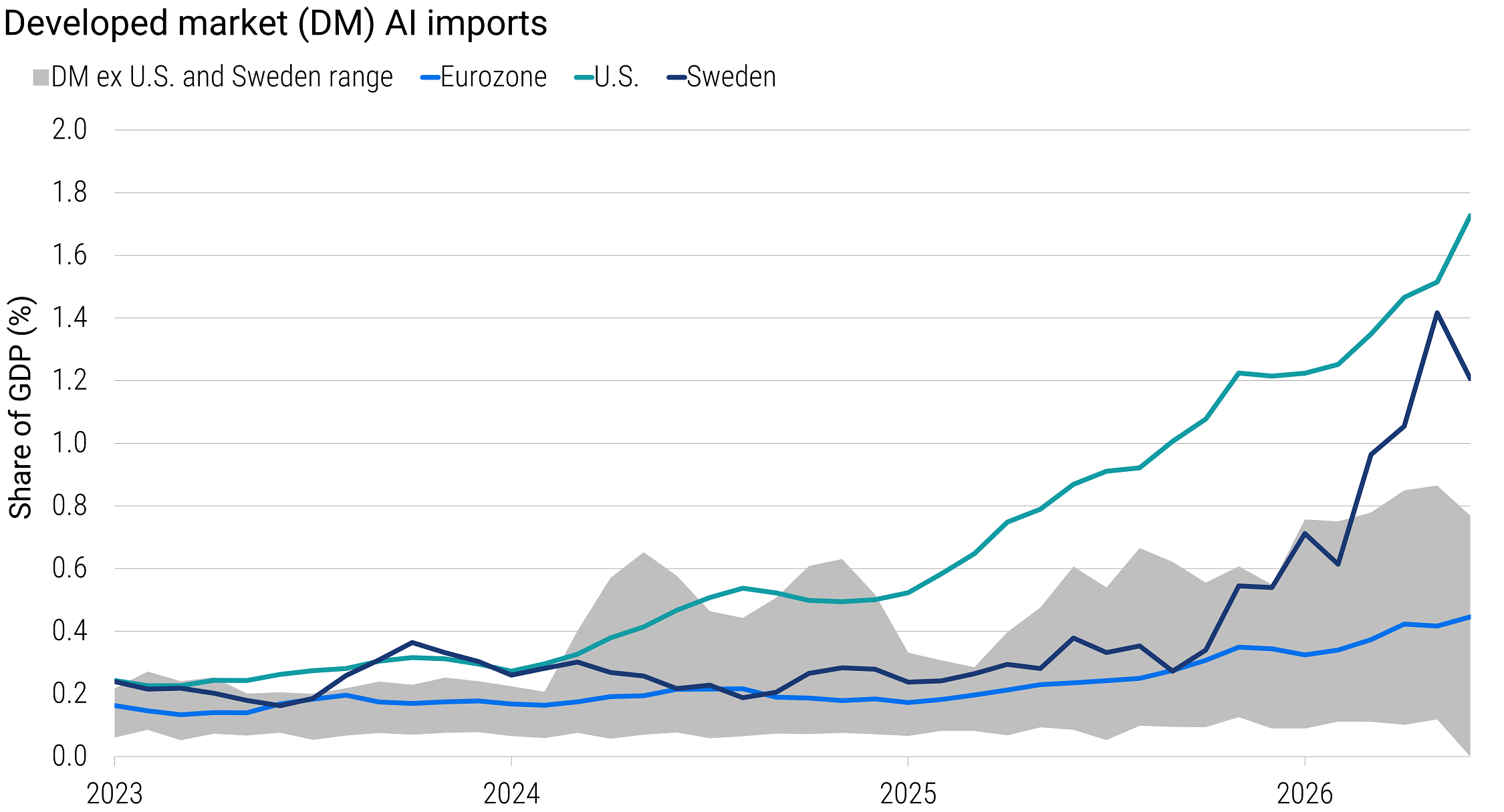

Figure 4: AI-related exports have become a meaningful share of key producers’ overall GDP
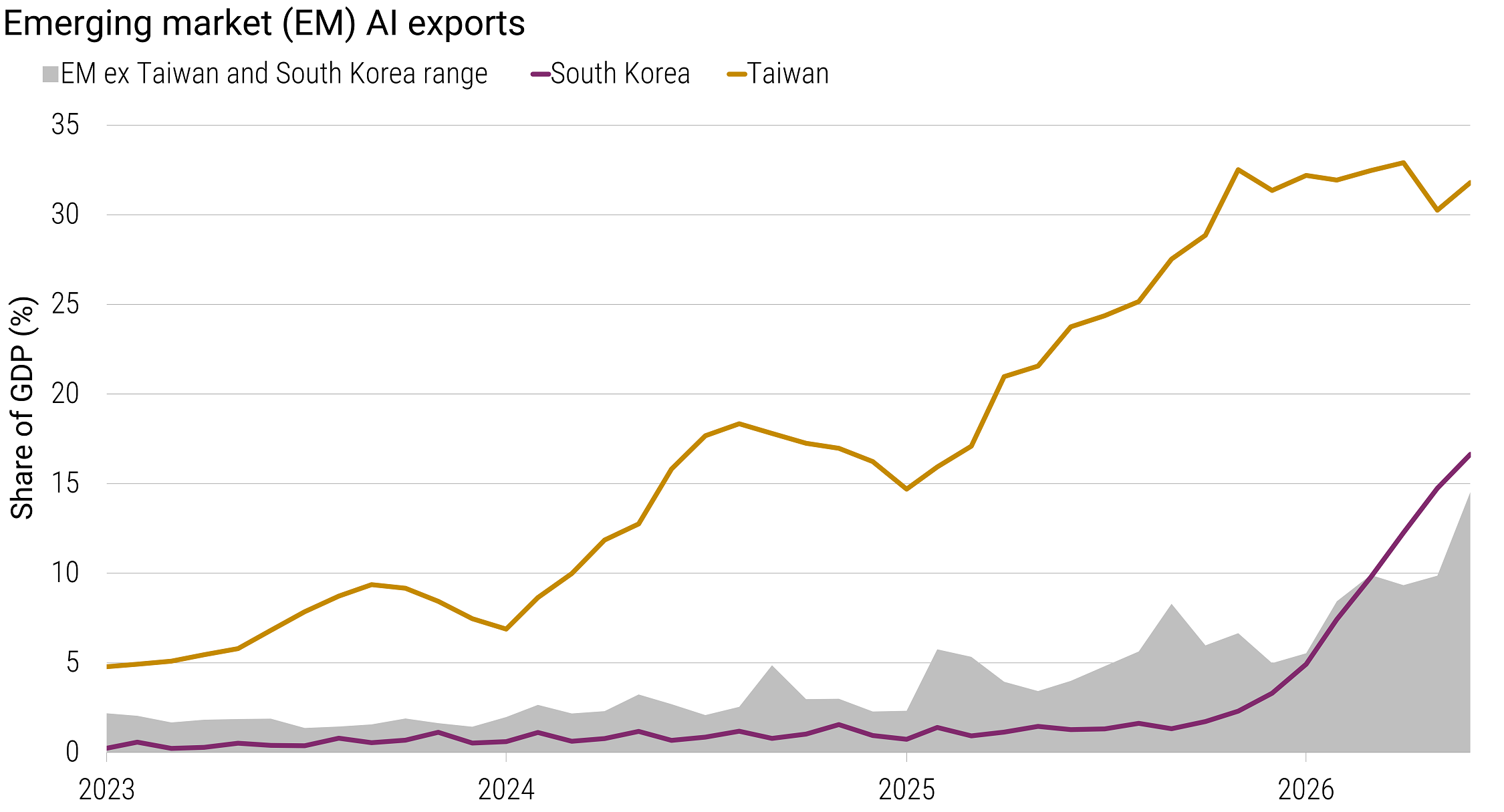

In other words, high import content limits the direct U.S. growth contribution from AI investment, but the U.S. simultaneously exports part of the investment impulse to the rest of the world. The U.S. capex boom is therefore increasingly supporting a much broader manufacturing and trade cycle, particularly across the Asian technology supply chain.
The investment cycle is broadening beyond the U.S.
Third and finally, the U.S. is no longer the only important source of AI infrastructure demand. China was also an early mover, and other parts of Asia and the Middle East are increasingly investing in computing capacity, data centers, and the supporting infrastructure needed to power them.Footnote1 As more economies seek to build domestic computing capacity, AI infrastructure investment is increasingly interacting with broader national priorities around technology security, energy availability, and supply chain resilience.
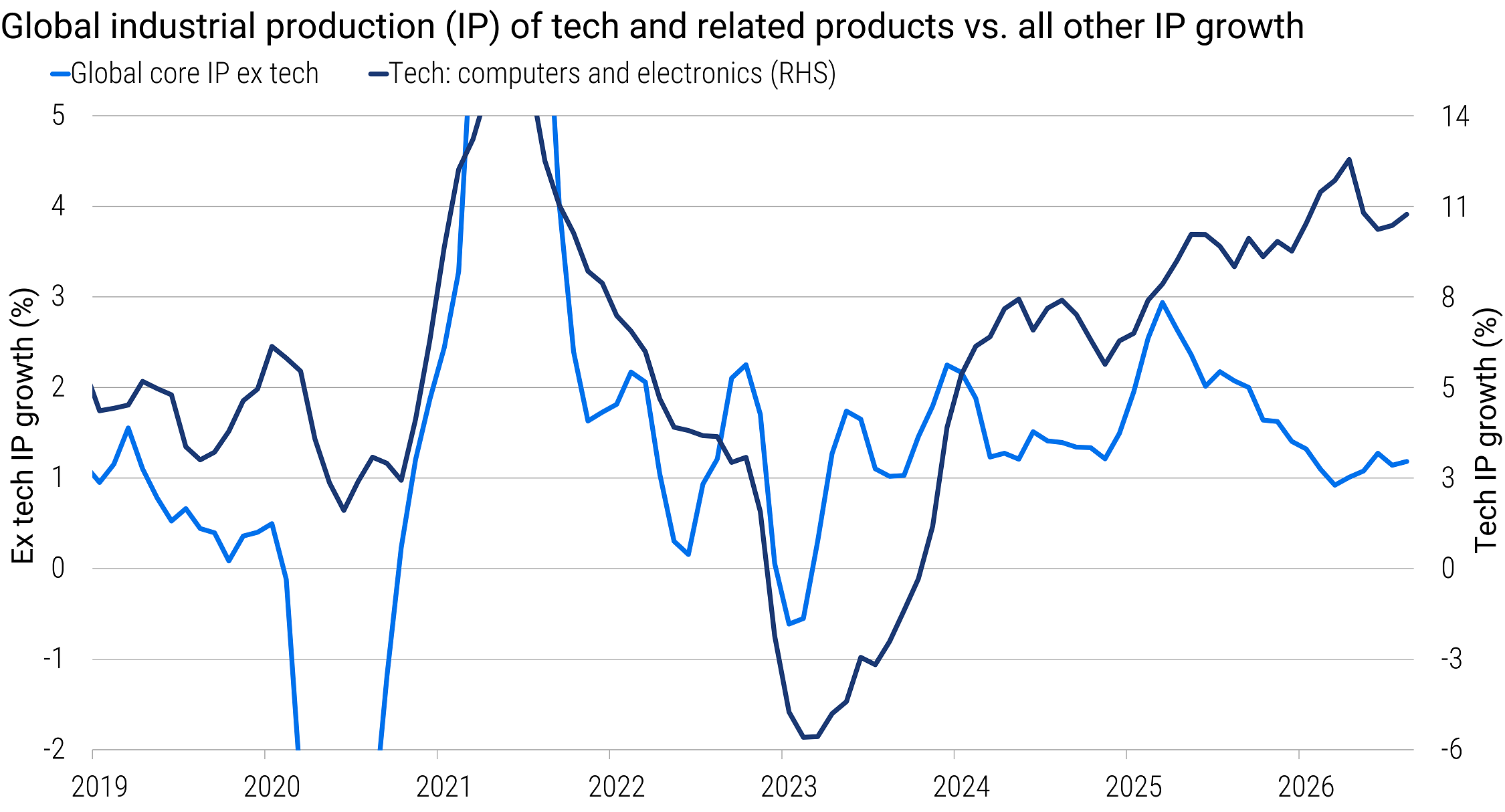
The result is that the global AI capex cycle has become an important driver of global industrial production and trade. Even against relatively muted aggregate global industrial production growth, production of computers, electronics, and related equipment has been exceptionally strong. In other words, it is producing a distinct global industrial cycle that is helping global production, while also increasing the number of economies that could be affected by an eventual slowdown.
Figure 5: Global industrial production of computers and electronics is on a multi-year upswing

Implications: A global growth engine, and a source of risk
AI was never simply a U.S. investment story. In the U.S., the direct contribution from investment is actually much smaller than the headline spending numbers suggest because so much of the equipment is imported. But the overall growth effect is larger once the equity wealth channel is included, and what subtracts from U.S. growth is added to global growth.
AI is therefore delivering several impulses at once: investment demand in the U.S. and other economies, manufacturing and exports across the global technology supply chain, and a financial conditions impulse through equity markets. Together, these forces have become an important source of support for the global expansion.
But that support also creates a new source of cyclical concentration. For the growth outlook, what matters is not simply the level of AI investment, but how long investment can continue to accelerate. The infrastructure buildout does not need to collapse for the growth impulse to diminish. It merely needs to slow. And when it does, it would have global implications – especially if the productivity gains aren’t being realized fast enough to be an offset.
Bottom line: The same forces that have made the global expansion more resilient have therefore also created a new source of cyclical concentration. AI is supporting U.S. demand, Asian production, and global investment simultaneously. That makes the boom a powerful global growth engine, but also one of the more important downside risks to the outlook if momentum fades.
Footnotes
1 François de Soyres, Alex Haag, Mike Liu, and Eva Van Leemput. “The Global Trade Effects of the AI Infrastructure Boom.” U.S. Federal Reserve FEDS Notes (13 February 2026).
A message from Advisor Perspectives and VettaFi: Discover something new! Click here to register for our upcoming webcasts.
Disclosures
Return to contentA word about risk: All investments contain risk and may lose value. Investments with exposure to the artificial intelligence sector may involve heightened risks, including rapid technological change, competitive disruption, elevated valuations, regulatory uncertainty, data privacy and cybersecurity concerns, infrastructure dependencies, and reliance on third-party models or platforms. AI-related opportunities may not develop as expected, fail to produce anticipated productivity or revenue benefits, or be concentrated among a limited number of issuers, and could result in increased volatility or loss of capital. Investing in the bond market is subject to risks, including market, interest rate, issuer, credit, inflation risk, and liquidity risk. The value of most bonds and bond strategies are impacted by changes in interest rates. Bonds and bond strategies with longer durations tend to be more sensitive and volatile than those with shorter durations; bond prices generally fall as interest rates rise, and low interest rate environments increase this risk. Reductions in bond counterparty capacity may contribute to decreased market liquidity and increased price volatility. Bond investments may be worth more or less than the original cost when redeemed. Equities may decline in value due to both real and perceived general market, economic and industry conditions. Sovereign securities are generally backed by the issuing government. Obligations of U.S. government agencies and authorities are supported by varying degrees, but are generally not backed by the full faith of the U.S. government. Portfolios that invest in such securities are not guaranteed and will fluctuate in value.
Statements concerning financial market trends or portfolio strategies are based on current market conditions, which will fluctuate. There is no guarantee that these investment strategies will work under all market conditions or are appropriate for all investors and each investor should evaluate their ability to invest for the long term, especially during periods of downturn in the market. Outlook and strategies are subject to change without notice.
PIMCO as a general matter provides services to qualified institutions, financial intermediaries and institutional investors. Individual investors should contact their own financial professional to determine the most appropriate investment options for their financial situation. This material contains the opinions of the manager and such opinions are subject to change without notice. This material has been distributed for informational purposes only and should not be considered as investment advice or a recommendation of any particular security, strategy or investment product. Information contained herein has been obtained from sources believed to be reliable, but not guaranteed. No part of this material may be reproduced in any form, or referred to in any other publication, without express written permission. PIMCO is a trademark of Allianz Asset Management of America LLC in the United States and throughout the world.
Pacific Investment Management Company LLC (“PIMCO”) is an investment adviser registered with the U.S. Securities and Exchange Commission (“SEC”). PIMCO Investments LLC (“PIMCO Investments”) is a broker-dealer registered with the SEC and member of the Financial Industry Regulatory Authority, Inc. (“FINRA”). PIMCO and PIMCO Investments is solely responsible for its content. PIMCO Investments is the distributor of PIMCO investment products, and any PIMCO Content relating to those investment products is the sole responsibility of PIMCO Investments.
The information provided herein is not directed at any investor or category of investors and is provided solely as general information about our products and services and to otherwise provide general investment education. No information contained herein should be regarded as a suggestion to engage in or refrain from any investment-related course of action as none of PIMCO nor any of its affiliates is undertaking to provide investment advice, act as an adviser to any plan or entity subject to the Employee Retirement Income Security Act of 1974, as amended, individual retirement account or individual retirement annuity, or give advice in a fiduciary capacity with respect to the materials presented herein. If you are an individual retirement investor, contact your financial advisor or other fiduciary unrelated to PIMCO about whether any given investment idea, strategy, product or service described herein may be appropriate for your circumstances.
© PIMCO
Membership required
Membership is now required to use this feature. To learn more:
View Membership Benefits