A Broader Foundation
The third quarter brought a mix of encouraging and cautionary signals. On the positive side, the economy kept growing, corporate earnings held up well, and the S&P 500 Index gained 2.03% for the quarter, bringing its year-to date return to 11.77%.1 At the same time, energy prices surged. The price of West Texas Intermediate (WTI) crude oil rose 29.26% during the quarter amid supply disruptions tied to the ongoing conflict involving Iran,1,2 keeping inflation elevated. In September, the Federal Reserve (Fed) raised the federal funds rate for the first time since 2023, lifting its target range to 3.75% to 4.00% and signaling that another increase may follow.3 Long-term interest rates moved higher as well, with the yield on the 10-year U.S. Treasury note ending the quarter at 5.29%.4 Rising rates weighed on the more rate-sensitive parts of the market. Small-cap stocks, which led in the first half of the year, gave background, with the Russell 2000 Index falling 7.52%.1 The result is a market with many moving parts. In this commentary, we look at three themes shaping our thinking: a shift in who is leading the market, the return of income as a meaningful source of return, and an economy that, in our view, is growing steadily rather than heading toward either extreme.
The Market Leadership Shift
For much of the past three years, the Magnificent Seven, a group of seven of the largest U.S. technology-oriented companies, accounted for an outsized share of stock market returns. That concentration began to ease in the first half of 2026, when U.S. small-cap stocks returned 22.93%, compared with 9.55% for large-cap stocks, their strongest first half on record relative to large caps.5 The strength was broad: all eleven small-cap sectors outperformed their large-cap counterparts over the period.5
The third quarter was a reminder that a broadening market rarely moves in a straight line. As interest rates climbed, the Russell 2000 Index fell 7.52%, while the S&P 500 gained 2.03% and the technology-heavy Nasdaq Composite Index gained 2.47%.1 Smaller companies tend to rely more on borrowing, which can make them more sensitive to rising rates. Year to date, the Russell 2000 is up 12.69%, slightly ahead of the S&P 500 at 11.77%, while the Nasdaq Composite, up 15.57%, shows that the largest technology companies remain a powerful force.1
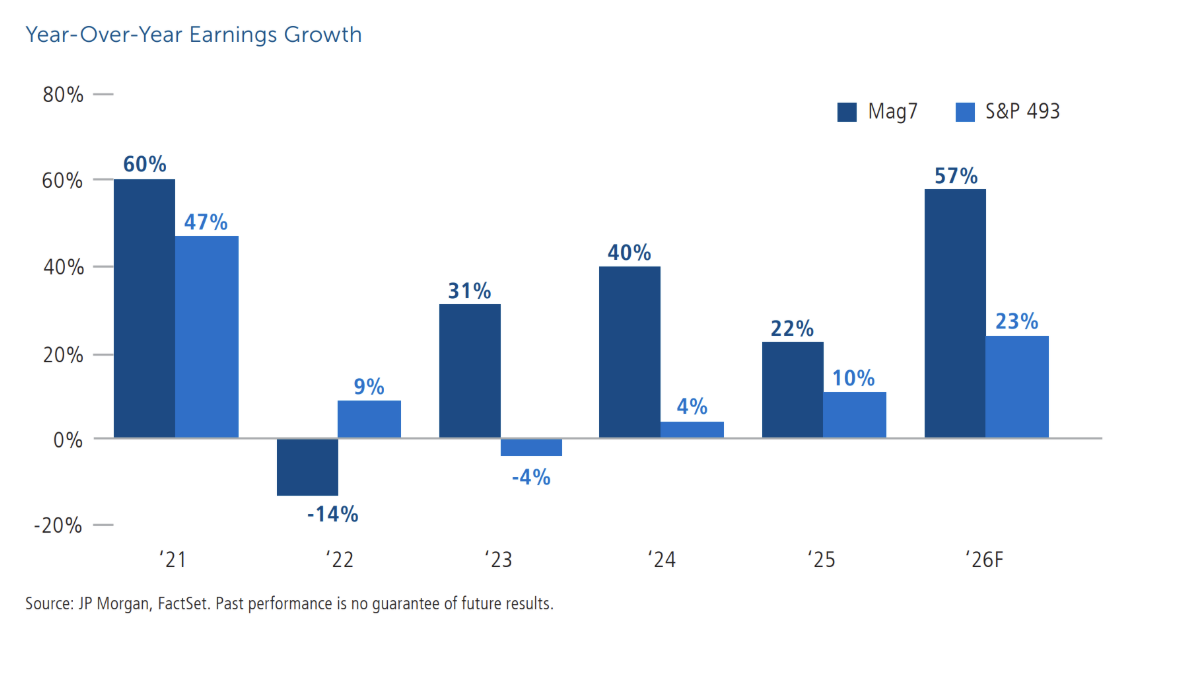
We believe that earnings suggest the broadening has further to run. Profits for the other 493 companies in the S&P 500 grew 31.8% in the second quarter, the fastest pace for that group since the fourth quarter of 2021, and analysts expect those companies to grow earnings faster than the Magnificent Seven in the fourth quarter of 2026 (26.8% versus 23.2%).6 In our view, the spread of profit growth, more than any single quarter’s price moves, is the more durable signal of where leadership is heading.
This does not mean the largest companies have stopped being strong businesses. It means the opportunity set is wider than it has been in some time, even if the path is uneven, and many investors have not adjusted. Some portfolios have become heavily tilted toward a few names, often simply because those names performed so well. For those portfolios, this may be a good time to review balance across company size, sector, and region with your advisor.
Income Matters Again
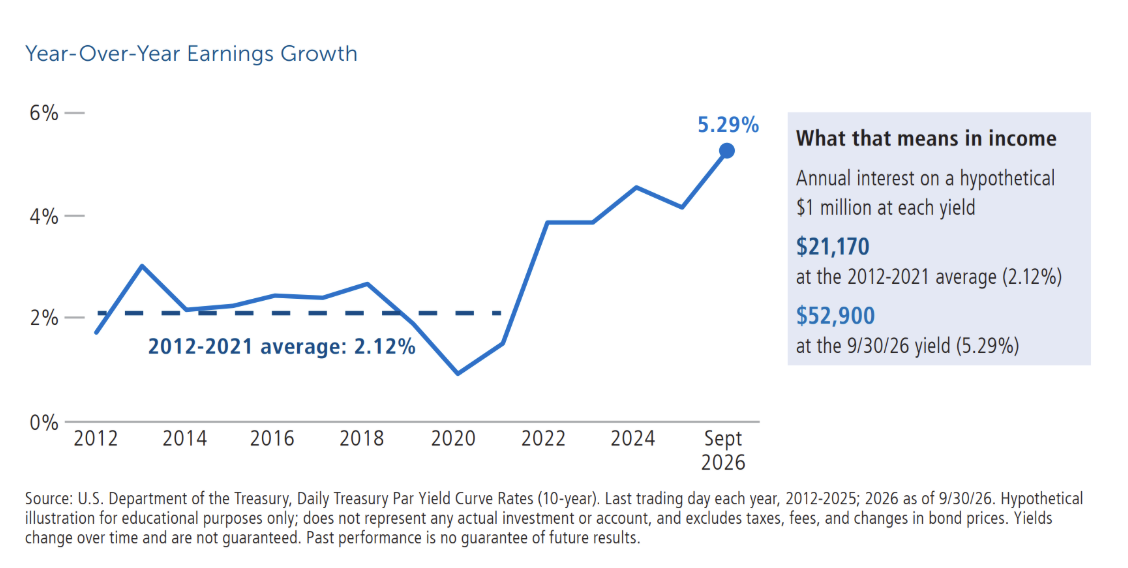
For more than a decade, bond yields were low enough that fixed income did little more than steady a portfolio. That has changed. The yield on the 10-year U.S. Treasury note ended the third quarter at 5.29%, up 0.85 percentage point from the end of June and roughly two and a half times its 2012 to 2021 year-end average of 2.12%.4
The idea is simple. When you buy a high-quality bond, its starting yield offers a useful reference point for what it may earn if held to maturity, assuming the issuer meets its obligations. Higher starting yields can provide more income, though returns are not guaranteed and bond prices will fluctuate.
Higher rates cut both ways, and we want to be clear about that. The sharp rise in yields this quarter weighed on the prices of existing bonds, particularly those most sensitive to changes in interest rates, and the Fed’s signal that another increase may follow keeps that risk in view. That is why we are being deliberate about the mix of shorter- and longer-term bonds rather than reaching for the highest available yield.
The same dynamic extends to private markets. Private credit, which consists of loans made directly to companies, often carries floating rates, meaning the income it pays can adjust as interest rates change. Higher rates also raise borrowing costs for those companies, which makes careful lending standards and manager selection more important, not less. Rental income continues to be a primary source of return in private real estate. Higher financing costs have reset valuations in ways that, in our view, may create more attractive entry points over time.
See more: Q3 Strategic Income Outlook: The Times They are a Changin’
Income with Discipline
It is our view that higher yields are an opportunity, but not every source of income carries the same risk. We focus on the quality of the borrower, the strength of the lending terms, and the track record of the manager. Private market investments involve significant risks, including illiquidity, potential loss of principal, and limited transparency. They are generally available only to investors who meet certain eligibility requirements and are not suitable for every investor.
Growth, Not Boom or Bust
The economy continues to show resilience. In September, Fed officials lowered their median projection for the unemployment rate to 4.1%.7 In our view, business investment, particularly in artificial intelligence (AI) and the infrastructure that supports it, remains a meaningful source of economic activity. Consumers are still spending, but energy costs are a growing strain on household budgets: WTI crude oil is up 57.59% so far this year.1
There are signals worth respecting. Inflation remains above the Fed’s 2% target, and long-term interest rates have climbed well above where they started the year, with the 10-year Treasury yield rising from 4.18% at the end of 2025 to 5.29% at the end of September.4 That raises borrowing costs for businesses and households and could slow activity over time. We take those signals seriously. Taken together, however, we believe the evidence points to an economy expanding at a moderate pace rather than one that is overheating or about to stall.
That distinction matters for portfolios. We believe a boom narrative encourages investors to chase whatever is rising fastest. We also believe a bust narrative encourages them to step aside entirely. A steadily growing economy rewards something in between: staying invested, being selective about where to take risk, and holding a mix of assets that do not all depend on the same outcome.
Portfolio Considerations and What We Are Watching for the Rest of the Year
Our positioning reflects all three themes. In equities, we remain invested and continue to favor broad diversification across company size, sector, and geography. In our view, the third-quarter pullback in small caps reflects rising interest rates more than a change in the broader earnings trend, and we are paying particular attention to portfolios that have become concentrated after several years of narrow leadership. This concentration is a key reason that we incorporate private markets into client portfolios. In fixed income, we see opportunity in adding high-quality bonds at today’s higher yields while managing sensitivity to further rate increases. For eligible clients, private credit, private equity, and private real estate continue to play a role as potential sources of income, diversification, and long-term growth, with manager selection a vital component in our analysis.
Looking toward year end, we are watching several things closely. The Fed’s Federal Open Market Committee (FOMC) meets again October 27 and 28,8 and its next decision will shape both bond yields and borrowing costs. Energy prices, which rose sharply this quarter, remain closely tied to developments in the Middle East. Third quarter earnings season will help show whether profit growth continues to broaden. The November midterm elections may bring short-term volatility; in our view, long-term market performance has been driven more by economic and earnings fundamentals than by election results.
Year end is also a natural time to review tax planning, rebalancing, and charitable giving alongside your investment plan. Your Calamos Wealth Management advisor can work with you and your tax professional on these conversations.
As always, please reach out to your advisor with any questions about your portfolio or the markets.
Sources and References
Sources
- [Confirm data source, e.g., Bloomberg, and whether figures are price or total returns.] Index and commodity returns for 7/1/26 to 9/30/26 (quarter) and 1/1/26 to 9/30/26 (year to date).
- J.P. Morgan Wealth Management, “Will the Fed Hike Rates in September? A 25-Basis-Point Move Is Now Expected,” August 5, 2026.
- Board of Governors of the Federal Reserve System, FOMC Statement, September 16, 2026.
- U.S. Department of the Treasury, Daily Treasury Par Yield Curve Rates, 10-year yields as of December 31, 2025, June 30, 2026, and September 30, 2026. The 2012 to 2021 average is the average of 10-year yields on the last trading day of each year.
- State Street Investment Management, “Small caps’ rally may be more durable than investors think,” July 17, 2026, citing Bloomberg Finance L.P. Returns for 1/1/26 to 6/30/26; small caps represented by the S&P SmallCap 600 Index and large caps by the S&P 500 Index. ETF flows are net inflows into U.S. small-cap and U.S. large-cap ETFs over the same period.
- FactSet, “‘Mag 7’ Companies Reported Earnings Growth Above 100% Boosted by Investment Gains,” August 28, 2026. Second-quarter growth reflects blended actual and estimated results; fourth-quarter figures are analyst estimates and are subject to change.
- Board of Governors of the Federal Reserve System, Summary of Economic Projections, September 16, 2026.
- Board of Governors of the Federal Reserve System, FOMC Meeting Calendar, 2026.
Glossary Terms
Exchange-traded fund (ETF): An investment fund that holds a basket of securities and trades on a stock exchange like an individual stock.
Federal funds rate: The interest rate at which banks lend to one another overnight. The Fed sets a target range for this rate as its primary tool for influencing borrowing costs across the economy.
Federal Open Market Committee (FOMC): The Federal Reserve committee responsible for setting U.S. monetary policy, including the target range for the federal funds rate.
Floating rate: An interest rate that adjusts periodically based on a benchmark rate, rather than remaining fixed for the life of a loan or bond.
High-quality bond: A bond issued by a government or company judged to have a strong ability to repay, typically rated investment grade by one or more credit rating agencies.
Large-cap, small-cap, and mega-cap stocks: Categories of companies based on market capitalization, the total value of a company’s outstanding shares. Large-cap generally refers to companies valued above roughly $10 billion, small-cap to companies valued between roughly $300 million and $2 billion, and megacap to the very largest companies in the market. Thresholds vary by index provider.
Magnificent Seven: A group of seven of the largest U.S. technology-oriented companies by market value, commonly referenced together by investors and the financial media. The remaining companies in the S&P 500 are often referred to as “the other 493.”
Maturity: The date on which a bond’s principal is scheduled to be repaid to the investor.
Private credit: Loans made directly to companies by non-bank lenders, rather than through public bond markets.
Private equity: Investments in companies that are not publicly traded, typically made through funds that seek to grow the value of those companies over several years.
Private real estate: Ownership interests in real estate held through private funds or vehicles rather than publicly traded securities.
Summary of Economic Projections: A quarterly release in which Fed officials share their individual forecasts for economic growth, unemployment, inflation, and the federal funds rate.
Treasury note (10-year): Debt issued by the U.S. government that matures in ten years. The 10-year yield is a widely followed benchmark for long-term borrowing costs.
West Texas Intermediate (WTI) crude oil: A grade of crude oil produced in the United States whose price is widely used as a benchmark for U.S. oil prices.
Yield: The income a bond pays, expressed as an annual percentage of its price.
Index Definitions
S&P 500 Index: A market-capitalization-weighted index of 500 leading U.S. publicly traded companies, widely regarded as a gauge of U.S. large-cap stocks.
Nasdaq Composite Index: A market-capitalization-weighted index of the common stocks listed on the Nasdaq stock exchange, with a heavy weighting toward technology companies.
S&P SmallCap 600 Index: An index of 600 small-cap U.S. companies selected to meet specific standards for size, liquidity, and profitability, widely used as a benchmark for U.S. small-cap stocks.
Russell 2000 Index: An index measuring the performance of approximately 2,000 of the smallest companies in the Russell 3000 Index, widely used as a benchmark for U.S. small-cap stocks. Indexes are unmanaged, do not reflect fees or expenses, and are not available for direct investment.
Important Disclosures
This material is distributed for informational purposes only and does not constitute investment, tax, or legal advice, or a recommendation to buy or sell any security. Opinions, estimates, and forecasts reflect our judgment as of the date of publication and are subject to change without notice. The views and strategies described may not be suitable for all investors. This commentary contains forward-looking statements that reflect our current views and are subject to change; actual results may differ materially. © 2026 Calamos Wealth Management. All Rights Reserved. Calamos® and Calamos Investments® are registered trademarks of Calamos Investments LLC. CWM 822445 1026 Past performance is no guarantee of future results. All investing involves risk, including the possible loss of principal. Diversification and asset allocation do not ensure a profit or protect against loss. Hypothetical illustrations are for educational purposes only, do not represent any actual investment or account, and do not reflect taxes, fees, or changes in bond prices. Fixed income investments are subject to interest rate risk (bond prices generally fall as interest rates rise), credit and default risk, and reinvestment risk. Smallcap stocks may be more volatile and less liquid than large-cap stocks. International and emerging market investments involve additional risks, including currency fluctuation and political and economic instability. Private market investments, including private credit, private equity, and private real estate, involve significant risks, including illiquidity, limited transparency, valuation uncertainty, use of leverage, higher fees, and potential loss of principal. These investments are generally available only to investors who meet specific eligibility requirements and are not suitable for all investors. Calamos Wealth Management does not provide tax or legal advice. Please consult your tax or legal professional regarding your specific situation. Information obtained from third-party sources is believed to be reliable but is not guaranteed.
Disclosures
This material has been prepared by Calamos Wealth Management, LLC (“Calamos”) for informational and educational purposes only. It does not constitute investment advice and should not be relied upon as the basis for any investment decision. Investing involves risk, including the possible loss of principal. Past performance is not indicative of future results. Different types of investments involve varying degrees of risk, and there can be no assurance that the future performance of any specific investment, investment strategy, or product (including the investments and/or investment strategies recommended or undertaken by Calamos Wealth Management, LLC [“Calamos]), or any non-investment related content, made reference to directly or indirectly in this commentary will be profitable, equal any corresponding indicated historical performance level(s), be suitable for your portfolio or individual situation, or prove successful. Due to various factors, including changing market conditions and/or applicable laws, the content may no longer be reflective of current opinions or positions. Moreover, you should not assume that any discussion or information contained in this commentary serves as the receipt of, or as a substitute for, personalized investment advice from Calamos. Private Alternative investments may not be suitable for all investors. Private investment funds generally involve various risk factors, including potential for complete loss of principal, liquidity constraints, and lack of transparency. Unlike liquid investments, private investment funds do not provide daily liquidity or pricing. Each prospective investor will be required to complete a Subscription Agreement confirming qualification and acknowledging the associated risk factors. The views and strategies described herein reflect the views of Jon Adams, CFA® as Chief Investment Officer of Calamos Wealth Management as of July 2026 and are subject to change without notice. Nothing in this material should be construed as a guarantee of future results. Data sources: Bloomberg / U.S. Energy Information Administration (market returns, yield data, oil prices, inflation breakevens); FactSet Research Systems (earnings estimates, revenue growth, profit margin data, P/E ratios, EPS guidance statistics; FactSet Earnings Insight as of July 2, 2026); U.S. Bureau of Labor Statistics (CPI, May and June 2026); Bureau of Economic Analysis (Core PCE, May 2026); Federal Reserve (FOMC June 2026 Summary of Economic Projections); University of Michigan Survey of Consumers. All return data as of June 30, 2026 unless otherwise noted. Forward-looking statements are based on current expectations and are subject to change. Calamos Wealth Management, LLC is an investment adviser registered with the Securities and Exchange Commission. © 2026 Calamos Investments LLC. All Rights Reserved. Calamos® and Calamos Investments® are registered trademarks of Calamos Investments LLC.
A message from Advisor Perspectives and VettaFi: Discover something new! Click here to register for our upcoming webcasts.
© Calamos Investments
More Artificial Intelligence Topics >