Key Takeaways
-
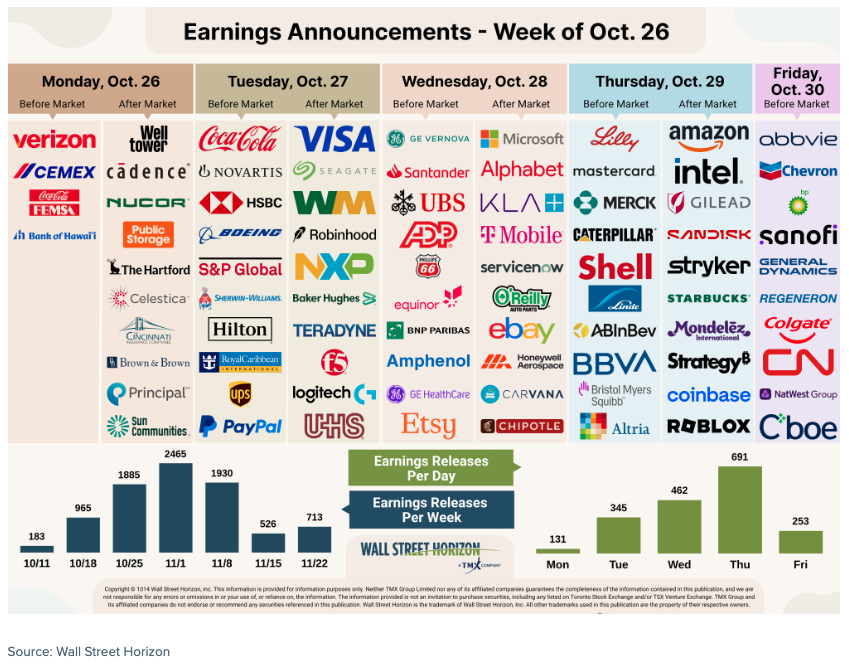
This marks the first peak week of Q3 earnings season, with 1,885 companies expected to report and overall S&P 500 EPS growth holding at a robust 29.5%
-
Meta’s AI capex-driven selloff set a new bar for hyperscalers — investors are no longer giving tech giants a blank check for AI infrastructure spend as Microsoft, Alphabet, and Amazon report this week, with Apple following next Monday
-
Seven S&P 500 companies confirmed outlier earnings dates this week, with Baker Hughes, Freeport-McMoRan, Avery Dennison, and General Dynamics reporting later than their historical norm
This marks the first peak week of Q3 earnings season, with 1,885 companies out of our universe of 11,000 global equities anticipated to release results. The season is off to a spotty start with some mixed results from banks, and META’s AI Capex surprise last week. However, even with those results, overall S&P 500 EPS growth remains high at 29.5% for Q3 according to FactSet, and the broad majority of names that have reported thus far have beaten profit (83%) and revenue (66%) expectations.1
See more: Five Key Questions for Third-Quarter Earnings Season
All eyes will turn to the remaining hyperscalers this week, and Meta’s results provided a clear playbook for what Wall Street demands. Investors are no longer giving tech giants a blank check for AI infrastructure. Meta proved that runaway capex, even paired with double-digit revenue growth, triggers immediate margin anxiety if free cash flow shrinks. As Microsoft, Alphabet, and Amazon report, the critical test will be whether cloud revenue growth accelerates enough to justify their surging capital budgets. Apple, who reports next Monday, November 2, will face similar scrutiny on whether its consumer AI strategy can catalyze hardware upgrades to offset the broader macro backdrop.
Outlier Earnings Dates This Week
Academic research shows that when a company confirms a quarterly earnings date that is later than when they have historically reported, it’s typically a sign that the company will share bad news on their upcoming call, while moving a release date earlier suggests the opposite.2
This week we get results from a number of large companies on major indexes that have pushed their Q3 2026 earnings dates outside of their historical norms. Seven companies within the S&P 500 confirmed outlier earnings dates for this week. Four of those companies, Baker Hughes (BKR), Freeport-McMoRan (FCX), Avery Dennison (AVY) and General Dynamics (GD) are later than usual and therefore have negative DateBreaks Factors*. On the other hand, Public Storage (PSA), Gen Digital (GEN) and Alliant Energy (LNT) all have positive DateBreaks Factor for this week.
* Wall Street Horizon DateBreaks Factor: statistical measurement of how an earnings date (confirmed or revised) compares to the reporting company’s 5-year trend for the same quarter. Negative means the earnings date is confirmed to be later than historical average while Positive is earlier.
Q3 2026 Earnings Wave
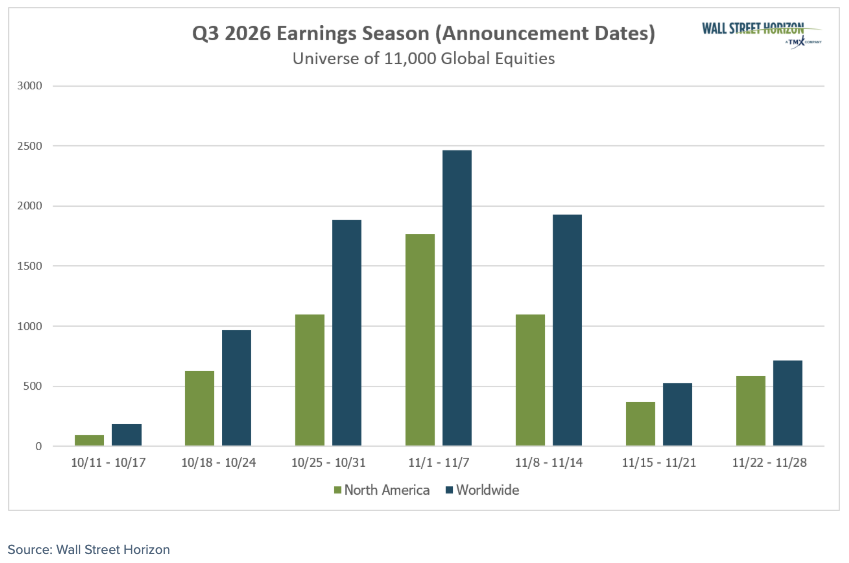
The peak weeks of the Q3 earnings season are expected to fall between October 26 - November 13, with each week expected to see over 1,800 reports. Currently, November 5 is predicted to be the most active day with 1,148 companies anticipated to report. Thus far, 70% of companies have confirmed their earnings date, and 10% have reported (out of our universe of 11,000+ global names). The remaining dates are estimated based on historical reporting data.
1 FactSet Earnings Insight, John Butters, October 23, 2026, https://advantage.factset.com
2 Time Will Tell: Information in the Timing of Scheduled Earnings News, Journal of Financial and Quantitative Analysis, Eric C. So, Travis L. Johnson, Dec, 2018, https://papers.ssrn.com
Copyright © 2026 Wall Street Horizon, Inc. All rights reserved. Do not copy, distribute, sell or modify this document without Wall Street Horizon's prior written consent. This information is provided for information purposes only. Neither TMX Group Limited nor any of its affiliated companies guarantees the completeness of the information contained in this publication, and we are not responsible for any errors or omissions in or your use of, or reliance on, the information. This publication is not intended to provide legal, accounting, tax, investment, financial or other advice and should not be relied upon for such advice. The information provided is not an invitation to purchase securities, including any listed on Toronto Stock Exchange and/or TSX Venture Exchange. TMX Group and its affiliated companies do not endorse or recommend any securities referenced in this publication. This publication shall not constitute an offer to sell or the solicitation of an offer to buy, nor may there be any sale of any securities in any state or jurisdiction in which such offer, solicitation or sale would be unlawful prior to registration or qualification under the securities laws of any such state or jurisdiction. TMX, the TMX design, TMX Group, Toronto Stock Exchange, TSX, and TSX Venture Exchange are the trademarks of TSX Inc. and are used under license. Wall Street Horizon is the trademark of Wall Street Horizon, Inc. All other trademarks used in this publication are the property of their respective owners.
A message from Advisor Perspectives and VettaFi: Discover something new! Click here to register for our upcoming webcasts.
© Wall Street Horizon
Read more commentaries by Wall Street Horizon