Key takeaways
-
Companies in the Nasdaq-100® Index consistently dedicate a higher share of revenue to research and development (R&D) than the broader market, underscoring their commitment to long-term growth.
-
Nvidia, Amazon, and Microsoft exemplify how large, sustained R&D and capital investments can drive innovation in transformative areas like AI and cloud computing.
-
While R&D can weigh on near-term earnings, a culture of innovation often lays the groundwork for products and services that fuel future profitability.
Investments are made for the long term. Wouldn’t it be nice to know that the companies you invest in have the same focus on the future? Innovation can fuel a company’s growth, but it doesn’t happen overnight. Rather, it is the result of a disciplined approach to investing in and executing strategic plans.
Innovation takes time—very often years—and can be expensive. For example, it wasn’t so long ago that Nvidia was considered to be just a gaming company. Today, it is one of the largest companies in the world with a dominant position in hardware and software tools powering the artificial intelligence (AI) revolution. Nvidia’s explosive growth has been fueled, in part, by the company’s investment in its own future.
One way to measure a company’s dedication to innovation is to look at its investment in R&D. Nvidia spent $13.38 billion on R&D for the six months ended July 2026, up 61.5% from the year-ago period.1
“AI has reached its inflection point. It’s doing useful work,” said Jensen Huang, founder and CEO of Nvidia. “The AI infrastructure buildout is at full steam.”2
Nvidia’s R&D spending is a reminder that complacency is a risk even for industry leaders, especially in the rapidly changing world of AI. Staying on top typically requires investing in the future to fend off competitors hungry to cut into market share. The proof is in the pudding: In its fiscal quarter ended July 2026, Nvidia reported a 106% year-over-year increase in revenue, remarkable growth for one of the market’s largest companies.2
Amazon is another tech leader known for investing heavily in its future. The company expects to invest about $200 billion in capital expenditures in 2026, with most of it going to its cloud computing unit, Amazon Web Services (AWS), to help meet demand for AI and other workloads.3
“We’re not investing approximately $200 billion in capital expenditures in 2026 on a hunch,” CEO Andy Jassy wrote in his 2025 letter to shareholders.4
Finally, Microsoft is another leader investing deeply in AI and cloud innovation. In its 2026 fiscal year, Microsoft spent $35.6 billion on R&D, up from $32.5 billion the year before, to drive advances in Azure AI, Copilot, and cloud infrastructure.5
“This year, Azure revenue surpassed $100 billion for the first time, and Microsoft 365 Copilot reached over 30 million paid seats,” said Satya Nadella, chairman and CEO of Microsoft.6
AI and large language models require massive capital expenditures because they depend on vast computing infrastructure—specialized chips, energy-intensive data centers, and high-bandwidth networks—that must scale quickly to train and run increasingly complex models.
See more: Your Clients Don’t Want a Market Update. They Want to Know You.
A focus on R&D
Ironically in today’s world, one way to increase profitability has been to cut R&D investments. For accounting purposes, R&D can be a drag on earnings in the year the investment is made, but for many companies this commitment to development offers the potential for higher sales and profitability down the road.
Scrimping on R&D may be penny-wise and pound-foolish. In other words, spending on R&D and creating a culture of innovation can be a long-term commitment that usually doesn’t yield immediate results.
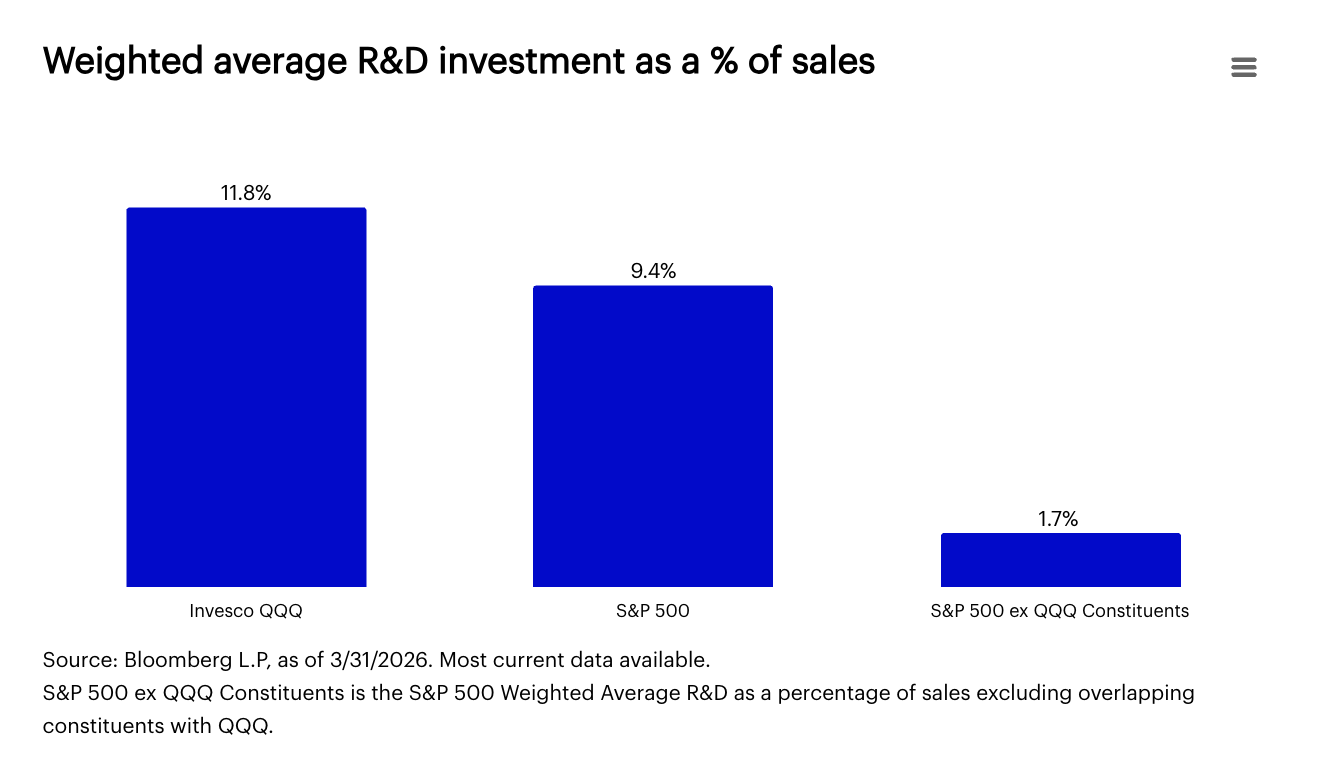
Invesco QQQ tracks the Nasdaq-100® Index. On average, companies within it have devoted 11.8% of sales to R&D, compared with 9.4% for companies in the S&P 500® Index and 1.7% for S&P 500 companies outside QQQ.7 This investment highlights their steadfast commitment to innovation and long-term growth.
In fact, 66 companies in the Nasdaq-100 (representing 85% of index weight) recently filed patents across one or more of 35 key areas of Disruptive Technology.8 In natural language processing (NLP), the AI technology behind chatbots and large language models, 17 Nasdaq-100 companies filed at least one patent over the 12-month study period, and Alphabet, Broadcom, and Meta together accounted for 20% of all NLP patent activity.8
A culture of innovation
We believe most companies held within QQQ have established a culture of innovation, and that their commitment to R&D has led to considerable exposure to a number of growing, transformative themes.
Some of these themes and technologies might contribute to a company’s bottom line today, while others may be future drivers of earnings growth 5, 10, or even 20 years down the road.
No matter how much the market environment changes, the desire and need to innovate remains constant. We think companies will continue to lay the groundwork for better products and new services as innovation continues to push us into the future.
Footnotes
NVIDIA Corporation, Form 10-Q for the quarter ended July 26, 2026, filed August 26, 2026.
“NVIDIA Announces Financial Results for Second Quarter Fiscal 2027,” Nvidia.com, August 26, 2026.
“Amazon Q4 Earnings: Jassy Defends Spending Spree, Denies ‘Quixotic Top-Line Grab,’” CRN, February 5, 2026.
“2025 Letter to Shareholders,” Amazon.com, April 2026.
Microsoft Corporation, Form 10-K for the fiscal year ended June 30, 2026, filed July 29, 2026.
“Microsoft Cloud and AI strength fuels fourth quarter results,” Microsoft, July 29, 2026.
Nasdaq, FactSet. Data as of March 31, 2026.
Nasdaq. Patent data as of February 27, 2026. Index data as of March 31, 2026. Most current data available.
Important information
NA6043607
Definitions:
Capital expenditure is the money a company spends to buy, build, or upgrade long-term physical or intangible assets.
An SEC Form 10-Q is a mandatory comprehensive quarterly report that publicly traded companies must file with the U.S. Securities and Exchange Commission (SEC). The 10-Q provides crucial transparency for tracking short-term financial trends and comparisons.
Form 10-K is a comprehensive annual report that publicly traded companies must file with the U.S. SEC.
The opinions expressed are those of the authors, are based on current market conditions and are subject to change without notice. These opinions may differ from those of other Invesco investment professionals.
Forward-looking statements are not guarantees of future results. They involve risks, uncertainties, and assumptions; there can be no assurance that actual results will not differ materially from expectations.
There are risks involved with investing in ETFs, including possible loss of money. Shares are not actively managed and are subject to risks similar to those of stocks, including those regarding short selling and margin maintenance requirements. Ordinary brokerage commissions apply. The Fund's return may not match the return of the Underlying Index. The Fund is subject to certain other risks. Please see the current prospectus for more information regarding the risk associated with an investment in the Fund.
Investments focused in a particular sector, such as technology, are subject to greater risk, and are more greatly impacted by market volatility, than more diversified investments.
The Fund is non-diversified and may experience greater volatility than a more diversified investment.
The risks of investing in securities of foreign issuers can include fluctuations in foreign currencies, political and economic instability, and foreign taxation issues.
QQQ Top 10 Holdings. Holdings are subject to change and are not buy/sell recommendations.
The Nasdaq-100® Index comprises the 100 largest non-financial companies traded on the Nasdaq. An investor cannot invest directly in an index.
A message from Advisor Perspectives and VettaFi: Discover something new! Click here to register for our upcoming webcasts.
More Innovative ETFs Topics >