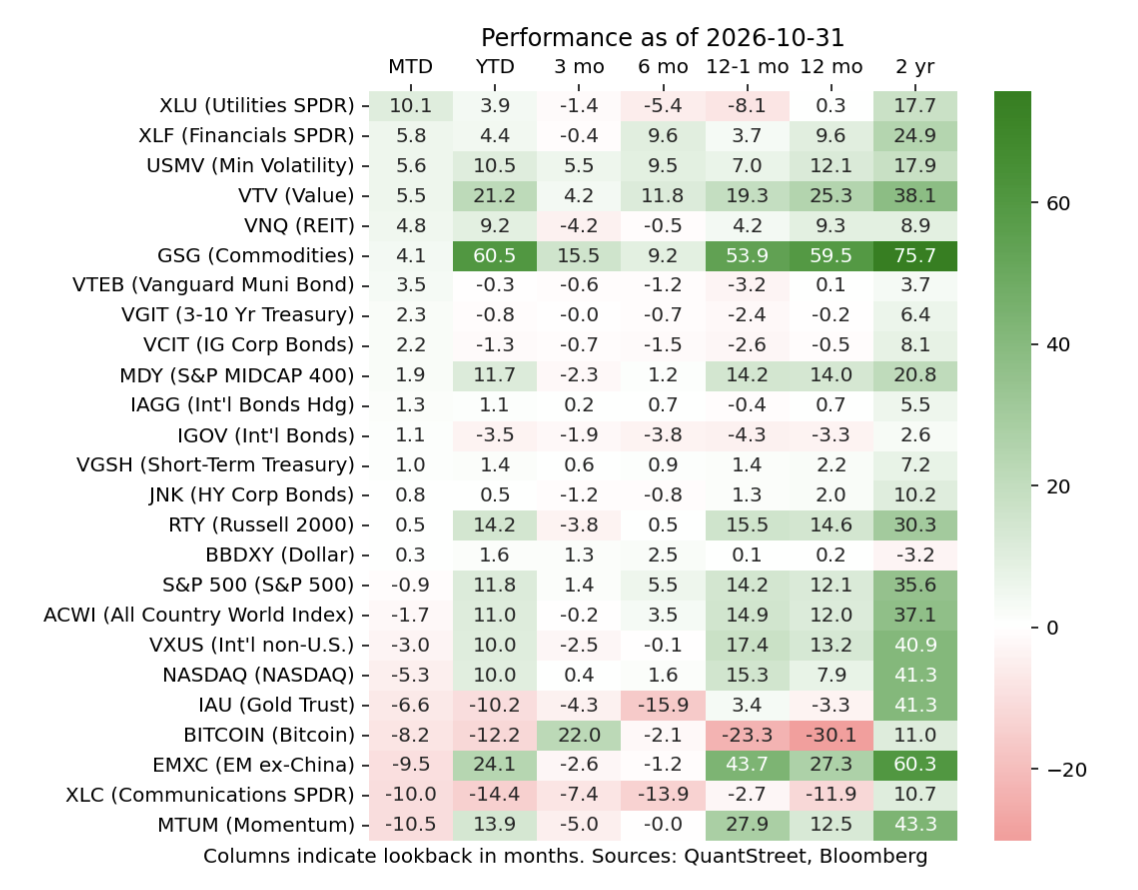
With the one constant being that gold fell again, this time by 6.6%, October’s price action is a mirror image of what happened in markets in September. In September, tech and momentum led the charge higher, with anything value- or rate-related leading the selloff. October was the exact opposite. Utilities, financials, value, and all things rate-related had sharp rallies, while all things tech had a horrendous month, with Nasdaq down 5.3% and EM ex-China (i.e., largely Korea and Taiwan and their semiconductor sectors) down close to 10%. A broader index of international stocks did not fare very well either, seeing a drop of 3% on the month. Fixed income markets, after being positively trounced in September, had a bit of a bounce with high-yield bonds up 0.8%, investment grade and municipal bonds up 2.2% and 3.5% respectively, and medium-duration Treasuries up 2.3%.
At QuantStreet, our portfolios had some bad calls and some good ones. Our small gold exposure hurt the portfolio (for the second month in a row), our international exposure did not fare well either, while our overweight in value and low-vol stocks helped (after having done poorly the month before). Overall, the portfolios performed in-line with benchmarks, with some risk levels doing worse and some doing better than their benchmarks. You can see our absolute performance numbers here. If you would like to see relative performance numbers, please email us at [email protected].
Everyone is very worried
It is telling that many of the journalists that I regularly read and respect wrote very negative pieces about the AI trade and markets more broadly in October.
Charlie Gasparino of the NY Post recently wrote about the parallels between the dot-com bubble and the AI buildout, predicting that “the correction is coming to AI.” A mid-October article from James Mackintosh of the WSJ warned that AI companies would have a hard time avoiding the overinvestment trap of prior technological revolutions. Mackintosh argues that concerns about this overbuild are leading to lower price-to-forward-earnings multiples (more on this below) as “investors are paying less per dollar of the earnings coming up in the next year, because they know it won’t last.”
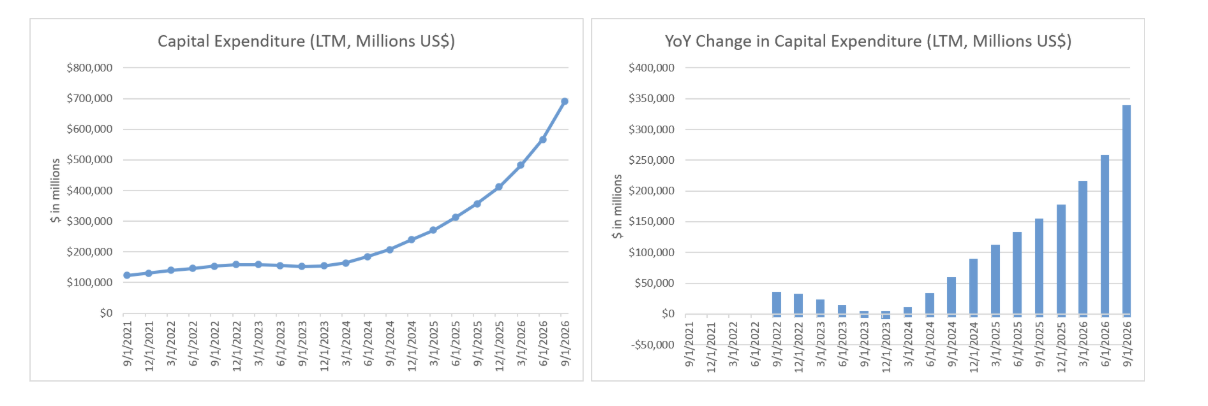
Indeed, the pace of investing by the hyperscalers (Amazon, Google, Meta, Microsoft, Oracle) has been remarkable. Collectively, they’ve spent $690bn in capital expenditures (capex) over the last twelve months (LTM), with that amount representing a $334bn increase from the LTM spend from a year ago. (Interestingly, the LTM net income of these companies looks very similar to, though a bit lower than, their LTM capex. So, at least, the additional investment is of the same order of magnitude as current profits.)
A more recent WSJ article from James Mackintosh talks about the “tangled web of AI bets” as one reason to be wary of the AI boom. Another WSJ piece, from Gunjan Banerji, documents how investors are looking to buy insurance against an AI selloff using either equity derivatives or credit default swaps. Boston University’s Larry Kotlikoff, in a recent Substack piece, warns about an impending stock market collapse due to AI overinvestment.
See more: The Fed Risks a Policy Error Fighting Oil Prices
In short, there is no lack of negative narratives about how anything AI-related might go belly up in a big way. While there is of course endogeneity—these articles were all written after the start of October’s market selloff—the causality likely runs in the other direction too (see my JFQA paper on this topic). Such narratives reflect persistent investor fears and depress valuations.
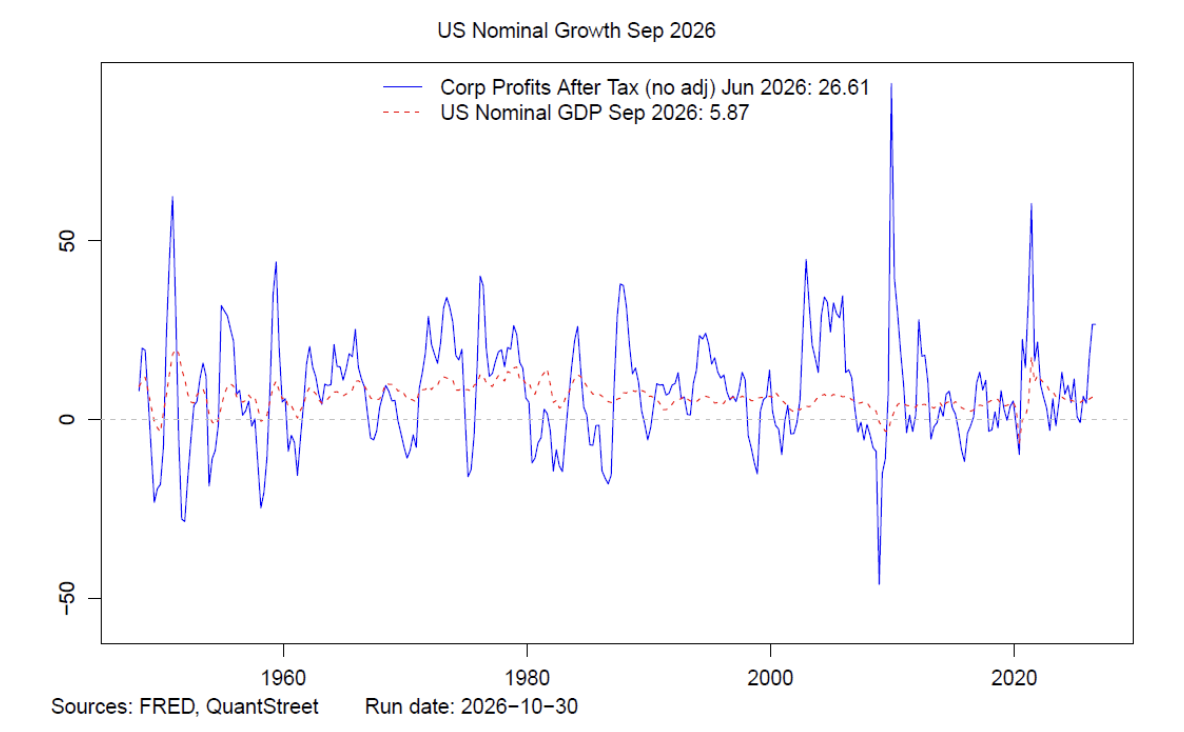
One data point that supports a cheerier outlook is that a lot of smart people are warning about the dangers of AI overinvestment. Investors and firms are paying attention. If the AI trade does indeed blow up one day, it won’t be because no one saw it coming. And the fact that so many people see it coming might, perversely, mean that the blow up never arrives. Another cheerful data point comes from US macro data. As of 2Q 2026, corporate after-tax profits (unadjusted) grew 26.6% in nominal terms year-over-year, while the latest 3Q 2026 GDP data showed 5.9% year-over-year nominal growth. These are heady numbers indeed. Of course, the naysayers are concerned that such growth rates are not sustainable. But, if they turn out to be, the gloomy market narratives are likely misplaced.
Valuations
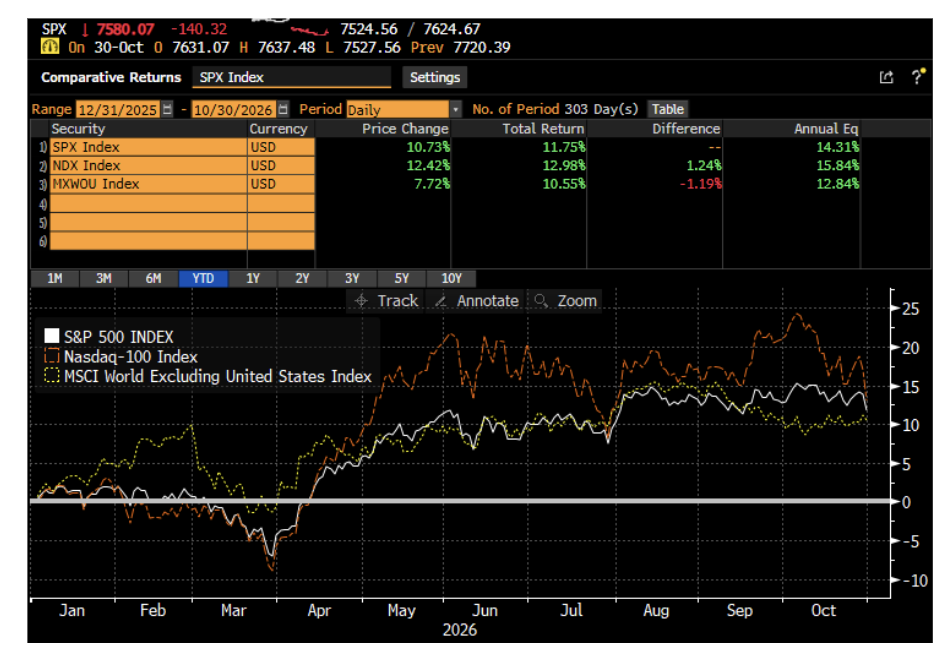
The confluence of the above narratives—whether cause or consequence—was associated with a tough October for US, tech and international stocks. Despite this one month, all three markets remain well up on the year: S&P 500 is up 11.75% year-to-date, the Nasdaq-100 is up 12.98%, and developed international stocks (MSCI World ex-US) are up 10.55%.
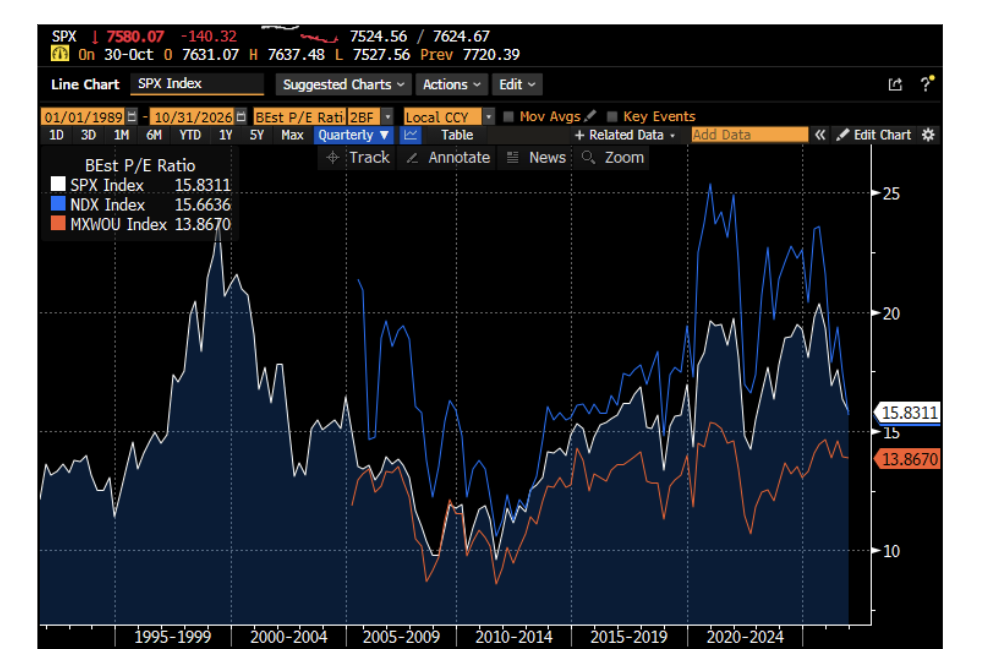
As already mentioned, price-to-forward-earnings multiples for these (and other) markets are well off their highs at this point. The S&P 500 and Nasdaq-100 are both trading at a two-year forward multiple of under 16. In fact, the Nasdaq-100 multiple is slightly lower than the S&P 500 one at this point, which is quite unusual. These multiples make the markets look downright reasonably valued, and should give pause to those using elevated CAPE ratios (price to average earnings over the last ten years) to argue that markets are overvalued: earnings per share (EPS) have grown meaningfully over the last ten years and the cyclically-adjusted earnings part of CAPE unfairly understates the current level of corporate profitability.
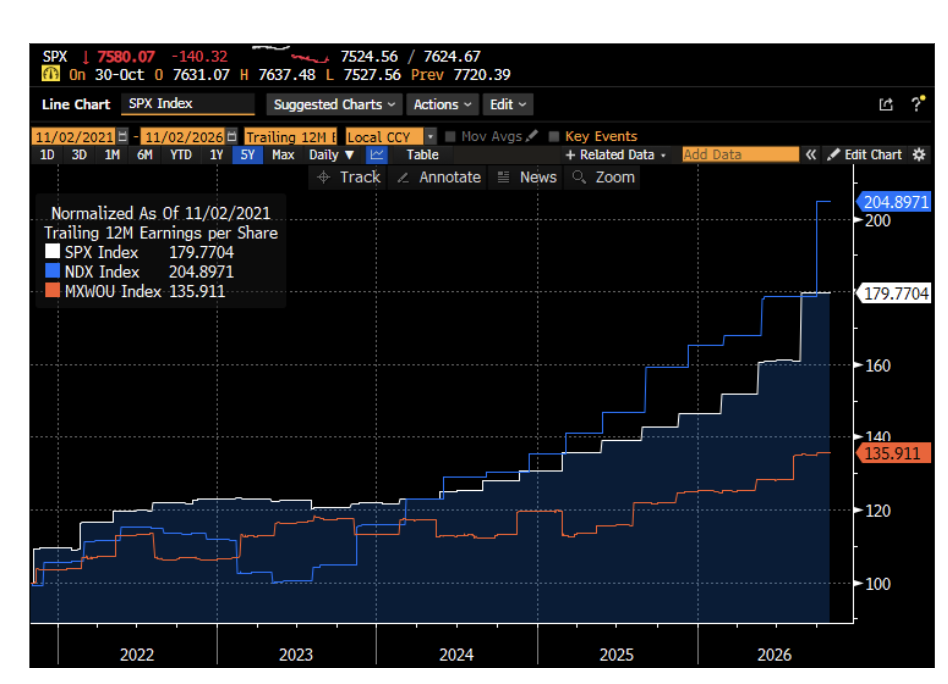
Of course what’s really bothering people is that current EPS levels are not sustainable. The next chart shows EPS growth for US, tech, and non-US international stocks over the last five years (all series are normalized to start at 100). S&P 500 EPS has grown at a 12.4% CAGR over the last five years. The concerns about AI overinvestment hinge on the idea that if the investments don’t pan out, corporate profitability will fall, and (as James Mackintosh wrote) these EPS levels will not be sustainable.
t’s hard, or impossible, to know how future corporate earnings will evolve, but the currently insatiable demand for compute combined with robust GDP growth in the US suggest that the good times might continue for some time yet.
Positioning for the Month Ahead
Our thesis has been that the AI trade will, at some point, have to transition from the AI creators to the AI users. We wrote that September price action was worrying because the rest of the corporate sector was getting crushed while the AI creators (tech, semis) were doing great. That seemed to us a non-sustainable dynamic. October’s price action was the exact opposite: the companies that will ultimately benefit from AI rallied, while the AI providers were the ones that sold off. (This Vanguard piece lays out a similar rest-of-corporate-America will benefit from AI thesis.) We also continue to hold a sizable value exposure, as well as a small allocation to low volatility stocks, a sector which looks a bit like the equal-weighted S&P 500, with large weights in technology, healthcare, and financials.
In addition to these lower-volatility names (value is also less volatile than the broad market), we introduce a bit of a barbell exposure into the portfolios, with allocations to high beta sectors, like EM ex-China and tech stocks. We like the EM exposure for two reasons: first, it provides exposure to world-class semiconductors companies; second, it benefits from structural tailwinds, e.g., low leverage, improving corporate governance and focus on profitability, as laid out in a recent JP Morgan report. We like tech because it does really well on days when the broader market rallies, thus providing needed beta exposure to the portfolios. And the valuation story (see discussion above) strikes us as a compelling catalyst. The downside is that, should the AI naysayers prove correct, both of these positions will be very exposed.
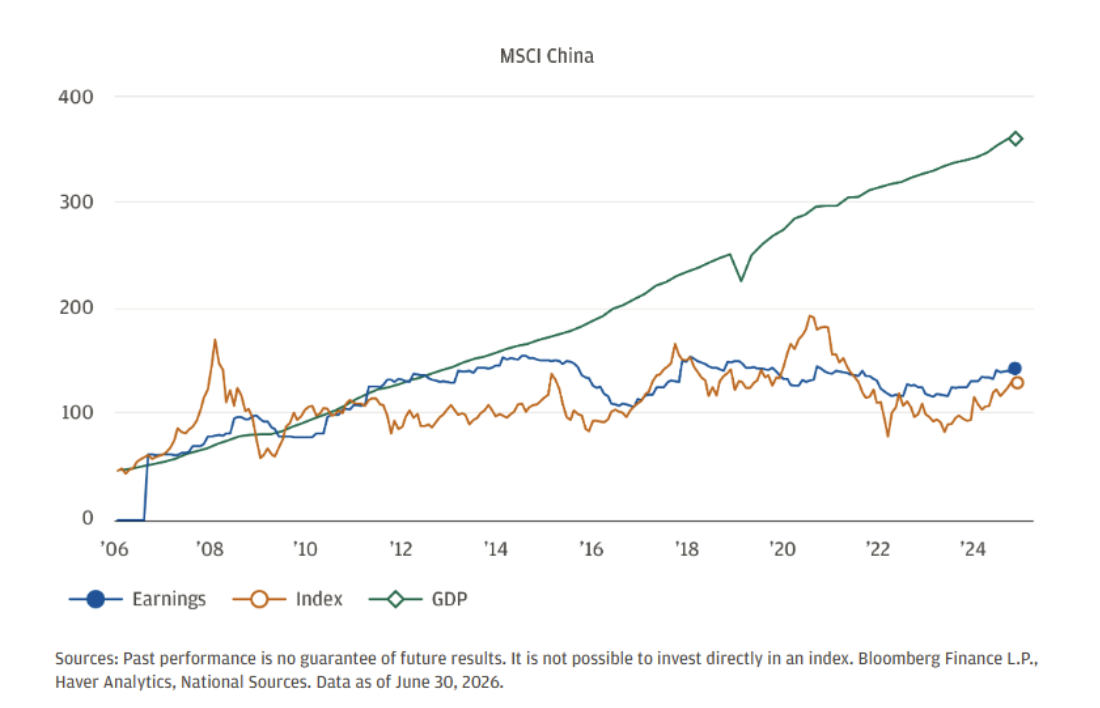
As an aside, the reason we like EM exposure of the ex-China variety is well captured by this next chart from the JP Morgan report. While China’s GDP growth has been extraordinary, the pass-through of that growth to corporate earnings has been meager. The analogous chart for the rest of the world shows earnings growth handily beating GDP growth. As long as the GDP-earnings pass-through isn’t “working” in China, it is hard to see how Chinese stocks do well relative to their global peers.
On the fixed income side, we maintain part of our exposure in the 5- to 7-year Treasury space, while keeping the core 2-year Treasury position that we’ve carried for a long time now. This leaves us still relatively short duration compared to our benchmarks, an exposure which we like across model, trend, and fundamental (i.e., strong growth) dimensions.
Working with QuantStreet
QuantStreet offers financial planning and wealth management services for individuals and families. For the advisor community, we offer model portfolios, portfolio analytics, and a platform for those looking to gain independence. The firm’s investment approach is systematic, data-driven, and shaped by years of investing experience. To work with or learn more about QuantStreet, join our mailing list or contact us at [email protected]. Also, please sign up for our Substack.
QuantStreet is a registered investment advisor. Registration does not imply a certain level of skill or training. All financial forecasts are fraught with risk and uncertainty. Our views may prove incorrect and market outcomes may be materially worse than we anticipate. Please see our full disclosure about the limitations of forward-looking statements and the risks of investing at https://quantstreetcapital.com/blog_disclosure/.
A message from Advisor Perspectives and VettaFi: Discover something new! Click here to register for our upcoming webcasts.
© QuantStreet Capital
Read more commentaries by QuantStreet Capital