Venezuela Was Richer Than Poland in 1990. Now Poland Is Six Times Richer
Membership required
Membership is now required to use this feature. To learn more:
View Membership Benefits
A few years back, I compared two island-nations whose leaders came to power in 1959. At the time, Cuba was by far the wealthier of the two—rich in sugar, tobacco and tourism—while Singapore was a sleepy former colonial outpost with almost no natural resources.
Fifty-something years later, and the roles have completely reversed. Singapore’s Lee Kuan Yew bet on free markets, low taxes and the rule of law. Cuba’s Fidel Castro bet on central planning.
You know how that turned out.
See more: Strong But Concentrated Economic Growth
I’ve wanted to write a follow-up for a while now, and today I’d like to look at two more countries—Poland and Venezuela—that teach the very same lesson, only from opposite directions.
Poland spent four decades under socialist rule and, in 1989, had the courage to walk away from it.
Venezuela, on the other hand, was once among the richest nations in the Western Hemisphere, and they walked right into it.
Poland’s Road Back from Socialism
It’s easy to forget how bad things used to be. Several years ago, I sat down with Joanna Sawicka, then a junior analyst on our team, after she returned from a trip to her native Poland. She remembered having to stand in line for hours as a child just to buy food and school supplies. Families were issued government cards that limited how much meat they could buy each month.
Joanna wasn’t exaggerating. In 1981, the communist government cut the meat ration to just three kilograms per person per month, according to an economic history of Poland published by the Fraser Institute. Real GDP per person fell 18% between 1980 and 1982. By 1990, inflation had hit 586%, and the country’s foreign debt would soon top $48 billion, money it had no way of repaying.
Then Poland did something remarkable. On January 1, 1990, Finance Minister Leszek Balcerowicz launched what became known as “shock therapy.” Roughly 90% of prices were freed, the money printing slowed dramatically, and state-owned enterprises were sold off. Shortages that had plagued Poles for decades ended within weeks.
Knocking on the Door of the Top 20
The results have been nothing short of a miracle. Poland’s GDP per capita on a purchasing power parity (PPP) basis grew from about $6,730 in 1990 to nearly $56,000 in 2025. The average Pole is now wealthier than roughly 85% of the world’s population, according to the Polish Economic Institute. After its transition recession, Poland grew for 28 straight years, and it was the only European Union (EU) member to dodge a recession during the global financial crisis.
Back in 2014, I wrote that economists believed Poland could join the world’s 20 largest economies by as early as 2030. Today it’s practically there. The latest International Monetary Fund (IMF) data puts Poland’s 2025 GDP at $1.036 trillion, a hair behind Switzerland, and the IMF projects Poland will pass Switzerland by 2028.
Not bad for a country whose economy was in ruins a little over three decades ago.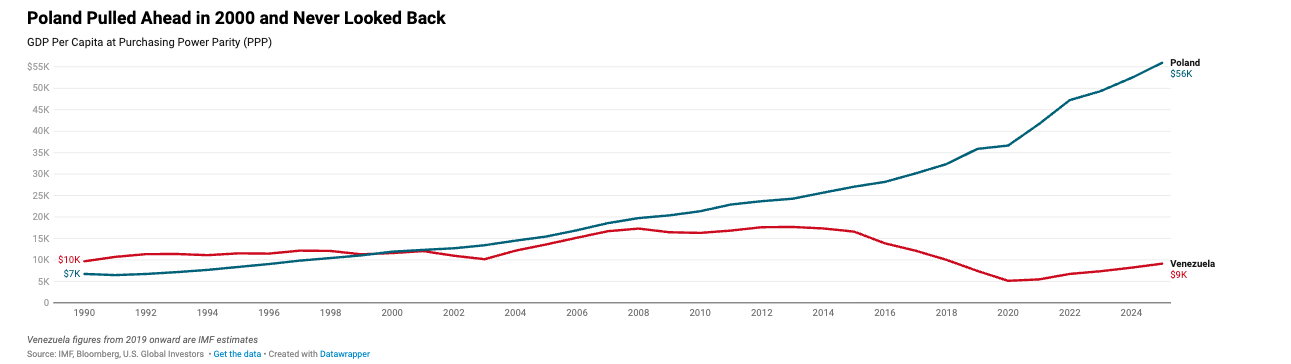
Critics like to say that the EU deserves the credit. Membership no doubt helped. But money alone doesn’t build an economy. If it did, Venezuela would be the richest nation in South America today.
Venezuela’s Self-Inflicted Wound
That’s what makes Venezuela’s story so tragic. In the 1950s, by some measures, Venezuela’s income per person rivaled that of the U.S. As recently as 1990, a Library of Congress country study said Venezuela “enjoyed the highest standard of living in Latin America.” The country was so wealthy, it was “more frequently a donor than a recipient of foreign assistance.” The same year, the average Pole’s income was only about 70% of the average Venezuelan’s on a purchasing power basis.
To be fair, Venezuela had real problems before Hugo Chavez took office in 1999, including corruption and an overreliance on oil revenues. But Chavez took a flawed petro-state and supercharged its worst instincts. He expropriated private businesses, imposed price and currency controls and turned the state oil company, PDVSA, into a piggy bank for his political programs.
Just look at oil production. Venezuela pumped about 3.45 million barrels a day at its peak in 1998 and roughly 2.9 million when Chavez was sworn in. It never got back there, even when oil traded above $100 a barrel. By September 2020, output had collapsed to just 310,000 barrels a day, a jaw-dropping drop of about 91% from the peak.
The rest of the economy followed. Real GDP shrank more than 75% between 2014 and 2020. Inflation hit an unthinkable 65,374% in 2018, according to the IMF. Roughly 8 million Venezuelans, about a quarter of the population, have fled the country.
Compare that to Poland, where emigrants began returning home after 2015 to take advantage of new opportunities.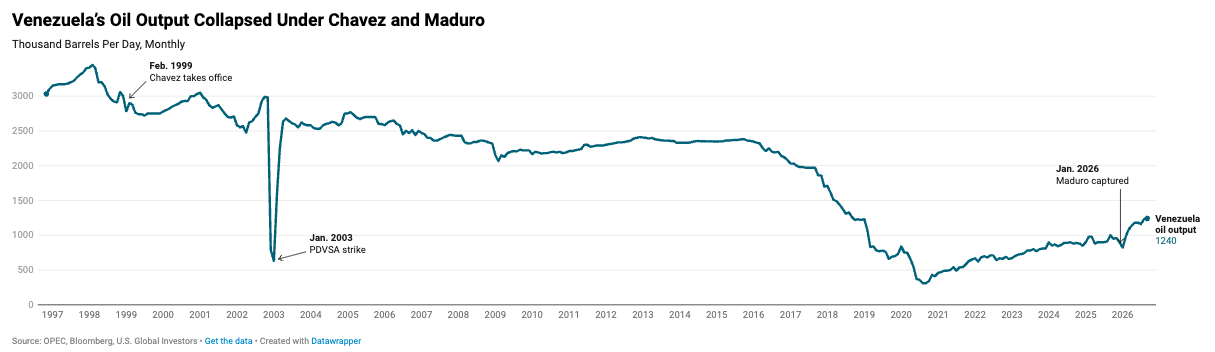
The rest of the economy followed. Real GDP shrank more than 75% between 2014 and 2020. Inflation hit an unthinkable 65,374% in 2018, according to the IMF. Roughly 8 million Venezuelans, about a quarter of the population, have fled the country.
Compare that to Poland, where emigrants began returning home after 2015 to take advantage of new opportunities.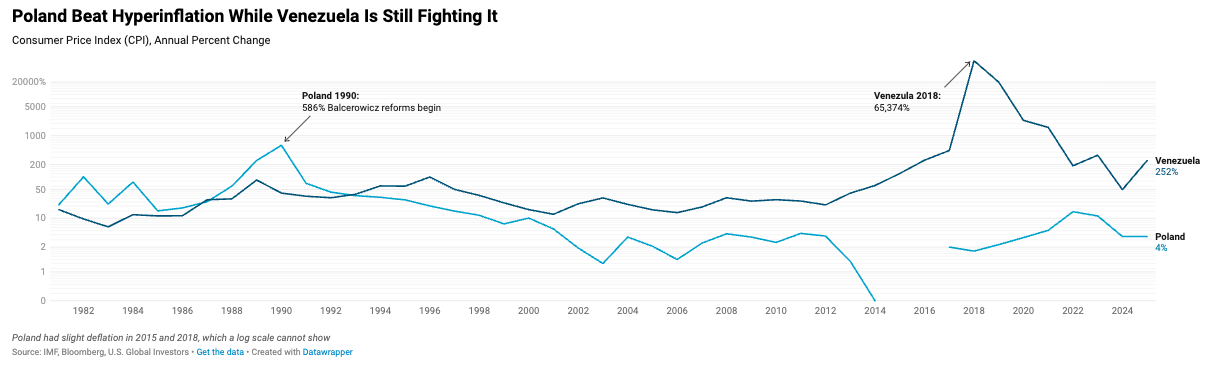
What Investors Should Watch
As I wrote in January, the U.S. capture of Nicolas Maduro on January 3 was a major turning point. Venezuela’s oil output has climbed from about 820,000 barrels a day in January to 1.24 million in September, an increase of roughly 50%. The country’s defaulted government bonds, which traded around 17 cents on the dollar at the start of 2025, jumped into the low 40s right after Maduro’s capture and changed hands near 51 cents today.
That tells you investors believe things are getting better. But it also tells you they still expect to lose about half their money. And that’s before you consider the human toll of the devastating earthquakes that struck the country in June.
I think the market has it about right. Venezuela hasn’t had its Balcerowicz moment yet. Inflation was still running at 252% last year, and the IMF expects it to get worse in 2026. Restoring oil production to 3 million barrels a day could require as much as $180 billion in capital, according to Berkeley Research Group. Serious investors are going to want sound money, secure property rights, the rule of law and free elections before they commit that kind of money.
The good news is that Poland proves it can be done. In 1989, Poland looked a lot like Venezuela does today, with empty shelves, runaway inflation and unpayable debts. Thirty-five years later, it’s one of the most dynamic economies in Europe.
Freedom Is the Best Economic Policy
Whether it’s Singapore and Cuba or Poland and Venezuela, the lesson is the same. Economic freedom creates prosperity, and central planning destroys it. As the authors of the Fraser Institute history warn, the temptation to return to socialism grows stronger as memories fade and fewer people remain who lived through it.
That’s a warning we here in the U.S. would do well to heed, especially with midterm elections coming up.
Airlines and Shipping
Strengths
- The best-performing airline stock for the week was Frontier, up 30.6%, following a good quarter. Airfares are continuing to move higher. The average domestic round-trip ticket price for the Thanksgiving travel period is forecast to rise 31%.
- Global crude oil in floating storage rose 8% week-over-week to 87.42 million barrels as of October 23, according to Vortexa. Europe surged 75% week-over-week to 6.99 million barrels, while North Sea volumes more than doubled, rising 101% to 3.94 million barrels. Asia-Pacific climbed 24% to 27.50 million barrels, while the U.S. Gulf Coast fell 51% to 2.69 million barrels, according to Bloomberg.
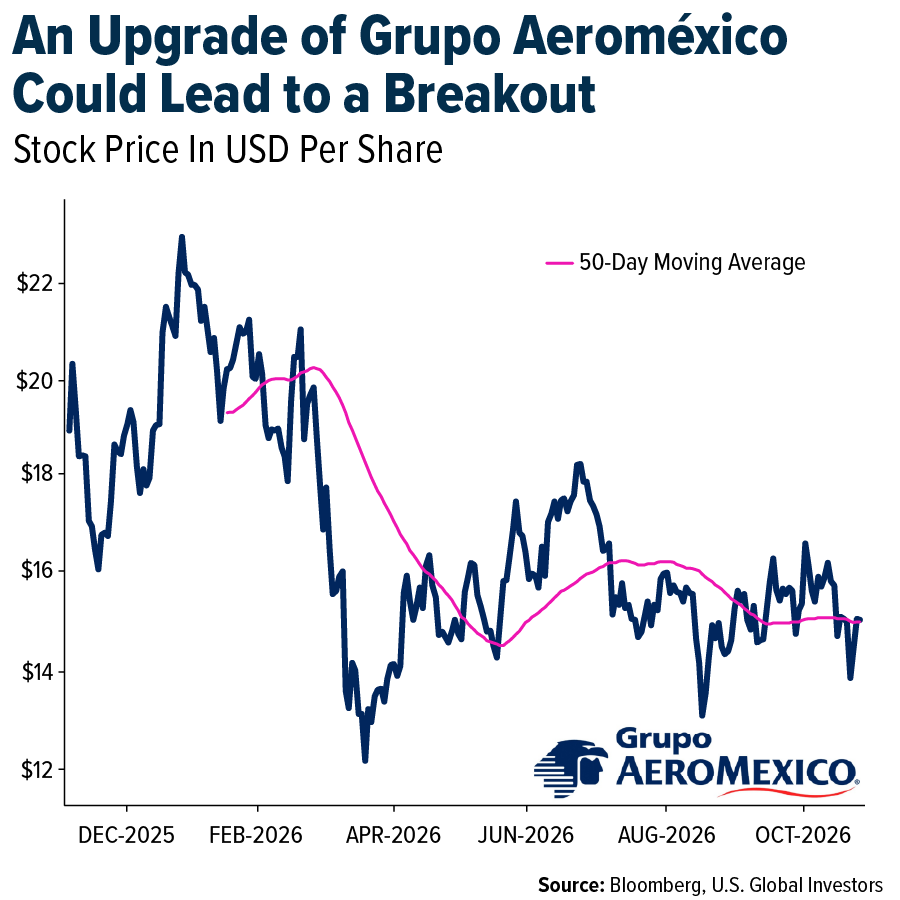
- S&P upgraded Aeromexico’s long-term credit rating to BB- from B+, with a stable outlook. S&P cited resilient EBITDA margins, effective fuel cost pass-throughs and strong cash generation in its commentary, according to Bloomberg.
Weaknesses
- The worst-performing airline stock for the week was SkyWest, down 11.5%, as the company’s growth outlook decreased despite earnings-per-share being in-line with estimates. A JetBlue-initiated domestic fare increase faltered over the weekend, following only limited matching by competitors. JPMorgan was not particularly surprised, given the industry’s identical, successful effort the previous week. The firm continues to expect further domestic fare increases in the coming weeks, assuming jet fuel prices do not quickly and meaningfully recede.
- October has been the worst month on record for ship attacks in the Strait of Hormuz and nearby waterways, according to the Washington Institute for Near East Policy. The think tank recorded 28 confirmed attacks in October and 113 since the war began. Meanwhile, a Reuters review found that 11 very large crude carriers (VLCCs) were damaged this month alone, representing about 3.5% of the global fleet.
- Airlines are growing reluctant to add new fuel hedges as jet fuel prices remain near double their pre-Iran war levels. Ryanair’s CEO warned that fares could rise 15% to 20% through summer 2027 as hedges expire. European Union airfares rose 5.8% year-over-year (YoY) in September, compared with an increase of more than 20% in the U.S., where fuel hedging is rare, according to Reuters.
Opportunities
- JetBlue burned $329 million in free cash flow in the third quarter (Q3), according to UBS. Its guidance implies cash burn will narrow to $235 million in the fourth quarter (Q4), significantly better than UBS’s $385 million estimate. The airline increased the stated value of its unencumbered aircraft and engines to $2.8 billion as of September 2026. It also plans to draw on the $250 million accordion facility in Q4.
- According to Clarksons, China’s port congestion index continues to ease following the National Day holiday, returning close to its average level in the first half of 2026 (H1 2026). Clarksons has not seen further escalation in the impact of the El Niño climate phenomenon on Panama Canal transits. El Niño reduced daily transits through the canal from 36 to 32 vessels beginning in September 2026.
- Volaris has passed the peak of its aircraft groundings, ending the third quarter of 2026 (Q3 2026) with 21 grounded aircraft, down from 36 in Q2 2026. According to JPMorgan, grounded aircraft are expected to remain in the low-to-mid-20s range through summer 2027 and normalize by mid-2028.
Threats
- JetBlue’s senior creditor group is working with restructuring advisors to either file for bankruptcy or pursue an out-of-court restructuring in the near future. Investors have also expressed concern that the airline’s credit card processor could create a cash squeeze by increasing its holdback.
- About 35,700 import containers were awaiting on-dock rail service at the Ports of Los Angeles and Long Beach this week, with railcar shortages slowing inland freight movement. Of those, 10,562 containers had been on terminals for at least nine days as of October 26. Approximately 250 ILWU watchmen voted to authorize a strike at the two ports, according to the Pacific Maritime Association. A walkout could begin at 5 p.m. Pacific time if a new agreement is not reached before the contract extension expires, according to FreightWaves.
- Canada’s Competition Bureau found that the proposed expansion of the United Airlines-Air Canada joint venture would likely harm competition on 10 U.S.-Canada routes. Air Canada and United currently account for all nonstop traffic on five of the 10 routes proposed for addition to the joint venture. The bureau said the arrangement could lead to higher fares. Canada’s Minister of Transport will consider its findings.
Luxury Goods and International Markets
Strengths
- U.S. consumer confidence came in well above expectations at 91.7, compared with the 81.0 consensus, reaching its highest level since June. The stronger reading suggests consumers remain relatively resilient, potentially supporting discretionary spending on travel and luxury purchases.
- Investor sentiment toward Tesla improved this week as Barclays highlighted recovering vehicle sales, growing adoption of Full Self-Driving (FSD) technology and the potential for a combination with SpaceX. FSD adoption exceeded 75% of new Tesla purchases in North America in Q3, signaling stronger demand for the technology. While a potential SpaceX combination remains uncertain, improving vehicle sales provide additional support for the stock.
- Capri Holdings, the luxury apparel group best known for Michael Kors, Jimmy Choo and Versace, was the best-performing name in the S&P Global Luxury Index over the past five days, with shares climbing 17.7% after the company reported stronger-than-expected first-quarter results.
Weaknesses
- A report released October 26 highlighted continued weakness in Chinese consumer demand. LVMH’s Fashion & Leather Goods sales to Chinese customers fell by a mid-teens percentage, while Kering’s Chinese sales were estimated to be down 15%–20%. Broader Chinese retail sales grew just 1.1% from January through September.
- British luxury automaker Aston Martin reported a £77 million loss in the third quarter, bringing cumulative losses since Lawrence Stroll led its 2020 rescue to approximately £2.3 billion. Higher prices for its most exclusive models are helping performance, but analysts remain concerned about rising debt and the company’s reliance on limited-edition models to drive growth.
- Lucid Group, Lucid Group, an electric vehicle maker, was the worst-performing name in the S&P Global Luxury Index, with shares declining roughly 14.2% over the past five days amid continued concerns over profitability and cash burn.
Opportunities
- Cruise demand remains strong, supported by solid third-quarter results from Royal Caribbean (RCL) and Norwegian Cruise Line Holdings (NCLH). Viking is also expanding its premium offerings with a new 19-day Nile cruise in Egypt, priced at approximately $15,000 per person, highlighting continued growth in high-end experiential travel.
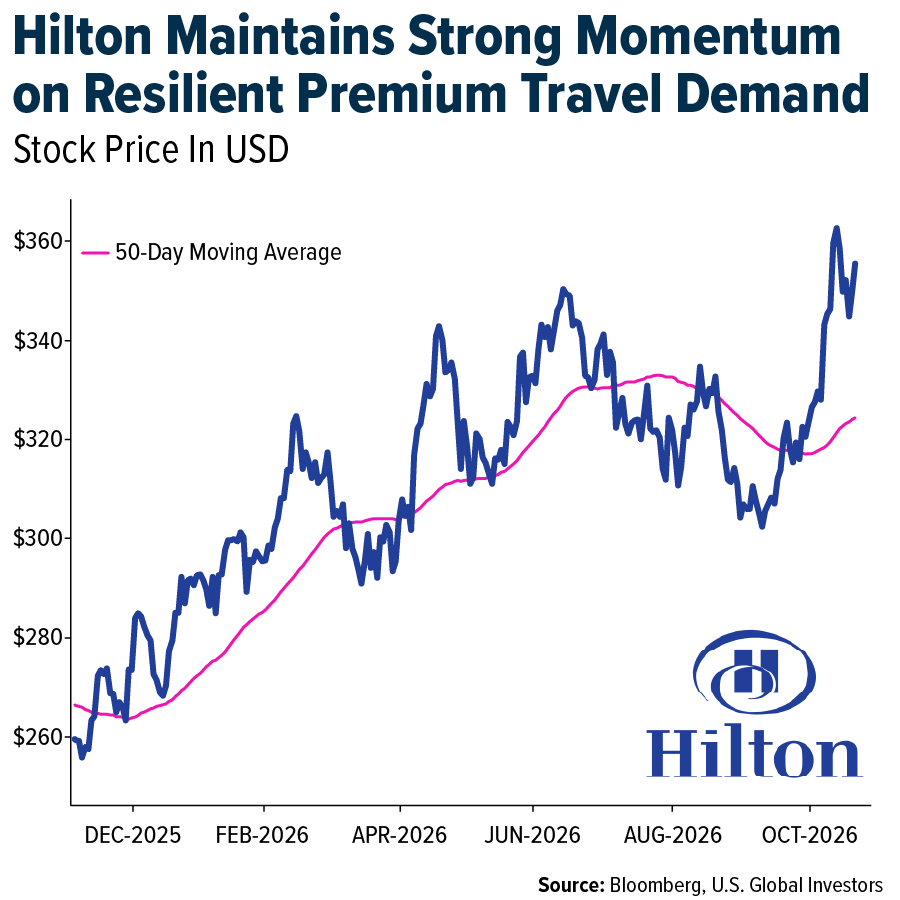
- Hilton Worldwide’s strong third-quarter results and positive analyst reactions point to resilient demand for premium travel. The results suggest higher-end consumers continue to prioritize travel and experiences, providing a favorable read-through for luxury hotels and experience-driven discretionary spending.
- Rémy Cointreau delivered better-than-expected quarterly sales as Cognac demand strengthened, particularly in China and other Asian markets. Africa also performed well. The improvement offers an encouraging sign that demand for premium spirits is recovering in key markets.
Threats
- The Federal Reserve (Fed) and European Central Bank (ECB) maintained restrictive monetary policies this week. The Fed held its federal funds rate at 3.75%–4.00%, while the ECB kept its deposit rate at 2.50%. Persistent inflation could keep interest rates higher for longer, increasing borrowing costs and potentially weighing on economic growth, consumer spending and equity valuations.
- Porsche is showing early signs of a turnaround, supported by cost cuts and strong demand for higher-margin models. However, declining deliveries, continued weakness in China and another transition year ahead suggest the luxury automaker still faces a longer road to a full recovery.
- Ferretti Group, an Italian maker of luxury yachts and superyachts, reported weaker profitability and cut its full-year earnings guidance for the second consecutive quarter. Slower purchasing decisions and weaker orders in key markets, including the Americas and Middle East, suggest even ultra-wealthy consumers are becoming more cautious about major luxury purchases.
Energy and Natural Resources
Strengths
- The best-performing commodity for the week was zinc, up 4.30%, supported by tightening supply conditions and declining inventories. London Metal Exchange (LME) zinc prices extended a five-day winning streak as inventories fell by 1,400 metric tons to 161,275 tons on October 30. Inventory drawdowns outside China also widened the LME cash-to-three-month backwardation, signaling tighter near-term availability and providing further support for prices, according to Bloomberg.
- According to Bank of America, the global copper market remains tight as strong U.S. imports have reduced international availability, while domestic inventories have climbed above 1.5 million metric tons. Supply constraints persist, with declining treatment and refining charges, weak Chilean mine output and stagnant Chinese refined production pointing to continued market tightness into 2027.
- Brent crude rose above $115 per barrel, reversing a two-day decline amid heightened geopolitical tensions following a closely contested Israeli election and reports that the U.S. had warned Gulf nations to prepare for a potential renewed military campaign against Iran, according to Bloomberg. U.S. Naval Forces Central Command also advised vessels without essential transit needs to avoid the Strait of Hormuz to minimize potential delays.
Weaknesses
- The worst-performing commodity for the week was coffee, down 6.59%, as arabica futures headed for their steepest weekly decline since early June, pressured by a sharp depreciation of the Brazilian real. Although prices briefly rebounded as investment funds covered short positions ahead of the November 12 options expiration, the recovery was largely technical and failed to reverse the broader weekly decline, according to Bloomberg.
- According to Morgan Stanley, gasoline crack spreads remain elevated by historical standards but have recently come under pressure across major trading regions. Seasonal blending of lower-cost butane, declining prices for high-octane blending components, rising freight costs that limit arbitrage opportunities, and rebuilding U.S. gasoline inventories have weighed on refining margins. Meanwhile, higher crude oil prices driven by geopolitical tensions have further compressed gasoline crack spreads.
- Iron ore benchmark futures in Singapore fell to $89.25 per metric ton, their lowest intraday level since September 2024. BMI lowered its 2026 average price forecast to $95 per ton from $99, citing continued weakness in China’s property and infrastructure sectors, reduced stimulus expectations from Beijing, and ample supply from Guinea’s Simandou project and major global producers. BMI sees little prospect of a near-term recovery.
Opportunities
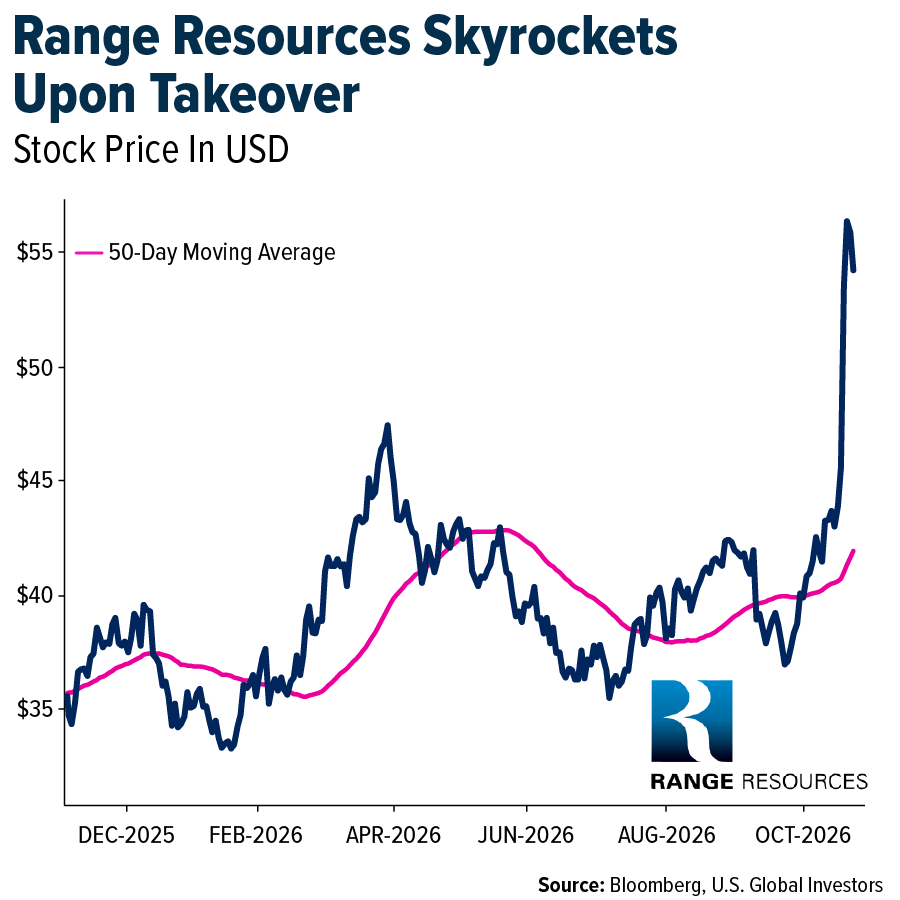
- EQT agreed to acquire Range Resources in an all-stock transaction valued at approximately $12.8 billion, creating what the company describes as the largest vertically integrated natural gas producer in the U.S. The combined company, valued at more than $50 billion, is expected to produce more than 9 billion cubic feet equivalent per day in Appalachia, with over 30 years of drilling inventory across nearly 3 million net acres. EQT anticipates $325 million in annual synergies within two years, with analysts suggesting additional efficiency gains may be possible.
- Refined fuel supply constraints are expected to persist into 2027, according to Goldman Sachs, as refiners address deferred maintenance. This could limit exports and support refining margins, potentially benefiting major refiners such as Valero Energy.
- According to MT Newswires, Eni and TotalEnergies have begun executing Cyprus’s first natural gas development, the offshore Cronos field, following the signing of major engineering, construction and drilling contracts. The companies each hold a 50% stake in the project, which is expected to begin production in the first half of 2028 and reach peak output of up to 500 million standard cubic feet per day, expanding regional natural gas supply.
Threats
- According to Bloomberg, European natural gas prices climbed above €97 per megawatt-hour for the first time since 2022, as colder temperatures across the continent are expected to boost heating demand amid tight global gas supplies. Rising seasonal consumption and constrained supply could provide further support for natural gas prices and benefit producers.
- Global aluminum supply remains tight, although recovering Middle Eastern production and rising Indonesian output could push the market into surplus by 2027, according to Bank of America. Global production declined 1.0% year-over-year (YoY) year-to-date, driven by a 31.4% drop in the Middle East. September output, however, rose 0.4% month-over-month as regional operations normalized. Indonesia’s production and exports reached an annualized 1.7 million metric tons in August, while China’s annualized output remained above 45 million metric tons despite a 0.6% YoY decline in domestic demand.
- According to Bloomberg, labor disruptions are adding pressure to global copper supplies. USW Local 7619 launched a strike at Teck Resources’ Highland Valley Copper operations in British Columbia, reducing production capacity. In Chile, workers at Codelco’s Ministro Hales mine blocked access to the site amid disputes over bonuses and working conditions. Meanwhile, China’s copper market remains tight due to declining domestic production and reduced imports, potentially supporting copper prices.
Bitcoin and Digital Assets
Strengths
- The Office of the Comptroller of the Currency (OCC) granted final approval to Ripple National Trust Bank on October 26, allowing the cryptocurrency company to operate a specialized bank under federal supervision. The bank will manage reserves backing Ripple’s RLUSD stablecoin and provide regulated digital asset custody services to institutional clients. Launched in December 2024, RLUSD has reached approximately $2.5 billion in market capitalization. Ripple also expects to exit 2026 with a $900 million annualized product revenue run rate, supported by threefold growth in customers and partners using multiple solutions. These developments point to growing commercial adoption of blockchain-based financial services and deeper integration between digital assets and traditional banking.
- Prediction-market platform Polymarket introduced five-minute cryptocurrency price contracts on October 28 through its U.S. platform, operated by QCX LLC under Commodity Futures Trading Commission (CFTC) oversight. The contracts allow traders to predict whether Bitcoin, Ethereum, Solana or XRP will rise or fall over five-minute intervals. Correct predictions pay $1 per share, while incorrect ones pay nothing. The launch follows growing demand for crypto-based event contracts, with rival Kalshi recording more than $1 billion in crypto contract trading in March 2026. The expansion highlights continued innovation in digital asset markets, creating new trading opportunities and potentially attracting additional participants.
- Blockchain infrastructure provider Chainlink introduced a continuous pricing service for tokenized equities, commodities and other traditional financial assets, extending market data availability through weekends and holidays. Decentralized lending platform Aave is the launch partner, integrating the service into its blockchain-based financial infrastructure. The development addresses a key limitation in tokenized asset markets: traditional exchanges operate during fixed trading hours, while blockchain networks function continuously. Reliable, around-the-clock pricing could improve collateral valuation, risk management and the efficiency of decentralized financial applications, strengthening the infrastructure supporting real-world asset tokenization.
Weaknesses
- Binance, one of the world’s largest cryptocurrency exchanges, suffered an estimated $6.3 billion theft on October 29 after attackers exploited internal systems to drain its hot wallets in approximately 20 minutes. The exchange said it allocated $6.34 billion in corporate resources to restore affected customer balances, while industry partners froze approximately $3 billion in stolen assets. Blockchain analytics firms linked the attack to North Korean hackers with high confidence. The breach triggered sharp losses in smaller cryptocurrencies, including a more than 90% collapse in FUNToken within a Uniswap liquidity pool. Binance temporarily suspended withdrawals for security checks. The incident highlights cybersecurity and investor protection risks across the digital asset ecosystem.
- The U.S. Securities and Exchange Commission (SEC) sued Blox Lending LLC, Digital Licensing Inc. and three individuals, alleging they raised more than $200 million from over 100,000 investors through a fraudulent cryptocurrency investment scheme. The defendants allegedly marketed digital tokens backed by commodity royalties from mining and other natural resource operations while misrepresenting the underlying assets and returns. The SEC claims the operation violated federal securities laws and exhibited characteristics of a Ponzi scheme. The case highlights ongoing concerns about transparency, due diligence and investor protection in the cryptocurrency industry.
- U.S. spot Ether exchange-traded funds recorded approximately $1.4 billion in net outflows during October, according to Bloomberg Intelligence, as falling prices pushed aggregate holdings below their estimated average cost basis of $3,200 per Ether. Since the October 10, 2025, market crash, cumulative outflows have reached $2.5 billion, reversing much of the $3 billion in inflows recorded between July and September 2026. Ether has also fallen approximately 52% from its August 2025 peak above $4,900. The withdrawals point to weakening investor demand and potential challenges for institutional participation in digital assets.
Opportunities
- The U.S. Intercontinental Exchange (ICE), owner of the New York Stock Exchange, will acquire a minority stake in Trade[XYZ], although the investment amount was not disclosed. The proposed platform would support 24/7 trading in products linked to equities, equity indexes, commodities and currencies, with dedicated clearing, know-your-customer (KYC) and anti-money-laundering (AML) systems. Trade[XYZ]’s Hyperliquid markets have generated more than $650 billion in trading volume in just over a year. The partnership highlights growing institutional interest in decentralized trading infrastructure and regulated blockchain-based derivatives.
- Switzerland’s financial regulator, FINMA, approved the Bitcoin Fund ETF (BBIT) on October 20, granting an exemption from diversification requirements that allows the fund to invest entirely in Bitcoin. The ETF is expected to begin trading on SIX Swiss Exchange in November, with access through approximately 90 participating institutions. Unlike many European Bitcoin products structured as debt securities, BBIT will hold Bitcoin in a regulated fund with assets legally separated from those of its manager, providing additional investor protections. The approval could encourage further cryptocurrency ETF launches and expand institutional access to digital assets.
- Nasdaq-listed Canton Strategic Holdings (CNTN) announced plans to tokenize its shares through TSV LLC, a trading platform built on the Canton Network, with trading expected to begin as early as November 2. The company partnered with SEC-registered transfer agent Fairmint to issue tokenized shares and maintain official ownership records. Unlike competing platforms such as OKX–ICE, which have faced objections from corporate issuers, TSV uses an issuer-sponsored model that avoids the 30-day objection period under the SEC’s five-year Innovation Exemption. The platform plans to offer 24/7 trading and simultaneous settlement of shares and payments, potentially improving market efficiency and accelerating institutional adoption of blockchain-based equities.
Threats
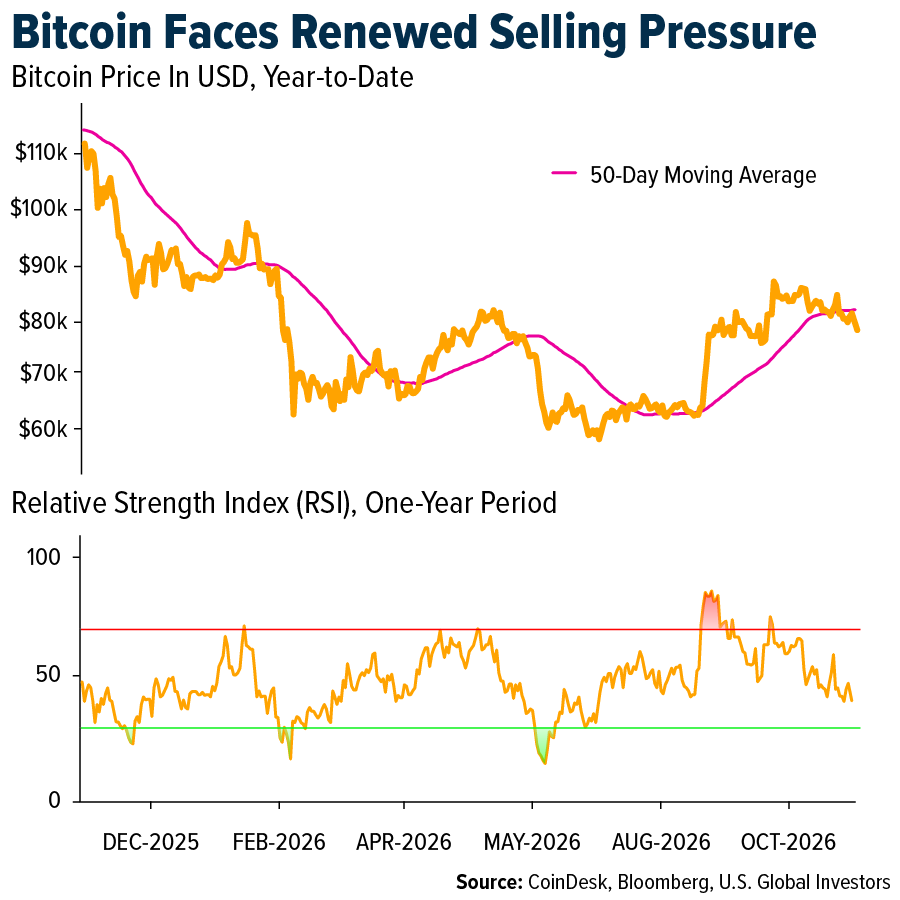
- Bitcoin fell to approximately $77,327 on October 30 as weakness in technology stocks and a hawkish Federal Reserve weighed on cryptocurrency markets. Crypto futures recorded $356 million in liquidations over 24 hours on October 29, including $205 million in long positions. Adding to volatility, approximately $11 billion in Bitcoin options were scheduled to expire on October 30, representing roughly one-third of outstanding options on Deribit. Bloomberg data showed Bitcoin trading below its 50-day moving average of $81,943, while its 14-day relative strength index (RSI) fell to 35.1, approaching oversold territory.
- Walmart, Eli Lilly and three other companies have objected to plans by crypto exchange OKX and New York Stock Exchange parent Intercontinental Exchange (ICE) to offer tokenized stock trading, bringing total objections to 38, according to CoinDesk. Under the Securities and Exchange Commission’s (SEC) five-year Innovation Exemption, companies have 30 days to reject unauthorized third-party tokenization of their shares. The opposition highlights concerns over issuer control and market structure, potentially slowing adoption of blockchain-based equity trading and tokenized real-world assets (RWAs).
- The U.S. Treasury Department’s Office of Foreign Assets Control (OFAC) sanctioned 10 individuals and one entity on October 28 for allegedly using fraudulent North Korean IT workers to fund the country’s weapons programs. Two Russian nationals allegedly facilitated approximately $5.5 million in cryptocurrency conversions, while six workers tied to a North Korean-controlled organization in Russia generated more than $750,000 since 2025. Authorities also identified eight cryptocurrency addresses on Ethereum and Tron linked to the sanctioned individuals. The case highlights ongoing money laundering and sanctions-evasion risks in digital assets, potentially increasing regulatory scrutiny and compliance costs for cryptocurrency platforms.
Defense and Cybersecurity
Strengths
- Samsung Electronics delivered a historic third quarter of 2026 (Q3 2026), with revenue rising 126.8% year-over-year (YoY) to a record 195.3 trillion won and operating profit surging 780.3% to 107.4 trillion won, supported by strong AI server memory demand and a 55% operating margin. Management said its entire 2027 high-bandwidth memory (HBM) supply is already sold out at agreed prices, while continued AI infrastructure investment is expected to keep memory supply tight through 2028. Samsung also raised 2026 capital expenditures (CapEx) to 84.4 trillion won and expects continued memory revenue and pricing growth, supported by HBM4E mass production and double-digit quarter-over-quarter (QoQ) Foundry growth.
- Google unveiled Gemini 4 Carbon, a new frontier AI model that reportedly outperforms GPT-6 Astra and Claude Opus 5.5 in long-context processing, mathematics, office tasks and cybersecurity, while reducing hallucinations and test-cheating behaviors. Designed to autonomously handle complex engineering tasks over several days, the model is currently restricted to a select group of vetted specialists and companies.
- Rheinmetall reopened domestic heavy tank gun barrel manufacturing at its Telford plant in the United Kingdom, resuming production of 120mm L55A1 smoothbore guns for Challenger 3 tanks after a 20-year hiatus.
Weaknesses
- Since June, thieves in the U.S. have stolen more than $100 million in AI server hardware from semi-trucks by hacking freight exchanges, using fake drivers with AI-generated IDs and staging coordinated heists. The stolen shipments are stripped for parts, tracked using spoofed coordinates and sold on the gray market, often to overseas buyers.
- Intel beat Q3 earnings expectations, reporting revenue of $16.5 billion, up 21% year-over-year (YoY) and down 1% quarter-over-quarter (QoQ), and adjusted EPS of $0.52, up 126% YoY. However, shares plunged 18% after hours following weaker-than-expected Q4 guidance of $15 billion to $16 billion in revenue and adjusted EPS of $0.25, alongside a projected gross margin of 38%. Management cited sluggish PC demand, supply bottlenecks and margin pressure from ramping up new server products.
- U.S. officials identified Singapore-based data center executive Alice Huang as an alleged Chinese intelligence asset who targeted Nvidia CEO Jensen Huang to obtain information and circumvent AI chip export controls. Jensen Huang defended the interactions as normal business dealings with Megaspeed International.
Opportunities
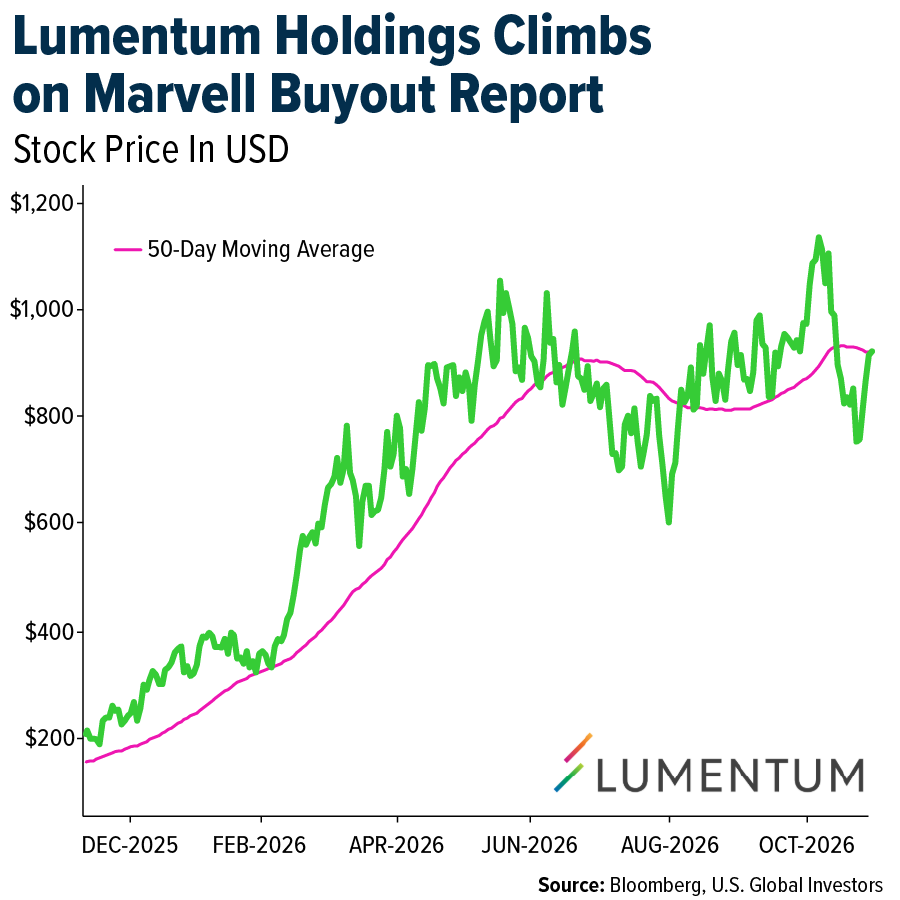
- Lumentum Holdings could benefit from potential merger-and-acquisition (M&A) upside as Marvell Technology is reportedly in advanced talks to acquire the Nvidia-backed data center optics maker, highlighting the strategic value of its AI infrastructure exposure.
- Global server CPU shipments are projected to grow more than 40% year-over-year (YoY) in 2027. Meanwhile, ARM-based processors are rapidly gaining market share, expected to exceed 20% in 2026 and approach 30% by 2027, driven by custom deployments from major cloud hyperscalers and NVIDIA.
- Aerospace semiconductor manufacturers received orders in October to scale deliveries of radiation-hardened telemetry and digital bus interface chips for F-16 integration with solid-propellant hypersonic strike missiles. The development could transform relatively inexpensive, mass-produced F-16 fighters into carriers of strategic hypersonic weapons.
Threats
- The U.S. Department of War launched an active cyber-sabotage investigation on October 30, 2026, after malicious firmware tampering caused recurring operational failures in industrial refrigeration and climate-control supervisory control and data acquisition (SCADA) systems at domestic military bases.
- The U.S. is weighing renewed military strikes on Iran following the midterm elections, with officials reviewing military action and naval blockade options. Washington has also warned Middle Eastern allies to prepare for potential military action and Iranian retaliation, raising the risk of a broader regional conflict.
- The Ethiopian Air Force received its first batch of 12 Russian-made Su-35S multirole air-superiority fighters on October 29, 2026, making Ethiopia the first country in sub-Saharan Africa to operate the platform.
Gold Market
This week gold futures closed the week at $3,894.30, down $113.60 per ounce, or 2.83%. Gold stocks, as measured by the NYSE Arca Gold Miners Index, ended the week lower by 3.16%. The S&P/TSX Venture Index came in off 2.09%. The U.S. Trade-Weighted Dollar rose 0.07%.
Strengths
- The best-performing precious metal for the week was gold, although it was still down 2.82%. According to RBC, Greatland Resources got off to a strong start to FY27, with first-quarter (Q1) gold production of 70,000 ounces, 5% above the consensus estimate of 67,000 ounces. All-in sustaining costs (AISC) of A$2,925 per ounce were also 9% below expectations (consensus: A$3,216 per ounce) and at the lower end of FY27 guidance. The company maintained its FY27 guidance of 260,000–300,000 ounces of production at an AISC of A$2,900–A$3,330 per ounce, assuming a slightly stronger second half due to open-pit scheduling.
- The People’s Bank of China (PBoC) added 740,000 ounces of gold in September, up from 650,000 ounces in August. This marked its largest monthly purchase since October 2023 and its 23rd consecutive month of buying. China’s gold holdings now total 2,410 tons, with 3.32 million ounces added year to date (YTD)—nearly four times the 860,000 ounces purchased in all of 2025. At $4,000 per ounce, China’s gold reserves are worth approximately $310 billion, according to Canaccord.
- Chinese households are buying the dip in gold as prices test $4,000, with demand growing over the past two months. Trading volume in the Shanghai Gold Exchange’s Au99.99 contract jumped to 43 million lots (about 430 tons) last week, the highest level since April, according to Bloomberg.
Weaknesses
- The worst-performing precious metal for the week was silver, down 8.52%. Silver is testing the key $50-per-ounce level for the second time in just over a year. Its higher beta makes it particularly vulnerable to further declines. The near-term outlook remains weak, with additional downside expected before a potential rebound, while the medium-term outlook remains bearish.
- Russia’s central bank sold 6.2 metric tons of gold in September, marking its 10th consecutive month of sales and reducing official holdings to their lowest level since late 2019. The sales come amid mounting fiscal pressure and elevated war-related spending. Kazakhstan’s central bank also plans to reduce gold’s share of reserves from roughly 78% to 75% by year-end, citing attractive U.S. Treasury yields. The adjustment is expected to involve a combination of physical gold sales and options.
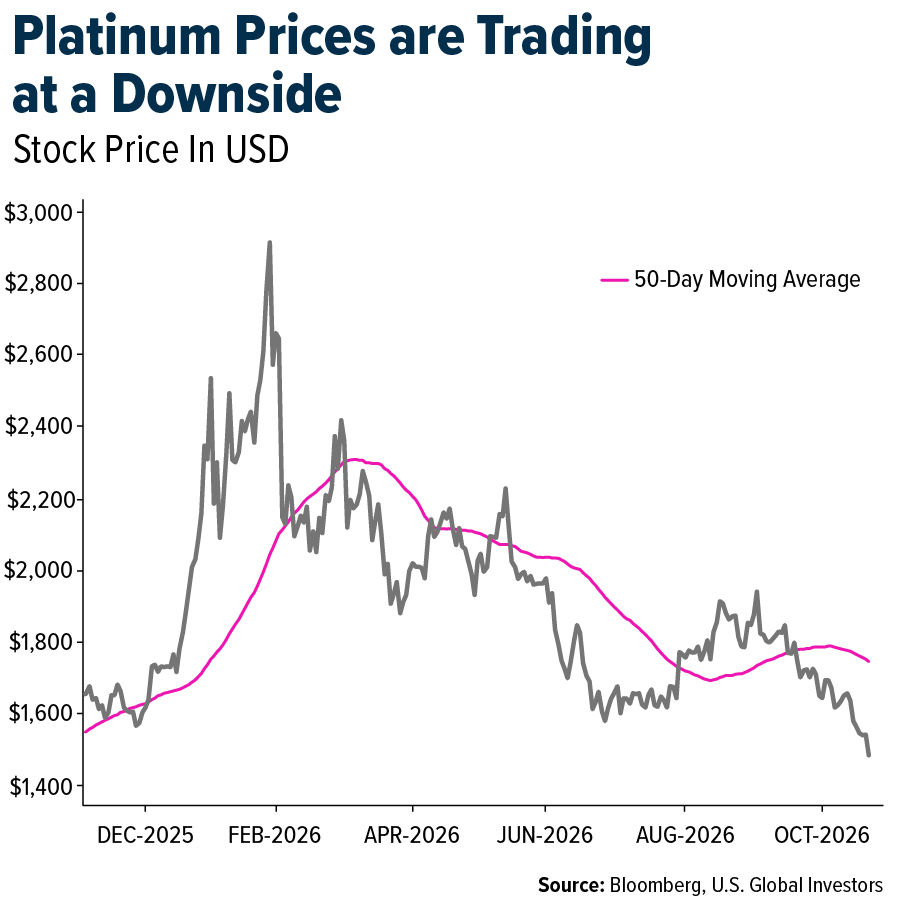
- Platinum fell below $1,500 per ounce, its lowest level since September 2025, pressured by investment outflows, elevated interest rates and a weakening demand outlook. Automotive demand is expected to decline 4%, while the World Platinum Investment Council forecasts a 265,000-ounce surplus in 2026, reflecting weaker investment and jewelry demand despite a projected 5% increase in industrial demand.
Opportunities
- Canaccord raised its 2026 gold price forecast to $4,451 per ounce from $4,374 previously, an increase of 1.8%. The firm expects producers across its coverage universe to generate record all-in sustaining cost (AISC) margins this year, averaging $2,475 per ounce—up 41% from last year’s record of $1,759 per ounce—as higher gold prices more than offset rising costs. Despite record margins and free cash flow (FCF), Canaccord believes the sector remains largely disciplined, focusing on executing organic growth plans, maintaining production, reducing debt, modestly increasing dividends and expanding share buybacks.
- BMO believes lower gold prices are beginning to attract physical buyers, with stronger premiums in India and a sharp pickup in Chinese trading signaling renewed demand. According to Bloomberg, gold ETFs added 29,500 ounces in the latest session, bringing year-to-date (YTD) net purchases to 2.07 million ounces. Official-sector activity remains mixed, with continued selling by Russia contrasting with further accumulation by China.
- The Federal Reserve (Fed) held interest rates steady while leaving a potential year-end hike on the table, adding uncertainty to the monetary policy outlook. Plans to reduce the number of annual rate decisions from eight to six could add to that uncertainty, potentially supporting safe-haven demand for gold.
Threats
- According to Scotiabank, third-quarter 2026 (Q3/26) production is expected to decline 2% quarter-over-quarter (QoQ) to 5.2 million ounces. Total cash costs (TCC) and all-in sustaining costs (AISC) are forecast at $1,450 and $1,990 per ounce, respectively. AISC margins are expected to fall to 54%, compared with 58% in Q2 and 55% a year earlier, reflecting a 6% QoQ decline in gold prices and 3%–5% higher costs. Overall, margins could be lower QoQ but roughly flat year-over-year (YoY).
- Rising diesel prices pose a growing cost risk for gold miners, potentially squeezing margins despite elevated gold prices. Agnico Eagle expects diesel to add $50–$60 per ounce to costs in Q4, up from roughly $30 per ounce in Q3. The company warned the impact could reach as much as $80 per ounce in 2027, with full-year AISC already tracking toward the high end of guidance.
- Bank of America reports that assets under management (AUM) in physically backed silver ETFs have remained steady, while market participants have continued to liquidate net-long futures positions. Precious metals refiner Heraeus commented, “If the move below $55/ounce is sustained, it would mark a further deterioration in the price trend. Below this, the $50/ounce psychological level provides the next obvious support band.”
U.S. Global Investors, Inc. is an investment adviser registered with the Securities and Exchange Commission (“SEC”). This does not mean that we are sponsored, recommended, or approved by the SEC, or that our abilities or qualifications in any respect have been passed upon by the SEC or any officer of the SEC.
This commentary should not be considered a solicitation or offering of any investment product. Certain materials in this commentary may contain dated information. The information provided was current at the time of publication. Some links above may be directed to third-party websites. U.S. Global Investors does not endorse all information supplied by these websites and is not responsible for their content. All opinions expressed and data provided are subject to change without notice. Some of these opinions may not be appropriate to every investor.
Holdings may change daily. Holdings are reported as of the most recent quarter-end. The following securities mentioned in the article were held by one or more accounts managed by U.S. Global Investors as of (09/30/2026):
JetBlue
Ryanair Holdings
United Airlines
Air Canada
Rheinmetall
Nvidia
Lumentum Holdings
Agnico Eagle Mines
Tesla
Royal Caribbean
Norwegian Cruise Lines
Hilton
Remy Cointreau
Porsche
Range Resources
Valero Energy
TotalEnergies SE
*The above-mentioned indices are not total returns. These returns reflect simple appreciation only and do not reflect dividend reinvestment.
The Dow Jones Industrial Average is a price-weighted average of 30 blue chip stocks that are generally leaders in their industry. The S&P 500 Stock Index is a widely recognized capitalization-weighted index of 500 common stock prices in U.S. companies. The Nasdaq Composite Index is a capitalization-weighted index of all Nasdaq National Market and SmallCap stocks. The Russell 2000 Index® is a U.S. equity index measuring the performance of the 2,000 smallest companies in the Russell 3000®, a widely recognized small-cap index.
The Hang Seng Composite Index is a market capitalization-weighted index that comprises the top 200 companies listed on Stock Exchange of Hong Kong, based on average market cap for the 12 months. The Taiwan Stock Exchange Index is a capitalization-weighted index of all listed common shares traded on the Taiwan Stock Exchange. The Korea Stock Price Index is a capitalization-weighted index of all common shares and preferred shares on the Korean Stock Exchanges.
The Philadelphia Stock Exchange Gold and Silver Index (XAU) is a capitalization-weighted index that includes the leading companies involved in the mining of gold and silver. The U.S. Trade Weighted Dollar Index provides a general indication of the international value of the U.S. dollar. The S&P/TSX Canadian Gold Capped Sector Index is a modified capitalization-weighted index, whose equity weights are capped 25 percent and index constituents are derived from a subset stock pool of S&P/TSX Composite Index stocks. The NYSE Arca Gold Miners Index is a modified market capitalization weighted index comprised of publicly traded companies involved primarily in the mining for gold and silver. The S&P/TSX Venture Composite Index is a broad market indicator for the Canadian venture capital market. The index is market capitalization weighted and, at its inception, included 531 companies. A quarterly revision process is used to remove companies that comprise less than 0.05% of the weight of the index, and add companies whose weight, when included, will be greater than 0.05% of the index.
The S&P 500 Energy Index is a capitalization-weighted index that tracks the companies in the energy sector as a subset of the S&P 500. The S&P 500 Materials Index is a capitalization-weighted index that tracks the companies in the material sector as a subset of the S&P 500. The S&P 500 Financials Index is a capitalization-weighted index. The index was developed with a base level of 10 for the 1941-43 base period. The S&P 500 Industrials Index is a Materials Index is a capitalization-weighted index that tracks the companies in the industrial sector as a subset of the S&P 500. The S&P 500 Consumer Discretionary Index is a capitalization-weighted index that tracks the companies in the consumer discretionary sector as a subset of the S&P 500. The S&P 500 Information Technology Index is a capitalization-weighted index that tracks the companies in the information technology sector as a subset of the S&P 500. The S&P 500 Consumer Staples Index is a Materials Index is a capitalization-weighted index that tracks the companies in the consumer staples sector as a subset of the S&P 500. The S&P 500 Utilities Index is a capitalization-weighted index that tracks the companies in the utilities sector as a subset of the S&P 500. The S&P 500 Healthcare Index is a capitalization-weighted index that tracks the companies in the healthcare sector as a subset of the S&P 500. The S&P 500 Telecom Index is a Materials Index is a capitalization-weighted index that tracks the companies in the telecom sector as a subset of the S&P 500.
The Consumer Price Index (CPI) is one of the most widely recognized price measures for tracking the price of a market basket of goods and services purchased by individuals. The weights of components are based on consumer spending patterns. The Purchasing Manager’s Index is an indicator of the economic health of the manufacturing sector. The PMI index is based on five major indicators: new orders, inventory levels, production, supplier deliveries and the employment environment. Gross domestic product (GDP) is the monetary value of all the finished goods and services produced within a country’s borders in a specific time period, though GDP is usually calculated on an annual basis. It includes all private and public consumption, government outlays, investments and exports less imports that occur within a defined territory.
The S&P Global Luxury Index is comprised of 80 of the largest publicly traded companies engaged in the production or distribution of luxury goods or the provision of luxury services that meet specific investibility requirements.
Please consider carefully a fund’s investment objectives, risks, charges and expenses. For this and other important information, obtain a fund prospectus by visiting our prospectus page or by calling 1-800-US-FUNDS (1-800-873-8637). Read it carefully before investing. Foreside Fund Services, LLC, Distributor. U.S. Global Investors is the investment adviser.
Read additional important information. +
A message from Advisor Perspectives and VettaFi: Discover something new! Click here to register for our upcoming webcasts.
Membership required
Membership is now required to use this feature. To learn more:
View Membership Benefits