Key takeaways:
-
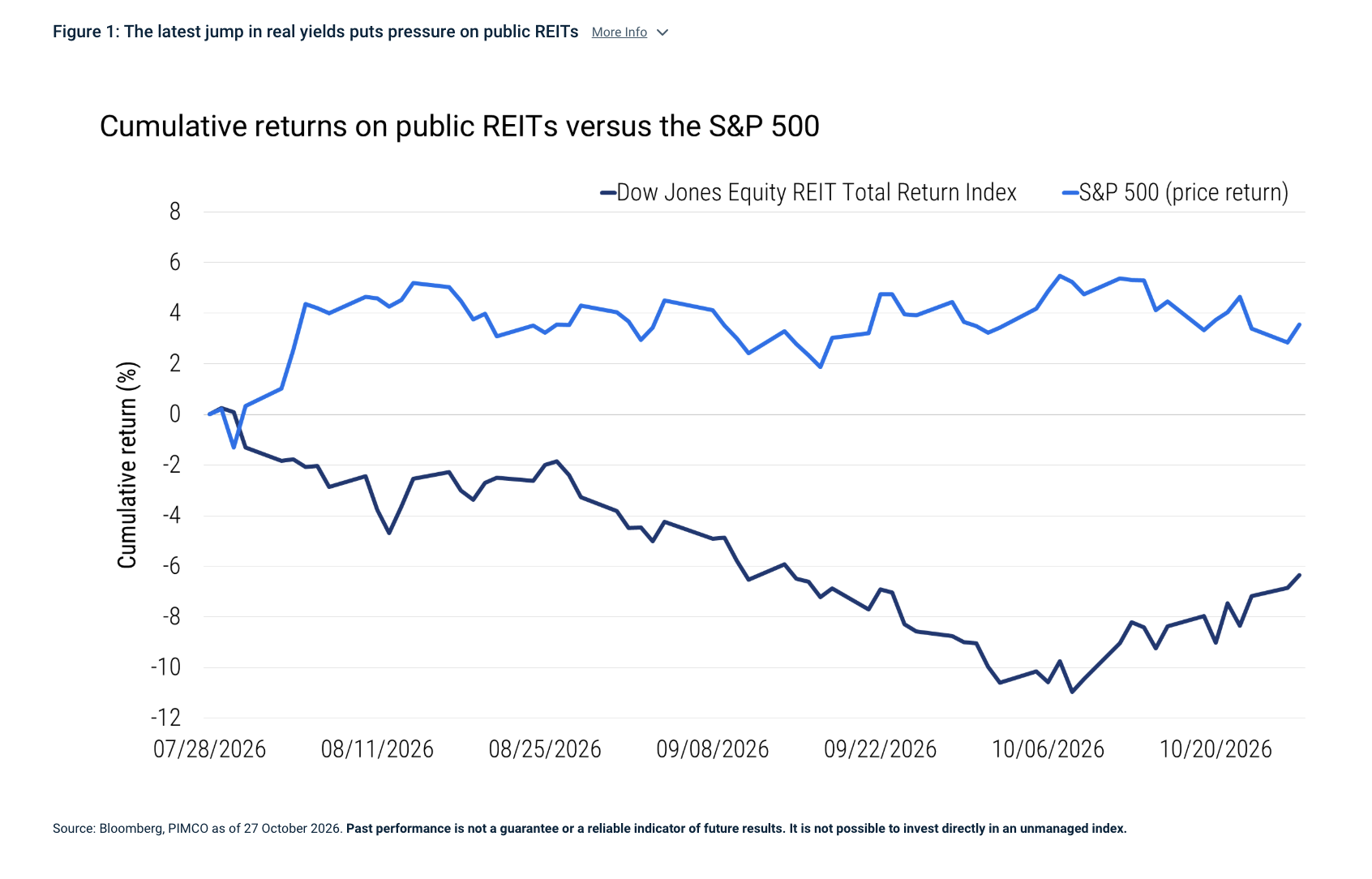
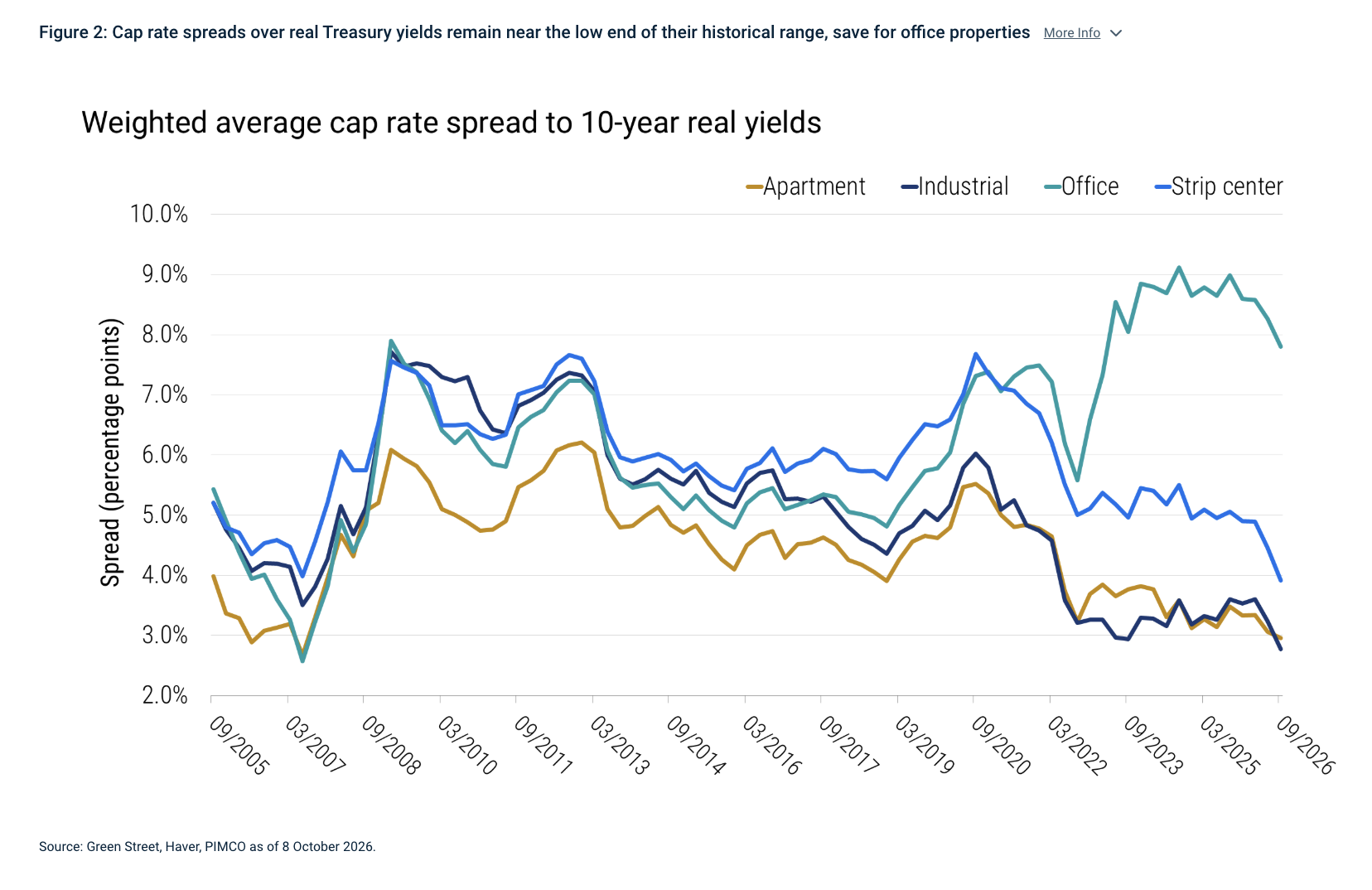
Recent decline notwithstanding, the reset higher in real yields has revived concerns about the commercial real estate (CRE) market. Public Real Estate Investment Trusts (REITs) sold off as real yields, or inflation-adjusted yields, rose in August and September, then regained some ground as yields declined in October. With cap-rate spreads over real Treasury yields near the low end of their historical range in most sectors, valuations remain exposed to renewed rate pressure, even without a deterioration in property fundamentals.
-
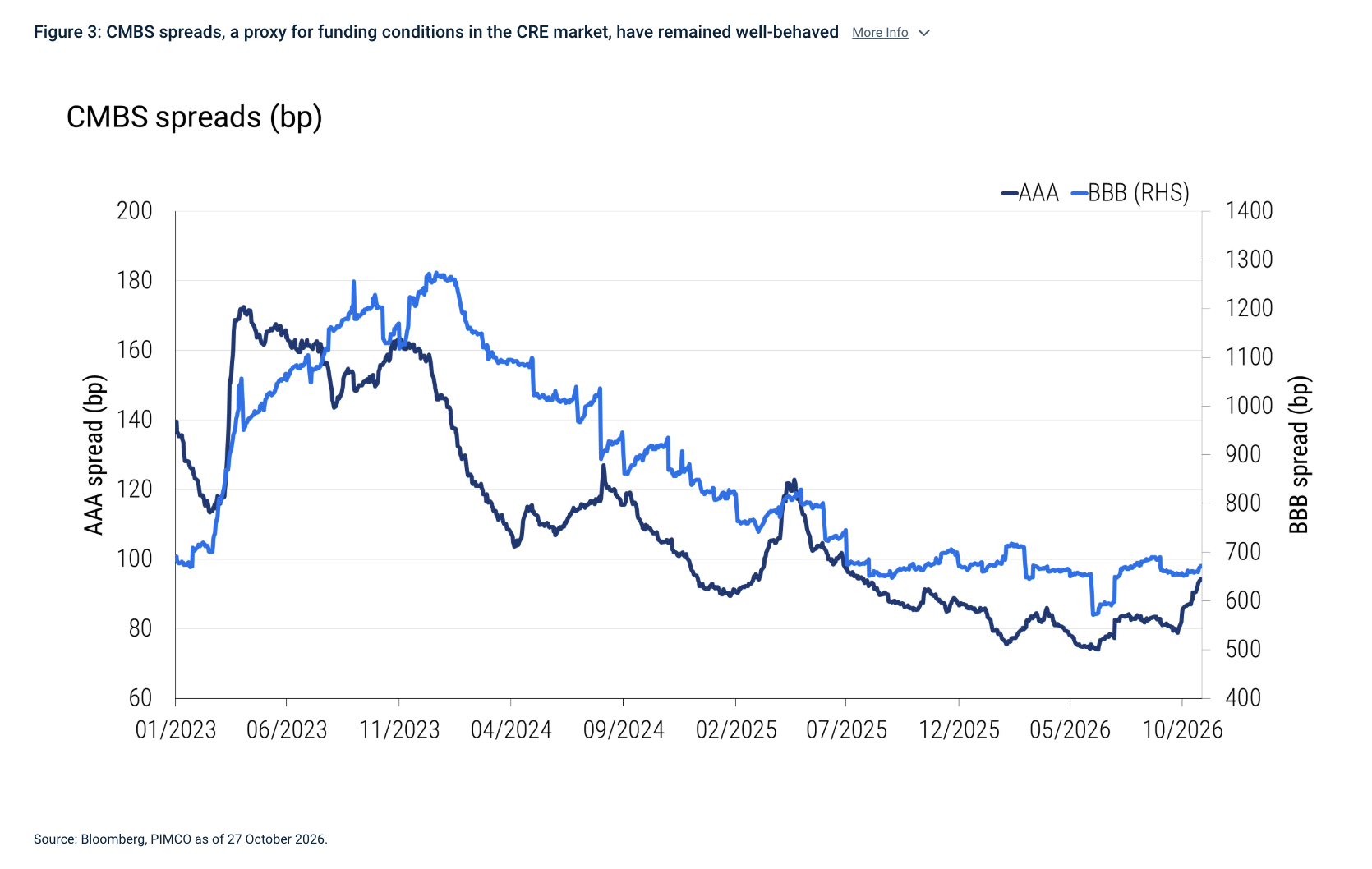
Credit markets, however, are not signaling a repeat of 2023. REIT bond spreads have broadly tracked the market, CMBS spreads have remained resilient, and issuance markets remain open. That contrasts with the funding shock that followed the regional banking crisis, when spreads widened sharply and private-label issuance stalled. Refinancing risks remain, particularly for weaker assets and borrowers, but the aggregate credit backdrop is healthier.
-
Several factors should make today’s adjustment less severe, though outcomes will vary across the market. Borrowing costs already start from a higher level, while several years of higher borrowing costs and tighter lending standards have favored lower leverage and stronger debt-service coverage. Credit availability has not contracted as it did in 2023, and most property sectors do not face the same structural demand shock that compounded the office downturn. Even so, elevated refinancing costs and differences by vintage, capital structure, and property type should sustain significant dispersion.
One concern raised by the recent backup in rates is whether CRE is about to relive the stress of 2023, when depressed post-pandemic office demand coincided with rising rates and a regional bank crisis, including Silicon Valley Bank and First Republic Bank. The selloff in public REITs suggests investors are repricing property values for a higher-rate world. Yet credit markets are sending a very different signal. While equity valuations have adjusted sharply, REIT bonds and CMBS have remained broadly resilient. That divergence suggests the current episode is more likely a valuation reset than the start of a broader credit deterioration.
REITs had a good run through late July, sold off in August and September as real yields moved higher, and have since staged a partial recovery. The broader message, though, is unchanged: property valuations remain sensitive to higher real rates (see Figure 1). A commonly used valuation metric in CRE is the capitalization, or “cap,” rate, which is simply the annual income yield on a property: net operating income (NOI) divided by its market value. A property generating $6 million of NOI and valued at $100 million therefore has a 6% cap rate. Because value equals NOI divided by the cap rate, the relationship works in reverse: if investors demand a higher yield to own the same property, its price has to fall.
See more: Higher Rates Put the AI Buildout to the Test
That is where real interest rates come into play. Commercial property is a real asset whose rents and income can adjust over time with inflation, so the relevant comparison is not simply between cap rates and nominal Treasury yields, but between cap rates and real risk-free yields. As real Treasury yields rise, investors can earn a higher inflation-adjusted return without taking property risk. Unless expected NOI growth improves, property yields therefore need to rise as well, which means valuations need to fall. A rise in nominal yields caused by higher inflation expectations is different: some of that inflation can ultimately feed through to rents and NOI.
Cap rates have already moved meaningfully higher since mid-2022, but their spread over real Treasury yields remains near the low end of its historical range, save for office properties (see Figure 2). That leaves property valuations sensitive to a further rise in real rates even without any deterioration in property fundamentals. For example, if a property's cap rate rises from 6% to 6.5% while NOI is unchanged, its value falls by roughly 8%. The recent REIT selloff therefore looks broadly consistent with investors pricing some of that valuation adjustment.
Credit, by contrast, has remained remarkably well-behaved. Both investment grade (IG) and high yield (HY) REIT bond spreads have moved largely in line with the market, while CMBS spreads have remained resilient (see Figure 3). CMBS origination volumes have softened in recent months, but the market remains open. That stands in sharp contrast to 2023. Following the regional banking crisis, spreads on BBB rated tranches of conduit CMBS, which are securitizations backed by diversified pools of commercial real estate loans, widened dramatically, multiple deals were pulled, and private-label issuance effectively ground to a halt. The key difference is that today’s rise in yields has not been accompanied by a comparable tightening in credit availability.
Is this time different? Most likely yes.
First, just as starting yields shape prospective returns for fixed income portfolios, the starting level of borrowing costs matters for CRE portfolios. The 2022–23 CRE shock repriced debt from near-zero rates. Today’s move begins from a much higher level of borrowing costs, so the incremental increase in debt-service burdens is considerably smaller.
Second, several years of tighter financing conditions have created a meaningful survivorship bias. Transactions completed during the post-2022 period generally had to work at higher rates, lower leverage, and stronger debt-service coverage ratios. As a result, the existing collateral pool is, on average, more resilient than the one that entered the tightening cycle.
Third, the 2023 CRE shock was never just a rates story. The regional banking crisis sharply reduced credit availability at precisely the wrong moment, amplifying the impact of higher rates through a simultaneous funding shock. Today’s backdrop looks very different. If anything, the policy direction has shifted toward easing constraints on bank lending. The March risk proposal from the OCC, Federal Reserve and FDIC would reduce standardized CRE risk weights and allow banks to retain more lower-Loan-To-Value (LTV) loans on balance sheet, providing a larger buffer than was available several years ago.
Finally, today’s environment lacks the secular-decline characteristics that defined much of the office market in 2023. At the time, higher rates coincided with a structural reassessment of office demand as hybrid work reduced space needs in many markets. Investors were revaluing not only the discount rate but also the cash flows themselves. Today’s CRE repricing is more of a discount-rate story than a secular-demand story. While certain property types continue to face idiosyncratic challenges, most sectors benefit from more stable demand and occupancy fundamentals.
Sector dispersion also matters. Retail and multifamily cap-rate spreads are already tight, limiting the scope for further compression and leaving valuations more exposed to higher Treasury yields. Multifamily fundamentals remain relatively supportive, but a large maturity wall and elevated refinancing costs provide an important counterweight.
Michael Puempel and Gabriel Cazaubieilh contributed to this report.
Disclosures
Statements concerning financial market trends or portfolio strategies are based on current market conditions, which will fluctuate. Outlook and strategies are subject to change without notice.
Past performance is not a guarantee or a reliable indicator of future results. Forecasts, estimates and certain information contained herein are based upon proprietary research and should not be considered as investment advice. There is no guarantee that stated results will be achieved.
All Investments contain risk and may lose value. High-yield, lower-rated, securities involve greater risk than higher-rated securities; portfolios that invest in them may be subject to greater levels of credit and liquidity risk than portfolios that do not. Investments in commercial real estate debt are subject to risks that include prepayment, delinquency, foreclosure, risks of loss, servicing risks and adverse regulatory developments, which risks may be heightened in the case of non-performing loans. Mortgage and asset-backed securities may be sensitive to changes in interest rates, subject to early repayment risk, and while generally supported by a government, government-agency or private guarantor there is no assurance that the guarantor will meet its obligations. Bond investments are subject to market, interest rate, issuer, credit, inflation, and liquidity risks. Bond prices generally fall when interest rates rise, with longer-duration bonds typically more sensitive to rate changes. Reduced market liquidity may increase price volatility. Investors may receive more or less than their original investment upon redemption. Equity investments may decline in value due to both real and perceived general market, economic and industry conditions. Investing in foreign denominated and/or domiciled securities may involve heightened risk due to currency fluctuations, and economic and political risks, which may be enhanced in emerging markets. Sovereign securities are generally backed by the issuing government. Investments with exposure to the artificial intelligence sector may involve heightened risks, including rapid technological change, competitive disruption, elevated valuations, regulatory uncertainty, data privacy and cybersecurity concerns, infrastructure dependencies, and reliance on third-party models or platforms. AI-related opportunities may not develop as expected, fail to produce anticipated productivity or revenue benefits, or be concentrated among a limited number of issuers, and could result in increased volatility or loss of capital. REITs are subject to risk, such as poor performance by the manager, adverse changes to tax laws or failure to qualify for tax-free pass-through of income. The value of real estate and portfolios that invest in real estate may fluctuate due to: losses from casualty or condemnation, changes in local and general economic conditions, supply and demand, interest rates, property tax rates, regulatory limitations on rents, zoning laws, and operating expenses.
The credit quality of a particular security or group of securities does not ensure the stability or safety of the overall portfolio. References to specific securities and their issuers are not intended and should not be interpreted as recommendations to purchase, sell or hold such securities. It is not possible to invest directly in an unmanaged index.
PIMCO as a general matter provides services to qualified institutions, financial intermediaries and institutional investors. Individual investors should contact their own financial professional to determine the most appropriate investment options for their financial situation. This material contains the opinions of the author and such opinions are subject to change without notice. This material has been distributed for informational purposes only and should not be considered as investment advice or a recommendation of any particular security, strategy or investment product. Information contained herein has been obtained from sources believed to be reliable, but not guaranteed. No part of this material may be reproduced in any form, or referred to in any other publication, without express written permission. PIMCO is a trademark of Allianz Asset Management of America LLC in the United States and throughout the world.
CMR2026-1030-6075708
A message from Advisor Perspectives and VettaFi: Discover something new! Click here to register for our upcoming webcasts.
© PIMCO
More Alternative Investments Topics >