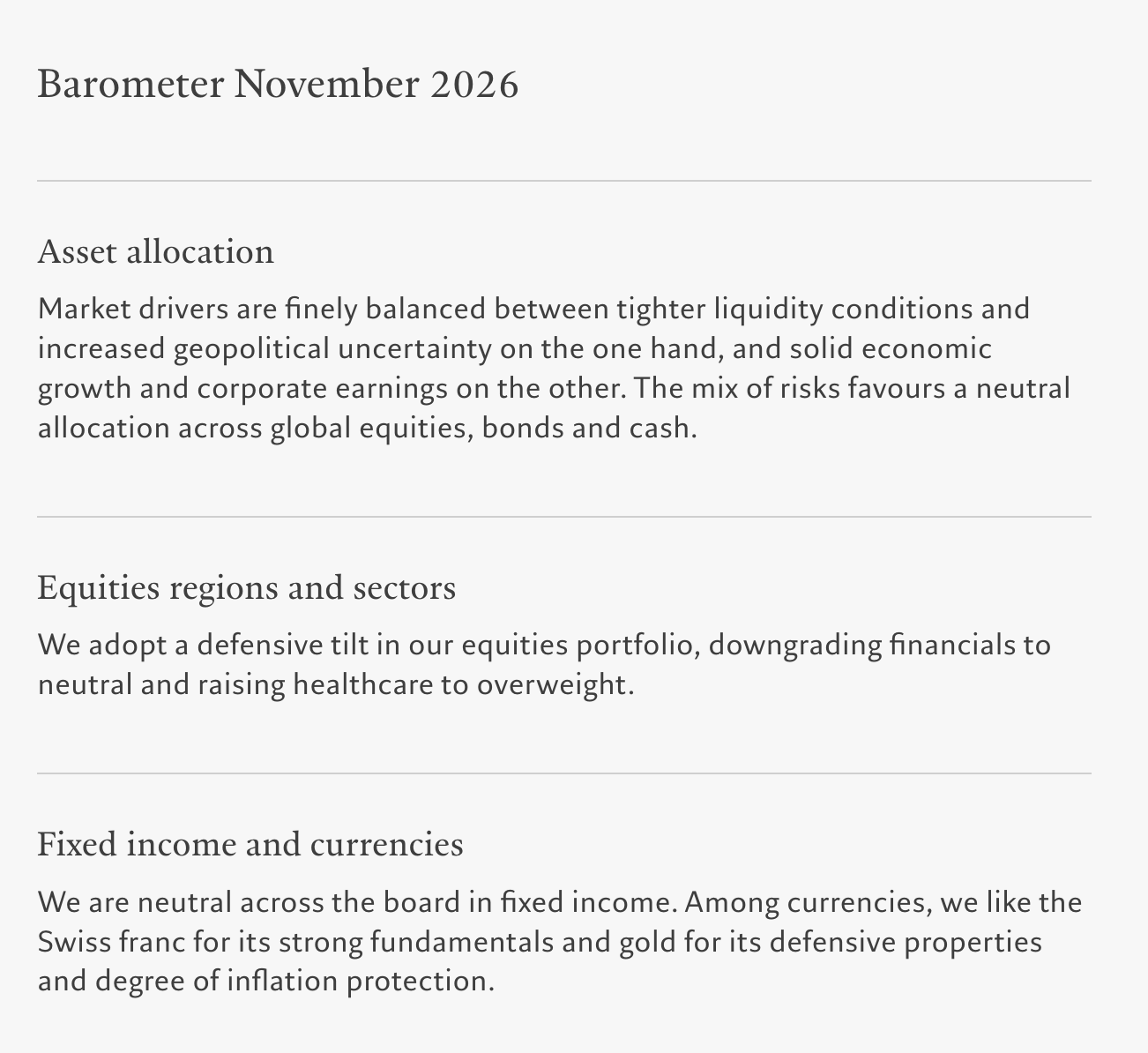
Asset allocation: dialling down equities as monetary conditions tighten
There is little doubt that financial conditions worldwide have become less favourable over the past several months. Government bond yields may have inched lower in October in much of the developed world but they remain some 30 basis points higher on average compared to the start of the year. At the same time, debt markets appear to be struggling to absorb the large volume of corporate bonds issued to fund the construction of AI infrastructure. Then there’s monetary policy. Central banks are set to raise borrowing costs further. The US Federal Reserve is likely to hike rates by at least another 25 basis points this cycle to rein in inflation that remains above its 2% target; the Bank of Japan and the European Central Bank will likely follow suit.
All of which explains why our models show that excess liquidity – money growth less nominal GDP growth, one of the pillars of our asset allocation model – has been shrinking across all major economies bar China.
Fig.1 - Monthly asset allocation grid November 2026
Source: Pictet Asset Management
This does not bode well for equities. And neither does the fraught geopolitical backdrop. In the US, investors are bracing for a potentially more unpredictable Trump administration if, as seems likely, the opposition Democrats secure control of both the House and the Senate in congressional elections. The picture on the other side of the Atlantic is perhaps even more concerning. There, the French government has so far failed to convince investors that it can deliver a budget that would reduce public sector deficit from the current 5.4% while dealing with social unrest.
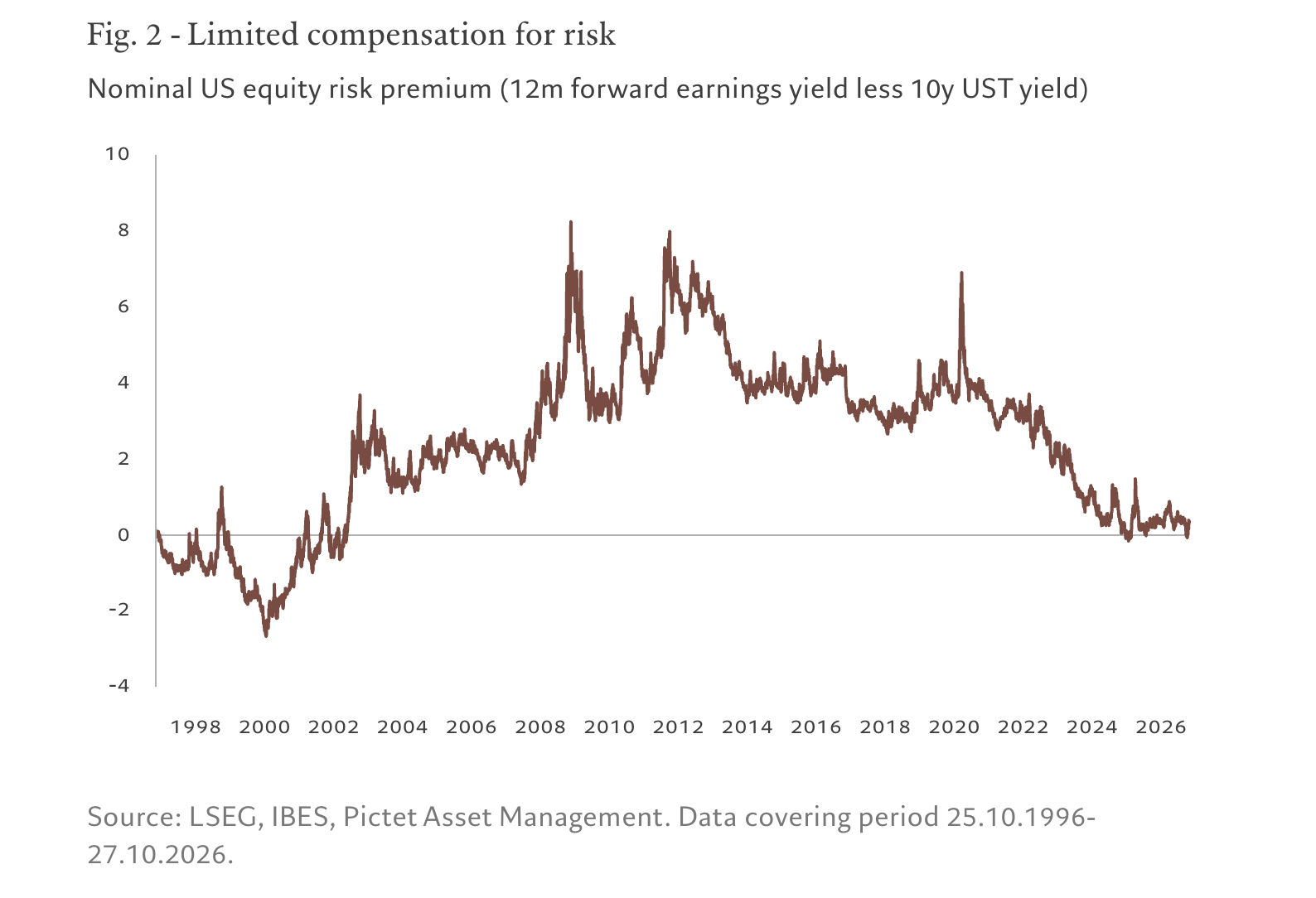
Valuations of stocks compared to bonds don’t look especially compelling either (see Fig. 2).
But the picture isn’t universally bleak. Economic growth remains healthy, with US and European GDP expanding at rates near to what we consider to their long-term potential. US corporate earnings should increase by some 15% next year even if, as we expect, profits among AI firms are less likely to outpace forecasts. Technical signals are also positive for stocks.
Taking all this into account, we have decided to downgrade equities but only to neutral – the risks of a correction in stocks are counterbalanced by some encouraging signs elsewhere. We leave our neutral stance on bonds unchanged as the clear value embedded in the asset class is unlikely to be unlocked in the absence of a wider growth shock.
Our business cycle indicators show generally healthy conditions across the developed world. US GDP growth is proving stronger than we had previously forecast. We now expect to see an expansion of about 2% both this year and next – in line with its long-term rate. Consumption and capital investment are likely to hold up well. Inflation meanwhile should peak by the first quarter of next year.
The European economy is also expected to be a bright spot. We see GDP growth rising to 1.4% next year from 1% this year, thanks to a pick up in defence spending and exports.
By contrast, the Chinese economy has undershot our expectations. While exports remain strong, the country’s weak property market and lacklustre consumer spending continue to weigh on overall growth.
Beyond China, however, emerging markets have proved remarkably resilient to an oil price rise that in the past would have hit growth. Asian economies in particular are benefiting from AI-related investment.
Our liquidity indicators show a sustained deterioration in financial conditions that is negative for riskier asset classes. Borrowing costs in the US, Europe and Japan are on the rise and we don’t see any reason to expect a pick up in lending among commercial banks. China is the only major economy where financial conditions are easing and we expect the central bank to provide more stimulus.
Our valuations analysis shows that, while equities have cheapened following the recent pullback in stock markets, they remain expensive, not least when compared to bonds. Bonds appear more or less fairly valued in aggregate. In government debt, there is value to be found in inflation-linked bonds in the US and UK.
Technical signals are broadly supportive for stocks. Seasonal readings are positive – equities tend to do well in November as institutional investors maintain their allocations ahead of a year-end rebalancing. However, hedge funds have reduced exposure to risk in general, and especially to the AI ecosystem, to match previous lows in such cycles.
Equities regions and sectors: recalibrating risk
Our more balanced stance on global equities is reflected in a slightly more conservative tilt across sectors and regions. The economic cycle, the earnings outlook and the technical backdrop all remain supportive, but in the short-term is balanced out by concerns regarding AI financing, elevated yields (as a result of competition for capital and fiscal concerns) and higher energy costs. The resulting balance, we believe, warrants a less cyclical equity position.
To this end, we downgrade financials to neutral. The earnings outlook has turned less positive, taking some of the shine off what are otherwise cheap valuations. And, although rising interest rates tend to boost banks’ lending margins, we believe markets are overestimating the potential for rate hikes in major developed economies.
Concerns about fiscal balances in Europe and the US present an additional risk, given banks’ extensive sovereign bond holdings.
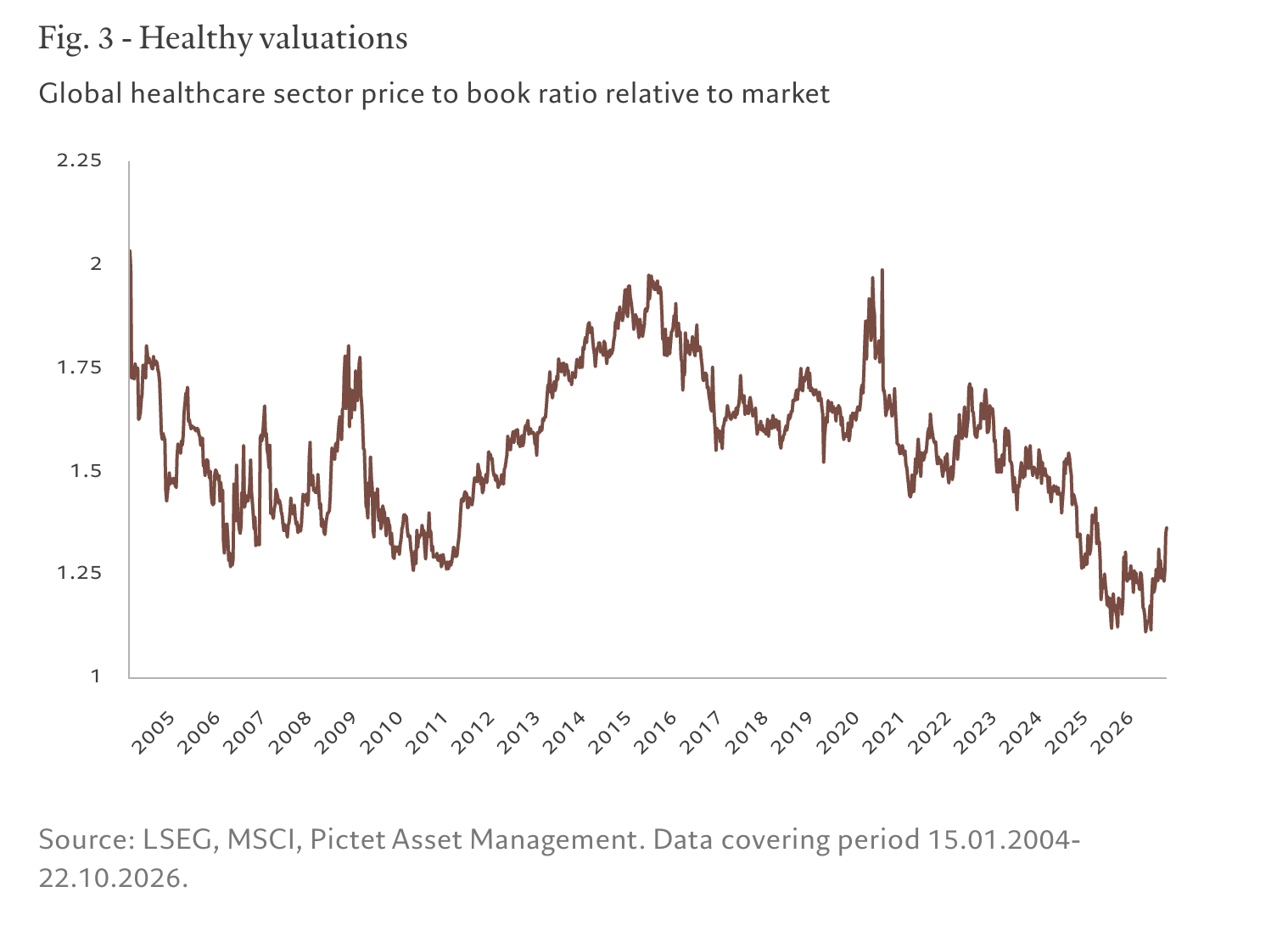
Our quality tilt is reinforced by an upgrade of healthcare stocks to overweight. Valuations have room to rise if investors move towards quality: healthcare’s price-to-book ratio relative to the broader market is currently 1.36 times, compared with a 20-year average of 1.56 times (see Fig. 3).
The sector is also well positioned to benefit from advances in AI, which are already speeding up diagnostics and drug discovery, improving efficiency and broadening access to care.
Despite recent turbulence, we remain overweight IT. AI-related earnings and investment remain strong despite greater scrutiny of financing and returns on capital.
Regionally, we still see strong potential in emerging markets ex-China. Emerging markets remain one of the strongest parts of the global economy. Higher commodity prices have been absorbed considerably better than in 2022, with stronger trade balances and much smaller currency depreciations limiting the tightening of financial conditions. Commodity exporters remain particularly well positioned, while Asian economies continue to benefit from the AI and global investment cycle. As a result, the profits outlook for emerging market companies is healthy: our model suggests earnings growth of 27% next year compared to 17% for global equities. Investment inflows into the asset class remain supportive, with investors keen to re-establish positions soon after any minor market fall.
However, we take a more cautious stance on Chinese equities, downgrading them to underweight. China is now the only negatively-rated country in our macroeconomic model, with domestic consumption and investment remaining weak.
In developed markets, we hold neutral positions in both US and European stocks. Economic activity in both regions is running at around potential. However, both also face fiscal and political risks, which deter us from increasing our allocations.
Fixed income and currencies: in search of havens
In fixed income and currencies we are aiming for a balanced portfolio with a marginally more defensive tilt.
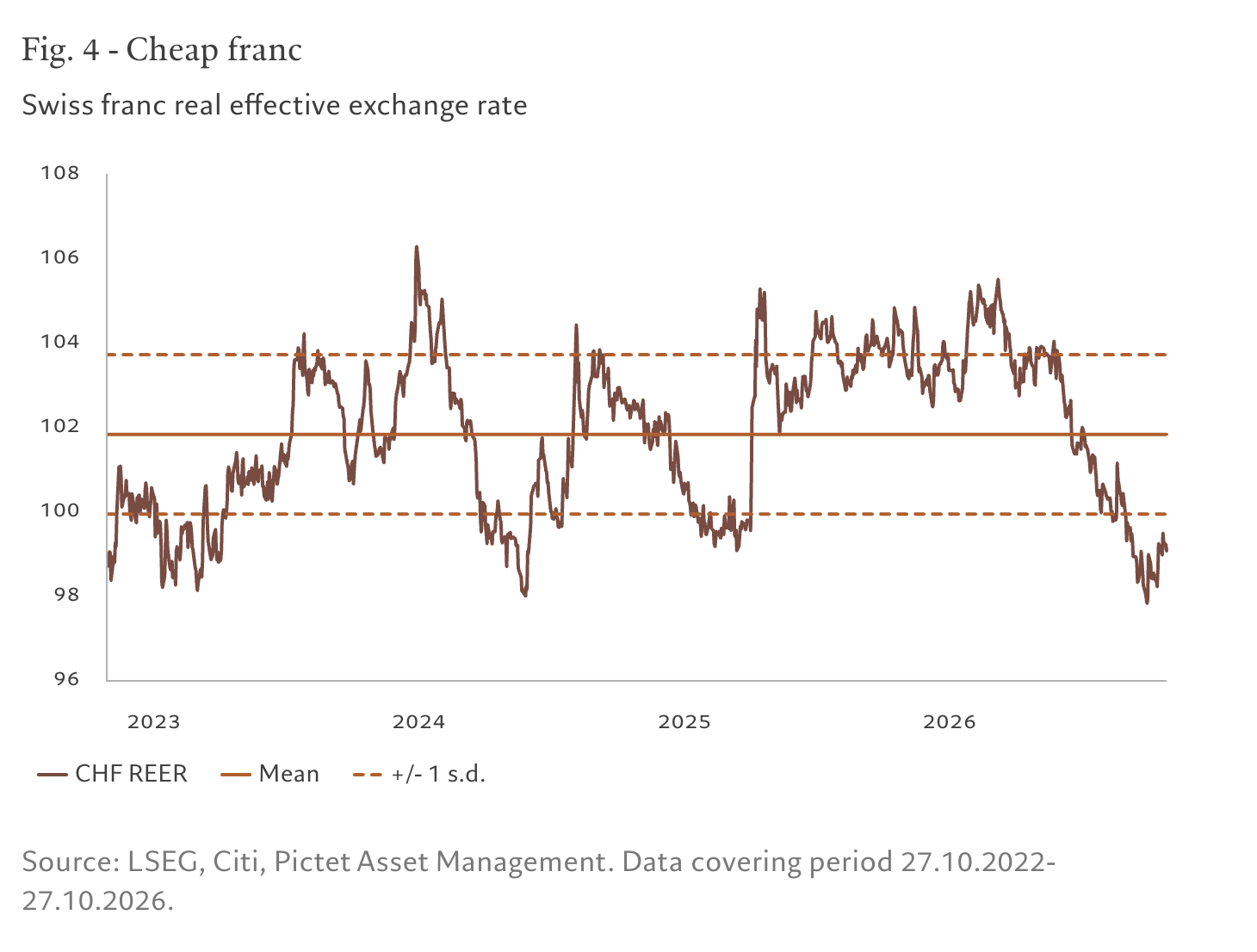
The main change to our positioning is an upgrade of the Swiss franc to overweight. The currency offers defensive properties while valuations are attractive following the recent sell-off. Based on the real effective exchange rate (REER), the franc is around 5% weaker than five months ago, putting it more than one standard deviation below its four-year average (see Fig. 4).
The franc is also supported by solid fundamentals. We expect the Swiss economy to expand by some 2.5% this year, comfortably above its long-term potential rate of 1.7% and compared with near-potential growth in the euro area and the US.
The resilient economy, combined with a modest pick-up in inflation, should pave the way for one or two interest rate hikes over the coming year, which is broadly in line with market pricing. Conversely, in the US we believe market expectations of rate hikes could be overdone; if these expectations are pared back, pricing could move in favour of the Swiss franc.
We also retain an overweight in gold. Although its valuations remain stretched relative to its 20-year history, the asset offers inflation protection and defensive properties, supporting continued strong investment flows.
In fixed income, our positioning is neutral across the board. Although the recent rise in yields has made valuations more attractive for both credit and government bonds, the immediate environment still favours selective exposure rather than a major directional move into bonds. Technical trend signals are also yet to turn positive.
The higher yields on US, UK and French government bonds are at least partially justified by greater fiscal concerns. We would like to see these concerns dissipate before increasing positions.
At the same time, the higher yields on offer in developed markets have reduced the carry offered by emerging market debt. We therefore take the opportunity to bank some profits, reducing our position in local currency bonds (ex-China) to neutral from overweight.
In credit, the focus of attention remains the boom in AI-related borrowing. We believe this creates an important supply and duration risk rather than a leverage problem. Estimates suggest that hyperscalers could account for up to 11% of US investment grade bonds by the end of next year, up from roughly 5.5% currently. With such issuers having preferred to borrow at longer maturities, they already account for a quarter of the 30-year US investment grade bucket.
The health of the credit market thus hinges on continued resilience in corporate earnings (in tech and beyond), ideally combined with a normalisation in inflation.
Global markets overview: stocks suffer in a volatile month
October proved to be an especially volatile month for the global equity and fixed income markets.
World stocks fell some 1.5% with the unravelling of the AI trade at the centre of the storm. The tech-heavy Nasdaq index recorded its worst month in more than a year, while the Philadelphia Semiconductor Index lost more than 7% on October 31 alone.
The IT and telecom sectors were among the hardest hit as concerns about the scale and returns of AI infrastructure spending weighed on hyperscalers, semiconductor companies and industrial stocks linked to data centre construction.
Emerging Asian stocks, among the mosts exposed to the tech trade, were the worst performer with a loss of over 8% in local currency terms in the month. Other emerging regions and Japanese stocks fell between 4-7%. Swiss and UK stocks outperformed as investors rotated away from tech-driven markets into energy and defensive sectors of healthcare and consumer staples.
Global government bonds ended the month up 1.4% as the asset class attracted flight-to-safety flows.
US Treasuries were the top performers with a gain of over 3%. Reflecting the scale of the turbulence, the benchmark 10-year yields rose during the month to around the 5.4%, the highest since 2002, as concerns intensified about inflation and heavy government borrowing. The yields then fell back, registering their largest monthly decline since December 2023.
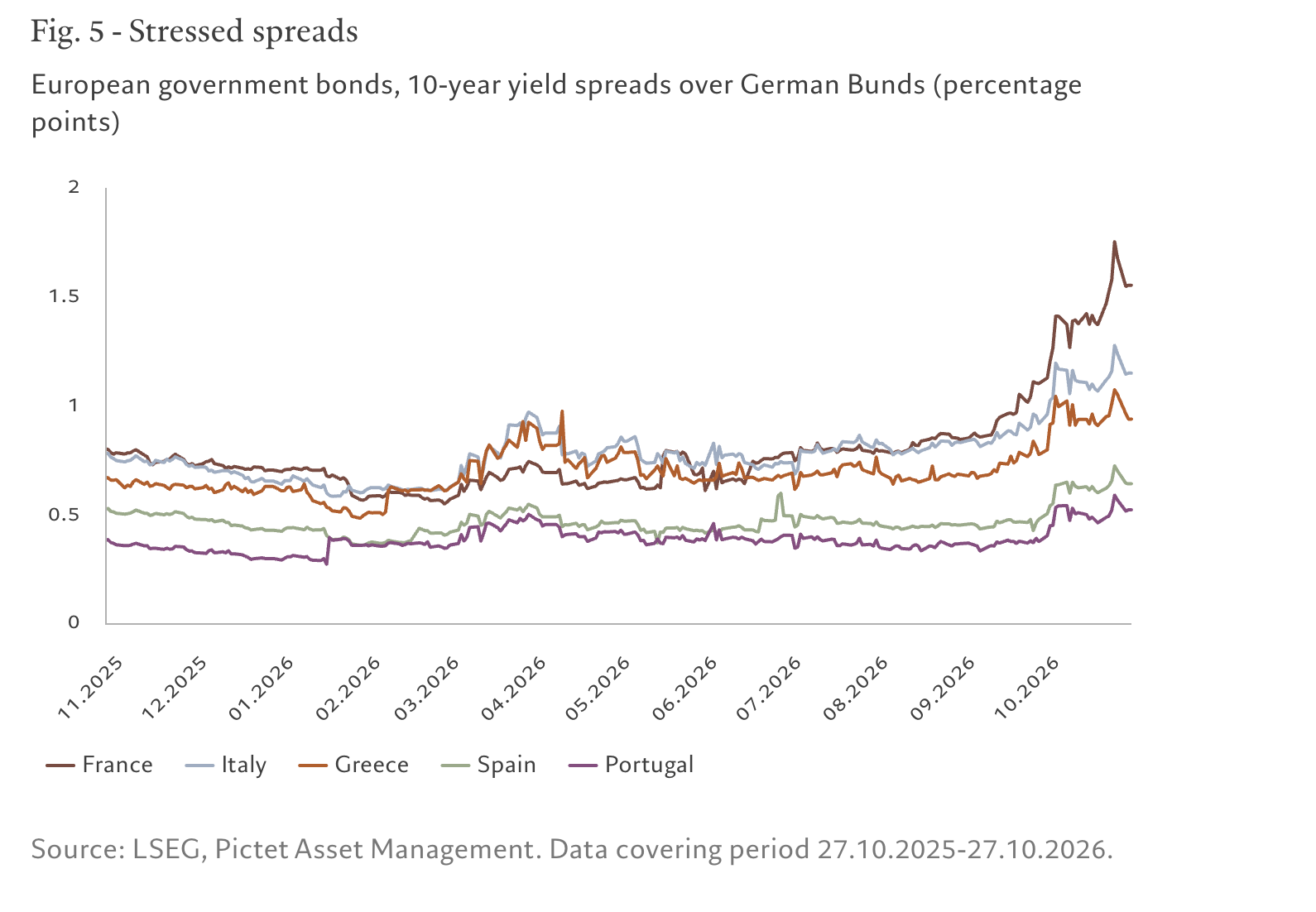
European government bonds ended up 2% in a month that saw French government bond yields rising sharply because of concerns over the state of France’s public finances. The sell-off in French OATs briefly pushed the spread over bunds to 160 basis points – its highest since 2012 (see Fig. 5).
Corporate bonds were mixed as high-quality investment grade held up better than the weakest high-yield segments. US investment grade gained the most, ending the month up 2%, while US high yields were nearly flat. European high yields fell 1% as spreads widened sharply.
In currencies, the safe-haven Swiss franc outperformed with a gain of 1.4%. The dollar recorded a modest gain of 0.4% at the expense of the euro, which fell 1.7%. Other major developed currencies were broadly unchanged, while emerging market currencies fell some 0.5%.
Gold fell more than 6% as growing expectations of central bank interest rate hikes have made the precious metal, which offers no yield, less attractive.
In brief
Important information
Marketing communication
The information and data presented in this document are not to be considered as an offer or solicitation to buy, sell or subscribe to any securities or financial instruments or services. The information used in the preparation of this document is based upon sources believed to be reliable, but no representation or warranty is given as to the accuracy or completeness of those sources. Information, opinions and estimates contained in this document reflect a judgment at the original date of publication and are subject to change without notice. This material does not contain sufficient information to support an investment decision and it should not be relied upon by you in evaluating the merits of investing in any products or services offered or distributed by Pictet Asset Management. Pictet Asset Management has not ensured the suitability of the securities mentioned in this document for any specific investor, and it should not be relied upon as a substitute for independent judgment; investors are advised to determine the suitability of the investment based on their financial knowledge, experience, goals and situation, or to seek specific advice from an industry professional before making any investment decisions. Investors should read the prospectus or offering memorandum before investing in any Pictet managed funds. Tax treatment depends on the individual circumstances of each investor and may be subject to change in the future. Past performance is not a guide to future performance. The value of investments and the income from them can fall as well as rise and is not guaranteed. Investors may not get back the amount originally invested.