October reminded investors that markets rarely move in response to a single factor. The US economy continued to expand at a moderate pace, supported by healthy consumer spending and solid business activity, even as markets contended with higher energy prices, renewed inflation concerns and heightened geopolitical tensions.
Demonstrating the month’s push and pull churn, rising oil prices added to inflation expectations – which can lead to higher Treasury yields – while concerns surrounding AI spending and challenges overseas heightened demand for US Treasurys, lowering yields. The outcome: The 10-year Treasury yield declined, and longer-term bonds benefited as investors sought safety.
Equities remained relatively resilient despite the volatility and concerns surrounding the sustainability of AI-related financing and investment. Weaknesses in areas closely tied to AI were offset by strength in more value-oriented sectors. Moderating interest rates also helped improve sentiment toward traditionally rate-sensitive areas of the market, helping to broaden it beyond growth and technology.
See more: Strong But Concentrated Economic Growth
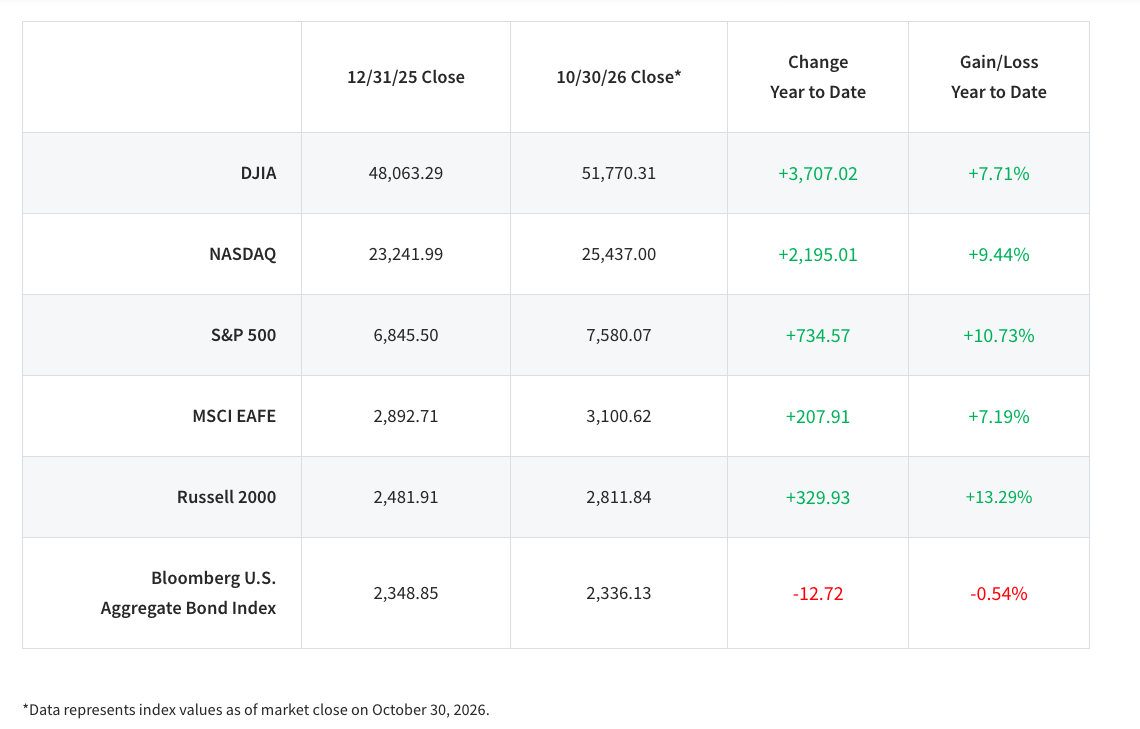
According to Chief Investment Officer Larry Adam, “Volatility gets investors’ attention, but it shouldn’t change their game plan. In fact, this is exactly why diversification matters. The technology and communication services sectors were both down more than 7% this month, yet most other sectors were higher, and bonds helped cushion the portfolio as yields fell. The other key is perspective. Despite the recent volatility, most major equity indices are still up double digits this year, and technology is up nearly 20%. Successful investing isn’t about avoiding every market pullback. It’s about staying disciplined, staying diversified and staying invested.”
Before we get into the details, let’s look at where the major indices stand.
Growth continued as inflation pressures build
Economic data continued to point to an expanding US economy, although the picture was far from uniform. Both manufacturing and services remained in expansion territory, and industrial production increased more than expected. Durable goods orders also pointed to continued investment in AI and data centers. Against a backdrop of growing pressure from inflation and a softening labor market, nonfarm payrolls rose only slightly, while the Producer Price Index saw its largest increase since March 2022. Much of that increase came from fuel prices, underscoring how energy market disruptions are affecting production costs. At its October Federal Open Market Committee meeting, the Federal Reserve held interest rates steady, as policymakers indicated they would wait for further data to assess the effects of September’s rate increase.
Geopolitical risks remained in focus
Geopolitical developments took center stage in Washington during October, with Iran posing the largest threat. The US expanded its regional military presence as attacks on Gulf shipping and energy infrastructure contributed to elevated oil and diesel prices. The administration responded with several measures intended to provide relief from diesel prices, including temporarily expanding use of tax-exempt dyed diesel and pursuing greater fuel supplies. Those efforts offered some near-term relief to fuel-intensive industries, though they do not address the underlying supply constraints.
A shift in the rate outlook
One of October's more notable market developments came from fixed-income markets. Weaknesses tied to AI technology sparked a late-month push toward Treasury securities, lowering yields, even as inflation data ran hot. Headline consumer inflation and producer prices rose more than expected. Oil prices also remained elevated. Those conditions would ordinarily exert upward pressure on yields, but demand for safety became strong enough to counteract the influence from inflation and economic resilience.
Diesel costs rippled through the economy
Higher energy prices took a toll well beyond the gas pump last month. Diesel fuel has been particularly affected by disruptions stemming from Russia's war in Ukraine and the US-Iran conflict, with prices more than doubling year-to-date and approaching record highs. Since diesel fuels trucking, freight railroads and much of the nation's agricultural equipment, sustained price increases can cascade down supply chains and increase the cost of transporting goods. The effects can also vary considerably by region. New England households have relatively high exposure to heating oil – another term for diesel – while farmers in the Midwest face higher diesel costs compounded with higher fertilizer costs.
Stocks diverged over ties to AI
The headline performance of the stock market did not tell the full story in October. The S&P 500 had moved largely sideways since early August, but beneath the surface nearly half of S&P Composite 1500 stocks, representing about nine-tenths of the US market by capitalization, were well below their highs. The market has also become increasingly divided between companies closely tied to AI and the rest of the index. That segmentation reinforces the importance of diversification as leadership rotates.
France put fiscal discipline in the spotlight
France was the standout development in international markets during October. The country's fiscal challenges intensified as political and public opposition complicated efforts to reduce government spending and stabilize its debt burden. Those concerns spilled into the sovereign bond market, with France's 10-year government bond yield rising above multi-year highs, while its yield spread over comparable German government bonds widened sharply. France's primary budget deficit is substantially larger than those of other major euro area economies, increasing pressure on policymakers to pursue fiscal consolidation despite resistance to proposed austerity measures.
The bottom line
October highlighted that markets rarely follow clean narratives, and outcomes are the sum of often intense competing forces. The economy continues to expand and corporate fundamentals remain supportive, but investors are also navigating a variety of potentially destabilizing headwinds. These factors can create periods of volatility and lead to rapid changes in market leadership. Diversification across asset classes, sectors and regions can help investors navigate those shifts while remaining focused on the economic and corporate fundamentals that ultimately matter most over the long term.
Investing involves risk, and investors may incur a profit or a loss. All expressions of opinion reflect the judgment of the Raymond James Chief Investment Officer and are subject to change. There is no assurance the trends mentioned will continue or that the forecasts discussed will be realized. Past performance may not be indicative of future results. Economic and market conditions are subject to change. Diversification does not guarantee a profit nor protect against loss.
The Dow Jones Industrial Average is an unmanaged index of 30 widely held stocks. The NASDAQ Composite Index is an unmanaged index of all common stocks listed on the NASDAQ National Stock Market. The S&P 500 is an unmanaged index of 500 widely held stocks. The MSCI EAFE (Europe, Australasia and Far East) index is an unmanaged index that is generally considered representative of the international stock market. The Russell 2000 is an unmanaged index of small-cap securities. The Bloomberg Barclays US Aggregate Bond Index is a broad-based flagship benchmark that measures the investment grade, US dollar-denominated, fixed-rate taxable bond market. An investment cannot be made in these indexes. The performance mentioned does not include fees and charges, which would reduce an investor’s returns. Consumer Price Index (CPI) A consumer price index is a price index, the price of a weighted average market basket of consumer goods and services purchased by households. Consumer Sentiment is a consumer confidence index published monthly by the University of Michigan. The index is normalized to have a value of 100 in the first quarter of 1966.
Companies engaged in business related to a specific sector, including the technology sector, are subject to fierce competition and their products and services may be subject to rapid obsolescence. There are additional risks associated with investing in an individual sector, including limited diversification. Bond prices and yields are subject to change based upon market conditions and availability. If bonds are sold prior to maturity, you may receive more or less than your initial investment. Income from municipal bonds is not subject to federal income taxation; however, it may be subject to state and local taxes and, for certain investors, to the alternative minimum tax. Income from taxable municipal bonds is subject to federal income taxation, and it may be subject to state and local taxes.
Investing in oil or the energy sector involves special risks, including the potential adverse effects of state and federal regulation and may not be suitable for all investors. Investing in small-cap stocks generally involves greater risks, and therefore, may not be appropriate for every investor. The prices of small company stocks may be subject to more volatility than those of large company stocks. International investing involves additional risks such as currency fluctuations, differing financial accounting standards, and possible political and economic instability. These risks are greater in emerging markets.
Material created by Raymond James for use by its advisors.
A message from Advisor Perspectives and VettaFi: Discover something new! Click here to register for our upcoming webcasts.
Links are being provided for information purposes only. Raymond James is not affiliated with and does not endorse, authorize or sponsor any of the listed websites or their respective sponsors. Raymond James is not responsible for the content of any website or the collection or use of information regarding any website's users and/or members.
Raymond James & Associates, Inc., member New York Stock Exchange / SIPC, and Raymond James Financial Services, Inc., member FINRA / SIPC, are subsidiaries of Raymond James Financial, Inc.
Raymond James® and Raymond James Financial® and power of personal® are registered trademarks of Raymond James Financial, Inc.
© Raymond James
More Tax Loss Harvesting Topics >