Key takeaways:
- Divided government makes major federal policy changes unlikely.
- Data center moratorium proposals in Texas, Georgia and Ohio raise risks for AI infrastructure development.
- The election leaves our broad market outlook unchanged, while adding political and execution risks to watch into 2027.
Democrats sweep the midterms
Democrats are projected to take control of both chambers of Congress, with a larger-than-expected Senate gain and decisive wins in several states central to the AI buildout.
See more: What Midterm Election Results Could Mean for the Market Outlook
The results will leave Washington divided through 2028, limiting the scope for major federal policy changes. At the state level, however, incoming governors have proposed restrictions that could affect the pace of AI infrastructure investment.
How markets are reacting
Markets rallied following the Democratic sweep as election uncertainty faded and investors anticipated greater limits on the administration's agenda. S&P 500 futures reversed early losses to gain 1%, while Nasdaq 100 futures also moved higher.
The dollar fell against all major currencies, while the 10-year Treasury yield declined two basis points to 4.93%. Investors appear to be pricing in less fiscal expansion and government borrowing, easing pressure on bond yields. Lower yields, combined with resilient economic growth, have also supported equities.
Not all stocks benefited. Tesla and SpaceX came under pressure following Democratic victories in Texas, while oil prices declined after President Trump indicated he had no immediate plans for strikes on Iran.
Historically, markets have tended to rise following midterm elections as uncertainty fades. The focus now turns to which proposals become policy and whether they affect the economic growth and corporate earnings supporting markets.
Pressure on spending
Even with 55 Senate seats, Democrats lack the votes to override a presidential veto, making major new legislation and spending programs difficult to pass.
Democrats are likely to prioritize initiatives such as expanding access to Medicaid and SNAP benefits, along with greater oversight of the administration. However, divided government will constrain their ability to enact major changes, leaving much of the current tax and spending policy intact.
Congress could also constrain the administration's proposed $1.5 trillion defense budget for 2027, while trade policy remains largely under executive control.
Corporate earnings are expected to remain above trend, and the immediate impact on economic growth and inflation appears limited. While a decisive Democratic victory raises questions about corporate tax policy after 2028, it is too early to price a future administration's agenda into markets.
Implications for data center development
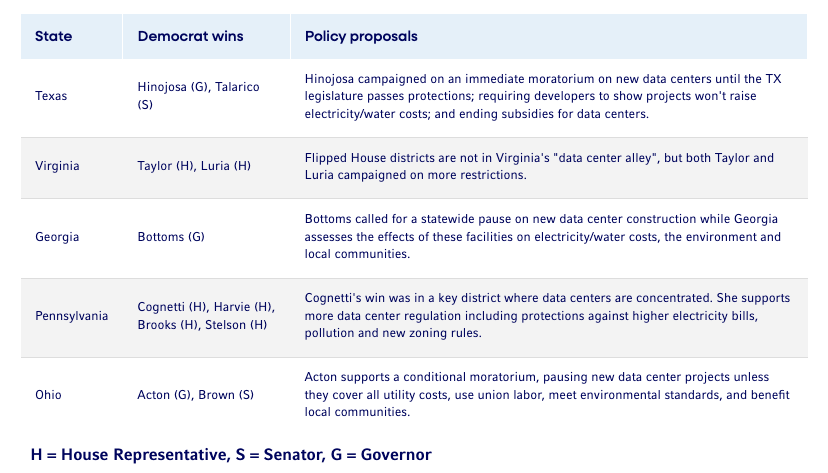
For the first time since 1987, Democrats will hold the governorships of Texas, Georgia and Ohio. All three incoming governors have supported proposals to pause or restrict new data center development.
Source: Russell Investments, Aterio, public comments of officials. November 3, 2026.
The effects could extend beyond data center developers to construction, HVAC and electrical equipment, industrial machinery, utilities and AI hardware. Restrictions that delay projects or raise development costs could affect both corporate earnings and the pace of AI-related investment.
What we're continuing to watch
Data center restrictions. Whether campaign proposals become law, particularly in Texas, where the development pipeline is largest. The scope and timing of any moratorium will determine how much planned investment is affected.
AI investment and economic growth. Whether higher costs and project delays begin to affect capital spending. AI infrastructure has been an important contributor to growth, making the pace of development consequential for the broader economy.
Corporate earnings and supply chains. Whether slower construction affects demand for semiconductors, electrical equipment and other infrastructure, including suppliers across Asia.
Federal spending and fiscal policy. Whether divided government constrains defense spending, delays budget agreements or raises the risk of a debt ceiling standoff.
Corporate tax policy. Whether investors begin pricing in the possibility of higher corporate taxes after the 2028 election, even as existing policies remain largely intact.
Our market outlook
We do not see the election as a reason to change our broad market outlook. The global economy remains resilient and corporate earnings are robust. The results do, however, raise new political and execution risks around the AI infrastructure cycle that bear watching into 2027.
A message from Advisor Perspectives and VettaFi: Discover something new! Click here to register for our upcoming webcasts.
The information, analyses and opinions set forth herein are intended to serve as general information only and should not be relied upon by any individual or entity as advice or recommendations specific to that individual entity. Anyone using this material should consult with their own attorney, accountant, financial or tax adviser or consultants on whom they rely for investment advice specific to their own circumstances.
Products and services described on this website are intended for United States residents only. Nothing contained in this material is intended to constitute legal, tax, securities, or investment advice, nor an opinion regarding the appropriateness of any investment, nor a solicitation of any type. The general information contained on this website should not be acted upon without obtaining specific legal, tax, and investment advice from a licensed professional. Persons outside the United States may find more information about products and services available within their jurisdictions by going to Russell Investments' Worldwide site.
Russell Investments is committed to ensuring digital accessibility for people with disabilities. We are continually improving the user experience for everyone, and applying the relevant accessibility standards.
Russell Investments' ownership is composed of a majority stake held by funds managed by TA Associates Management, L.P., with a significant minority stake held by funds managed by Reverence Capital Partners, L.P. Certain of Russell Investments' employees and Hamilton Lane Advisors, LLC also hold minority, non-controlling, ownership stakes.
On July 2, 2026, Russell Investments Group, Ltd. (“Russell Investments”) entered into a definitive agreement and plan of merger (the “Transaction”) pursuant to which Russell Investments will be acquired by a consortium led by B Capital Group Management, L.P. that includes California Public Employees Retirement System. The Transaction is expected to close by the end of Q1 2027, subject to the receipt of regulatory approvals and other customary closing conditions.
Frank Russell Company is the owner of the Russell trademarks contained in this material and all trademark rights related to the Russell trademarks, which the members of the Russell Investments group of companies are permitted to use under license from Frank Russell Company. The members of the Russell Investments group of companies are not affiliated in any manner with Frank Russell Company or any entity operating under the "FTSE RUSSELL" brand.
© Russell Investments Group, LLC. 1995-2026. All rights reserved. This material is proprietary and may not be reproduced, transferred, or distributed in any form without prior written permission from Russell Investments. It is delivered on an "as is" basis without warranty.
© Russell Investments
More Tax Loss Harvesting Topics >