The DC plan’s next evolution could help participants turn savings into income more easily.
Retirement confidence is a matter of perspective. While many defined contribution (DC) plan participants believe they’re making progress toward retirement savings, relatively few are certain they’ll have what they need at the finish line. And when the conversation shifts from turning savings into the increasingly important final step of generating sustainable income, their understanding becomes even less clear, according to our latest survey.
Savings Confidence Improves but Only So Far
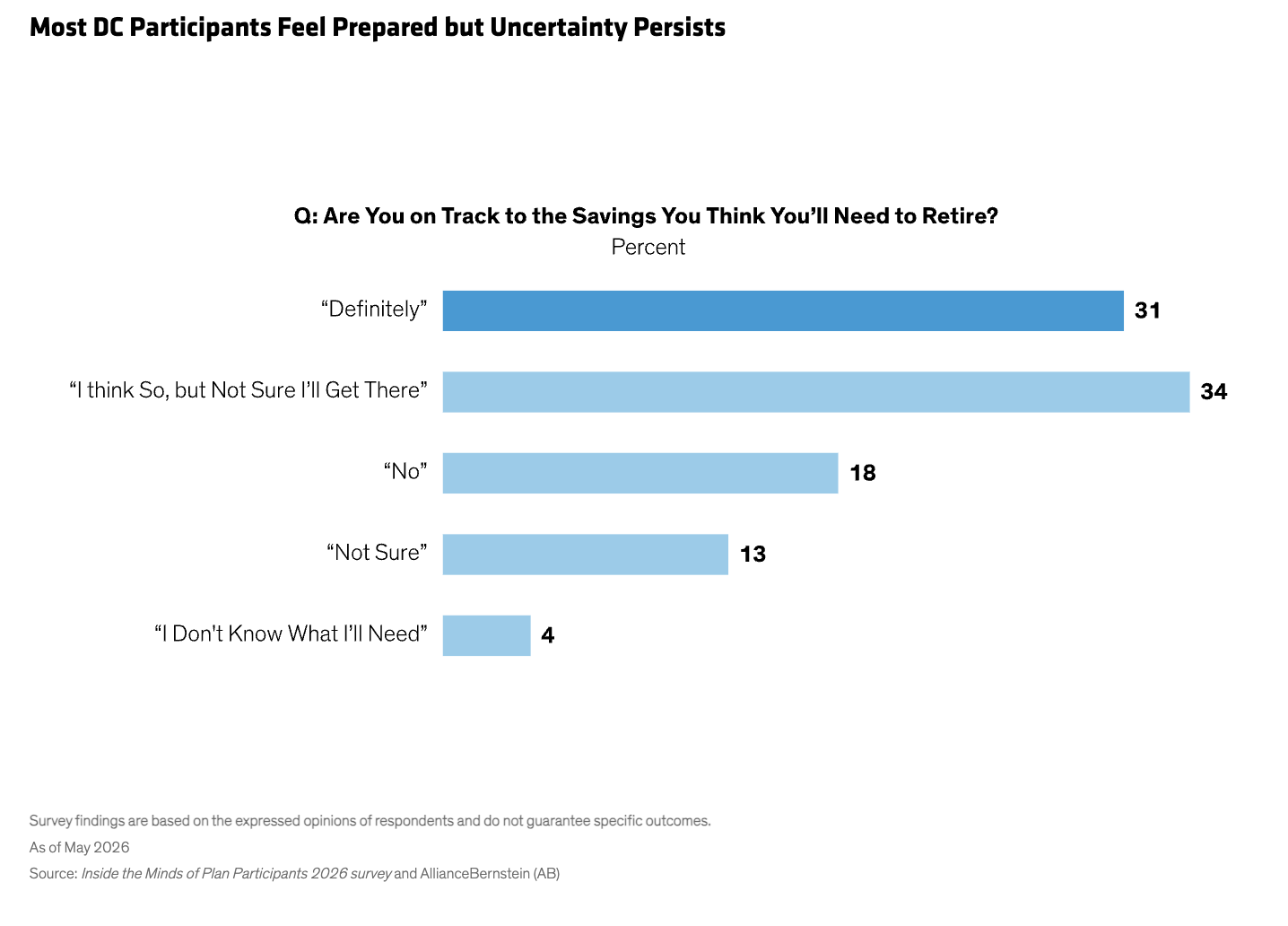
There’s still a considerable gap between participants who believe they’re retirement-ready and those uncertain about it, according to AB’s Inside the Minds of Plan Participants 2026 survey. While confidence in savings is up slightly, only 31% of participants definitively believe they’re on track to accumulate enough for retirement (Display). Another 34% think they’re on the right path but aren’t sure they’ll arrive. The rest either feel they’re clearly not on track, aren’t sure or don’t know how much savings they’ll need.
Uncertainty about retirement extends to the income phase as well as the accumulation phase. We’ve seen a stubborn income-knowledge gap that hasn’t improved much in the six years we’ve raised the topic. Systematic withdrawals, such as taking out a set amount or regular payments, are common retirement-income choices.
See more: Tuning Up Your Growth Engine
But only 7% of participants in AB’s survey believe they can withdraw a conservative 1%– 3% of savings, which in our view won’t provide enough income to meet their needs. Another 27% estimate 4%–6% withdrawals, while a striking 66% believe they can take 7% or more, potentially risking running out of money. Industry consensus generally points closer to a 3%–4% range—although this can still be challenged by a market downturn near or early in retirement.
To us, the implication is straightforward: saving for retirement is now table stakes, and turning that savings into lifetime income has become just as pressing, if not more so, for participants and plan sponsors.
Participants Want Income but With Control of Their Assets
Participants’ preferences point to two key needs: flexibility and certainty. When participants chose between two retirement-income approaches, 61% preferred the one with lower guaranteed annual income but with continued market growth potential and access to principal. The remainder favored a higher income payout but without growth potential or liquidity.
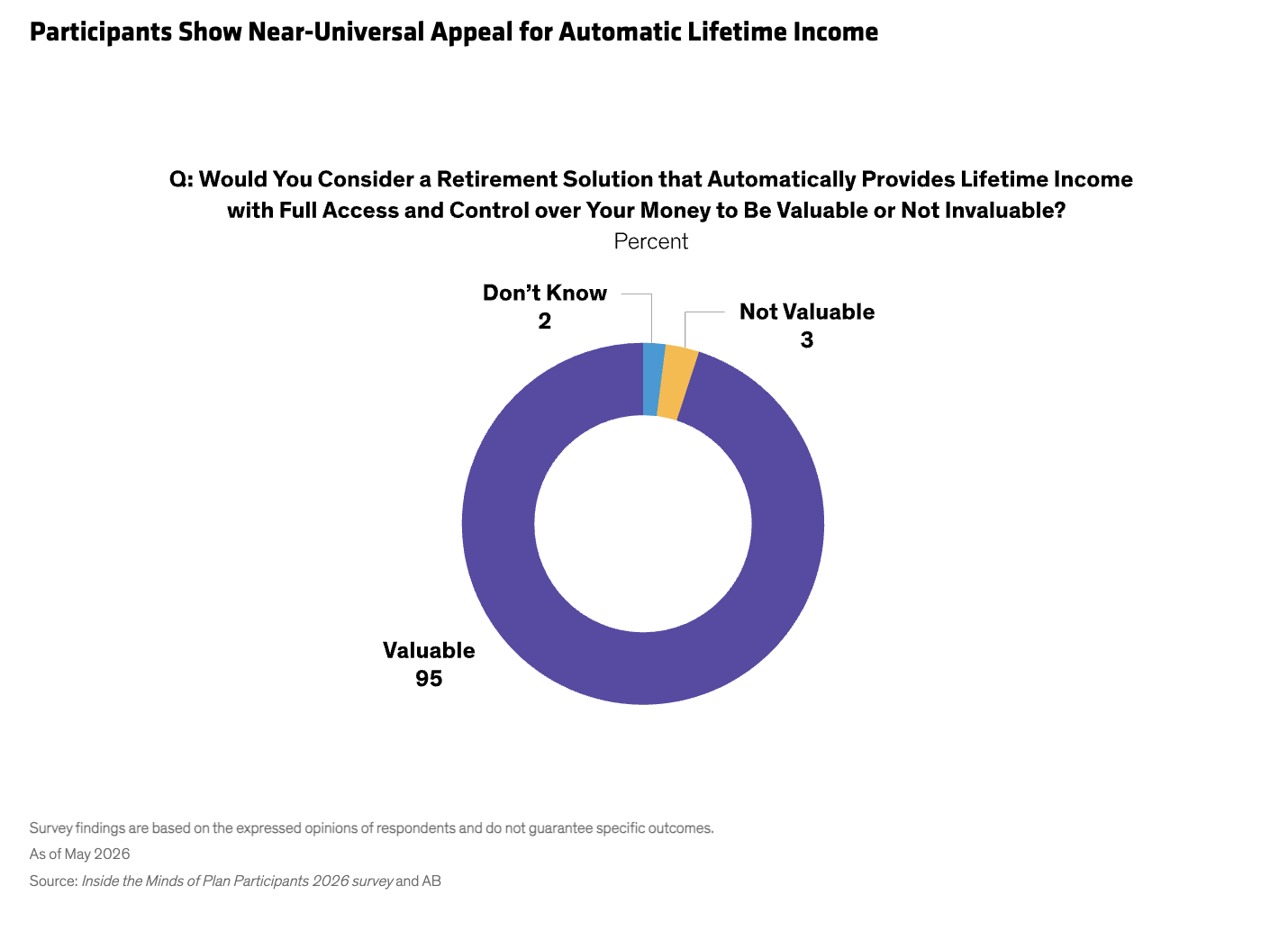
The strong desires for both flexibility and certainty help put another striking survey finding into perspective: according to AB’s 2026 survey, 95% of participants say they value a retirement solution that automatically provides lifetime income while still offering full access to their money (Display).
We believe the “automatic” component is especially important. Instead of requiring participants to make another of many decisions they already face, income can begin automatically when they retire or at a later age. They also retain control of their assets and aren’t permanently locked in, given they can revoke it later if they want.
Why Simplicity Matters for Income Solutions
We think including an automatic lifetime income solution is the next evolution for sponsors designing a competitive yet easy-to-navigate retirement plan amid a rapidly shrinking defined benefit (DB) pension environment. And its automatic feature is a natural extension of familiar DC services, such as auto enrollment and auto escalation.
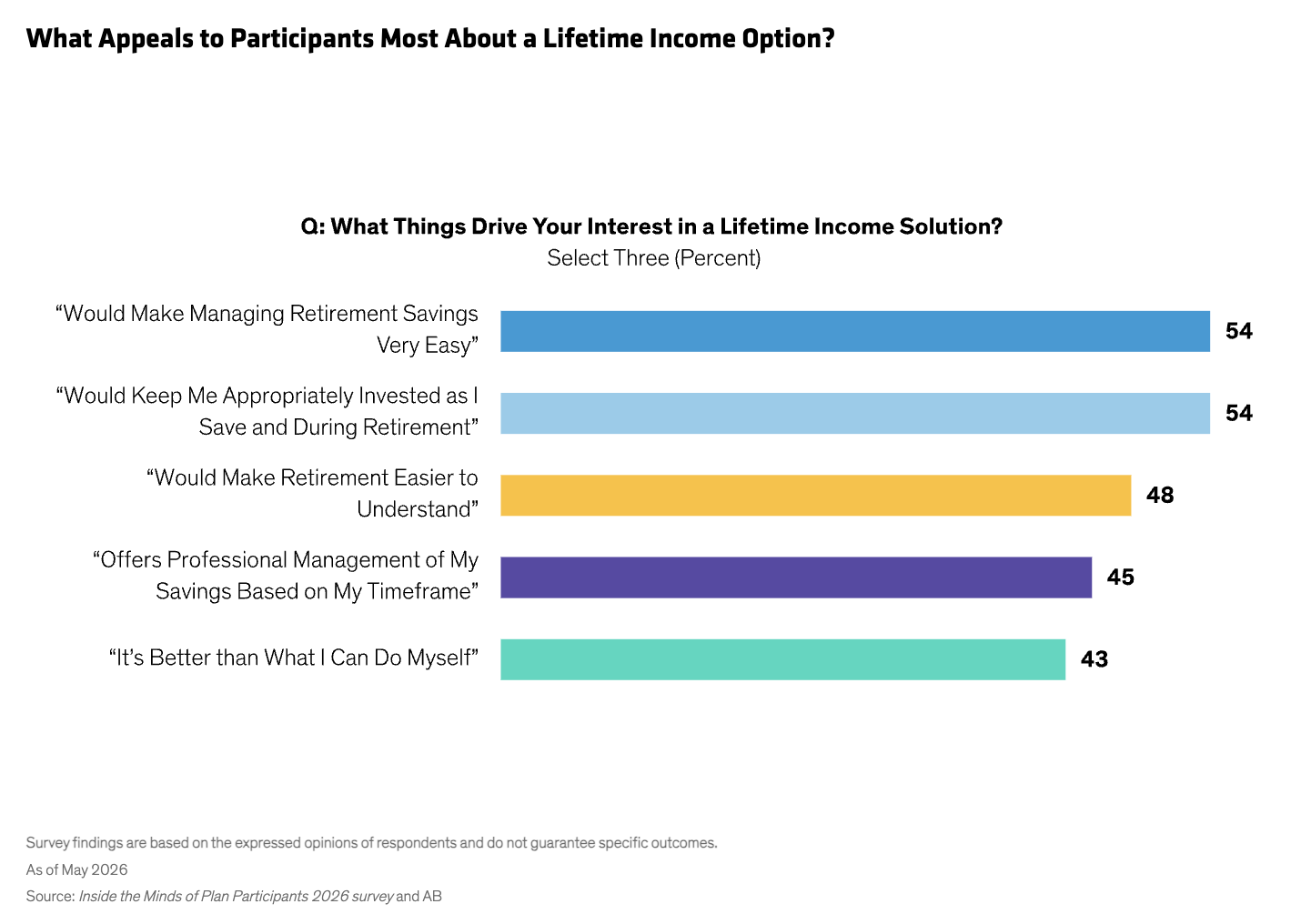
Our research also tells us that participants very much want a lifetime income solution for many reasons. When asked what they liked most about it (Display), participants appreciated how it eases their retirement savings management (54% of respondents) and helps keep them stay appropriately invested before and during retirement (also 54%). Making retirement easier to understand was also highly valued (48%).
We believe our findings suggest that ease and simplicity can be as important as the income itself. As the general population ages and lifespans expand, more participants than ever face hard questions about how much they’ll need, how much they can safely withdraw and how to secure their assets. Every decision adds a layer of complexity.
Participants certainly have no shortage of content designed to bring clarity, but more information doesn’t necessarily make their retirement-income decisions easier. As participants navigate a growing mix of financial guidance, we think sponsors have a leading role in helping them cut through the noise and translate information into action.
Translating Participants’ Lifetime Income Interest into Plan Design
We see a growing opportunity for plan sponsors to simplify the transition from retirement savings to income. Participants may not know which retirement-income solution to ask for, but their priorities are making a clearer statement: it should be automatic, simple and accessible with growth potential.
In our view, plan design that includes a lifetime income solution can address all these needs, while potentially reducing the burden of making difficult decisions before and long after retirement. Motivating participants to build savings has long been central to the DC plan. In our view, helping them turn those savings into income—and do it easily and with confidence—is its next evolution.
“Target date” in a fund’s name refers to the approximate year when a plan participant expects to retire and begin withdrawing from his or her account. Target-date funds gradually adjust their asset allocation, lowering risk as a participant nears retirement. Investments in target-date funds are not guaranteed against loss of principal at any time, and account values can be more or less than the original amount invested—including at the time of the fund’s target date. Also, investing in target-date funds does not guarantee sufficient income in retirement.
The views expressed herein do not constitute research, investment advice or trade recommendations, do not necessarily represent the views of all AB portfolio-management teams and are subject to change over time.
Jennifer DeLong is a Senior Vice President, Managing Director and Head of Defined Contribution, responsible for leading AB’s defined contribution business in North America.
Heather Balley is Managing Director of Participant Communications for AB's Defined Contribution business.
A message from Advisor Perspectives and VettaFi: Discover something new! Click here to register for our upcoming webcasts.
© AllianceBernstein
More Specialty Investments Topics >