The Setup
The votes have been cast. While control of the House and Senate has been decided, now we wait for the final tallies (and celebrate the end of the political ads — at least for another 20 months or so). We’re not political strategists, but policy does move markets, so it’s important to pay attention.
Before we get into potential policy implications of the midterms and the relationships between stocks and elections, our thinking on this election cycle — which has been correct at least up until now — is that the setup was not one for as much market volatility as we’ve endured historically (the average pre-midterms drawdown in the S&P 500 has been 17% and this year we’ve gotten 9%). The strong performance of the Democrats yesterday introduced some volatility in futures trading overnight, but markets calmed on the clarity this morning.
We would attribute the relative calm in broad stock market indexes over the past two months to strong economic growth and corporate profits, and the overwhelming anticipation of divided government. Divided government takes major sweeping tax and spending policies off the table and halts any of the more extreme policies of the political right and left. Further, some key policy objectives of the Trump administration can be executed via executive order and through regulatory bodies, reducing the influence of Congress (immigration, de-regulation, and tariffs to name a few, though Democrats in the next session of Congress are sure to push back on tariffs imposed unilaterally).
Some Important Policy Considerations
Here are several important policy implications from divided government that could matter for select market segments:
-
Healthcare (Medicaid spending cuts) and consumer staples (SNAP funding). The major congressional questions surrounding these programs are how the timing of scheduled subsidies could affect consumer spending on the edges through a potential reversal of cuts to supplemental nutrition programs from a blue wave. A cohesive Democratic majority could also delay or reverse some healthcare spending cuts, potentially providing support for healthcare services while adding a bit to consumption in 2027 (Morgan Stanley estimates effects of 0.1% to 0.4%). Drug pricing will continue to get headlines, but the rules of the road limit price increases are already in place.
-
AI and data centers. AI and data center construction have become a very important post-election policy story. In divided government, the policy implications at the federal level may be limited, but data center policy decisions sit at the state and utility-commission level, making gubernatorial and utility races important alongside Congress, particularly Governor Abbott’s loss in Texas. LPL Research continues to expect the buildout to occur but strong performances by Democrats in key data center states (and pushback from the not in my backyard folks) may slow it down some, potentially increasing regulatory pressure on AI infrastructure stocks including semiconductors, machinery, and power generation.
-
Defense. Defense could benefit from bipartisan compromise, but gridlock creates funding risk. The possibility of a bipartisan budget deal in which Democrats get healthcare-related priorities while Republicans get additional defense funding does exist. Without a deal, repeated continuing resolutions would create a more difficult funding backdrop. This may be wishful thinking, but the upside potential for defense contractors seems feasible.
-
Banking deregulation. We do not expect the election results to reverse the trend of banking deregulation by the Trump administration. However, the strong performance by the Democrats will likely slow it down. Companies might try to rush mergers and acquisitions through in 2027 before the regulatory environment potentially gets tougher in 2028.
-
Treasury yields. Under gridlock in Washington, more fiscal expansion than is already on the books is unlikely. Another reconciliation bill to increase spending would have required a Republican sweep. On the other hand, divided government may imply less Treasury supply pressure and tempered rate volatility.
See more: Can Economic Indicators Or Betting Markets Predict Election Results?
Seasonal Tailwinds: Will Risk Appetite Return to the Stock Market?
Midterm elections have historically served as an important clearing event for markets. In the weeks leading up to Election Day, political uncertainty tends to rise as investors assess potential changes in congressional control and the implications for fiscal policy, taxes, regulation, and other market-sensitive issues. The higher degree of uncertainty is often reflected in higher implied volatility, with the VIX typically building into the midterms as investors increase demand for portfolio protection.
However, once the election is over and the clouds of uncertainty part, investors can stop worrying about what might happen and start positioning around what did. The reduction in event risk can help unwind defensive positioning, reduce demand for hedges, and bring risk appetite back to the table. The potential resetting of sentiment could come at an opportune time as the S&P 500 hovers near the lower end of its multi-month trading range.
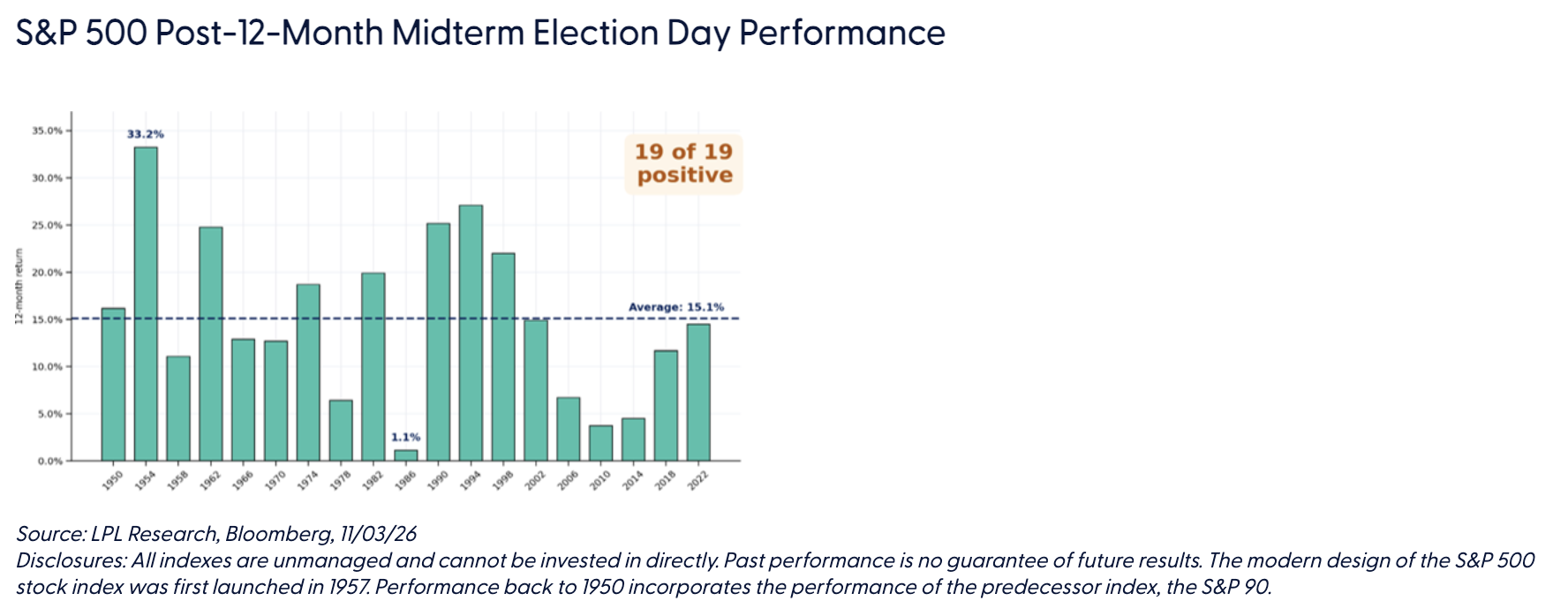
History is on the market’s side. Going back to 1950, the S&P 500 has gained an average of 15.1% over the 12 months following midterm Election Day, with all 19 periods producing positive returns. Even the weakest outcome remained positive: following the 1986 midterms, the S&P 500 gained 1.1% over the next 12 months, despite that window including the October 1987 stock market crash.
Political Opinions are Best Expressed at the Polls, Not in your Portfolio
What happens in Washington, D.C., can play an important role in our daily lives, and help shape the country in many ways, but politics alone does not drive the economy or the stock market. There are other more powerful macro forces that drive economic expansions and contractions, such as the health of corporate earnings, consumer spending, inflation, interest rates, credit conditions, and monetary policy. Today, that list also includes the secular AI investment cycle, which has become an increasingly important contributor to market performance, earnings growth, and economic activity.
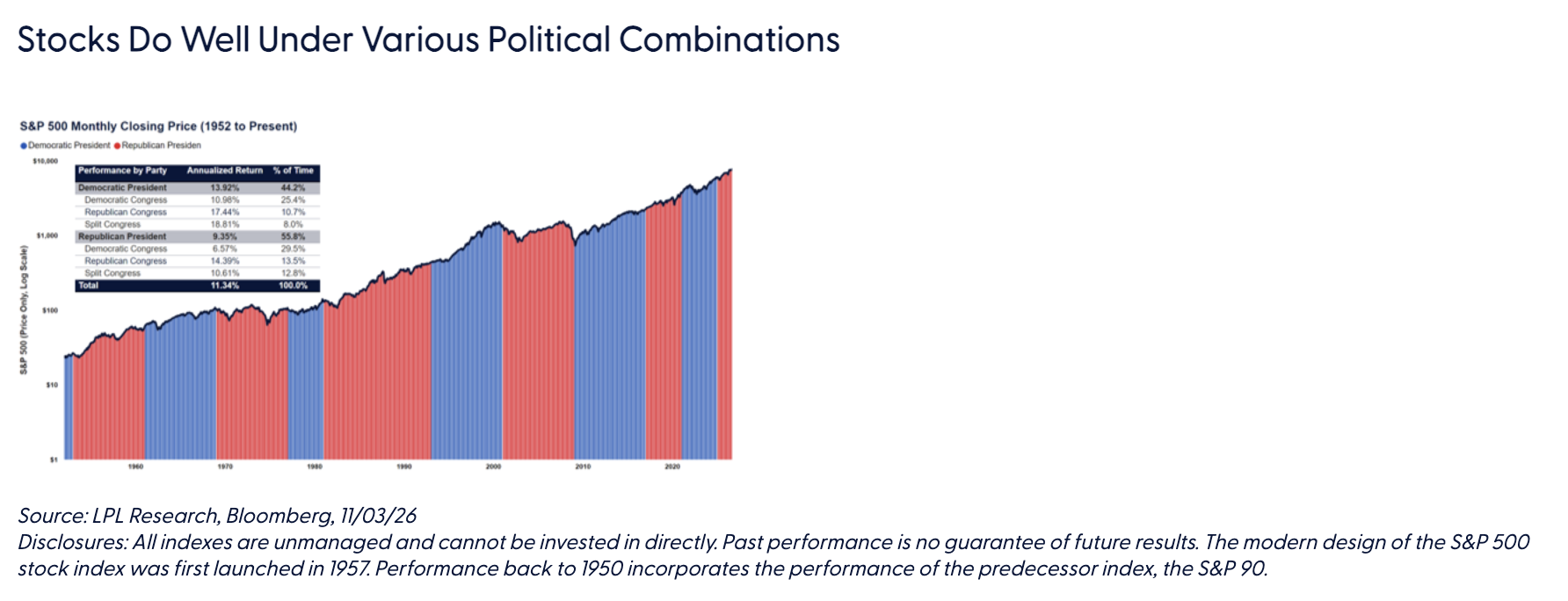
For the long-term investor, we believe political opinions are best expressed at the polls and not in portfolios. As highlighted in the “Stocks Do Well Under Various Political Combinations” chart, the S&P 500 has historically been able to advance under a variety of political configurations because, over longer horizons, drivers such as economic growth and corporate profitability have mattered far more than party labels.
So, from a broad economic and market perspective, under divided government, there was not as much on the line this election in terms of policy implications as in previous cycles. There will be a lot on the line in 2028, where market participants will turn their attention right away. But for now, we would focus on the strong seasonal tailwind at the back of this market, the solid economic growth outlook with, we believe, favorable prospects inflation to begin to come down after New Year’s, and the benefits of AI adoption which are becoming more apparent every day.
Jeff Buchbinder, CFA, provides the top-down view of the stock market for LPL Financial Research. He has over 25 years of experience in equities.
Important Disclosures
This material is for general information only and is not intended to provide specific advice or recommendations for any individual. There is no assurance that the views or strategies discussed are suitable for all investors. To determine which investment(s) may be appropriate for you, please consult your financial professional prior to investing.
Investing involves risks including possible loss of principal. No investment strategy or risk management technique can guarantee return or eliminate risk.
Indexes are unmanaged and cannot be invested into directly. Index performance is not indicative of the performance of any investment and does not reflect fees, expenses, or sales charges. All performance referenced is historical and is no guarantee of future results.
This material was prepared by LPL Financial, LLC. All information is believed to be from reliable sources; however LPL Financial makes no representation as to its completeness or accuracy.
Unless otherwise stated LPL Financial and the third party persons and firms mentioned are not affiliates of each other and make no representation with respect to each other. Any company names noted herein are for educational purposes only and not an indication of trading intent or a solicitation of their products or services.
Asset Class Disclosures –
International investing involves special risks such as currency fluctuation and political instability and may not be suitable for all investors. These risks are often heightened for investments in emerging markets.
Bonds are subject to market and interest rate risk if sold prior to maturity.
Municipal bonds are subject and market and interest rate risk and potentially capital gains tax if sold prior to maturity. Interest income may be subject to the alternative minimum tax. Municipal bonds are federally tax-free but other state and local taxes may apply.
Preferred stock dividends are paid at the discretion of the issuing company. Preferred stocks are subject to interest rate and credit risk. They may be subject to a call features.
Alternative investments may not be suitable for all investors and involve special risks such as leveraging the investment, potential adverse market forces, regulatory changes and potentially illiquidity. The strategies employed in the management of alternative investments may accelerate the velocity of potential losses.
Mortgage backed securities are subject to credit, default, prepayment, extension, market and interest rate risk.
High yield/junk bonds (grade BB or below) are below investment grade securities, and are subject to higher interest rate, credit, and liquidity risks than those graded BBB and above. They generally should be part of a diversified portfolio for sophisticated investors.
Precious metal investing involves greater fluctuation and potential for losses.
The fast price swings of commodities will result in significant volatility in an investor's holdings.
This research material has been prepared by LPL Financial LLC.
Not Insured by FDIC/NCUA or Any Other Government Agency | Not Bank/Credit Union Deposits or Obligations | Not Bank/Credit Union Guaranteed | May Lose Value
For Public Use – Tracking: #1202423
A message from Advisor Perspectives and VettaFi: Discover something new! Click here to register for our upcoming webcasts.
More Innovative ETFs Topics >