For families planning to fund college, completing the Free Application for Federal Student Aid (FAFSA) is an important step in understanding financial options available to them. While the FAFSA for the upcoming academic year typically becomes available on October 1, navigating the process involves more than simply completing a form. Understanding the requirements and planning ahead can make a meaningful difference. Here are five key things families should know as they navigate the financial aid process.
1. Income generally matters more than assets in determining aid
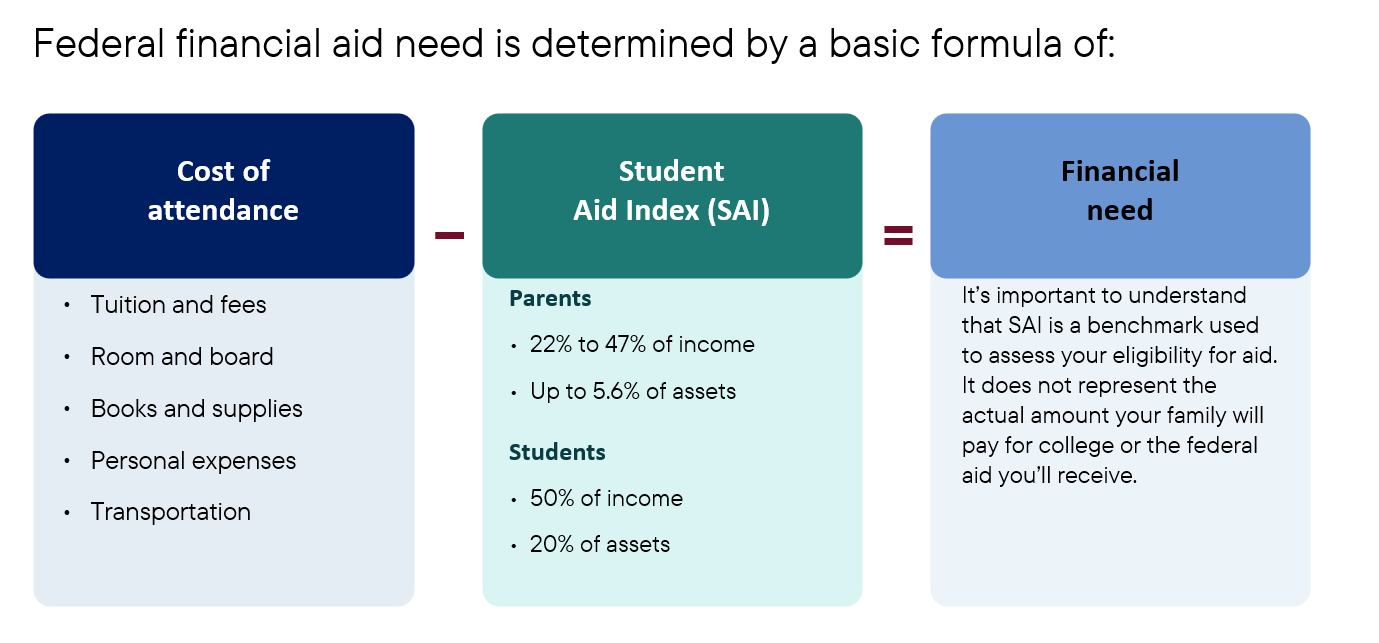
Colleges use the Student Aid Index (SAI) to help determine a student’s financial need and eligibility for federal student aid, including grants, loans and work-study programs. The SAI considers both a family’s income and assets, but the two are not weighted equally. In general, income has a greater impact on the calculation than assets. The SAI calculation generally considers four main factors: parent income, parent assets, student income, and student assets. The formula is driven primarily by income, while savings have a more modest impact. Under the federal aid formula, the assessment of parental income generally ranges from 22%–47%, while assessable parental assets may be counted at a rate of up to approximately 5.64%, depending on the family's circumstances. For students, 50% of income and 20% of assets may be counted. For this reason, parent-owned 529 plans are generally treated more favorably in the federal aid calculation established under the Uniform Gifts to Minors Act (UGMA) or Uniform Transfers to Minors Act (UTMA), which are typically considered student assets.
2. Grandparent-owned 529 plans are not considered as part of the aid calculation
Due to changes in the FAFSA process, distributions from grandparent-owned 529 savings plans are no longer treated as student income in the SAI calculation. This includes other non-parent-owned accounts as well. Historically, while a grandparent-owned 529 was not counted as a reportable asset on the FAFSA, distributions from the account could be treated as student income, potentially reducing eligibility for need-based financial aid in a subsequent academic year. Beginning with the 2024—25 FAFSA, this is no longer the case.
See more: Teaching Financial Advisors the Depth Behind Tools & Recipes
However, some colleges require families to complete the CSS Profile administered by the College Board, in addition to the FAFSA, when determining eligibility for institutional financial aid. The CSS-Profile may request information on non-parent-owned 529 accounts, and colleges may consider these accounts when calculating aid eligibility. Families should understand the requirements of each college to which a student is applying.
3. Complete the FAFSA as early as possible
Completing the FAFSA as early as possible may help families maximize their financial aid opportunities. While the application determines eligibility for federal aid, some state and institutional aid programs have their own deadlines and limited funding, making early submission particularly important. Families should check federal, state, and college-specific deadlines to avoid missing potential aid opportunities.
4. Don’t assume your income is too high to qualify
Even if a family believes its income is too high to qualify for financial aid, completing the FAFSA will still be worthwhile. There is no universal income cutoff for federal student aid eligibility. Eligibility depends on several factors such as the cost of attendance, which will vary among colleges. Completing the FAFSA may also be necessary to access certain state-based aid, institutional grants and scholarships, as well as federal student loans. Having a FAFSA on file can also be helpful if a family experiences a significant change in financial circumstances, such as a job loss or substantial reduction in income. In these situations, families can contact the college’s financial aid office to discuss their circumstances and determine whether an adjustment to their financial aid eligibility may be warranted. Lastly, some colleges require a completed FAFSA to be considered for merit-based scholarships or other forms of aid not based on financial need.
5. Not all financial aid is created equal
A financial aid package may include a combination of grants, work-study opportunities, and student loans, each of which affects a family’s college costs differently. Families should look beyond the total amount of aid offered and focus on how much represents free assistance versus borrowing. They should also consider other factors that affect the overall cost of an aid package, including interest rates and loan terms. For example, a financial aid package that includes student loans may be considerably more expensive today than a similar package offered several years ago, given the broad increase in interest rates.
Closing thoughts and action steps
- Remember to file the FAFSA every year. Families must submit a new FAFSA for each academic year to be considered for federal student aid
- Get organized before you begin. Gather relevant tax information, records of reportable assets, and other information to help completing the application easier.
- Use available resources. Visit studentaid.gov to learn more about the FAFSA process and use the Federal Student Aid Estimator to get an early estimate of potential federal student aid eligibility.
- Engage with college financial aid offices. If your family is comparing offers from several colleges, consider contacting financial aid offices directly to ask questions about an award, clarify available assistance, or discuss whether additional financial aid may be available. Some colleges may be willing to reconsider an offer based on competing awards or a change in family circumstances.
For more information on how 529 college savings plans may affect financial aid eligibility, check out our brochure, Saving for Education with 529s and the Effect on Financial Aid, for additional insights and planning considerations.
A message from Advisor Perspectives and VettaFi: Discover something new! Click here to register for our upcoming webcasts.
WHAT ARE THE RISKS?
All investments involve risks, including possible loss of principal.
Any information, statement or opinion set forth herein is general in nature, is not directed to or based on the financial situation or needs of any particular investor, and does not constitute, and should not be construed as, investment advice, forecast of future events, a guarantee of future results, or a recommendation with respect to any particular security or investment strategy or type of retirement account. Investors seeking financial advice regarding the appropriateness of investing in any securities or investment strategies should consult their financial professional.
Franklin Templeton, its affiliated companies, and its employees are not in the business of providing tax or legal advice to taxpayers. These materials and any tax-related statements are not intended or written to be used, and cannot be used or relied upon, by any such taxpayer for the purpose of avoiding tax penalties or complying with any applicable tax laws or regulations. Tax-related statements, if any, may have been written in connection with the “promotion or marketing” of the transaction(s) or matter(s) addressed by these materials, to the extent allowed by applicable law. Any such taxpayer should seek advice based on the taxpayer’s particular circumstances from an independent tax advisor.
Important Information
This material is intended to be of general interest only and should not be construed as individual investment advice or a recommendation or solicitation to buy, sell or hold any security or to adopt any investment strategy. It does not constitute legal or tax advice. This material may not be reproduced, distributed or published without prior written permission from Franklin Templeton.
The views expressed are those of the investment manager and the comments, opinions and analyses are rendered as at publication date and may change without notice. The underlying assumptions and these views are subject to change based on market and other conditions and may differ from other portfolio managers or of the firm as a whole. The information provided in this material is not intended as a complete analysis of every material fact regarding any country, region or market. There is no assurance that any prediction, projection or forecast on the economy, stock market, bond market or the economic trends of the markets will be realized. The value of investments and the income from them can go down as well as up and you may not get back the full amount that you invested. Past performance is not necessarily indicative nor a guarantee of future performance. All investments involve risks, including possible loss of principal.
Any research and analysis contained in this material has been procured by Franklin Templeton for its own purposes and may be acted upon in that connection and, as such, is provided to you incidentally. Data from third party sources may have been used in the preparation of this material and Franklin Templeton ("FT") has not independently verified, validated or audited such data. Although information has been obtained from sources that Franklin Templeton believes to be reliable, no guarantee can be given as to its accuracy and such information may be incomplete or condensed and may be subject to change at any time without notice. The mention of any individual securities should neither constitute nor be construed as a recommendation to purchase, hold or sell any securities, and the information provided regarding such individual securities (if any) is not a sufficient basis upon which to make an investment decision. FT accepts no liability whatsoever for any loss arising from use of this information and reliance upon the comments, opinions and analyses in the material is at the sole discretion of the user.
Franklin Templeton has environmental, social and governance (ESG) capabilities; however, not all strategies or products for a strategy consider “ESG” as part of their investment process.
Products, services and information may not be available in all jurisdictions and are offered outside the U.S. by other FT affiliates and/or their distributors as local laws and regulation permits. Please consult your own financial professional or Franklin Templeton institutional contact for further information on availability of products and services in your jurisdiction.
Issued in the U.S. by Franklin Templeton, One Franklin Parkway, San Mateo, California 94403-1906, (800) DIAL BEN/342-5236, franklintempleton.com. Investments are not FDIC insured; may lose value; and are not bank guaranteed.
You need Adobe Acrobat Reader to view and print PDF documents. Download a free version from Adobe's website.
CFA® and Chartered Financial Analyst® are trademarks owned by CFA Institute.
© Franklin Templeton
Read more commentaries by Franklin Templeton