Midterms Change Congress, Not the Macro Regime
Membership required
Membership is now required to use this feature. To learn more:
View Membership Benefits
The big question coming out of the midterms is whether they will change the macro regime itself. The answer is likely no. The forces shaping markets today—tariffs, geopolitics, deficits, and the shift from globalization toward self-sufficiency—are unlikely to be reset by Congress.
Democratic control of Congress may not mean a policy reset
Democratic control of Congress may shift the legislative agenda, but many of the policy levers driving market volatility remain with the executive branch (Figure 1). As a result, while legislative uncertainty may fade, broader policy-driven volatility may persist. Trade policy, in particular, remains an important executive branch tool and may increasingly be used to pursue targeted foreign policy objectives.
See more: How Could the Midterm Results Impact Economic Growth?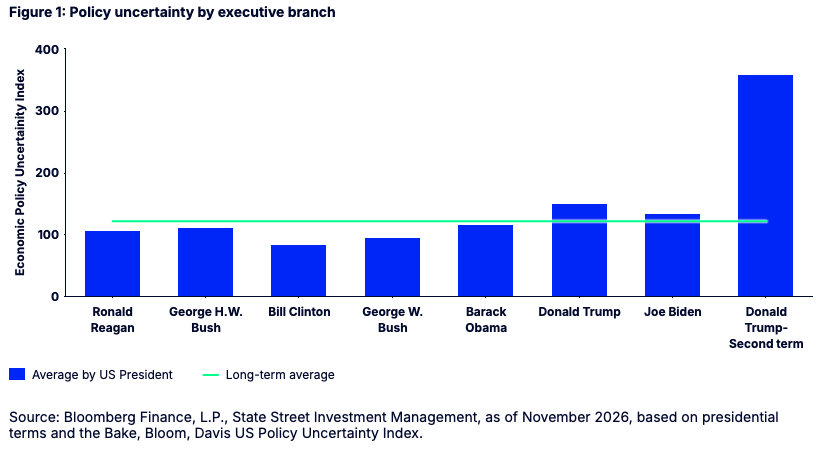
Will the historical post-midterm pattern hold?
Both US large-cap and small-cap equities historically have posted positive returns after midterms as the political overhang clears.1 This cycle could follow that pattern, especially with resilient earnings and improving economic surprises supporting risk assets.
But a potentially favorable backdrop for equities doesn’t mean all macro risks have faded. Federal Reserve policy, not Congress, will remain the driver of rates. And deficits are unlikely to be meaningfully addressed, given the constraints of the reconciliation process and limited political incentive to tackle spending, tax policy, or public borrowing.
That leaves investors wrestling with rising term premia, stubborn inflation, elevated Treasury supply, and fiscal credibility concerns. Those fiscal concerns extend overseas, with structurally large deficits posing challenges for policymakers globally.
Therefore, while bonds may continue to play an important role, they may not be as reliable a diversifier as they were in the prior disinflationary regime.
Political and fiscal uncertainty also may create near-term volatility through debt-ceiling debates or potential shutdowns. Those episodes can be disruptive, but they usually resolve. That’s why diversification may matter more when growth, inflation, rates, policy, and geopolitics are less synchronized.
How can investors build resilience for the road ahead?
Portfolios built around one dominant risk factor—or that rely too heavily on the traditional stock-bond relationship—may be less resilient in this environment.
In a post-midterm cycle unlikely to deliver a meaningful macro regime shift, consider these broad multi-asset diversifiers:
- State Street® Bridgewater® All Weather® ETF (ALLW) for a multi-asset strategy built to help investors navigate shifting economic environments by combining global stocks, bonds, commodities, and gold in a single portfolio
- State Street® Multi-Asset Real Return ETF (RLY) for a multi-asset real return strategy focused on inflation-sensitive assets to help add inflation resilience and diversification to portfolios
A message from Advisor Perspectives and VettaFi: Discover something new! Click here to register for our upcoming webcasts.
Footnotes
1 Bloomberg Finance, L.P., State Street Investment Management, as of November 4, 2026, based on the S&P 500 Index from 1930 to 2026 and the Russell 2000 Index from 1978 to 2026. The performance data quoted represents past performance. Past performance does not guarantee future results.
Glossary
Asset class
Distinct groups of investments that have similar characteristics and past performance, such as stocks, bonds, cash, real estate and commodities. Asset classes can also be further segmented, such as emerging market equities in the case of stocks and US corporate bonds in the case of fixed income.
Bond
A debt investment in which an investor loans money to an entity—typically a corporate or governmental entity—that borrows the funds for a defined period of time at a variable or fixed interest rate. Bonds are used by companies, municipalities, states and sovereign governments to raise money and finance a variety of projects and activities. Owners of bonds are debtholders, or creditors, of the issuer.
Diversification
A strategy of combining a broad mix of investments and asset class to potentially limit risk, although diversification does not guarantee protecting against a loss in falling markets.
Equities
An instrument that signifies an ownership position, or equity, in a corporation, and which represents a claim on its proportionate share in the corporation’s assets and profits.
Fiscal Policy
Government spending and taxation policies that influence macroeconomic conditions. Through fiscal policy, regulators attempt to improve unemployment rates, control inflation, stabilize business cycles and influence interest rates in an effort to control the economy.
Inflation
An overall increase in the price of an economy’s goods and services during a given period, translating to a loss in purchasing power per unit of currency. Inflation generally occurs when growth of the money supply outpaces growth of the economy. Central banks attempt to limit inflation, and avoid deflation, in order to keep the economy running smoothly.
Macro
The part of the economics concerned with large scale or general economic factors such as interest rates and national productivity.
Multi-asset class portfolio
A portfolio or fund that combines different asset classes, such as equities, bonds and cash. Modern multi-asset class portfolios reflect the greater access to investment markets afforded by tools such as ETFs and now go well beyond those basic three categories to include other asset classes such as private equity, hedge funds, real estate and hard assets such as commodities and gold.
Term premium
The compensation that investors require for bearing the risk that short-term Treasury yields do not evolve as they expected.
Volatility
The tendency of a market index or security to jump around in price. Volatility is typically expressed as the annualized standard deviation of returns. In modern portfolio theory, securities with higher volatility are generally seen as riskier due to higher potential losses.
Disclosure
Important risk information
United States: State Street Investment Management, One Congress Street, Boston, MA 02114.
State Street Global Advisors (SSGA) is now State Street Investment Management. Please go to statestreet.com/investment-management for more information.
Investing involves risk including the risk of loss of principal.
The whole or any part of this work may not be reproduced, copied or transmitted or any of its contents disclosed to third parties without SSGA’s express written consent.
All information is from SSGA unless otherwise noted and has been obtained from sources believed to be reliable, but its accuracy is not guaranteed. There is no representation or warranty as to the current accuracy, reliability or completeness of, nor liability for, decisions based on such information and it should not be relied on as such.
The information provided does not constitute investment advice and it should not be relied on as such. It should not be considered a solicitation to buy or an offer to sell a security. It does not take into account any investor's particular investment objectives, strategies, tax status or investment horizon. You should consult your tax and financial advisor.
The performance data quoted represents past performance. Past performance does not guarantee future results.
The views expressed in this material are the views of Matthew Bartolini through the period ended November 4, 2026, and are subject to change based on market and other conditions. This document contains certain statements that may be deemed forward-looking statements. Please note that any such statements are not guarantees of any future performance and actual results or developments may differ materially from those projected.
Generally, among asset classes, stocks are more volatile than bonds or short-term instruments. Government bonds and corporate bonds generally have more moderate short-term price fluctuations than stocks, but provide lower potential long-term returns. U.S. Treasury Bills maintain a stable value if held to maturity, but returns are generally only slightly above the inflation rate.
Bonds generally present less short-term risk and volatility than stocks, but contain interest rate risk (as interest rates rise, bond prices usually fall); issuer default risk; issuer credit risk; liquidity risk; and inflation risk. These effects are usually pronounced for longer-term securities. Any fixed income security sold or redeemed prior to maturity may be subject to a substantial gain or loss.
Foreign (non-U.S.) Securities may be subject to greater political, economic, environmental, credit and information risks. Foreign securities may be subject to higher volatility than U.S. securities, due to varying degrees of regulation and limited liquidity. These risks are magnified in emerging markets.
Actively managed ETFs do not seek to replicate the performance of a specified index.
Because the SPDR SSGA Active Asset Allocation ETFs are actively managed, they are therefore subject to the risk that the investments selected by SSGA may cause the ETFs to underperform relative to their benchmarks or other funds with similar investment objectives.
Commodities investing entail significant risk as commodity prices can be extremely volatile due to wide range of factors.
Bridgewater provides a daily model portfolio to SSGA Funds Management Inc. (SSGA FM) based on their proprietary All Weather® asset allocation approach. The model portfolio is specific to the Fund. Based on Bridgewater's investment recommendations, SSGA FM purchases and sells securities and/or instruments for the Fund. SSGA FM seeks to implement Bridgewater's investment recommendations, but may change the Fund's investment allocation at any time.
ETFs trade like stocks, are subject to investment risk, fluctuate in market value and may trade at prices above or below the ETFs net asset value. Brokerage commissions and ETF expenses will reduce returns.
While the shares of ETFs are tradable on secondary markets, they may not readily trade in all market conditions and may trade at significant discounts in periods of market stress.
ALLW is actively managed. The Adviser’s judgments about the attractiveness, relative value, or potential appreciation of a particular sector, security, commodity or investment strategy may prove to be incorrect, and may cause the Fund to incur losses. There can be no assurance that the Adviser’s investment techniques and decisions will produce the desired results.
Equity securities may fluctuate in value and can decline significantly in response to the activities of individual companies and general market and economic conditions.
The value of the debt securities may increase or decrease as a result of the following: market fluctuations, increases in interest rates, inability of issuers to repay principal and interest or illiquidity in the debt securities markets; the risk of low rates of return due to reinvestment of securities during periods of falling interest rates or repayment by issuers with higher coupon or interest rates; and/or the risk of low income due to falling interest rates. To the extent that interest rates rise, certain underlying obligations may be paid off substantially slower than originally anticipated and the value of those securities may fall sharply. This may result in a reduction in income from debt securities income.
Commodities and Commodity-Linked Derivatives: Commodity prices can have significant volatility, and exposure to commodities can cause the net asset value of Fund Shares to decline or fluctuate in a rapid and unpredictable manner. A liquid secondary market may not exist for certain commodity investments, which may make it difficult for the Fund to sell them at a desirable price or at the price at which it is carrying them.
ALLW may seek exposure to commodities by, among other things, investing in a wholly-owned subsidiary, an exempted limited company organized under the laws of the Cayman Islands (“Subsidiary”) and managed by the Adviser. The Subsidiary is not registered under the Investment Company Act of 1940, as amended (“1940 Act”) and is not subject to all of the investor protections of the 1940 Act. Thus, the Fund, as an investor in the Subsidiary, will not have all of the protections offered to investors in registered investment companies.
Derivatives Risk: A derivative is a financial contract the value of which depends on, or is derived from, the value of an underlying asset, interest rate, or index. Derivative transactions typically involve leverage and may have significant volatility. It is possible that a derivative transaction will result in a loss greater than the principal amount invested, and ALLW may not be able to close out a derivative transaction at a favorable time or price.
Market Risk: The Fund's investments are subject to changes in general economic conditions, general market fluctuations and the risks inherent in investing in markets. Investment markets can be volatile and prices of investments can change substantially due to various factors including, but not limited to, economic growth or recession, changes in interest rates, inflation, changes in the actual or perceived creditworthiness of issuers, and general market liquidity.
Bridgewater® and All Weather® are registered trademarks of Bridgewater® Associates, LP.
Distributor: State Street Global Advisors Funds Distributors, LLC is the distributor for certain registered products on behalf of the advisor. SSGA Funds Management, Inc. has retained Bridgewater Associates, LP as the respective sub-adviser. State Street Global Advisors Funds Distributors, LLC and SSGA Funds Management, Inc. are not affiliated with Bridgewater Associates, LP.
Intellectual property information: The S&P 500® Index is a product of S&P Dow Jones Indices LLC or its affiliates (“S&P DJI”) and have been licensed for use by State Street Global Advisors. S&P®, SPDR®, S&P 500®,US 500 and the 500 are trademarks of Standard & Poor’s Financial Services LLC (“S&P”); Dow Jones® is a registered trademark of Dow Jones Trademark Holdings LLC (“Dow Jones”) and has been licensed for use by S&P Dow Jones Indices; and these trademarks have been licensed for use by S&P DJI and sublicensed for certain purposes by State Street Global Advisors. The fund is not sponsored, endorsed, sold or promoted by S&P DJI, Dow Jones, S&P, their respective affiliates, and none of such parties make any representation regarding the advisability of investing in such product(s) nor do they have any liability for any errors, omissions, or interruptions of these indices.
© 2026 State Street Corporation - All Rights Reserved.
9220461.1.1.AM.RTL
Expiration date: 11/30/2027
Read more commentaries by State Street Investment Management
Membership required
Membership is now required to use this feature. To learn more:
View Membership BenefitsSponsored Content
Upcoming Virtual Events View All