The most consequential development last week was the Federal Reserve’s (Fed’s) decision to pause despite stronger growth and persistent inflation. The October 28 Federal Open Market Committee meeting, policymakers left fed funds rates unchanged at 3.75%–4.00%, with a 10–2 vote and two hawkish dissents from Lisa Cook and Beth Hammack. More importantly, the statement upgraded the Fed’s assessment of economic activity from “solid” to “strong,” while retaining the view that inflation remains elevated. Fed Chair Kevin Warsh acknowledged that financial conditions had tightened following September's hike, including in artificial intelligence (AI)-related financing, but stopped short of describing them as tight. He also argued that stronger productivity could allow growth to remain robust without necessarily generating further inflation. We would retain the December hike as the base case, although Warsh's reluctance to provide forward guidance suggests the Fed wants to preserve flexibility. The October meeting was a hawkish pause, but with less urgency than September. Moreover, the Committee appears increasingly willing to assess the effects of earlier tightening before acting again.
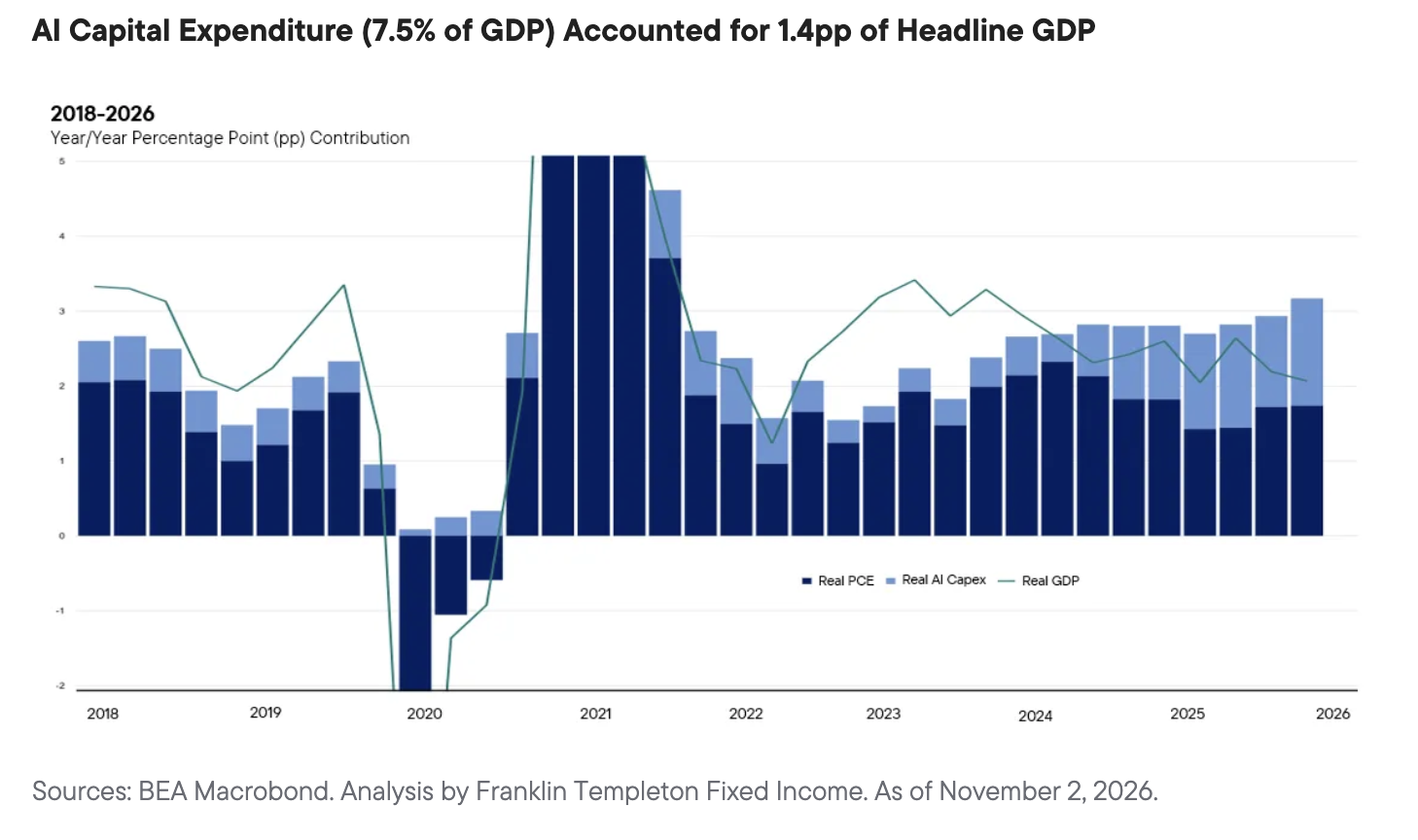
Third-quarter (Q3) gross domestic product (GDP) reinforced the resilience of the US economy, but also its growing dependence on AI investment. Real GDP accelerated to 3.4% quarter over quarter (q/q) annualized from 2.2% in the second quarter, while real final sales to private domestic purchasers (or net domestic demand) increased an even stronger 4.9% q/q. Consumer spending rose 3.8%, while non-residential investment remained particularly strong, led by information-processing equipment. Tech spending, which accounts for just about 7.5% of GDP, contributed a significant 1.4 percentage points to year over year (y/y) GDP growth. Meanwhile, September’s 13.5% y/y increase in core capital goods orders confirms that the AI-driven manufacturing rebound remains intact. However, residential investment declined 3.3%, reinforcing the divergence between AI-related activity and interest-rate-sensitive sectors. The GDP report strengthens the case for continued near-term growth resilience, but not necessarily a more broadly based expansion.
The more concerning development was the deterioration in real household purchasing power. September headline personal consumption expenditures (PCE) inflation accelerated to 3.6% y/y from 3.4%, while core PCE rose to 3.1% from 3.0%, with the latter increasing 0.3% month over month (m/m). Nominal consumer spending increased 0.5%, but real spending was unchanged, while real disposable income declined 0.3%. The saving rate fell to 3.8%, its lowest since September 2022. Real goods spending fell 0.3% and durable goods spending 0.8%, pointing to some loss of momentum beneath the strong Q3 consumption numbers. While households have relied on savings and credit to sustain consumption, the greater risk is that elevated prices increasingly constrain real spending, particularly among lower-income households.
See more: The Fed Risks a Policy Error Fighting Oil Prices
Meanwhile, a more significant shift in the AI investment narrative may be underway, with financing becoming an increasingly important constraint. The Financial Times reported that OpenAI reduced its latest fundraising target from US$30 billion to US$20 billion and its proposed valuation from US$1.4 trillion to US$1.25 trillion, amid weaker investor appetite and concerns about the scale of AI spending. This follows growing scrutiny of debt-financed infrastructure projects and the returns required to justify exceptionally large capital commitments. However, the distinction between financing pressures among highly leveraged AI companies and the spending capacity of cash-rich hyperscalers remains important. The immediate risk is not necessarily a collapse in AI investment, but a gradual tightening in financing conditions that could eventually weaken capital expenditure and equity-market wealth effects.
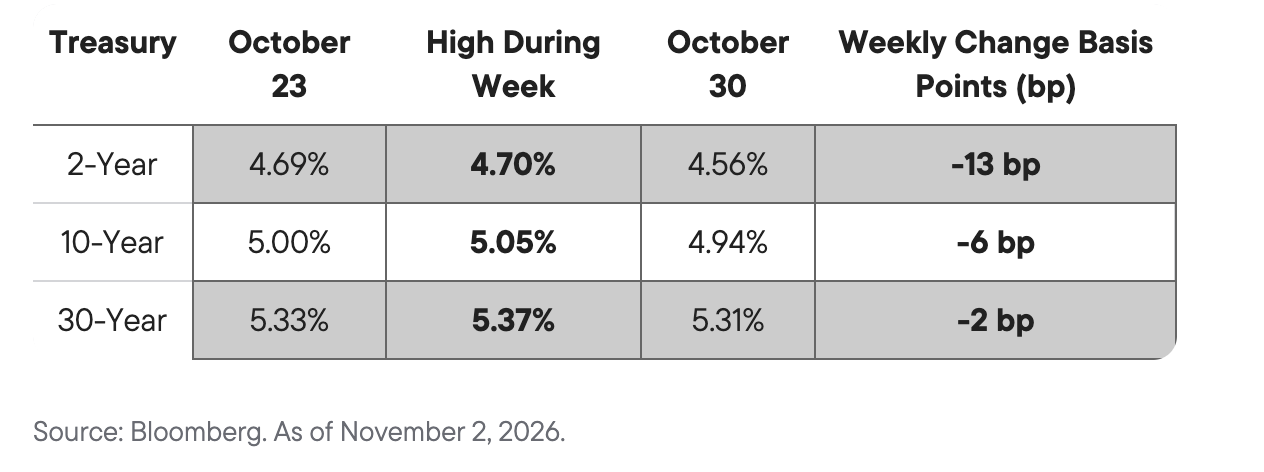
Treasuries rallied further despite the stronger GDP and inflation data, with the curve steepening as the short end outperformed. The moves suggest that weaker risk sentiment, Warsh’s more patient tone and demand for duration are outweighing persistent inflation concerns. However, with the federal debt-to-GDP ratio reaching 100% of GDP in September (the first time the ratio has hit the triple-digit mark since 1946), the long end remains exposed to large fiscal financing requirements, AI-related capital demand and uncertainty over Treasury issuance. The November 4 Treasury refunding announcement will be particularly relevant for assessing whether coupon issuance assumptions need to change.
The US dollar (USD) was broadly unchanged over the week despite the decline in US yields. The USD continues to benefit from relatively elevated yields and US growth outperformance. However, it lacks a clear catalyst for sustained appreciation. Developments elsewhere also matter. The Bank of Canada raised rates 25 basis points to 2.50%, the Bank of Japan signaled further tightening despite holding at 1.25%, while the European Central Bank maintained rates but highlighted upside inflation risks. Monetary-policy divergence is therefore becoming less favorable for the USD. We expect to see tactical rallies around inflation or Fed tightening, but with limited conviction, particularly if US yields continue to decline or the AI-related equity correction deepens.
Nikhil Mohan, Economist Research Analyst
WHAT ARE THE RISKS?
All investments involve risks, including possible loss of principal.
Fixed income securities involve interest rate, credit, inflation and reinvestment risks and possible loss of principal. As interest rates rise, the value of fixed income securities falls. Low-rated, high-yield bonds are subject to greater price volatility, illiquidity and possibility of default.
Equity securities are subject to price fluctuation and possible loss of principal.
There is no assurance that any estimate, forecast or projection will be realized.
Important Information
This material is intended to be of general interest only and should not be construed as individual investment advice or a recommendation or solicitation to buy, sell or hold any security or to adopt any investment strategy. It does not constitute legal or tax advice. This material may not be reproduced, distributed or published without prior written permission from Franklin Templeton.
The views expressed are those of the investment manager and the comments, opinions and analyses are rendered as at publication date and may change without notice. The underlying assumptions and these views are subject to change based on market and other conditions and may differ from other portfolio managers or of the firm as a whole. The information provided in this material is not intended as a complete analysis of every material fact regarding any country, region or market. There is no assurance that any prediction, projection or forecast on the economy, stock market, bond market or the economic trends of the markets will be realized. The value of investments and the income from them can go down as well as up and you may not get back the full amount that you invested. Past performance is not necessarily indicative nor a guarantee of future performance. All investments involve risks, including possible loss of principal.
Any research and analysis contained in this material has been procured by Franklin Templeton for its own purposes and may be acted upon in that connection and, as such, is provided to you incidentally. Data from third party sources may have been used in the preparation of this material and Franklin Templeton ("FT") has not independently verified, validated or audited such data. Although information has been obtained from sources that Franklin Templeton believes to be reliable, no guarantee can be given as to its accuracy and such information may be incomplete or condensed and may be subject to change at any time without notice. The mention of any individual securities should neither constitute nor be construed as a recommendation to purchase, hold or sell any securities, and the information provided regarding such individual securities (if any) is not a sufficient basis upon which to make an investment decision. FT accepts no liability whatsoever for any loss arising from use of this information and reliance upon the comments, opinions and analyses in the material is at the sole discretion of the user.
Franklin Templeton has environmental, social and governance (ESG) capabilities; however, not all strategies or products for a strategy consider “ESG” as part of their investment process.
Products, services and information may not be available in all jurisdictions and are offered outside the U.S. by other FT affiliates and/or their distributors as local laws and regulation permits. Please consult your own financial professional or Franklin Templeton institutional contact for further information on availability of products and services in your jurisdiction.
Issued in the U.S. by Franklin Templeton, One Franklin Parkway, San Mateo, California 94403-1906, (800) DIAL BEN/342-5236, franklintempleton.com. Investments are not FDIC insured; may lose value; and are not bank guaranteed.
You need Adobe Acrobat Reader to view and print PDF documents. Download a free version from Adobe's website.
CFA® and Chartered Financial Analyst® are trademarks owned by CFA Institute.
A message from Advisor Perspectives and VettaFi: Discover something new! Click here to register for our upcoming webcasts.
© Franklin Templeton
More Municipal Bonds Topics >