Key takeaways
-
AI concerns are overshadowing strong economic data: Stocks fell last week as investors questioned whether the artificial intelligence (AI) buildout is sustainable. The Nasdaq 100 dropped 4.91 percent for the week, including a 6.4 percent slide on Thursday that erased a record $2.3 trillion in market value. The S&P 500 finished the week down 2.68 percent.
-
A strong economy leaves the Fed in a tough spot: Payrolls rose 165,000 versus 70,000 expected, the unemployment rate fell to 4.1 percent, and the Institute for Supply Management (ISM) Manufacturing Index rose to 55.5. But the economy-weighted ISM Prices Index remains elevated at 73.2, and the odds of a December Fed rate hike fell to 77 percent on Friday from 90 percent on October 19, moving in step with the stock market.
-
Diversification is cushioning the blow: The Nasdaq 100 is down 13.56 percent from its October high, but the S&P 500 is off only 5.6 percent, and seven of its 11 sectors are still positive, led by defensive staples and health care. However, if AI concerns grow, the slowdown could spill into more parts of the market.
In a week that once again featured solid economic data, stocks faltered as investors continued to question the sustainability of the AI boom. This came in the context of the U.S. midterm elections, which saw the Democrats decisively take control of both the House and the Senate and win numerous gubernatorial races—even in traditionally Republican states. Stocks opened the post-election period with a sharp relief rally on Wednesday, albeit with AI-related names posting declines. That gave way to a broad rout on Thursday, when nearly every nook and cranny of the financial markets saw losses and the tech-heavy Nasdaq 100 fell 6.4 percent, wiping out a record $2.3 trillion in market value in a single day. Markets recovered some of those losses on Friday, but the S&P 500 still finished the week down 2.68 percent, led by losses in industrials (-2.83 percent), technology (-6.93 percent), and energy, which fell 11.93 percent on hopes that the U.S. and Iran could reach a deal.
The data released last week built on previous weeks and showed an economy that is still broadly pushing forward. The ISM Manufacturing Index rose to 55.5 from 54.5 (figures above 50 indicate growth), which, aside from a 55.6 reading in May, was the highest level since May 2022. Production also spiked to 59, the highest level since November 2021. The ISM Services Index remained in expansion even though it pulled back slightly to 54.5 from last month’s 54.9, leaving the economy-weighted ISM at 54.6, down from 54.9 and 55.3 in the previous two months but still at the highest levels since September 2022. The bad news is that the economy-weighted Prices Index remained at 73.2, down slightly from last month’s 74.3 but (aside from that September reading) still the highest level since June 2022. Indeed, data going back to 1997 shows only 7 percent of the 352 observations have been higher, and they have occurred in periods of heightened inflation.
The labor market report was equally strong and broad. Payrolls rose 165,000 versus the 70,000 expected, and the September number was revised higher to 60,000 from 29,000, part of a two-month revision that added 84,000. Private payrolls rose 159,000, with the previous month revised higher to 78,000 from 46,000, while manufacturing added 19,000 after a 13,000 gain. Hiring remained spread across multiple industries, with the one-month diffusion index holding above 50 for the 10th month in a row, while the three-month diffusion index rose to 60.4 from 58.6—the highest since June 2023. The unemployment rate fell to 4.1 percent from 4.2 percent.
See more: Midterm Election 2026: What Matters for Investors Now
However, strong data is being outmatched by AI concerns, which are real given the significant role AI has played in recent U.S. economic and stock market growth. The more technology-focused indices outside the S&P 500 highlight damage in many pockets of the industry that reflect these concerns. The Nasdaq 100 fell 4.91 percent, the Philadelphia Semiconductor Index (SOX) fell another 12.15 percent, and the Goldman Sachs (GS) basket of AI stocks fell another 11.36 percent. Technology and AI stocks began peaking on June 22, although a few indices did not set their highs until October 6. The Nasdaq 100 is now in correction territory, down 13.56 percent from its October high, while the SOX and the broader GS AI basket are down 35.84 percent and 31.84 percent, respectively, from their June 22 highs.
The S&P 500 technology sector has also fallen into correction territory, down 15.90 percent from its October 6 high, with 41 of its 76 members losing more than the index. Many heavyweight stocks remain well below their all-time highs, including NVIDIA, which is off 21.98 percent, Advanced Micro Devices (AMD) off 30.85 percent, Broadcom off 39.01 percent, and Micron off 43.14 percent. Despite these sharp moves lower, the good news is that other parts of the equity market are holding up and cushioning the blow for investors who have remained diversified. The S&P 500 is off only 5.6 percent from its October high, with seven of its 11 sectors positive since then, led by the defensive staples and health care sectors. Meanwhile, the S&P equal weight is only 3.2 percent off its recent high.
With many stocks falling sharply, some commentators argue that they now look cheap. But markets are forward looking, and the concern is likely the sustainability of companies’ future earnings streams. Those valuations largely reflect incredible earnings growth over the past few years, much of it tied to a booming AI buildout that may be slowing, which raises the question of whether AI spending is at a peak. Last week, the AI concerns we have highlighted recently gained another dimension. The blue wave in the U.S. midterm elections raises the prospect of a slowdown in data-center construction, and on Tuesday voters favored restrictions on data-center development in 40 of 41 local ballot measures, according to Ballotpedia tracking.
This potential slowdown in construction comes as questions grow about the cost of bringing AI to life. Despite strong third-quarter nonfarm productivity, which rose at an annualized rate of 3.6 percent and that some said likely reflected benefits from AI, reports indicate that large companies continue to place limits on AI usage. Apple was reported to have cut its daily AI spending cap for some engineers to $200 from $300, with a reduction to $100 under consideration. It joins Microsoft, Tesla, Uber, and Meta in capping employee usage. After months of “tokenmaxxing,” the ironic result is that the biggest users of AI are now rationing it, which raises the question of when the profits will justify the spending. At the same time, these companies are borrowing to fund AI rollouts, with Apple ($7.5 billion), Microsoft ($25 billion), Oracle ($10 billion), and Meta ($15 billion) all issuing debt last week. With that much borrowing underway, the cost of capital matters even more.
The other swing factor is the Federal Reserve, which is likely to have a significant impact on what happens going forward. Does it raise interest rates and risk pushing the cost of capital higher, or does it hold steady? Despite the strong economic data, bond yields fell again last week, and the odds of a rate hike also moved with the stock market. They stood at 81.8 percent on Wednesday, fell to 68.4 percent on Thursday when stocks sold off, and rose back to 77 percent on Friday as stocks recovered some of those losses, reducing from 90 percent on October 19. That is the reality of how large the U.S. stock market has become—2.15 times the size of the national economy, just off a record 2.3 times—and with the wealth effect helping power spending, it is likely to play a huge role in what the Fed does on December 9.
The University of Michigan survey shows just how important that wealth effect has become. The median value of stock market investments among respondents has climbed to $388,000—up from $100,000-$150,000 from the end of 2013 to February 2024. With that much wealth in the market, sentiment has become closely tied to it. All of this is happening even with signs of inflation still evident, which is going to mean a hard decision for the Fed at its next meeting—raising rates would risk further pressure on the AI trade and the economy as a whole if markets continue to wobble. That is the circle we’ve mentioned before: AI-driven market gains have supported stock wealth, confidence, and spending; and similarly, AI-driven market stress can feed right back into the economy.
Where the AI market is heading remains unknown, and several questions are still unanswered. Is AI spending peaking? Will the profits justify the cost? Will data-center pushback and tighter capital slow the buildout? And how does the Fed respond if inflation remains elevated? Even consumers are starting to ask, with University of Michigan respondents showing a sharp increase in mentions of a potential AI bubble.
Unfortunately, no one knows for certain if it is a bubble, and market movements over the past few months indicate that some air has already come out of the AI trade. This is where we continue to point to diversification as the antidote to heightened uncertainty in both the economy and financial markets. The benefits of diversification have been on display as the market has rotated, with AI and technology-related stocks faltering while other areas have held up, in large part because economic data has remained strong. However, if AI concerns continue to grow and the slowdown proves sharper, it is likely in to spill over into more parts of the market in the near term, as it did on Thursday.
Even so, we continue to believe that investors who stay diversified and true to a financial plan will be rewarded in the intermediate to longer term. Comparisons to the dot-com era are likely to grow in the coming months, and as in that period, the value chain should shift from those who built AI to the companies that use it, with the entire economy benefiting from increased productivity.
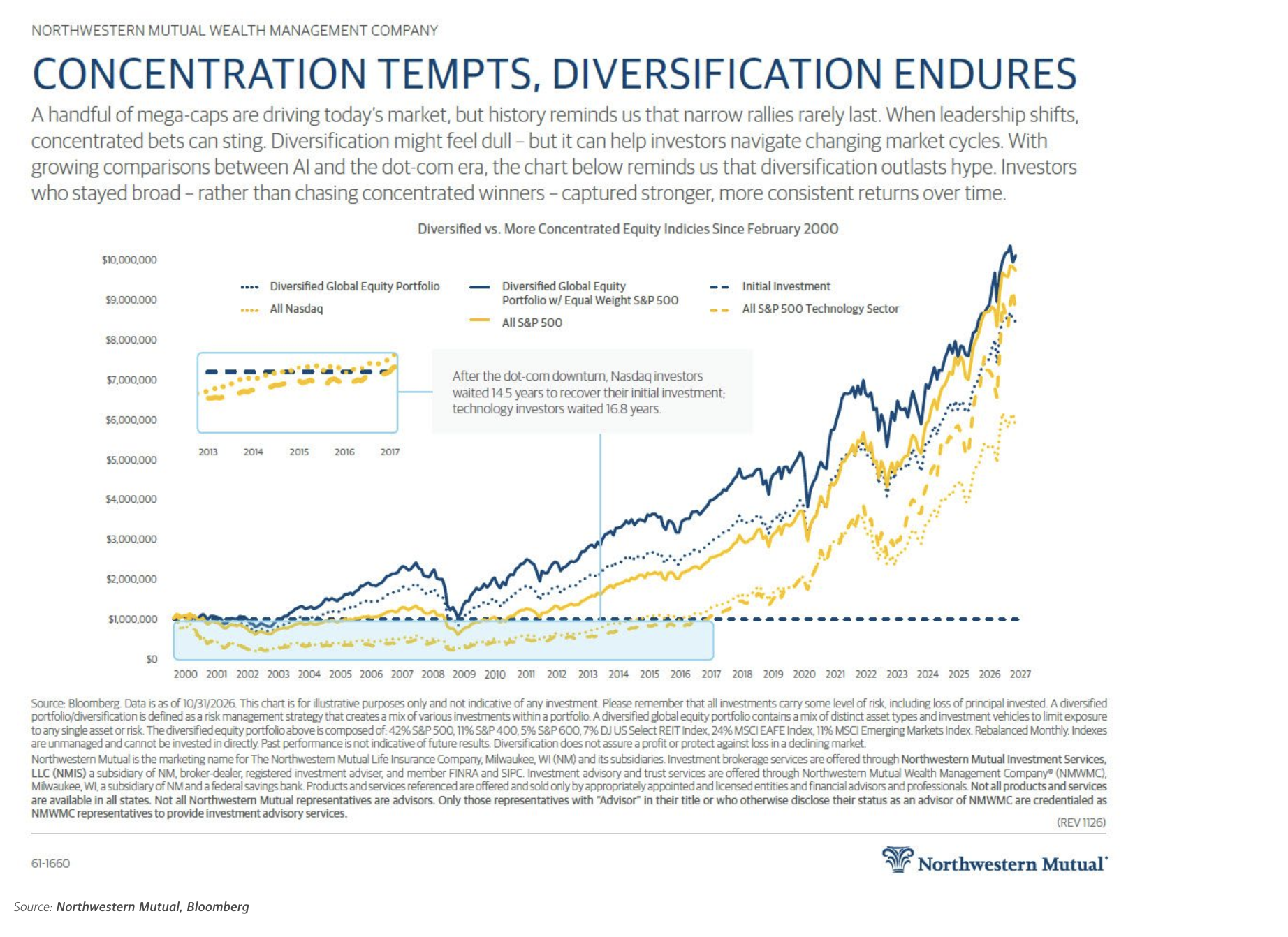
Lessons from that period also show us how diversification can lead to better performance. In the years after the market peaked in early 2000, a globally diversified equity portfolio—one that includes the S&P 500, U.S. small- and mid-caps, real estate investment trusts (REITs), and international stocks—weathered the storm and pushed higher, even as the Nasdaq and the S&P technology sector took 14.5 and 16.8 years to reach new highs, as the chart below shows. While we don’t know if history will repeat itself, we do believe diversified, long-term investors who stick to a financial plan will once again be rewarded for their patience.
Wall Street Wrap
ISM surveys show manufacturing and services activity still expanding
The ISM’s Manufacturing Index marked 10 consecutive months of expansion in October. New orders registered 55.5 percent and order backlogs 54.6 percent. With customer inventories still low at 41.6 percent, unchanged from September, strong new orders point to future production. The employment index edged down 0.3 percentage points to 52.4 percent but stayed above 50 for a fourth straight month, after 33 months in a row and 41 of the previous 42 months below 50. The Prices Index eased to 75.2 percent from 77.9 percent but remained elevated, well above the 58 percent reading a year ago and the 54.8 percent reading in October 2024. Supplier delivery times also remained elevated at 59.1 percent.
The Services Index registered 54.5 percent, down from 54.9 percent in September but the 28th consecutive month of expansion and nearly in line with its six-month average of 54.6 percent. Business activity slowed to 53.8 percent, the slowest since September 2025, and new orders fell to 55.9 percent from 59.8 percent and 60.9 percent in the two prior months, still strong but slowing a bit. The employment index rose to 51.4 percent from 50.1 percent in September and 47.8 percent in August and has been above 50 in five of the past 10 months. The backlog of orders reached 58 percent, up from 56.6 percent and its highest reading since July 2022. Supplier deliveries rose to 56.7 percent from 53.2 percent, the highest since a 56.8 percent reading in April 2026 and, before that, July 2022. The Prices Index registered 73 percent, down from 74 percent last month but, aside from that reading, still the highest since July 2022, a reminder that cost pressures remain a concern for businesses and for the Federal Reserve.
Employers add 165,000 jobs in October
Tota nonfarm payroll employment rose by 165,000 in October, well above the consensus forecast of 70,000, according to the Bureau of Labor Statistics. August’s payroll gain was also revised up, to 186,000. On a three-, six-, and nine-month basis, total nonfarm payrolls are averaging 137,000, 83,000, and 78,000, respectively.
Job growth was broad-based. Professional and business services added 70,000 jobs, health care added 42,000, and transportation and warehousing added 25,000. The one-month diffusion index, which shows how widespread hiring is, was 57.6, after nine of 12 months came in below 50 last year. The six-month index was 57 after 57.2 last month. The labor force participation rate was 61.9 percent. The household survey showed the labor force rising by 421,000 and employment by 463,000, which helped lower the unemployment rate. Average hourly earnings increased 0.4 percent for the month after the prior month was revised up to 0.3 percent from 0.1 percent, and 3.1 percent from a year earlier, although the three-month pace of 3.9 percent shows some signs of possible upward pressure. The stronger than expected report suggests the labor market remains resilient, although the Federal Reserve will likely weigh it alongside still elevated inflation as it considers its next move.
Initial jobless claims fall to 189,000 as layoffs remain low
Initial claims for unemployment benefits fell 6,000 to a seasonally adjusted 189,000 for the week ending October 31, according to the Department of Labor. The prior week’s reading was revised up by 1,000 to 195,000. The four-week moving average, which helps smooth weekly volatility, declined by 2,250 to 194,750.
The latest reading suggests layoffs remain limited. Indeed, claims matched the level reached in July, which was the lowest since 1969. However, when it comes to hiring, the report offered a more nuanced picture. Continuing claims, which measure the number of people still receiving unemployment benefits after an initial week of aid, increased by 23,000 to 1.718 million for the week ending October 24.
The combination of low initial claims and somewhat higher continuing claims fits with a labor market in which employers remain reluctant to shed workers, but those who do lose jobs may be taking longer to find new positions. That distinction will be important for the Fed as it assesses whether the labor market is cooling enough to ease wage and inflation pressures without experiencing a more pronounced deterioration.
Job openings rise to 7.52 million in September
The Job Openings and Labor Turnover Survey showed that job openings increased by 333,000 to 7.52 million in September, and the job openings rate rose to 4.5 percent from 4.3 percent. Hires held at about 5.4 million and total separations at about 5.3 million. The number of workers voluntarily leaving their jobs rose to 3.4 million, while layoffs and discharges were little changed at 1.6 million.
Separately, ADP reported private employers added 86,000 jobs in October. Taken together with the Labor Department’s jobless claims data and the Bureau of Labor Statistics employment report, the readings point to a labor market in which layoffs remain low, hiring may be picking up, and workers are somewhat more willing to change jobs.
Consumer sentiment improves in early November
The University of Michigan’s preliminary consumer sentiment index rose to 51 in November from 48 in October, a three-month high and above the roughly 48 that economists expected. The current conditions index increased to 51 from 46.7, and the expectations index rose to 50.9 from 48.8, although all these readings remain very depressed. The improvement was driven by independents, who reported their strongest sentiment in a year, while Republican and Democratic sentiment faltered. Survey respondents were interviewed between October 20 and November 2.
Year-ahead inflation expectations declined to 4.3 percent from 4.7 percent, and long-run expectations edged down to 3.4 percent from 3.5 percent, although both remain well above levels seen before February. About 57 percent of consumers spontaneously mentioned that high prices had eroded their living standards. The survey also noted that sentiment fell for consumers with the largest stock portfolios and that comments revealed growing anxiety over a possible AI bubble.
The week ahead
Monday: The September Wholesale Trade report is scheduled for release at 10:00 a.m. ET, followed by the New York Fed’s Survey of Consumer Expectations at 11:00 a.m. ET. We will be watching the consumer survey for changes in households’ expectations for inflation, employment, and their personal finances. With inflation remaining above the Federal Reserve’s 2 percent goal, consumers’ longer-term inflation expectations will be particularly important as policymakers assess whether price pressures are becoming more entrenched.
Tuesday: The National Federation of Independent Business’s Small Business Optimism Index for October is scheduled for release at 6:00 a.m. ET, offering a read on how small business owners view hiring, sales, and costs. Later that morning, October’s Consumer Price Index is scheduled for release at 8:30 a.m. ET and will likely be one of the most-watched reports of the week. We will be paying particular attention to core inflation, which excludes volatile food and energy prices, for signs of whether underlying price pressures are easing. The report should provide an important update on the inflation picture as the Fed weighs still elevated price pressures against conditions in the labor market and the broader economy.
Thursday: The Weekly Initial Jobless Claims report is scheduled for release at 8:30 a.m. ET, providing another timely look at layoffs and labor market conditions. We will be watching to see whether claims remain at historically low levels and whether the data continues to point to a labor market characterized by limited layoffs even as hiring has moderated. The National Association of Realtors’ Existing Home Sales report is scheduled for release at 10:00 a.m. ET, and we will be watching for signs of how housing activity is responding to elevated interest rates and affordability pressures.
Friday: October’s Producer Price Index is scheduled for release at 8:30 a.m. ET. The report measures the prices domestic producers receive for their goods and services and can provide insight into inflationary pressures further up the supply chain. We will be watching both headline and core readings for signs of whether businesses continue to face elevated cost pressures and what those trends could mean for consumer inflation in the months ahead.
Brent Schutte, CFA, is chief investment officer of the Northwestern Mutual Wealth Management Company.
Northwestern Mutual is the marketing name for The Northwestern Mutual Life Insurance Company and its subsidiaries. Life and disability insurance, annuities, and life insurance with longterm care benefits are issued by The Northwestern Mutual Life Insurance Company, Milwaukee, WI (NM). Longterm care insurance is issued by Northwestern Long Term Care Insurance Company, Milwaukee, WI, (NLTC) a subsidiary of NM. Investment brokerage services are offered through Northwestern Mutual Investment Services, LLC (NMIS) a subsidiary of NM, brokerdealer, registered investment advisor, and member FINRA and SIPC. Investment advisory and trust services are offered through Northwestern Mutual Wealth Management Company (NMWMC), Milwaukee, WI, a subsidiary of NM and a federal savings bank. Products and services referenced are offered and sold only by appropriately appointed and licensed entities and financial advisors and professionals. Not all products and services are available in all states. Not all Northwestern Mutual representatives are advisors. Only those representatives with Advisor in their title or who otherwise disclose their status as an advisor of NMWMC are credentialed as NMWMC representatives to provide investment advisory services.
A message from Advisor Perspectives and VettaFi: Discover something new! Click here to register for our upcoming webcasts.
© Northwestern Mutual Wealth Management
More Innovative ETFs Topics >