Voters sent a clear message about data centers on Tuesday. We take it seriously. But data centers are one node in a larger AI-infrastructure build: chips, networks, power, cooling, sites and the capital that funds them. We have to look past the heavy rhetoric to what the policy can actually do. The election changes the delivery path, the cost allocation and the timing of the build. It does not erase the demand.
The short version
- Divided government points to two years of headlines and hearings, not a new statutory regime.
- Policy bites hardest on the physical delivery path. The first-order risk is approval and location for 2028 data-center capacity. Most of the 2027 build is too far along to stop.
- Policy is moving cost and execution risk onto developers. That favors approved power, existing capacity, interconnection and builders that can fund themselves.
- Demand is still on a steep path. Public estimates put 2028 data-center electricity use at about 1.8 to 3.3 times the 2023 level.
- Strong AI demand does not guarantee strong supplier returns. Financing, customer concentration, cash conversion and valuation decide who earns them.
- We are in the early innings of a technology rebuild. The opportunity sits in constrained areas with pricing power, durable cash flows and equity duration.
Two kinds of evidence run through this note, and we label both. External Evidence marks what public sources and market data show. Westwood View marks our interpretation. We keep them apart on purpose. The facts are the same for everyone. What we do with them is our job.
What Changed, and What Did Not
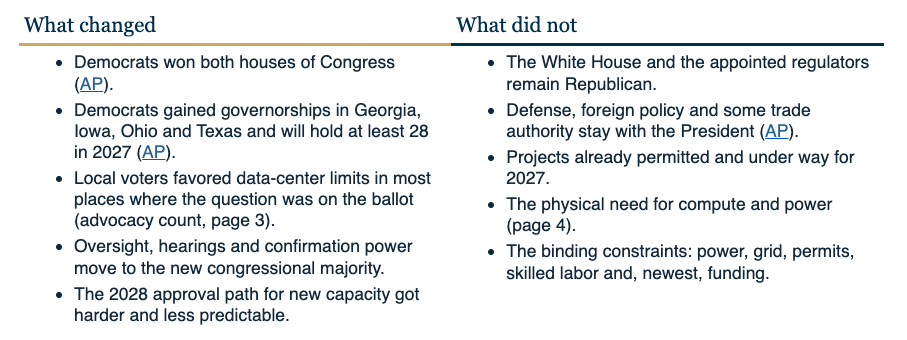
The vote moved the politics more than the physics. Here is how we separate the two.
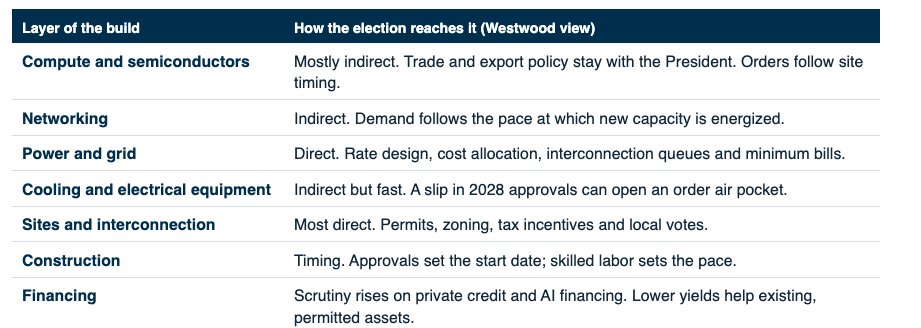
Where the Election Touches the AI Stack
Westwood View
Divided government rarely produces sweeping law. We expect two years of oversight, hearings, confirmation fights and must-pass bargaining. The more important shift is closer to the ground. States, utilities and localities decide where capacity goes, what it pays for power and who funds the grid upgrade. Texas is the largest swing factor because so much planned capacity sits there. Underwrite the permit and the power contract, not the election map.
The Ballot Message
External Evidence
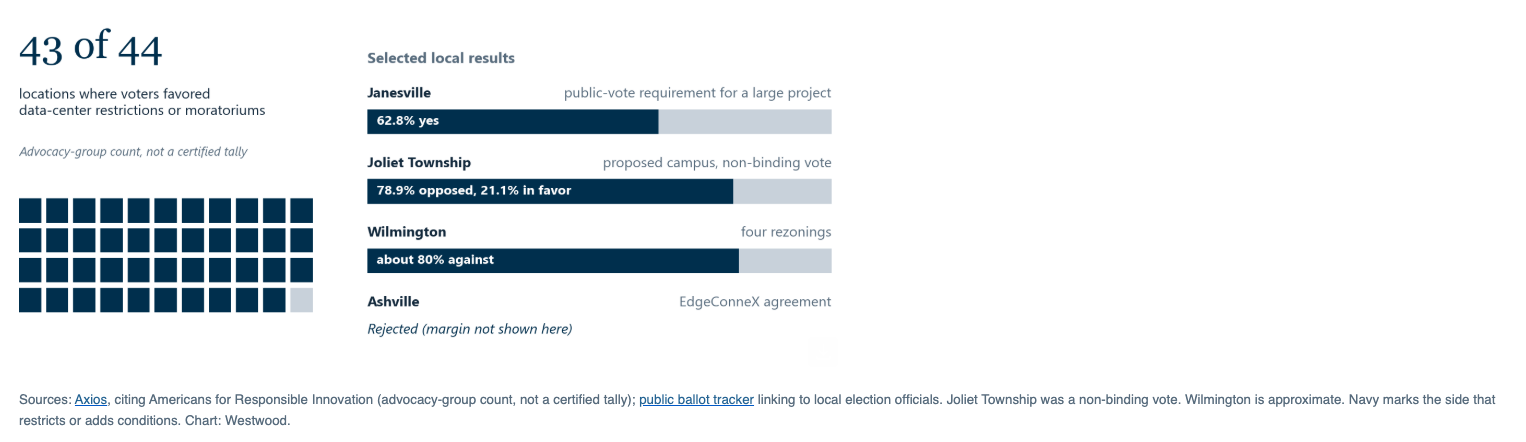
The clearest signal came from local ballots. Axios, citing the advocacy group Americans for Responsible Innovation, reported that voters favored data-center restrictions or moratoriums in 43 of 44 locations. This is an advocacy group's count carried by a news outlet. It is not a certified national tally, and the measures differ in form and force. The local results, which a public ballot tracker links to local election officials, tell a consistent story.
Westwood View
We read this as a vote on local costs and local control, not a vote against computing. Look at the tools voters used: a public-vote requirement, a non-binding vote, a rejected agreement and rejected rezonings. Each one changes where a project goes and on what terms. None of them removes the workload that the project was meant to serve.
That distinction matters for investors. An objection about who pays can be answered with a contract. The capacity that has already cleared these hurdles becomes worth more.
The Need Does Not Go Away
External Evidence
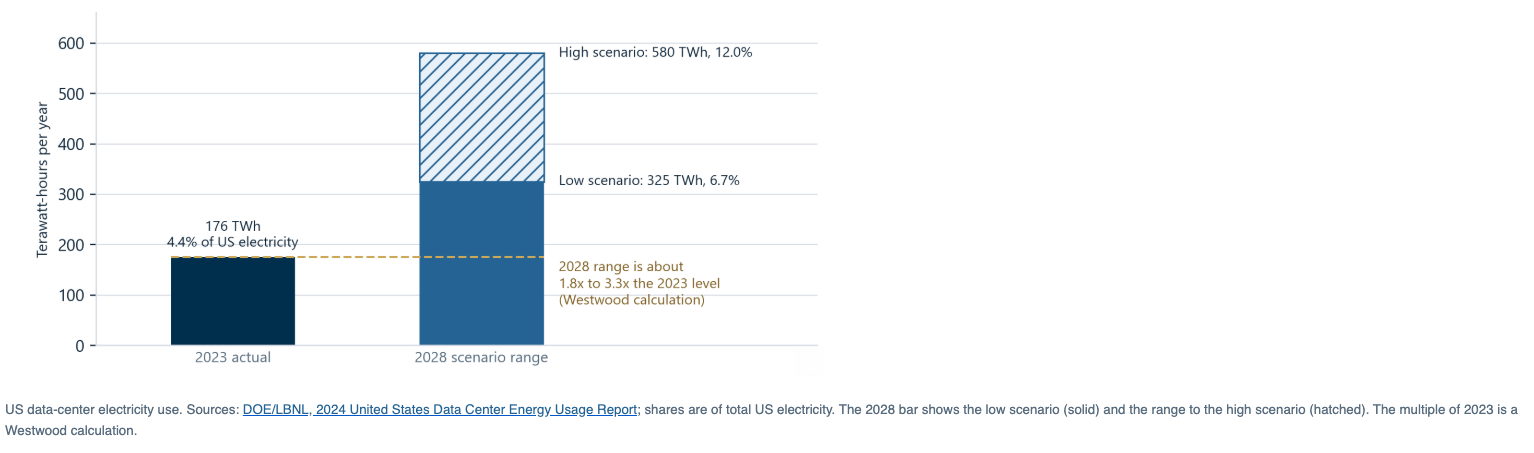
The Department of Energy and Lawrence Berkeley National Laboratory (DOE/LBNL) estimate that US data centers used 176 TWh of electricity in 2023, or 4.4% of the national total. Their 2028 scenarios range from 325 to 580 TWh, or 6.7% to 12.0%. DOE's 2026 resource hub cites an updated 2030 central estimate of 11.8%, within a 9.5% to 15.3% range.
Westwood View
Even the low end of the 2028 range is about 1.8 times the 2023 level. Local resistance can move a project to another county or another year. It does not remove the compute demand behind it.
The same arithmetic runs through the whole AI-infrastructure stack. Each new increment of load needs chips, networking, transformers, switchgear, cooling and a grid connection. A slower approval path concentrates value in the capacity that already has power, permits and interconnection. Demand is real. Financing, delivery and return now decide which builders deserve capital.
What Policy Can Actually Do
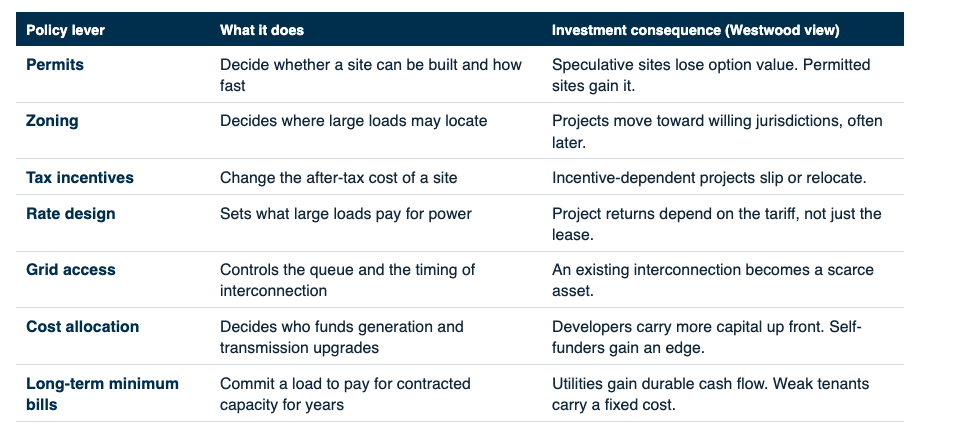
The rhetoric was heavy. The toolkit is narrower and more practical. Seven levers do most of the work, and most of them sit with states, utilities and grid operators.
External Evidence
- DOE's 2026 Ratepayer Protection Pledge asks technology companies to build, bring or buy new power, pay for delivery upgrades, negotiate separate rates, invest locally and coordinate with grid operators (DOE).
- FERC ordered all six regional grid operators to justify or reform their tariffs for large loads, including faster studies, limits on cost shifting, co-location and flexible-load service (FERC).
- Ohio's consumer advocate says AEP Ohio's tariff requires new large data centers to pay for at least 85% of contracted capacity for up to 12 years (Ohio Consumers' Counsel).
- Georgia's PSC allows special terms for new customers above 100 MW, including minimum bills and longer contracts (Georgia PSC).
Westwood View
None of these stops the build. Each moves cost and execution risk onto the developer. That is a different problem from prohibition, and it has different winners.
The AI-Infrastructure Market Reaction
External Evidence
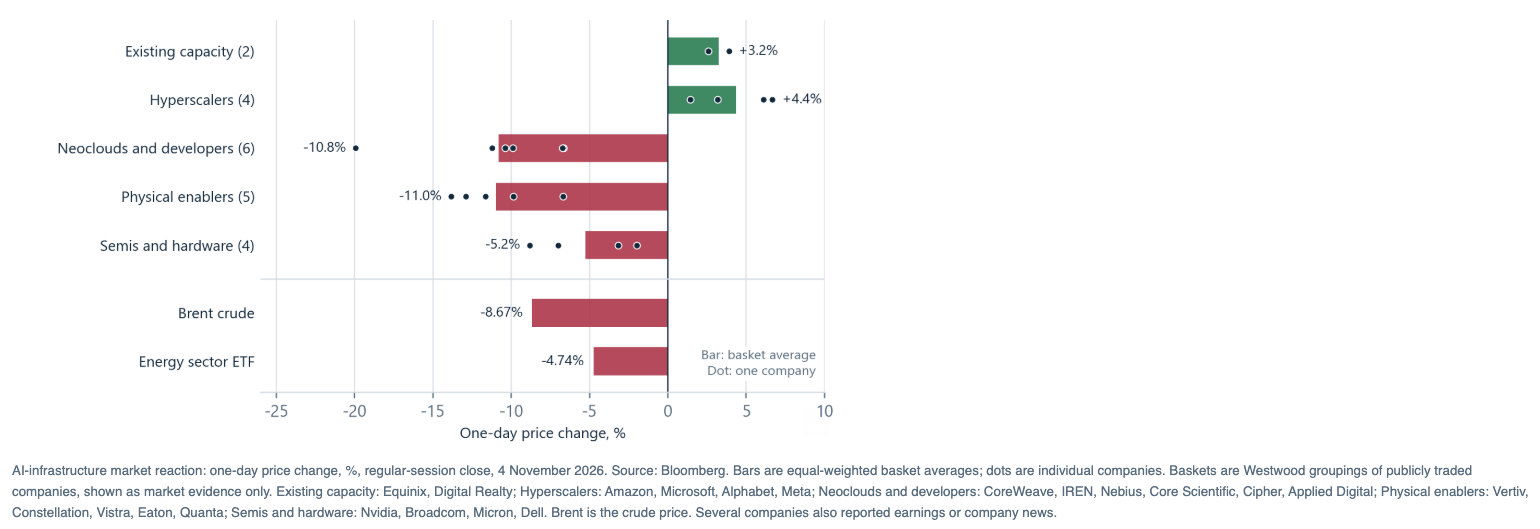
The S&P 500 rose 1.58% and the Dow rose 3.03%. The VIX fell 20.26%. Brent crude fell 8.67% and the energy sector fund fell 4.74%. Across the AI-infrastructure chain the spread was wide: existing capacity owners rose an average of 3.2% and hyperscalers 4.4%, while physical enablers fell an average of 11.0%. CoreWeave fell 9.90%.
Westwood View
The market drew the line we would draw. It paid for scarce, approved capacity and large self-funders. It sold developers with large unapproved pipelines and the suppliers whose 2028 orders could shift. We read the supplier sell-off as pricing a possible order air pocket, not a lower five-year volume path.
Where We See Opportunity in the AI Build
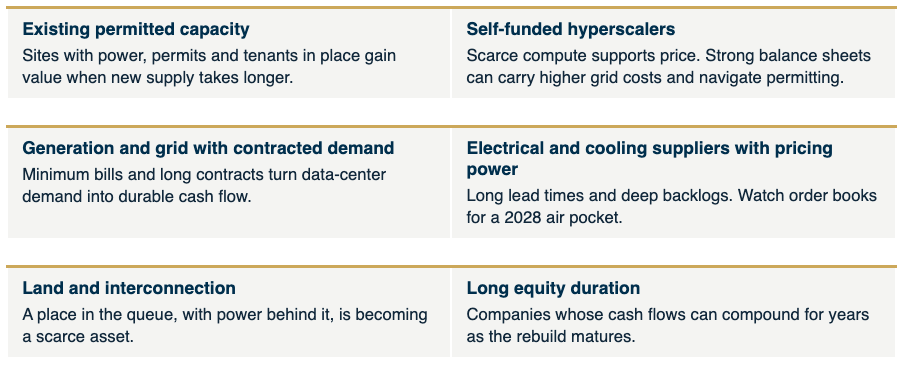
We are in the early innings of a technology rebuild. The election does not change that. It changes who captures the value. Strong AI demand does not guarantee strong supplier returns. Financing, customer concentration, cash conversion, valuation and the migration of bottlenecks decide who earns the return. We are finding opportunities in constrained areas with pricing power and equity duration.
Own the constraint. Not every builder.
These are areas of research focus, not recommendations to buy or sell any security.
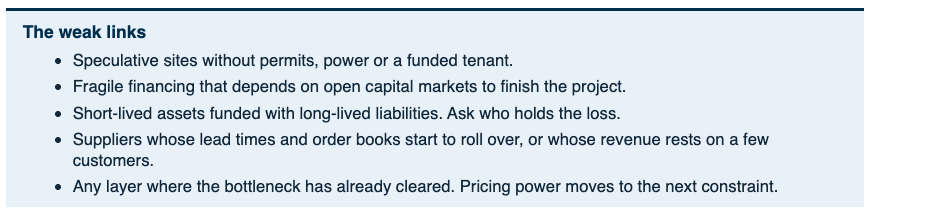
What Would Change Our Mind
We set these tests before the vote and we keep them. They are monitoring disciplines, not forecasts or trading signals. If several trip together, the case for the build weakens.
The Bottom Line
The opportunity continues to be the buildout, across the whole AI-infrastructure stack. The election raises the bar for new projects, and that raises the value of what is already approved, powered and funded. We would rather own the constraint than chase every builder. Pricing power, durable cash flows and long equity duration are where we want to be as the rebuild moves through its early innings.
A message from Advisor Perspectives and VettaFi: Discover something new! Click here to register for our upcoming webcasts.
Sources
Westwood house sources (Westwood View)
- Westwood Research, AI Infrastructure Deep Dive, October 2026
- Westwood Capital Markets Outlook, September 2026
- Westwood investment team discussion, 4 November 2026
External public evidence and market data
1. AP, markets and the election result, 4 Nov 2026
2. AP, governorships and state gains, 4 Nov 2026
3. Axios, citing Americans for Responsible Innovation (advocacy count)
4. Public data-center ballot tracker, linked to local election officials
5. DOE/LBNL, 2024 United States Data Center Energy Usage Report
6. DOE, Powering America's AI Future data-center resource hub
7. FERC, action on large-load integration
8. Ohio Consumers' Counsel, quick facts on data centers
9. Georgia PSC, rules for new customers above 100 MW
10. Market data: Bloomberg, regular-session close, 4 Nov 2026.
Important information. This commentary reflects the views of Westwood as of 4 November 2026. Views can change without notice. It is for information only and is not investment advice or a recommendation to buy or sell any security. Public sources are cited as reported and have not been independently verified. Past performance does not guarantee future results.
Use of AI. AI tools are used for research support, drafting and data summarisation only. They do not make, recommend or execute investment decisions. All investment decisions are made by Westwood investment professionals, who review and are responsible for any output shown here.
© Westwood
Read more commentaries by Westwood