Dividend ETFs have long been an investor favorite for their unique defensive flavor and total-return profile in the face of sticky inflation, rising interest rates, and volatile markets. While bonds may struggle with price erosion in rising rate cycles, and growth equities may face valuation compression, dividend stocks can offer resilience through cash flow and lower equity duration.
Key Takeaways:
- Dividend ETFs see massive inflows in 2026, marking their largest annual haul since 2022.
- Dividend stocks offer cash payouts and shorter duration, a cushion against volatility.
- High-yield ETFs vs. dividend growth ETFs delivering wide dispersion in results.
It’s no wonder, then, that in a year like 2026, dividend ETFs have been center stage in investors’ pursuit of factor exposure.
The category took in more than 50% of factor-specific ETF inflows in October and more than 60% year-to-date. That investor appetite translates to nearly $80 billion in net new creations for dividend ETFs so far this year. That’s the largest annual haul since 2022.
See More: Rising Rates Not a Dealbreaker for Stocks
What’s to Love About Dividend Stocks?
Companies that are capable of sustaining and growing payouts typically have strong competitive moats and some level of pricing power. They also return cash to investors in the near term, making them short-duration equities, which can anchor valuations in rising rate environments.
Fidelity put it nicely in a piece of research: “Dividend-paying stocks provide a way for investors to get paid during rocky market periods, when capital gains are hard to achieve. They may provide some hedge against inflation, especially when they grow over time. They are tax advantaged when compared to some other forms of income, such as interest on fixed-income investments. Dividend-paying stocks, on average, tend to be less volatile than non-dividend-paying stocks. A dividend stream, especially when reinvested to take advantage of the power of compounding, can help build wealth over time.”
But not all dividend stocks — and dividend ETFs — are created equal.
High Dividend vs. Dividend Growers
Consider, for instance, the difference between high dividend payers and dividend growers. The first focuses on capturing the highest payout, prioritizing immediate cash flow over long-term growth. The latter looks at durability and stability of payouts over multiple years, offering defense longer-term.
Here are two ETF examples that illustrate that key difference in focus, and ultimately, in results across different market environments: The State Street SPDR Portfolio S&P 500 High Dividend ETF (SPYD) versus the ProShares S&P 500 Dividend Aristocrats ETF (NOBL).
SPYD invests in the 80 highest-yielding stocks in the S&P 500. The stocks are equally weighted in the portfolio. NOBL tracks an equal-weighted index of S&P 500 constituents that have increased dividend payments annually for at least 25 years.
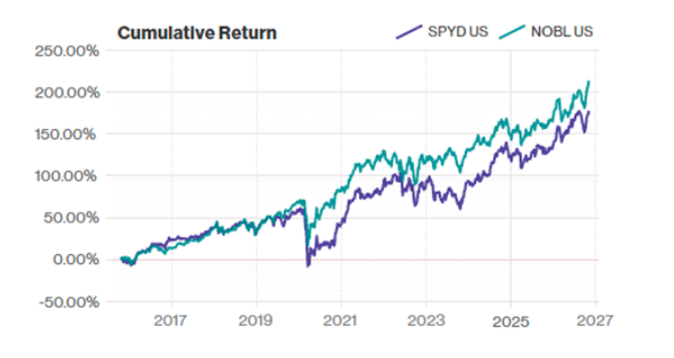
The ETF currently owns 68 names. Performance leadership fluctuates between them depending on macro conditions, and year-to-date, high-yielding SPYD has led, while long-term NOBL has held an edge. What’s noteworthy here is that in October, when the S&P 500 lost about 1%, both these ETFs delivered more than 8% in gains during the month. See chart below:
Performance Across Time Periods:
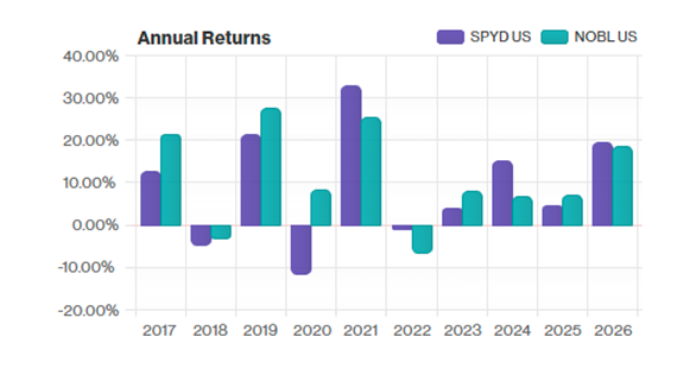
There’s a lot of return disparity over time. See this calendar-year view of returns:
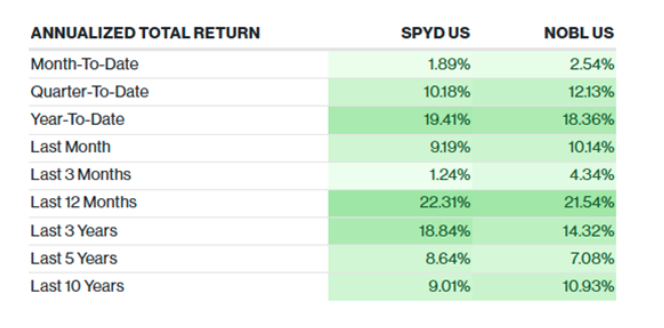
From another perspective, consider rolling results across popular time frames below:
Also different is the level of yield generated by these strategies.
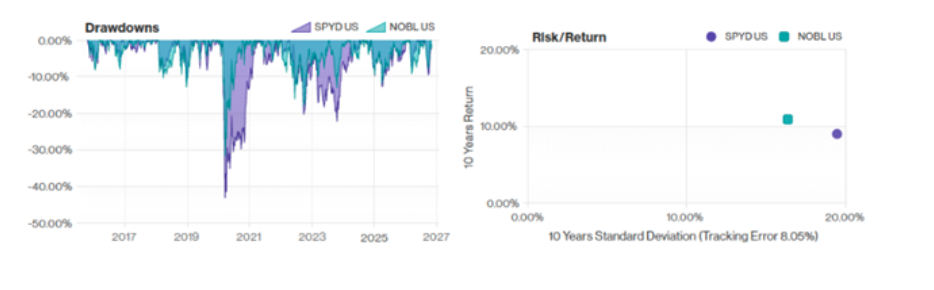
Considering that part of the appeal of dividend strategies is their defensive, lower-volatility quality, high yielders and dividend growers also have a diverging track record on the risk/return spectrum, as seen below:
Sector Mix a Source of Divergence
It goes without saying that individual stocks and sector tilts play a major role in these performance differences, especially in a year when S&P 500 sector return divergence exceeds 50 percentage points between best and worst performing.
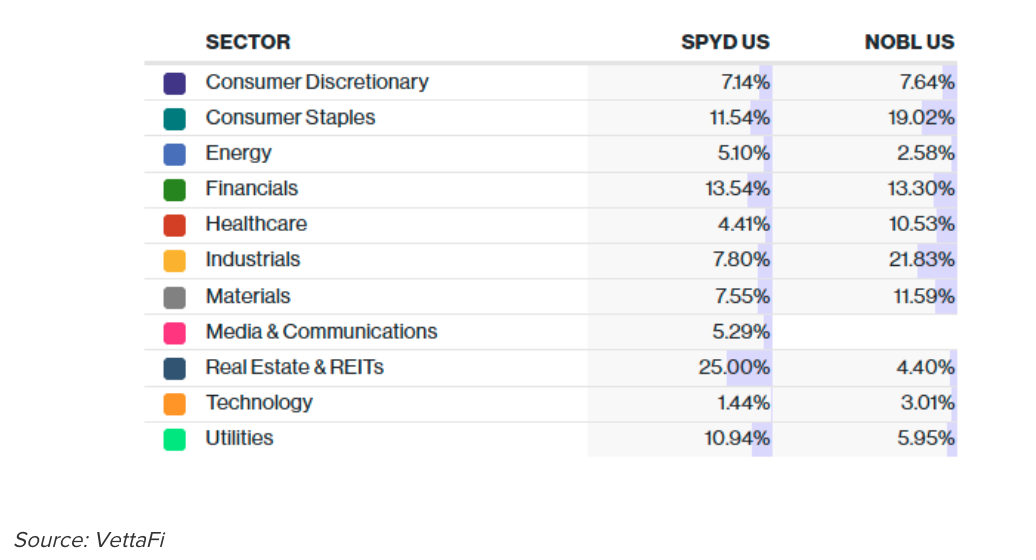
A high-yielding fund like SPYD is leaning heavily into real estate, financials, and utilities, while a dividend aristocrat fund like NOBL is carrying a lot more of industrials, consumer staples and healthcare weight, by comparison.
Dividend ETFs are an interesting category of equity funds that offer equity risk and equity income, and a prolific category at that, with roughly 190 unique dividend ETFs in the market today.
To dive deeper, catch the latest episode of Inside the Ticker where my colleague Todd Rosenbluth and I do a side-by-side comparison of these funds.
For more news information and analysis, visit the Equity ETF Content Hub.
Originally posted on ETF Trends
A message from Advisor Perspectives and VettaFi: Discover something new! Click here to register for our upcoming webcasts.
Read more commentaries by VettaFi