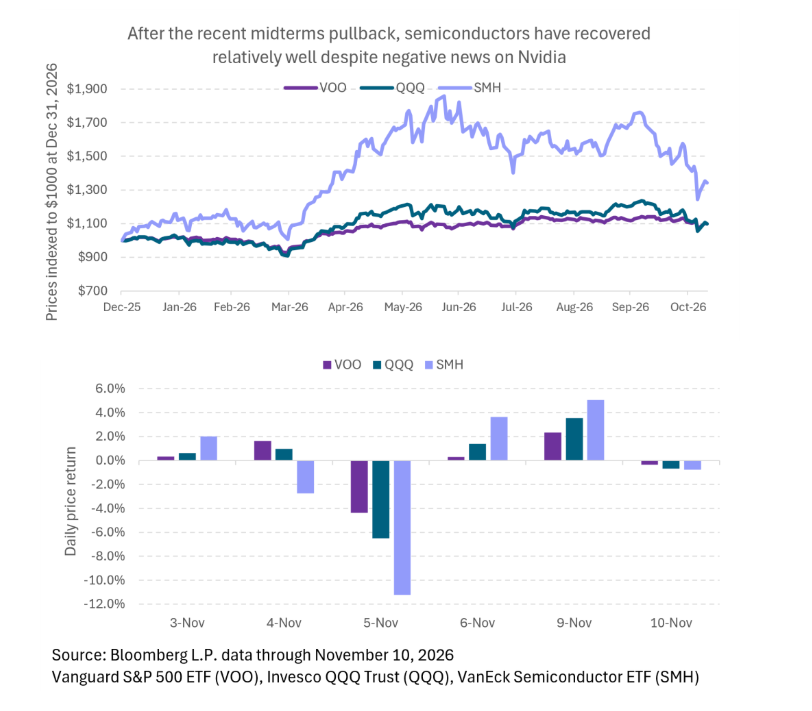
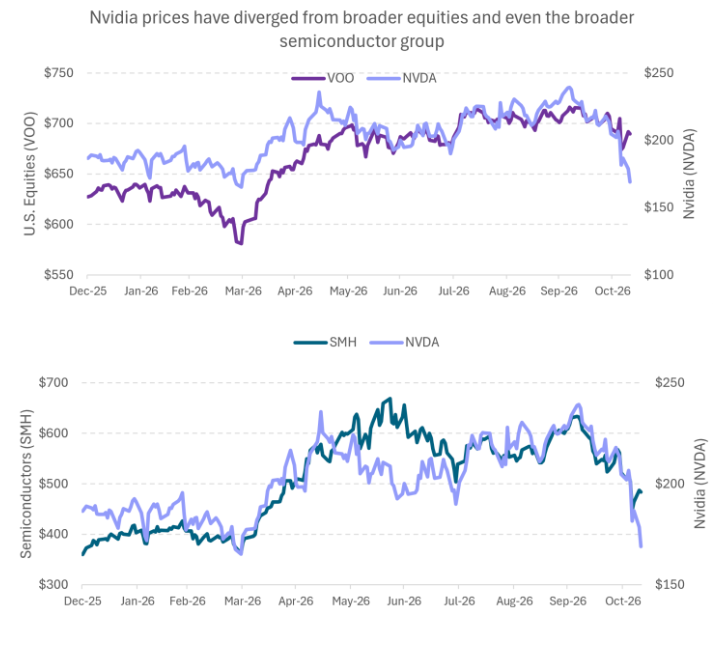
High-interest areas like cryptocurrencies and AI-related stocks have faced renewed volatility following the midterm elections, while the recent investigation into Nvidia Corporation (NVDA) has introduced additional unexpected uncertainty for the technology sector and broader equity markets. However, Nvidia’s weakness has not extended equally to its semiconductor/artificial intelligence peers, and investors have continued adding exposure to both broad equity and technology ETFs despite the negative headlines. Comparing ETF flows and trading activity across traditional and leveraged ETFs may provide insight into long-term investor conviction.
Key Takeaways:
- Nvidia’s selloff highlights concentration risks in market-cap-weighted ETFs, despite resilience among semiconductor peers.
- Investors continue buying technology-heavy ETFs despite Nvidia’s investigation and post-election uncertainty.
- Strong inflows into leveraged semiconductor ETFs suggest investors remain willing to take additional risks.
Midterms Spark New Uncertainty for AI Stocks
The recent midterm elections have introduced new uncertainty for areas like AI, cryptocurrencies, and energy. In a “blue wave,” Democrats gained control of both chambers of Congress, potentially increasing scrutiny of digital assets and AI infrastructure while raising the possibility of greater pressure to resolve the U.S.-Iran conflict.
AI-related stocks have faced the most pressure as investors reassess high valuations, rising infrastructure costs, and the sustainability of AI spending. Greater regulatory scrutiny and potential data center restrictions could particularly affect smaller data center operators that depend on future development. These developments create risks for established technology companies, semiconductor manufacturers, and AI infrastructure providers. As a result, we experienced a broader AI and technology pullback last week despite interest in the sector boosted by Anthropic’s upcoming IPO.
Nvidia Concentration Raises Concerns
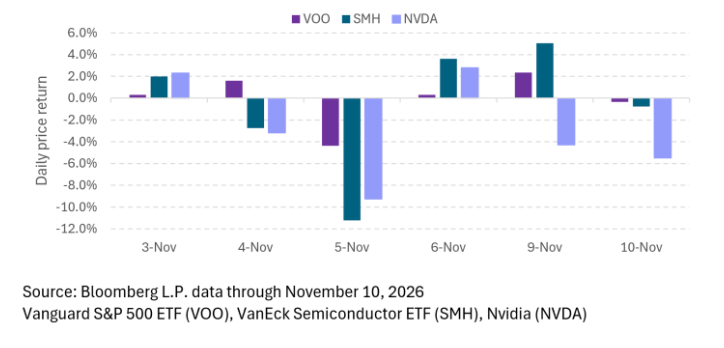
Beyond the midterm elections, Nvidia’s recent investigation has introduced company-specific uncertainty for the largest player in the AI investment theme. On November 8, Nvidia’s board announced an independent investigation following reports that CEO Jensen Huang had been targeted by an alleged foreign spy. The company stated that it had no reason to believe national security or company secrets were compromised, although the investigation remains ongoing.
Nvidia’s size makes its recent weakness particularly relevant for ETF investors. According to ETFdb, 639 ETFs have Nvidia within its top 15 holdings, and 1,070 ETFs total have exposure to Nvidia (which is almost 20% of the ~5,800 ETFs in the U.S.). Most of these ETFs are market-cap-weighted ETFs, which allocate greater weight to the largest companies (like Nvidia). The SPDR S&P 500 ETF Trust (SPY), Vanguard S&P 500 ETF (VOO), and iShares Core S&P 500 ETF (IVV) have roughly 7–8% exposure to Nvidia, while technology funds like the Vanguard Information Technology ETF (VGT) have almost 18% exposure and semiconductor funds like the VanEck Semiconductor ETF (SMH) have over 20% exposure.
As a result, Nvidia’s performance can have a significant influence on these funds even when other underlying holdings are performing well. While these ETFs provide diversification, their concentration in Nvidia and other megacap technology stocks could leave them vulnerable to a broader downturn in the AI trade.
Diversification Still Makes a Difference
However, Nvidia’s recent divergence from its peers also illustrates how diversified funds can offset some company-specific weakness through exposure to other companies. On November 9 (the day immediately following the announcement), Nvidia shares fell approximately 4%, while Advanced Micro Devices (AMD) gained 13% and Broadcom (AVGO) rose nearly 9%. Although semiconductor stocks are often influenced by similar AI-related trends, this divergence illustrates how company-specific developments can affect individual stocks without necessarily reflecting weakness across the broader industry.
By midday November 11, CoreWeave (CRWV) helped lead a rebound in technology stocks following stronger-than-expected earnings and guidance, reinforcing that market pullbacks do not necessarily signal a broader downturn — one of the reasons why investors continued to buy broad, diversified ETFs despite pockets of weakness.
Short-Term Investors Take Mostly Bullish Leveraged Opportunities in AI & Technology
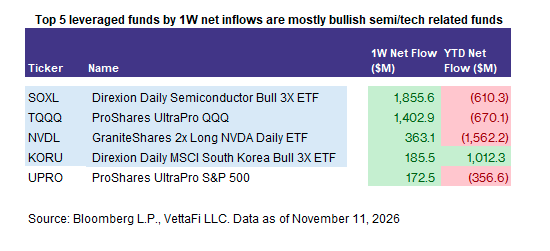
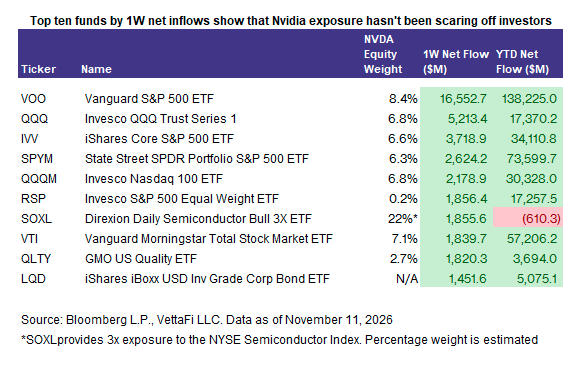
While Nvidia’s recent weakness raised potential concentration risks, some investors have chosen to double down on their exposure to the stock. Leveraged ETFs can offer insight into where investors are willing to take additional risk, particularly during periods of market volatility. The Direxion Daily Semiconductor Bull 3X Shares (SOXL) attracted $1.9 billion in net inflows over the past week ending November 10, while the ProShares UltraPro QQQ (TQQQ) added $1.4 billion over the same period.
Interest in leveraged semiconductor exposure also extends beyond broad-based funds. The GraniteShares 2x Long NVDA Daily ETF (NVDL) and the Direxion Daily MSCI South Korea Bull 3X ETF (KORU) took in $363 million and $185 million this week. The index underlying KORU has almost half of its exposure to Samsung Electronics (005930 KS) and Sk Hynix (000660 KS), making this essentially a leveraged play on these international semiconductor names. These inflows suggest that some investors are taking more concentrated positions in individual semiconductor companies rather than relying exclusively on diversified sector exposure.
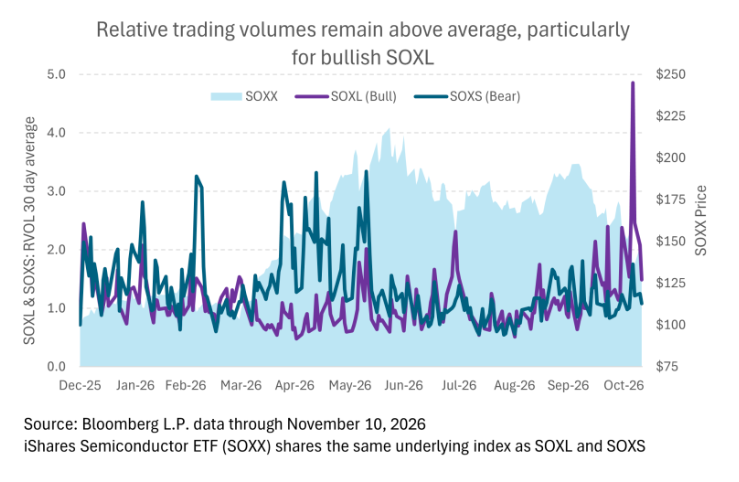
Trading volume provides another way to measure investor interest, particularly because leveraged ETFs are frequently used for short-term trading. Comparing one-day trading volume with the 30-day average daily volume, also known as relative volume (RVOL), can help identify unusually high volume. SOXL and its bear counterpart — the Direxion Daily Semiconductor Bear 3X ETF (SOXS) have both seen elevated trading volume, but bullish SOXL has received a lot more attention.
However, because of their short-term nature, elevated volume does not necessarily indicate long-term bullish sentiment. Regardless, the concentration of inflows in technology and semiconductor funds suggests that some investors remain willing to take aggressive positions in these sectors.
Investors Also Seem to Be Buying the Dip in Traditional ETFs
While leveraged ETF activity can provide insight into short-term investor sentiment, flows into traditional ETFs suggest longer-term investors may still buying through the broader market dip. Over the one-week period ending November 10, VOO attracted $16.6 billion in net inflows, while IVV added $3.7 billion. As discussed above, both funds have significant exposure to Nvidia, suggesting that its recent headlines have not prevented investors from adding exposure to broad U.S. equities even if it there is a high concentration to Nvidia and the technology sector.
Investors have also continued adding exposure to the broader technology sector despite recent volatility. The Invesco QQQ Trust (QQQ) attracted $5.2 billion in net inflows, while the Invesco Nasdaq 100 ETF (QQQM) added $2.2 billion and the Technology Select Sector SPDR Fund (XLK) brought in $888 million.
The Invesco S&P 500 Equal Weight ETF (RSP), however, which distributes exposure more evenly across S&P 500 constituents, also attracted $1.9 billion in net inflows over the same period. Equal-weight strategies can help reduce dependence on Nvidia and other megacap companies, although they also introduce greater exposure to smaller index constituents.
These flows suggest that investors remain relatively comfortable buying the dip and maintaining broad technology and semiconductor exposure despite Nvidia’s recent weakness, although some are taking a more cautious equal-weight approach.
Bottom Line:
Investors appear to be maintaining their long-term conviction in U.S. equities, despite the midterm election results and recent Nvidia headlines. While broad equity and sector ETFs remain heavily concentrated in technology and AI stocks, including Nvidia, diversified ETFs can help reduce company-specific risks. Meanwhile, the recent pullback may be providing an attractive entry point for investors.
For more news information and analysis, visit the Equity ETF Content Hub.
Originally posted on ETF Trends
A message from Advisor Perspectives and VettaFi: Discover something new! Click here to register for our upcoming webcasts.
Read more commentaries by VettaFi