The US midterm elections have brought about a major political realignment, with the Democratic Party taking decisive control of both the House and the Senate. What are the most likely implications for the economic outlook and financial markets?
Many analysts and commentators have argued that the two most likely consequences are (1) gridlock between the administration and the new Congress, which will narrow the budget deficit, and (2) a slowdown in artificial intelligence (AI) infrastructure investment, which will reduce growth and force the Federal Reserve (Fed) to a less hawkish stance.
I disagree with both.
See more: After the Midterms: High Expectations and “Good Gridlock”
The best place to start is to understand what voters rejected, what they voted for, and what political parties are willing and likely to deliver. Judging by the exit polls, as well as opinion polls before the ballots were cast, voters were especially dissatisfied with the state of the economy, the Iran war (which also contributed to a higher cost of living), tariffs (ditto) and an immigration policy that went well beyond popular support for greater border control. Voters also expressed a strong dislike for the massive development of AI data centers.
Let’s start with AI. The election outcome will likely lead to several key states, such as Texas and Ohio, adopting a less-welcoming attitude to data centers. While projects that have already secured permits and power will likely go ahead without trouble, the bar for the rest will be higher, and the hyperscalers have already signaled they will be more sensitive to local concerns. In my view, this will probably make the AI infrastructure buildout slower after next year and more expensive: Data centers are less likely to benefit from fiscal incentives and more likely to have to contribute to build new power generation, or pay subsidies to help defray the higher cost of power due to their additional demand, and maybe commit to boosting local employment. These challenges are not insurmountable, but they could increase the cost of the build out.
The adverse fallout on economic activity, however, will likely be moderate. The often-repeated argument that US growth is now almost entirely dependent on AI investment is vastly overstated.
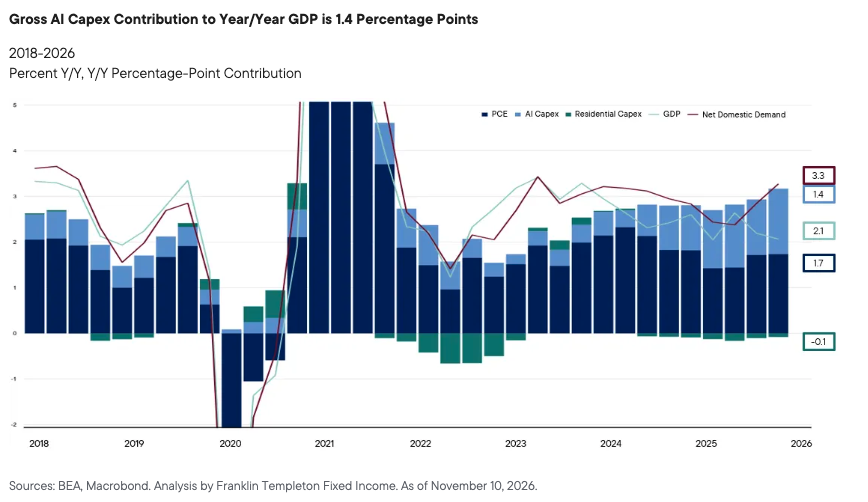
The contribution of AI capital expenditures (capex) to gross domestic product (GDP) growth peaked in the third quarter of this year, when it accounted for 1.4 percentage points out of an annual growth rate of 2.1%. What we and other analysts can measure as AI capex, however, captures more than just AI investment. National accounts statistics provide data on information processing equipment, software, research and development, and data centers as the categories most closely associated with AI. This is the combined measure of capex that peaked at 1.4 percentage points last quarter. Between 2015 and 2022, before generative-AI came onto the scene, this same measure averaged about 0.5 percentage points. The excess attributable to AI is therefore short of one percentage point. Moreover, a lot of the related hardware is imported and therefore needs to be subtracted to get the net contribution to growth. This adjustment would at least halve the contribution of AI capex to growth, bringing it to a more realistic 0.4 to 0.5 percentage points, somewhat less than one-quarter of the US economy's growth rate. Clearly this is a meaningful contribution, but far from the only driver of US growth.
AI capex will not disappear, and these estimates show that even if it were cut in half, it would reduce US GDP growth by less than a quarter of a percentage point, which would still leave the US economy running at about potential. Since AI capex accounts for just over 7% of nominal GDP, the fallout would be modest, including in terms of employment (the same sectors account for about 5% of private payrolls). Finally, some of the slowing AI capex would plausibly be made up by an acceleration in other areas that have more recently been crowded out by the AI boom. The bottom line for me is that the shift in the political wind will make the AI infrastructure buildout slower and more expensive, but without major implications for growth and inflation.
If concerns about the growth impact of AI slowdowns are overblown, I think the idea that a divided government will narrow the fiscal deficit is wishful thinking. If there is one thing that unites the two political sides, it is their desire to spend more. Democratic election campaign featured multiple spending promises, and after the election result prominent Democratic leaders have reiterated their determination to reverse Medicaid cuts, extend Affordable Care Act tax credits, raise the federal minimum wage; reverse cuts to child care tax credits and Supplemental Nutrition Assistance Program and eliminate the State and Local Tax deduction cap. The Republicans for their part have shown little support for fiscal restraint, and if anything are likely to want to spend more in areas like defense.
It seems likely, therefore, that any dealmaking between the two parties will lead to an even wider fiscal deficit. To get a sense of the potential implications, a rough accounting of the measures mentioned above would cost between US$250-US$330 billion on an annual basis over the next 10 years. Repudation of the Trump tariffs would add another US$140 billion per year to the bill. The total of US$390-US$470 billion would be more than one-fifth of the current estimated US$2 trillion budget deficit. This is obviously unrealistic, and the numbers are simply intended to illustrate the scale of the problem—noting also that we are not including here any of the increase in defense spending that the Administration is likely to demand. A divided house will not spend less. It will likely spend more.
The Iran war has proved unpopular on both sides of the spectrum. Leading Democratic politicians have been calling for a cessation of hostilities since before the elections, and after the midterm victory have vowed “we are going to end the war,” in the words of Democratic Senate leader Chuck Schumer. On this issue, Democrats might find support in the Republican camp, where some have viewed the attack on Iran as a betrayal of the president’s promise not to get embroiled in more “endless wars.” Last September, four Republican senators supported a Democratic-led resolution to end the war or require congressional authorization.
A similar argument holds for tariffs. As noted above, House Democratic leader Hakeem Jeffries identified reversing US President Trump’s tariffs as one of the priorities for the new Congress. Here again, Democrats might find some sympathetic ears on the other side of the aisle. Trump's unpredictable use of high tariffs has increased prices for consumers, raised costs for industries, and made the business environment more volatile and unpredictable. While the relationship with China will remain contentious, there will be a strong push to eliminate or drastically reduce tariffs on our key longstanding trade partners such as Canada and European countries.
Putting this all together, the growth outlook remains healthy, in my view. Looser fiscal policy and potentially lower energy prices, if the Iran crisis is resolved, would be positive for economic activity and would outweigh the limited headwind from a potentially slower pace of AI infrastructure investment. As far as the Fed is concerned, a resilient economy, a strong labor market, and entrenched inflationary pressures will matter more than a potential marginal reduction in price pressures from energy and tariffs. I therefore think the Fed remains on track to deliver another two to three rate hikes, starting most likely in December.
I also think pressure on bond yields will remain to the upside. As I have argued in past articles, I think real yields are not rich yet. The neutral nominal fed funds rate is around 4%-4.50%, in my view, and adding about 1 percentage point of term and risk premium would give us a fair value of 5%-5.50% for 10-year US Treasuries. I expect continued loose fiscal policy will keep generating substantial funding requirements for the government. And as I mentioned above, I think any slack in funding demand created by a potential slowdown in AI infrastructure is likely to be taken up by investment in other sectors of the economy. Upward pressure on yields is therefore likely to persist.
In credit, attractive yields do not necessarily translate into adequate compensation for risk. Despite recent moderate widening, quality-adjusted high-yield spreads sit near the 29th percentile of their range over the past three decades, compared with the 60th percentile over the past five years. Dispersion is significant, however, with CCC spreads near the 99th percentile of their five-year range, signaling material distress among weaker borrowers. While I do not see evidence of broad deterioration in corporate fundamentals, refinancing risks are increasingly important. I favor durable cash flows, manageable refinancing needs and sufficient compensation for downgrade and default risk. The opportunity is to earn income without underwriting a refinancing problem.
A message from Advisor Perspectives and VettaFi: Discover something new! Click here to register for our upcoming webcasts.
WHAT ARE THE RISKS?
All investments involve risks, including possible loss of principal.
Fixed income securities involve interest rate, credit, inflation and reinvestment risks, and possible loss of principal. As interest rates rise, the value of fixed income securities falls. Low-rated, high-yield bonds are subject to greater price volatility, illiquidity and possibility of default.
Equity securities are subject to price fluctuation and possible loss of principal.
There is no assurance that any estimate, forecast or projection will be realized.
Important Information
This material is intended to be of general interest only and should not be construed as individual investment advice or a recommendation or solicitation to buy, sell or hold any security or to adopt any investment strategy. It does not constitute legal or tax advice. This material may not be reproduced, distributed or published without prior written permission from Franklin Templeton.
The views expressed are those of the investment manager and the comments, opinions and analyses are rendered as at publication date and may change without notice. The underlying assumptions and these views are subject to change based on market and other conditions and may differ from other portfolio managers or of the firm as a whole. The information provided in this material is not intended as a complete analysis of every material fact regarding any country, region or market. There is no assurance that any prediction, projection or forecast on the economy, stock market, bond market or the economic trends of the markets will be realized. The value of investments and the income from them can go down as well as up and you may not get back the full amount that you invested. Past performance is not necessarily indicative nor a guarantee of future performance. All investments involve risks, including possible loss of principal.
Any research and analysis contained in this material has been procured by Franklin Templeton for its own purposes and may be acted upon in that connection and, as such, is provided to you incidentally. Data from third party sources may have been used in the preparation of this material and Franklin Templeton ("FT") has not independently verified, validated or audited such data. Although information has been obtained from sources that Franklin Templeton believes to be reliable, no guarantee can be given as to its accuracy and such information may be incomplete or condensed and may be subject to change at any time without notice. The mention of any individual securities should neither constitute nor be construed as a recommendation to purchase, hold or sell any securities, and the information provided regarding such individual securities (if any) is not a sufficient basis upon which to make an investment decision. FT accepts no liability whatsoever for any loss arising from use of this information and reliance upon the comments, opinions and analyses in the material is at the sole discretion of the user.
Franklin Templeton has environmental, social and governance (ESG) capabilities; however, not all strategies or products for a strategy consider “ESG” as part of their investment process.
Products, services and information may not be available in all jurisdictions and are offered outside the U.S. by other FT affiliates and/or their distributors as local laws and regulation permits. Please consult your own financial professional or Franklin Templeton institutional contact for further information on availability of products and services in your jurisdiction.
Issued in the U.S. by Franklin Templeton, One Franklin Parkway, San Mateo, California 94403-1906, (800) DIAL BEN/342-5236, franklintempleton.com. Investments are not FDIC insured; may lose value; and are not bank guaranteed.
You need Adobe Acrobat Reader to view and print PDF documents. Download a free version from Adobe's website.
CFA® and Chartered Financial Analyst® are trademarks owned by CFA Institute.
© Franklin Templeton
More Commodities Topics >