Election Noise, Steady Fundamentals
Membership required
Membership is now required to use this feature. To learn more:
View Membership Benefits
Voters handed Democrats control of both chambers of Congress on Tuesday, November 31. As of Sunday, November 8, the Associated Press count showed Democrats with 54 Senate seats to Republicans’ 44, and 254 House seats to 162, with 19 House races still uncalled1. With a Republican in the White House, that means divided government starting in January.
Markets took a quick, bumpy ride through the result. The S&P 500 rose 1.58% on Wednesday, November 4, then fell 4.36% on Thursday, November 5, its worst day since April 20252,3. After a rebound of about 2.3% on Monday, November 9, the index closed within 0.3% of its election-day level4.
My view is that the election matters less for portfolios than the headlines suggest. The six months after an election have usually been positive for stocks, the economy is growing, the job market is holding up, and credit markets are calm. The part of the market that sold off hardest, AI and chip stocks, was reacting to the prospect of slower AI spending, which I think may prove healthier than it looks.
See more: Five Questions for Markets After the Midterm Elections
A sharp but narrow selloff
Thursday’s decline started in a specific corner of the market. Chipmakers slid on speculation that the new Democratic majorities will move to restrain the AI industry, and the Nasdaq 100 had its worst session since March 20205. The PHLX Semiconductor Index fell 12.2% in a single day3. Every S&P 500 sector declined, but technology led with a 7.30% drop, and the seven largest technology companies lost about $1 trillion in market value6.
Credit markets barely flinched. The high-yield bond spread, the extra yield investors demand to hold below-investment-grade corporate debt instead of Treasuries, widened from 3.32 to 3.48 percentage points that day and was back to 3.42 by Friday, November 67. I read calm credit markets during an equity selloff as a sign that the selling was more about positioning and valuations than about the economy.
What history says about the next six months
I looked at every federal election since 1928, the earliest year my daily S&P 500 data allow, which gives 49 presidential and midterm elections4. For each, I measured the index’s price change from the last close on or before Election Day to the close six months later, and classified the outcome by the government voters elected, using the official party-control records of the Senate and House historians8–12.
The S&P 500 was higher six months later after 37 of the 49 elections, a hit rate of 75.5%, with an average gain of 7.5% and a median of 8.1%12. For comparison, the index rose in 67.2% of all six-month periods since 1928, averaging 3.9%12. In other words, post-election stretches have been somewhat better than a typical six months, though not dramatically so.
Split by outcome, divided government has the better record. After the 24 elections that produced divided government, the index was higher six months later 20 times (83.3%), with an average gain of 9.9%12. After the 25 elections that gave one party the White House and both chambers, it was higher 17 times (68.0%), averaging 5.3%12. Our new arrangement, a Republican president with a Democratic House and Senate, has occurred 11 times, with gains in 9 of them and an average of 11.8%12. Table 1 summarizes the results12; the full record is in the appendix.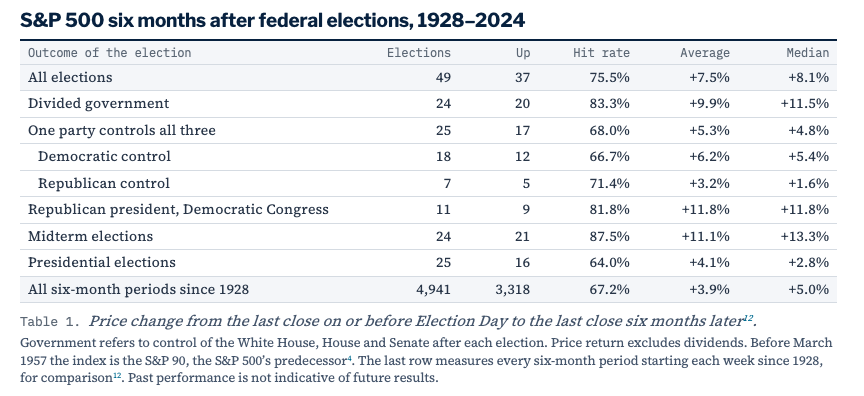
I would not lean too hard on the partisan split. Divided government usually follows a midterm, and midterms have their own pattern. The index was higher six months after 21 of the 24 midterms (87.5%), and that hit rate was the same whether the midterm produced divided or one-party government12. The three exceptions, 1930, 1938 and 1946, came during the Depression and the end of World War II12. The election calendar may explain more than which party won. Small samples cut both ways, too: the two worst six-month stretches, declines of 16.4% after 1938 and 16.3% after 1940, both followed elections that left one party in charge12.
The economy is giving markets something to stand on
Real GDP grew at a 3.4% annualized rate in the third quarter, according to the advance estimate13. Growth that solid may give markets a cushion while Washington adjusts to its new balance of power.
The labor market looks resilient. Payrolls rose 165,000 in October, well above the 48,000 monthly average of the prior 12 months, and September was revised up to 60,000 from 29,00014. The unemployment rate dipped to 4.1% and has stayed between 4.1% and 4.3% since March14.
Layoffs, meanwhile, are rare. Initial jobless claims, the weekly count of people filing for unemployment benefits for the first time, were 189,000 in the week ended October 3115. That is low by any historical standard: claims have been at or below that level in only about 1% of weeks since the data began in 196715. Because the labor force is far larger than it was then, the comparison is even more striking once you adjust for it. Measured as a share of the labor force, October’s average was the lowest on record15. Hiring has picked up while layoffs remain rare, a combination I think can continue to support consumer spending.
Credit markets tell a similar story. Corporate bond spreads tend to widen early when lenders start to worry about the economy. Figure 1 shows the spread between Moody’s Baa-rated corporate bonds and the 10-year Treasury at 1.57 percentage points, against a median of 2.13 since 1986; it has been this narrow or narrower on only about 11% of days in that period16.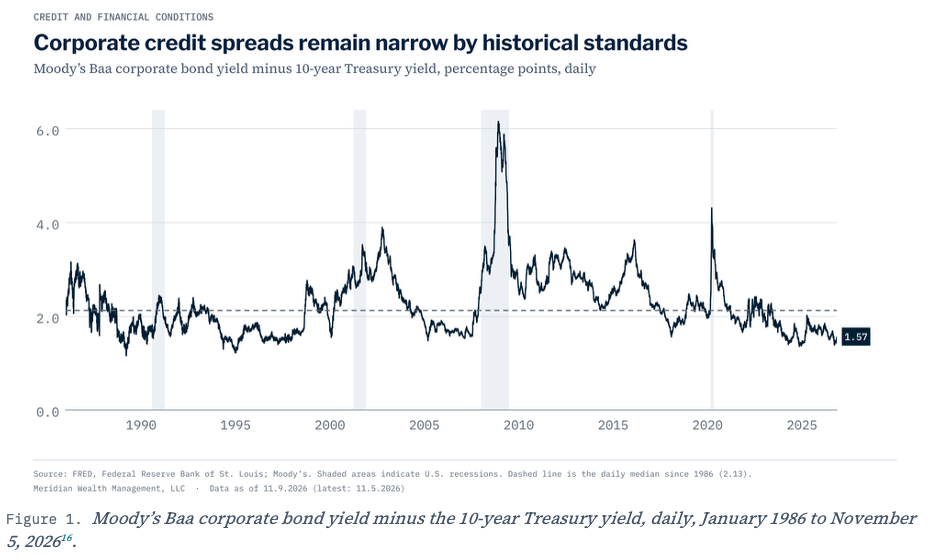
Narrow spreads are a sign of confidence. They also mean investors are being paid less to take credit risk, which leaves less cushion if conditions change.
Slower AI spending may not be a bad outcome
The AI selloff reflects a fair question about the pace of investment. Business spending on information processing equipment and software, the category that captures much of the data center build-out, reached 5.35% of GDP in the third quarter17. As Figure 2 shows, that is above the 4.46% peak of the dot-com boom at the end of 2000, and the spending rose 23.8% from a year earlier17.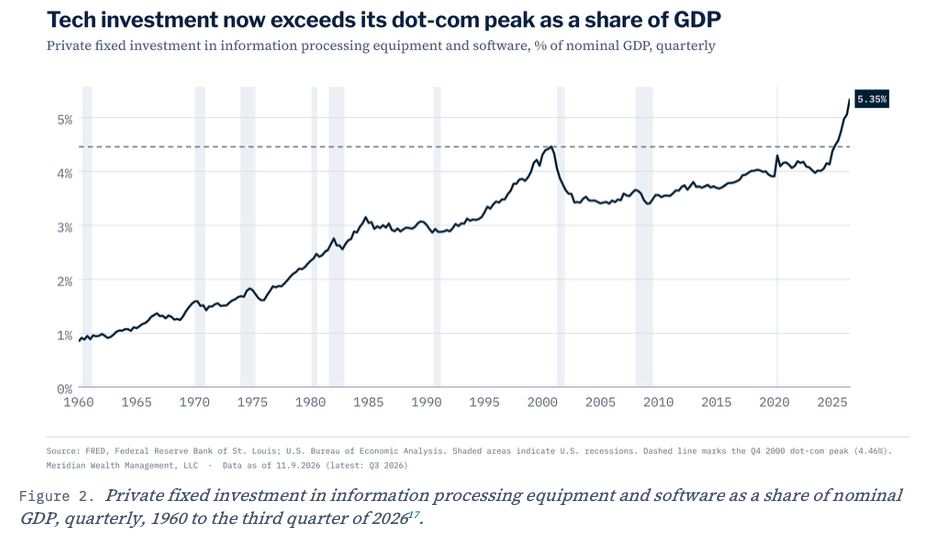
The pushback on that spending is not just a story about the change in Congress. On the same ballots, voters in 10 states decided 41 local measures on data centers18, 21 of them in Ohio and others in places ranging from Kansas and Florida to Maine and California19. Data centers lost 40 of the 4120. Restrictions passed in 27 of 28 votes, including five outright bans, and all 13 measures that would have eased the way for new projects failed18,20. The lone exception was a measure in Harwood, North Dakota, that would have added a review process for large industrial projects21. Permits are granted locally, so the build-out is likely to face friction whichever way Washington leans.
A slower build-out would not hit every AI company the same way. The bricks-and-mortar side of AI, the chipmakers, equipment makers, power producers and data center developers that sell into the build-out, depends on that spending continuing to grow, and it is where the reaction was sharpest. On Wednesday, November 4, Reuters reported that data center operators fell between 8.8% and 21% and that power producers and equipment suppliers tied to data center projects fell between 9.2% and 15.4%22.
The largest cloud companies, often called hyperscalers, sit on the other side of that trade. They are the buyers of chips and data center capacity, and the spending has been straining their cash flow. J.P. Morgan estimates that only about 20% of AI capital spending in 2027 will be funded from free cash flow, with the rest requiring outside financing23. BCA Research projects that depreciation and amortization at the five largest hyperscalers could reach $590 billion in 2029, more than their combined operating profits in 202624. AI-related borrowing by cloud providers and data center developers had helped push global bond issuance to a record $6.61 trillion for 2026 as of late October25.
Slower spending would ease those pressures, and investors noticed. On November 4, the same day data center stocks slid, Amazon and Microsoft each rose about 6% and Alphabet 4.6%, as investors bet a slower build-out would curb Big Tech’s spending and make existing data centers more valuable22. I name these companies only to illustrate the market’s reaction, not as recommendations. One strategist quoted by Reuters summed it up: the most vulnerable AI companies are “the borrowers, not necessarily the biggest spenders”22. Those gains didn’t survive Thursday’s broad selloff6, but the split shows how the market may sort the AI trade from here.
I still think AI investment is a durable trend; the question is pace. A natural speed limit may be healthier than a boom that runs until it breaks, and slower growth in spending could leave the largest spenders with more cash flow to work with. The risk runs the other way as well. AI spending has supported earnings and economic growth, so a sharper pullback than investors expect could weigh on both, and the companies most exposed to it are among the largest in the market.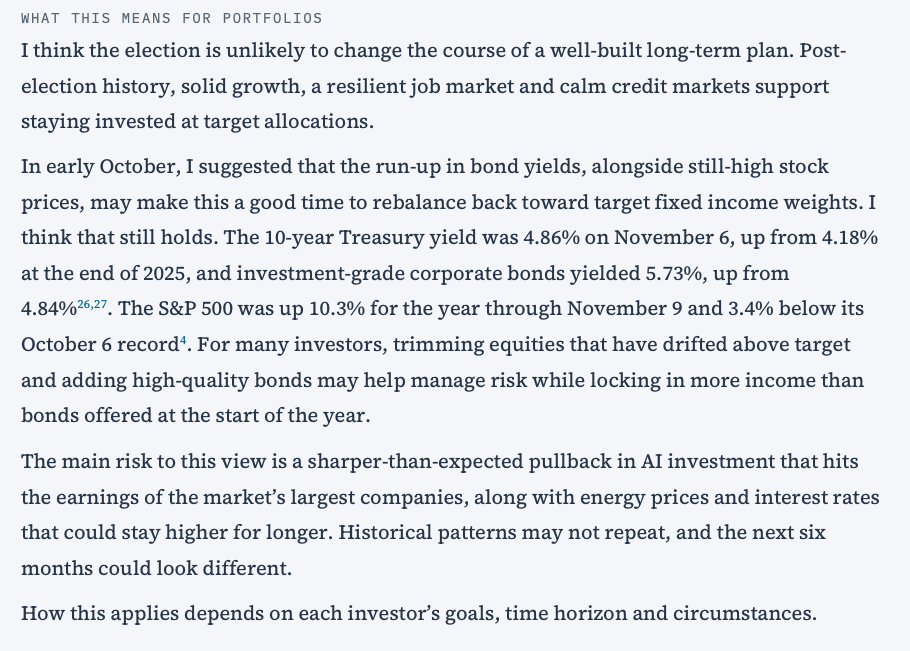
Appendix: the full record
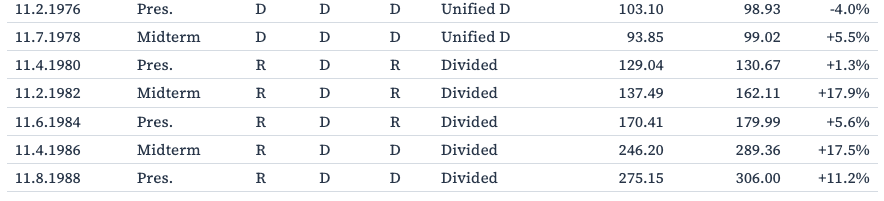
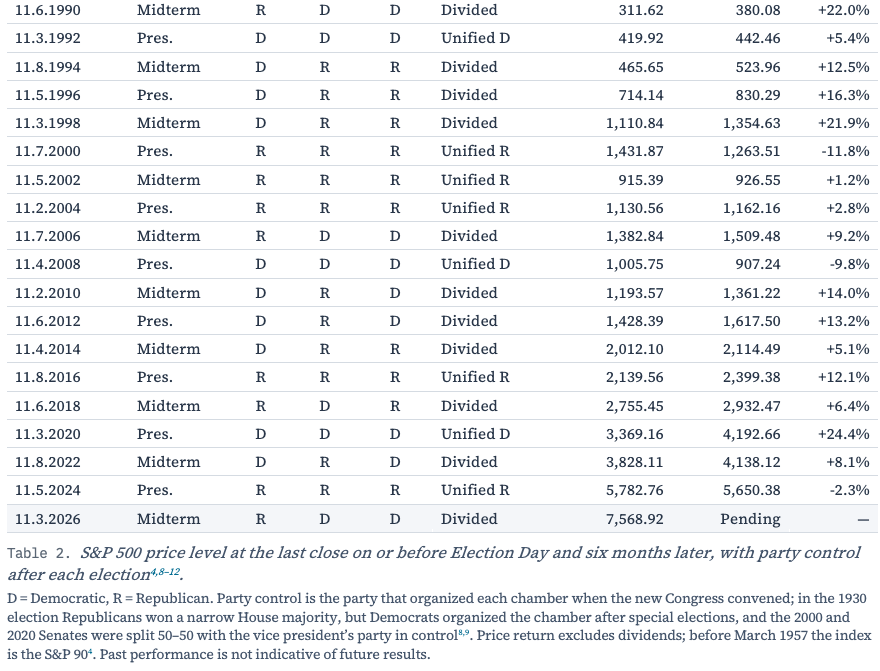
Table 2 lists every election in my study, with the government each one produced and the S&P 500’s price change over the following six months12. The 2026 midterm is shown for reference; its six-month window ends in May.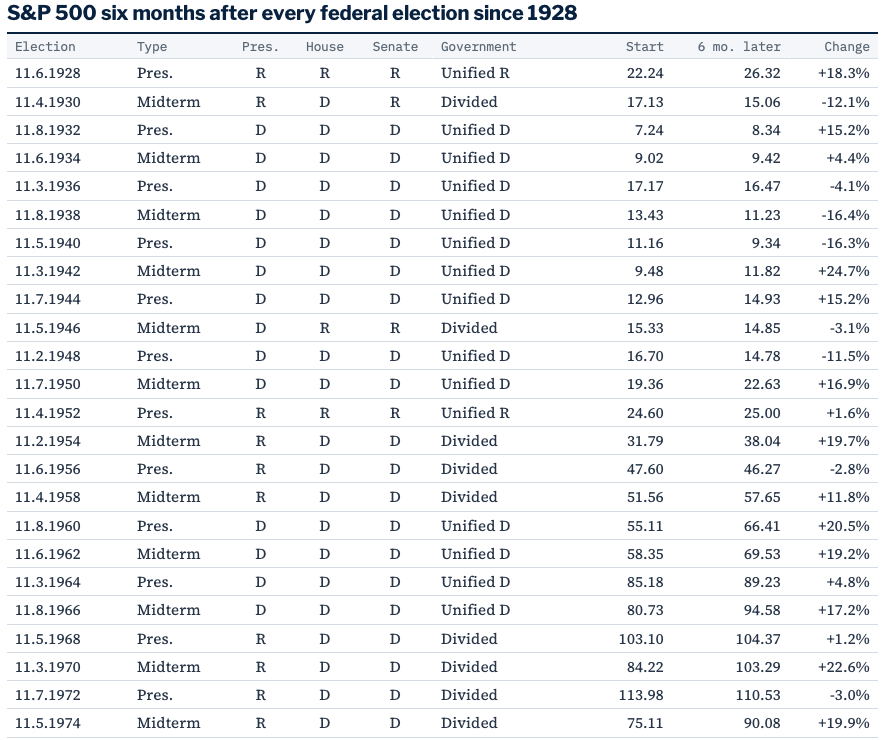
SOURCES
- Associated Press election results, as reported in Yahoo News, “Midterms 2026 latest updates.” Published 11.9.2026; accessed 11.9.2026.
- FRED, Federal Reserve Bank of St. Louis, S&P 500 (SP500), S&P Dow Jones Indices LLC; closes of 11.3.2026, 11.4.2026 and 11.5.2026. Data as of 11.5.2026; accessed 11.9.2026.
- Charles Schwab, “Stocks Plunge on AI Fears, Volatility Erupts.” Published 11.5.2026; accessed 11.9.2026.
- Yahoo Finance, S&P 500 (^GSPC) daily closing prices, S&P Dow Jones Indices data, 12.30.1927 to 11.9.2026; checked against FRED SP500 for 11.7.2016 to 11.5.2026 (largest difference 0.12%). Data as of 11.9.2026; accessed 11.9.2026.
- Bloomberg, “S&P 500 Sinks 4% as AI Washout Rattles Wall Street: Markets Wrap.” Published 11.5.2026; accessed 11.9.2026.
- CNBC, “Magnificent 7 loses $1 trillion. The most eye-popping stats from Thursday’s tech stock plunge.” Published 11.5.2026; accessed 11.9.2026.
- FRED, Federal Reserve Bank of St. Louis, ICE BofA US High Yield Index Option-Adjusted Spread (BAMLH0A0HYM2), ICE Data Indices, LLC. Data as of 11.6.2026; accessed 11.9.2026.
- United States Senate, Party Division, 71st–119th Congresses. Accessed 11.9.2026 (page data through 1.3.2026).
- Office of the Historian, U.S. House of Representatives, Party Divisions of the House of Representatives, 1789 to Present. Accessed 11.9.2026 (data through the 119th Congress, 1.3.2025).
- The American Presidency Project, UC Santa Barbara, Presidential Election Results, 1928–2024. Accessed 11.9.2026 (data through the 11.5.2024 election).
- 2 U.S. Code § 7, Time of election (Legal Information Institute, Cornell Law School). Accessed 11.9.2026 (election dates 11.6.1928 to 11.3.2026 derived from it).
- Meridian Wealth Management calculation from sources 4 and 8–11: S&P 500 price change from the last close on or before Election Day to the last close on or before the same date six months later, for 49 federal elections from 11.6.1928 to 11.5.2024; base rate uses six-month periods starting each fifth trading day from 1.3.1928. Calculated 11.9.2026; data as of 11.9.2026.
- FRED, Federal Reserve Bank of St. Louis, Real Gross Domestic Product, percent change at a seasonally adjusted annual rate (A191RL1Q225SBEA), U.S. Bureau of Economic Analysis, Q3 2026 advance estimate. Released 10.29.2026; accessed 11.9.2026.
- U.S. Bureau of Labor Statistics, The Employment Situation — October 2026. Released 11.6.2026; accessed 11.9.2026.
- FRED, Federal Reserve Bank of St. Louis, Initial Claims (ICSA), U.S. Employment and Training Administration, weekly from 1.7.1967, and Civilian Labor Force Level (CLF16OV), U.S. Bureau of Labor Statistics; share of weeks and monthly-average claims as a share of the labor force are Meridian calculations. Data as of 10.31.2026; accessed 11.9.2026.
- FRED, Federal Reserve Bank of St. Louis, Moody’s Seasoned Baa Corporate Bond Yield Relative to Yield on 10-Year Treasury Constant Maturity (BAA10Y), Moody’s; daily 1.2.1986 to 11.5.2026, median and share of days are Meridian calculations. Data as of 11.5.2026; accessed 11.9.2026.
- FRED, Federal Reserve Bank of St. Louis, Private fixed investment in information processing equipment and software (A679RC1Q027SBEA) and Gross Domestic Product (GDP), U.S. Bureau of Economic Analysis; share of GDP and year-over-year change are Meridian calculations. Data as of 7.1.2026 (Q3 2026); released 10.29.2026; accessed 11.9.2026.
- Ballotpedia News, “28 local ballot measures on Nov. 3 would limit data center development if approved, 13 would facilitate it.” Published 11.2.2026; accessed 11.9.2026.
- Reason, “Midterms 2026: Data Centers Out, Reproductive Freedom In.” Published 11.4.2026; accessed 11.9.2026.
- Ballotpedia, “Voters favored limiting data center development in 40 of 41 local ballot measures on Nov. 3” (published 11.6.2026), as reported by Wccftech. Published 11.8.2026; accessed 11.9.2026.
- Tom’s Hardware, “AI data centers comprehensively defeated at US midterm elections.” Published 11.4.2026; accessed 11.9.2026.
- Reuters (Purvi Agarwal and Johann M Cherian), “AI data-center stocks slide, renewables rally after Democratic US midterm sweep,” via Yahoo Finance. Published 11.4.2026; accessed 11.9.2026.
- J.P. Morgan estimate of the share of 2027 AI capital expenditure funded by free cash flow, as reported in The Daily Shot. Published 10.26.2026; accessed 11.9.2026.
- BCA Research (Peter Berezin), projection of depreciation and amortization for the five largest hyperscalers, as reported in The Daily Shot. Published 10.26.2026; accessed 11.9.2026.
- Bloomberg, global bond issuance year to date, as reported in The Daily Shot. Published 10.28.2026; accessed 11.9.2026.
- FRED, Federal Reserve Bank of St. Louis, Market Yield on U.S. Treasury Securities at 10-Year Constant Maturity (DGS10), Board of Governors of the Federal Reserve System; 12.31.2025 and 11.6.2026. Data as of 11.6.2026; accessed 11.9.2026.
- FRED, Federal Reserve Bank of St. Louis, ICE BofA US Corporate Index Effective Yield (BAMLC0A0CMEY), ICE Data Indices, LLC; 12.31.2025 and 11.6.2026. Data as of 11.6.2026; accessed 11.9.2026.
IMPORTANT DISCLOSURES
This material is provided by Meridian Wealth Management, LLC for informational and educational purposes only. It does not constitute investment advice, a recommendation, or an offer to buy or sell any security or strategy, and it is not tailored to the objectives, risk tolerance, tax situation, or financial circumstances of any individual client.
All investing involves risk, including the possible loss of principal. Diversification does not guarantee a profit or protect against loss.
This material was prepared with the assistance of artificial intelligence tools, which were used to help research, draft, and produce charts.
Advisory services offered through Meridian Wealth Management, LLC, a Registered Investment Advisor. For more information, please visit our website www.meridianwealthllc.com. Insurance offered through Meridian Insurance, LLC. Seek tax, legal, and insurance advice from a licensed professional relative to your situation. The information and opinions voiced in this material are strictly for general information only and are not intended to provide any security recommendations, specific advice, or recommendations. Past performance cannot guarantee future success.
A message from Advisor Perspectives and VettaFi: Discover something new! Click here to register for our upcoming webcasts.
Membership required
Membership is now required to use this feature. To learn more:
View Membership BenefitsSponsored Content
Upcoming Virtual Events View All