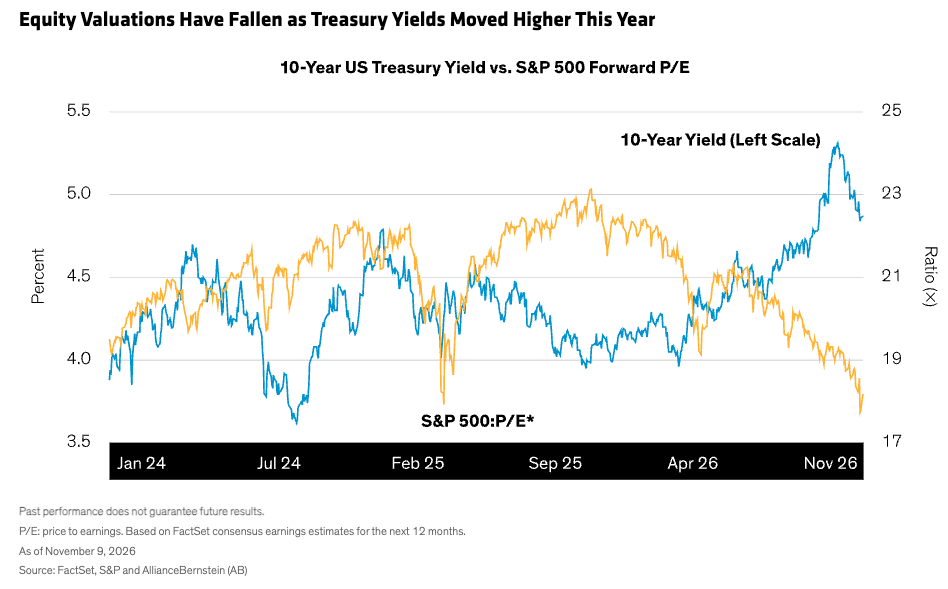
Higher interest rates tend to pressure equity valuations, but the level of yields alone doesn’t tell the whole story. Historical evidence suggests that the speed and scale of rate moves matter more, which helps explain why US stocks have gotten cheaper this year—even as markets have risen.
The 10-year US Treasury yield marched upward for most of this year, as markets priced in a more hawkish Fed stance. When the yield moved above 4.50%, price-to-earnings (P/E) multiples contracted (Display).
But rates aren’t the only force shaping stock prices. Powerful earnings growth can sometimes offset the pressure from higher yields. That helps explain why, until recently, many AI capex-related beneficiaries continued to perform strongly during much of the current cycle, as exceptional earnings growth and enthusiasm surrounding the AI capital spending boom outweighed traditional valuation concerns.
See more: Rate Hikes and Market Impacts
Why Are Valuations Affected by Rates?
Investors generally believe that higher interest rates are bad for stocks—and for good reason. Higher rates tend to increase the discount rates that investors apply to future corporate cash flows, which raises the hurdle for returns. Equities also may seem less attractive than bonds when rates rise, because they enhance the perceived return potential of fixed-income securities versus stocks.
But like so many investing concepts, the devil is in the details. Higher rates shouldn’t be assessed in a vacuum. It’s just as important to look at how quickly yields have risen to understand the dynamics of rates and equity valuations.
Rate Changes May Matter More
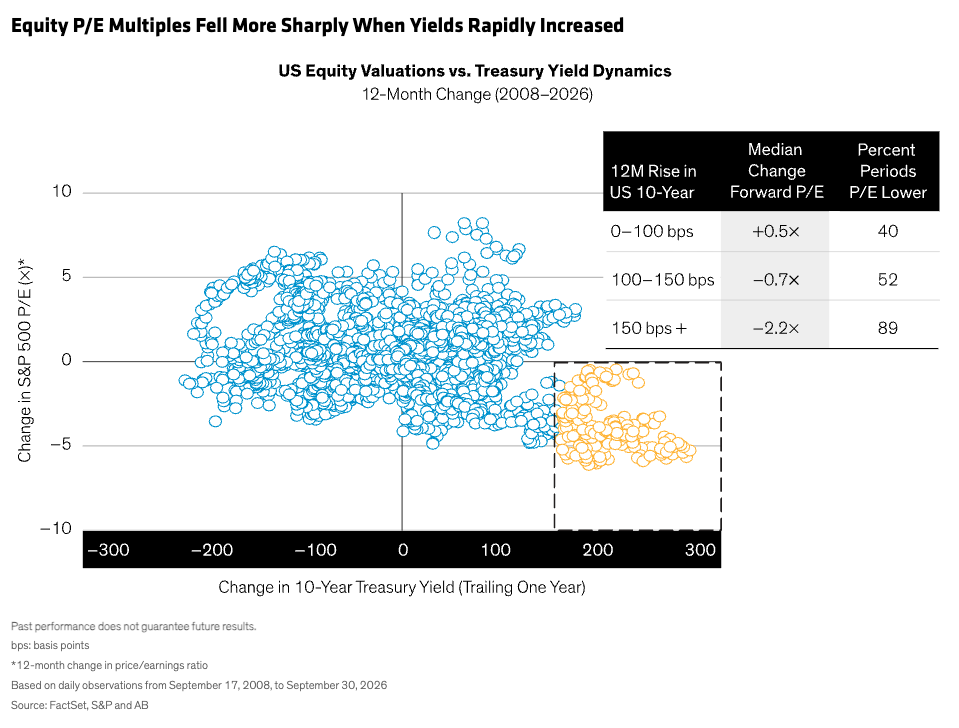
Our research suggests that historically, the pace of interest-rate moves may matter more than the absolute level of yields. We found that an increase of less than 100 basis points (bps) over 12 months was associated with a positive change in the median forward P/Es of US stocks. However, when the increase exceeded 150 bps, multiples tended to decline sharply, as shown in the yellow dots (Display). In these instances, the median P/E declined by 2.2 points—and equity multiples contracted in 89% of observations.
Recent Trends Require Context
The sharp volatility in early November helps illustrate a broader point: valuation pressure can come from more than one direction. Rapidly rising rates can compress multiples, but so can a sudden reassessment of the growth expectations embedded in stock prices.
Recent market moves show how these forces can interact. From early October to early November, Treasury yields fell from their peak of 5.31% in a flight-to-quality trade triggered by sharp declines in AI capex-related stocks amid greater scrutiny of the AI build-out. The episode underscores why the relationship between rates and equity valuations isn't fixed: both respond to changing growth expectations, investor sentiment and market conditions. In this case, the same concerns that put pressure on stock valuations can sometimes push investors toward Treasuries—sending yields lower.
Raise the Bar on Quality
Today, investors are increasingly questioning how the enormous infrastructure build-out will be financed and whether eventual revenues can justify the capital committed. Rather than trying to predict every move in yields or the course of the AI trade, we believe investors should focus on what they can control: the valuations they pay and the quality of the businesses they own.
Stay invested, but raise the bar. Rapidly rising yields may create valuation speed bumps, but they don't necessarily derail companies with strong fundamentals for long. Focus on businesses with durable cash flows, strong profitability and the ability to grow dividends, rather than counting on rising valuation multiples to drive returns. As the AI trade matures, we believe that same discipline may become increasingly important in distinguishing companies that simply spend on AI from those that generate attractive returns from it.
A message from Advisor Perspectives and VettaFi: Discover something new! Click here to register for our upcoming webcasts.
The views expressed herein do not constitute research, investment advice or trade recommendations, do not necessarily represent the views of all AB portfolio-management teams and are subject to change over time.
© AllianceBernstein
Read more commentaries by AllianceBernstein