Gold Has Taken Every Punch the Fed Could Throw
Membership required
Membership is now required to use this feature. To learn more:
View Membership Benefits
There’s no way to sugarcoat it. It’s been a rough stretch for gold investors. As I write this, the yellow metal is trading around $3,880 an ounce, about 30% below the record it set in late January. October was gold’s worst October since 2008, and this week’s inflation report knocked it right back to its low.
I’ve been invested in gold for decades, and I can tell you that pullbacks like this test everyone’s conviction. They’re also the best time to step back and ask what’s driving the price. When I do that today, I see a metal that’s absorbed just about every headwind you could throw at it, and it’s still trading near $4,000.
See more: Gold Is Falling on Hot Inflation, But Can the Fed Keep Raising Rates?
The Fed Isn’t Done Yet
On Tuesday, the government reported that consumer prices rose 0.4% in October, more than the 0.3% economists expected. Gold fell more than 2% that day as the dollar and Treasury yields jumped.
A lot of this inflation has come from energy. Gasoline prices are up more than 25% from a year ago, largely because of the conflict in the Middle East.
But energy isn’t the whole story. Prices for services outside of housing—things like medical care and car insurance—rose about 0.4% in October, close to a 5% annual pace. Chicago Fed Austan Goolsbee called the report “borderline disturbing” and warned that services inflation isn’t coming down anytime soon.
Investors now expect the Fed to raise rates in December and keep going. Fed funds futures are pricing in about three and a half quarter-point hikes through next fall, including December, according to Bloomberg data.
Those hikes would land on households that are already stretched. Americans are saving just 3.8% of their income, down from 5.7% at the start of last year, according to the Commerce Department. The New York Fed reports that balances on home equity lines of credit jumped by the most since 2005 in the third quarter. People are borrowing against their homes to keep up.
Why Higher Rates Hurt Gold
Gold, as you know, doesn’t pay interest. When safe investments like Treasuries pay more, holding gold costs you more by comparison. The best way to measure that is the real yield, which is what a 10-year Treasury pays after inflation. It peaked at 2.94% last month, the highest since November 2008. It’s at 2.84% today.
At the same time, the U.S. dollar index hit its highest level in a year this week. Gold is priced in dollars, so a stronger greenback tends to push it lower.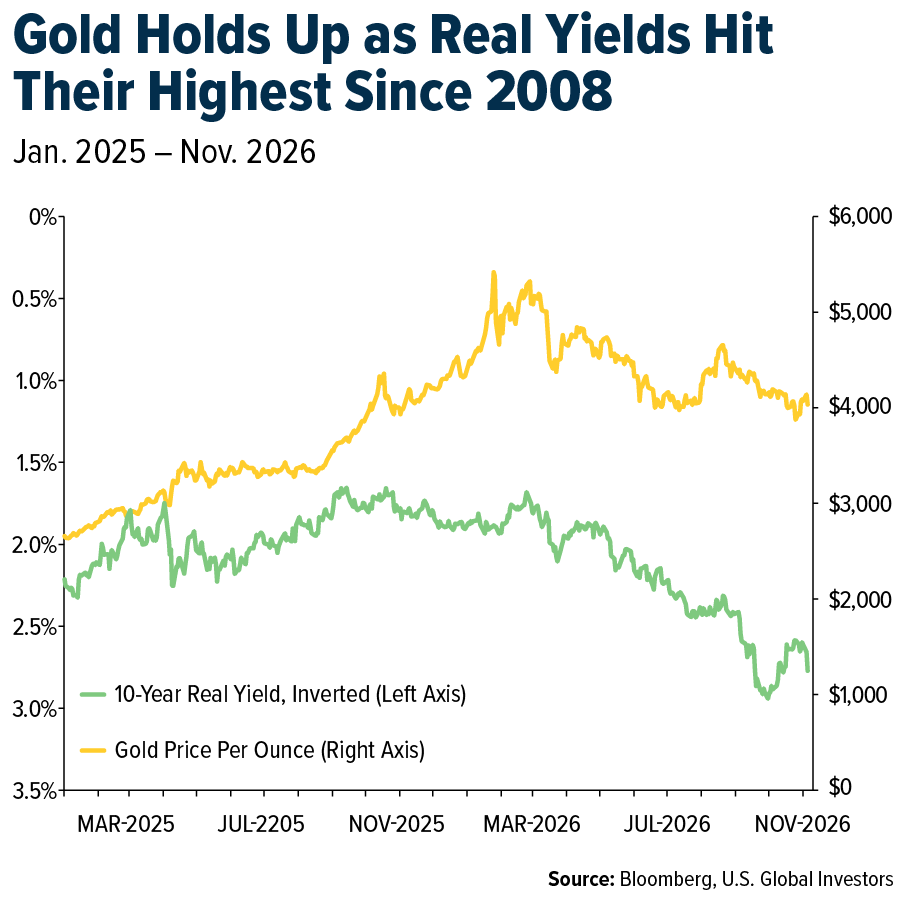
Interestingly, the last time real yields were this high, gold was trading around $800 an ounce. Today it’s nearly five times that. By the old rules, gold should have fallen much further than it has.
Who’s Still Buying
Much of the answer is central banks. According to the World Gold Council (WGC), central banks bought 321 metric tons of gold in the third quarter, 42% more than a year earlier. That brings the total to 675 tons so far this year, ahead of last year’s pace.
These buyers don’t care about yield. Many are moving reserves away from the U.S. dollar, and they’ve been doing it steadily for years. The WGC has also found that central banks tend to buy more when prices fall, which can help cushion a decline.
Investors overseas are stepping in as well. U.S. investors pulled about $1.8 billion out of the largest gold fund in October, but global gold funds still took in about $2.7 billion as buyers in Europe and Asia piled in.
The Debt Problem Hasn’t Gone Away
Then there’s Washington. The federal deficit came in at $2 trillion in fiscal 2026, or 6.2% of GDP, according to the Congressional Budget Office (CBO). Debt held by the public reached 100% of GDP, the highest level since 1946. Interest on that debt topped $1.1 trillion, up 11% in a single year. We now spend $225 billion more on interest than on the military.
Every rate hike makes that bill bigger. It’s one reason Commerzbank recently called gold’s October slide “excessive and unwarranted,” and why Swiss bank Julius Baer says gold’s long-term outlook remains compelling.
Signs of a Bottom
The WGC recently studied what conditions were in place when gold recovered during past downturns. It found three: 1) gold trading well below its long-term trend, 2) a sharp jump in the dollar and 3) speculators clearing out of the futures market. When all three lined up, gold was higher three months later every time.
Two of the three conditions are in place today. On October 30, gold closed 13.7% below its 200-day moving average, a common gauge of its long-term trend. That’s the widest gap since 2013. Since 2005, gold has fallen further below its trend only twice, in 2008 and 2013, and both times it was higher three months later. A year after the 2008 low, it was up more than 46%. In 2013, on the other hand, gold bounced and then kept sliding until late 2015, so history offers no guarantees.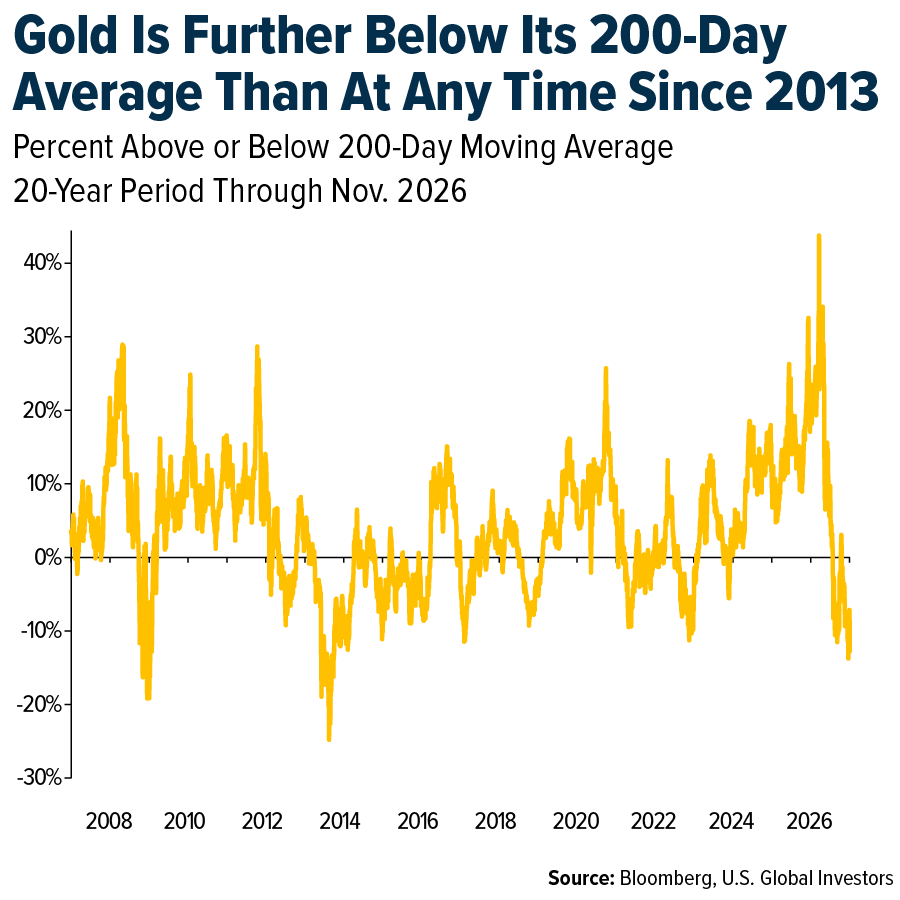
The missing piece is the speculators. Hedge funds and other large traders were still betting on higher gold prices to the tune of about 104,000 futures contracts as of November 3. That’s right around their 20-year average. At past bottoms in 2015, 2018 and 2022, these same traders had flipped to betting against gold. Smaller traders have been heading for the exits, cutting their bets nearly in half since January, but the big money hasn’t given up yet.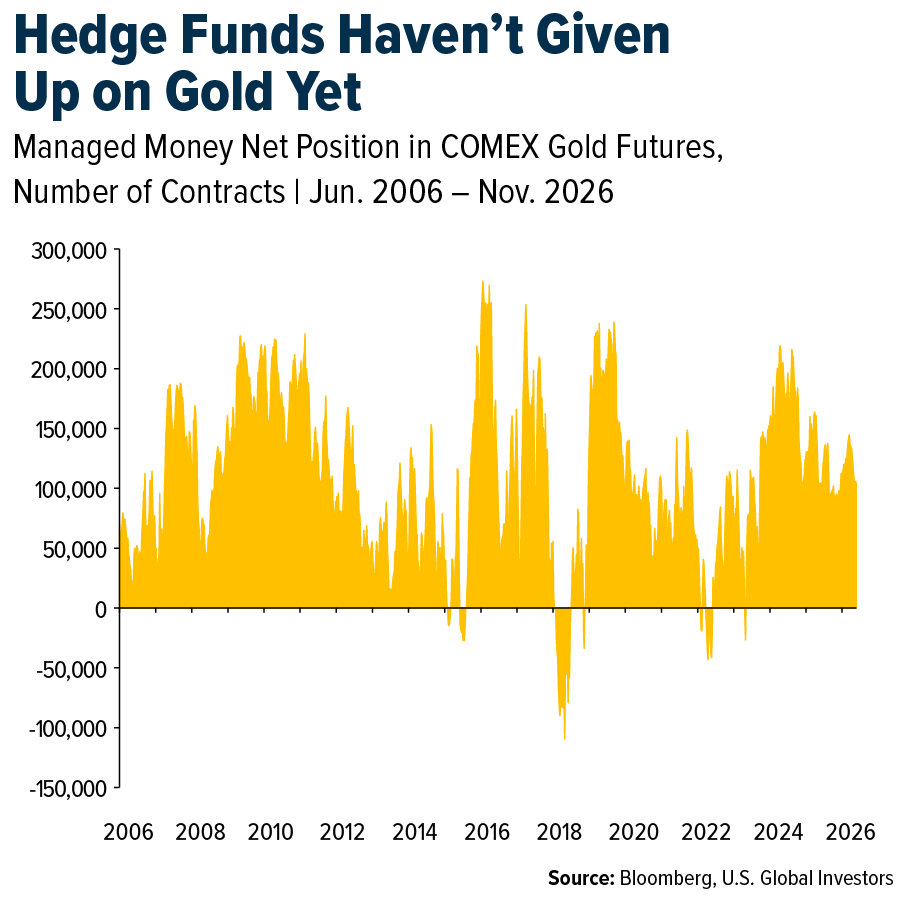
That tells me we could see one more shakeout before gold finds a durable floor. Technical analyst Katie Stockton sees a rebound setting up after what looked like a false breakdown earlier this month, though this week’s selling is putting that support to the test.
Stick With the 10% Rule
I can’t tell you exactly when gold will bottom. Nobody can.
What I can tell you is that the long-term drivers, from central bank buying to soaring federal debt to inflation that’s proving hard to tame, are as strong as I’ve seen them in years.
Gold miners are in good shape too. Even after this year’s pullback, their average profit margin in the second quarter was the second highest on record, according to the WGC.
That’s why I continue to recommend a 10% weighting in gold, with 5% in physical gold and 5% in high-quality gold mining stocks and funds, rebalanced regularly. Pullbacks like this one are when that discipline matters most. Rebalancing means adding when prices are down, and that’s exactly when it feels hardest to do.
Airlines and Shipping
Strengths
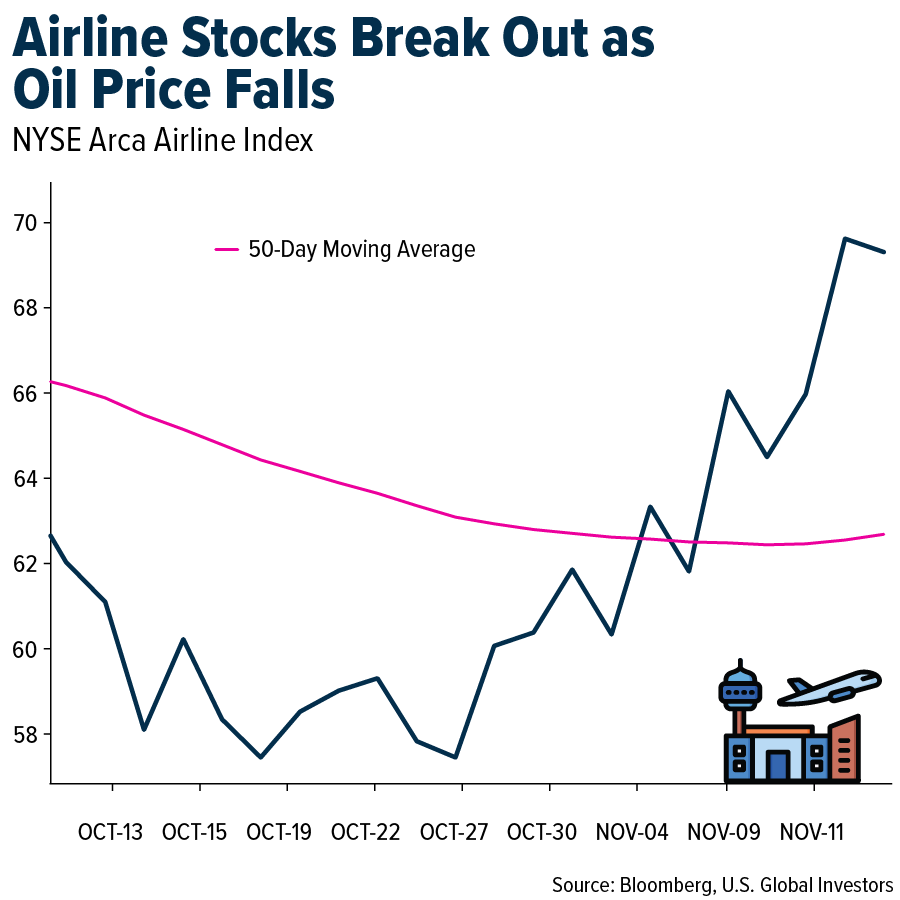
- The best-performing airline stock for the week was Sabre, up 10.4%. U.S. airline stocks jumped on November 9, with United Airlines rising as much as 8.3%, Delta Air Lines up 6.1%, and American Airlines gaining 5.9%. Crude oil fell as much as 6.4%, with Brent crude trading below $92 a barrel, according to Bloomberg.
- The Baltic Dry Index rose for a fourth straight day. Capesize shipping rates led the gains, reaching $36,936 per day, while Panamax rates climbed to $18,330 per day, according to Bloomberg.
- Embraer’s third-quarter 2026 (3Q26) revenue, EBITDA and free cash flow all came in ahead of expectations. Revenue grew 17% year-over-year (YoY), driven by strong results across all business segments. Its EBITDA margin reached 13.5%, 100 basis points above Goldman Sachs’ estimate. Embraer also raised its 2026 revenue outlook by 2% at the midpoint and increased its free cash flow forecast from more than $400 million to more than $700 million, signaling confidence in continued cash generation through year-end.
Weaknesses
- The worst-performing airline stock for the week was China Southern, down 4.4%. MSCI announced it will remove ANA from the MSCI Japan Index, effective November 30 after the U.S. market closes. The stock no longer meets the index’s minimum market value requirement for shares available to public investors. UBS estimates the change could lead to $210 million in fund outflows, equal to about three days of average trading volume.
- Shipping rates are falling sharply, according to Morgan Stanley. Of 27 tanker routes tracked, 13 fell by at least twice their normal weekly move. This has happened only once before since late 2021. One example: Rates for shipping oil from the U.S. Gulf Coast to Rotterdam on an Aframax tanker (TD25) fell 53% in five days to $9.10 per barrel. This is lowering the cost of delivering U.S. West Texas Intermediate (WTI) crude oil to Rotterdam.
- Boeing will cut 5% of its commercial airplane workforce through layoffs and employee attrition after delaying production increases. Commercial Airplanes CEO Stephanie Pope said lower production levels left the company with more workers than needed. Factories also need more time to improve production stability, according to Bloomberg.
Opportunities
- Goldman Sachs’ holiday travel data points to strong demand for both Thanksgiving and Christmas. Average airfares are up 42% for Thanksgiving travel and 63% for Christmas travel compared with the same periods last year, based on the weeks tracked so far. Both are well above the 24% increase seen ahead of Labor Day.
- Maersk’s management expects ocean shipping returns to remain stronger than before the pandemic. The company is investing in its fleet and chartering ships to target about 14% of global shipping volume. Management also sees growing demand from electrification, energy and AI infrastructure. Its logistics business could provide another source of growth through expanded warehouse capacity and acquisitions, according to Bloomberg.
- According to UBS, JetBlue management expressed confidence in its JetForward plan and its path to higher profits. Third-quarter (3Q) operating profit margins improved year-over-year (YoY), and the company remains on track to increase margins by 1 to 2 percentage points in the fourth quarter of 2026 (4Q26). Higher fuel costs have made progress harder to see, but management believes its plan is delivering results. JetBlue also sees several ways to reach more than $1 in earnings per share (EPS) and positive free cash flow (FCF) by fiscal year 2028 (FY28).
Threats
- UBS Evidence Lab data shows that active job listings in the air transportation industry fell 11% year-over-year (YoY) in October 2026 compared with October 2025. Job listings were also 35% below October 2019 levels. Among major U.S. airlines, listings fell 52% at Southwest, 24% at JetBlue and 11% at United.
- According to the Pacific Maritime Association, about 250 port watchmen represented by ILWU Local 26 have voted to authorize a strike at the Ports of Los Angeles and Long Beach. The deadline is November 20, following three contract extensions. While the group represents only 2% of the port complex’s union workforce, its members cover facilities that handle about 85% of Long Beach cargo and 33% of Los Angeles cargo, according to RBC.
- China’s domestic flight activity fell 7% year-over-year (YoY) in the week ended November 8, 2026, compared with a 5% decline the previous week. Flights on major business routes rose just 1% YoY, down from 3% the week before. Average domestic airfares were up 19% YoY following another fuel surcharge increase, although ticket prices edged lower week-over-week (WoW), according to Morgan Stanley.
Luxury Goods and International Markets
Strengths
- Burberry reported encouraging first-half results, with revenue rising 6% year-over-year to £1.1 billion, supported by a 4% increase in comparable retail sales. Growth was strongest in the Americas, while Greater China also showed improvement, suggesting the company’s turnaround strategy is gaining traction.
- According to market research firm Circana, U.S. prestige beauty sales reached $25.5 billion through September, up 5% year-over-year. Skincare and hair care each grew 7%, while fragrance sales increased 5%, highlighting continued consumer demand for affordable luxury products.
- Shiseido, the Japanese cosmetics company, was the best-performing constituent of the S&P Global Luxury Index over the past five trading days. The gains followed the company’s November 10 earnings report, in which it reported a return to profitability in the first nine months of 2026.
Weaknesses
- Luxury apparel is lagging behind luxury hotels, pointing to weaker spending on high-end fashion. LVMH’s Fashion & Leather Goods revenue fell 2% organically during the first nine months of 2026, partly due to weaker demand in China. Meanwhile, hotel companies such as Hilton, Hyatt, Marriott and Accor have benefited from steady demand for travel and experiences.
- European Union (EU) investor confidence weakened, but the decline was smaller than expected. This suggests investors remain more optimistic than anticipated despite ongoing economic challenges.
- Lucid Group, the U.S. luxury electric vehicle manufacturer, was the worst-performing stock in the S&P Global Luxury Index over the past five trading days. Shares came under pressure following the company’s third-quarter results, released November 9, which showed continued financial challenges despite a 30% quarter-over-quarter reduction in cash consumption.
Opportunities
- Tesla plans to scale back Cybertruck production by mid-2027, shifting capacity at its Texas factory toward its Cybercab robotaxi program. The company is also expanding its self-driving ride service, which launched in San Antonio, Texas, on November 9. The move highlights Elon Musk’s growing focus on autonomous transportation as a future growth opportunity, although the timeline for making robotaxis profitable remains uncertain.
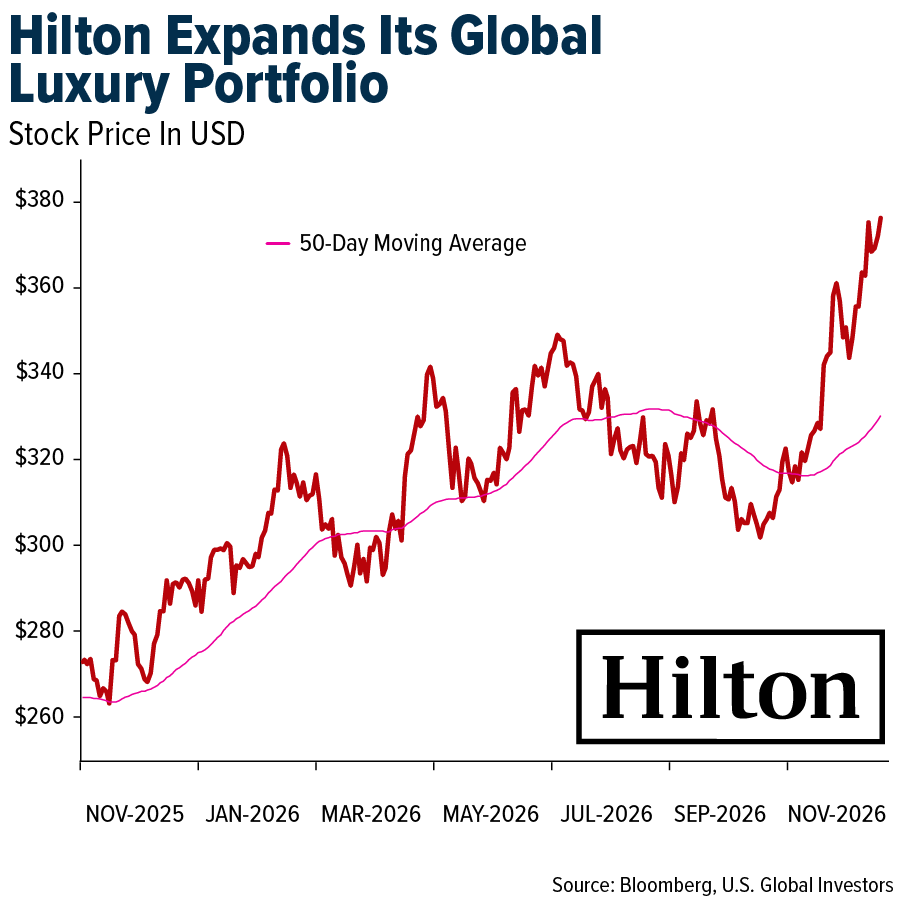
- Hilton is expanding in Egypt through a new partnership with PRE Group to develop six hotels and four branded residential projects, representing about EGP 14 billion in investment. The projects are expected to add up to 2,000 hotel rooms and residences in key destinations, including Ain Sokhna, the North Coast and New Cairo. The agreement highlights Hilton’s efforts to capture growing demand for luxury hotels and branded residences.
- U.S. retail spending continued to grow ahead of the holiday season, rising 3.6% year-over-year (YoY) in October. Core retail spending increased 3.4%, according to the CNBC/NRF Retail Monitor. Early holiday promotions were already helping drive sales, creating opportunities for luxury and other consumer brands to attract shoppers through seasonal deals, loyalty offers and special events.
Threats
- U.S. inflation remained elevated in October, with consumer prices rising 0.4% from the previous month, above economists’ expectations of 0.3%. Core inflation, which excludes food and energy, increased 0.3%, also above the expected 0.2%. Persistent inflation could keep interest rates higher for longer, potentially weighing on consumer spending and economic growth.
- China’s Singles’ Day, its largest annual online shopping event, is similar to Black Friday in the U.S., with major retailers such as Tmall and JD.com offering major discounts. In 2026, sales rose 4.8% year-over-year (YoY) to an estimated RMB 1.78 trillion. However, growth slowed sharply from 14.2% the previous year, suggesting Chinese consumers remain cautious about spending.
- China remains one of the world’s most important luxury markets, but rising political and trade tensions could hurt demand for Western brands and make it harder for companies to operate across borders. Deloitte identifies China as a key luxury growth market for 2026, making developments there especially important for major brands such as LVMH, Hermès and Kering.
Energy and Natural Resources
Strengths
- The best performing commodity for the week natural gas, up 7.91%. which was driven by renewed supply concerns and tightening global LNG markets. European gas storage stood at just 71% versus a five-year seasonal average of 89%, while Norwegian supply disruptions and stronger Asian LNG prices added further upside pressure.
- Record LME aluminum premium signals tight immediate supply. On November 11, LME cash aluminum traded $147 per metric ton above three-month futures, the widest premium in more than 30 years of Bloomberg data. LME warehouse inventories fell to their lowest level since at least the early 1990s, while spot aluminum also traded at a premium to later-dated futures in Shanghai.
- OPEC oil output recovers to 90% of its prewar level. OPEC production rose by 1.38 million barrels per day in October to 22.87 million, according to a Reuters survey. Saudi Arabia, Kuwait and Iraq led the gains despite continued export constraints stemming from the war with Iran and the U.S. blockade of Iran. Output reached 90% of February’s 25.48 million barrels per day, the last monthly level before the conflict disrupted Middle Eastern supply.
Weaknesses
- The worst performing commodity for the week was oil, down 2.52%. Oil prices were falling as hopes for a de-escalation in the Iran war built up post the election results, but that scenario was abruptly ended by President Trump’s announcement that we don’t need a deal with Iran, putting the oil price in limbo.
- Copper heads for its longest weekly losing streak in nearly two years. Benchmark three-month LME copper futures fell below $13,500 per metric ton, putting the metal on track for a fifth straight weekly loss. Copper was down about 2.5% for the week and headed for its lowest close since mid-July, after reaching a record high in September, according to Bloomberg.
- Lithium Americas raises Thacker Pass Phase 1 capital estimate by 31%. In a November 11 update, the company increased its definitive capital estimate to $3.83 billion from $2.93 billion, including contingency. Higher labor and installation costs and increased staffing needs for engineering, procurement and construction management (EPCM) and contractors drove most of the increase, with logistics costs and additional contingency also contributing, according to Bloomberg.
Opportunities
- Potential output cuts in Indonesia could support nickel prices. UBS channel checks indicate that Chinese nickel producers operating in Indonesia have discussed coordinated production cuts several times. UBS sees cuts as more likely if nickel stays in the low $15,000s per metric ton and expects coordination to be easier in more concentrated segments of the market. A recovery in stainless steel or EV battery demand could provide further upside.
- U.S. permitting bill could speed approvals for energy and mining projects. President Trump and the Edison Electric Institute backed a bipartisan Senate bill to streamline federal permitting, according to Bloomberg. If enacted, the measure could shorten approval timelines for mines, pipelines and power plants.
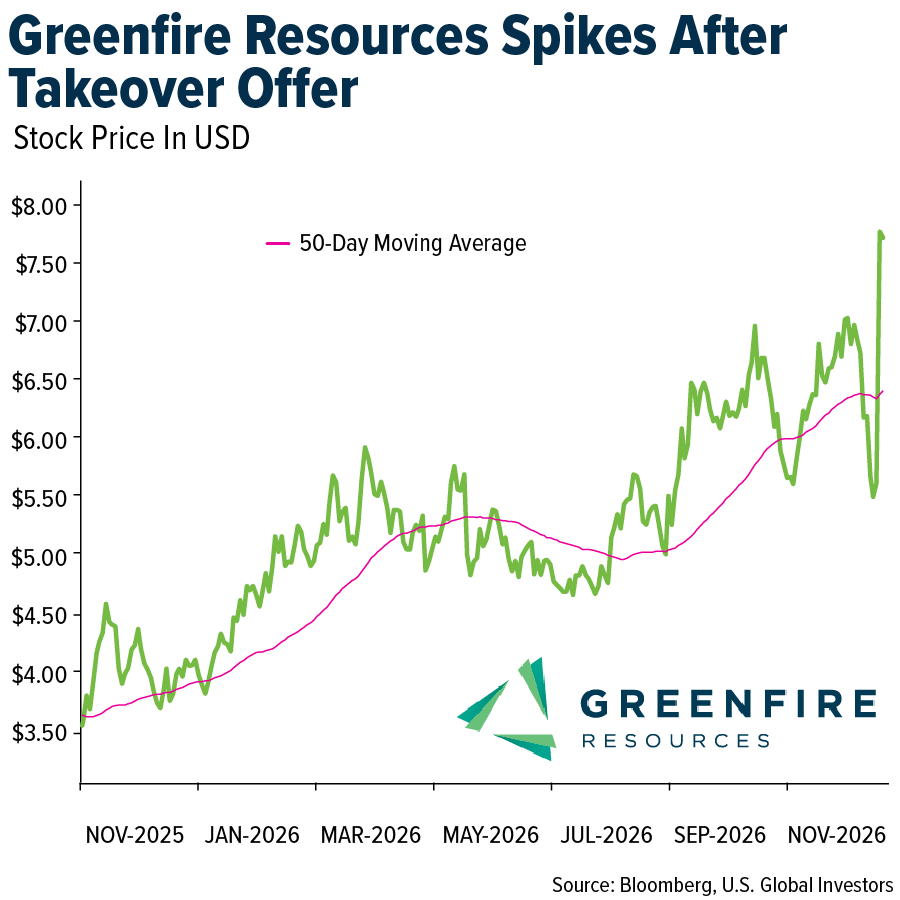
- Strathcona Resources agrees to acquire Greenfire Resources. BMO values the deal at $2.7 billion to $3.2 billion. Greenfire shareholders can elect to receive Strathcona shares valued at approximately $9 per Greenfire share or $11 per share in cash, subject to a $740 million cap on total cash consideration.
Threats
- China’s vehicle sales fall at a faster pace in October. Total vehicle sales fell 9.2% year over year, according to China Association of Automobile Manufacturers (CAAM) data cited by BMO. A prolonged downturn in auto sales could weigh on demand for metals used in vehicle production.
- China’s rare earth export restrictions raise costs for overseas buyers. Rare earths are trading at multiples of Chinese domestic prices in overseas markets as Beijing’s export restrictions limit availability, according to Bloomberg. The squeeze raises input costs and procurement risks for aerospace, defense, semiconductor and electric vehicle manufacturers.
- Low natural gas inventories and supply outages leave Europe exposed to higher winter gas prices. Benchmark European natural gas futures rose as much as 4.7% on Thursday, extending gains for a third straight session, according to Bloomberg. Storage withdrawals are running faster than a year earlier, while unplanned outages in Norway and lower LNG imports are tightening supply. This shortage is forcing record energy price upon Europe’s consumer and businesses.
Bitcoin and Digital Assets
Strengths
- Visa has partnered with Anchorage Digital to integrate Western Union’s USDPT stablecoin as a settlement asset on VisaNet. This will allow eligible partners to settle payment obligations using the token. The initiative builds on Visa’s annualized stablecoin settlement volume of $20 billion, more than 15 times the year-earlier level, highlighting growing institutional adoption of blockchain-based payment infrastructure.
- The Depository Trust & Clearing Corporation (DTCC) plans to make tokenized versions of eligible U.S. securities available on Solana in the second half of 2027. This follows the October launch of its tokenization service on Canton Network and a private blockchain. The expansion could accelerate institutional blockchain adoption, improve asset mobility and strengthen the connection between traditional financial markets and digital asset infrastructure.
- Securitize and Ethena launched a 24/7 liquidity facility that allows eligible investors to exchange shares of BlackRock’s tokenized Treasury fund for stablecoins, including USDC. The facility starts with $50 million in liquidity, with another $50 million available as needed. The initiative could improve liquidity and accessibility for institutional investors in tokenized assets.
Weaknesses
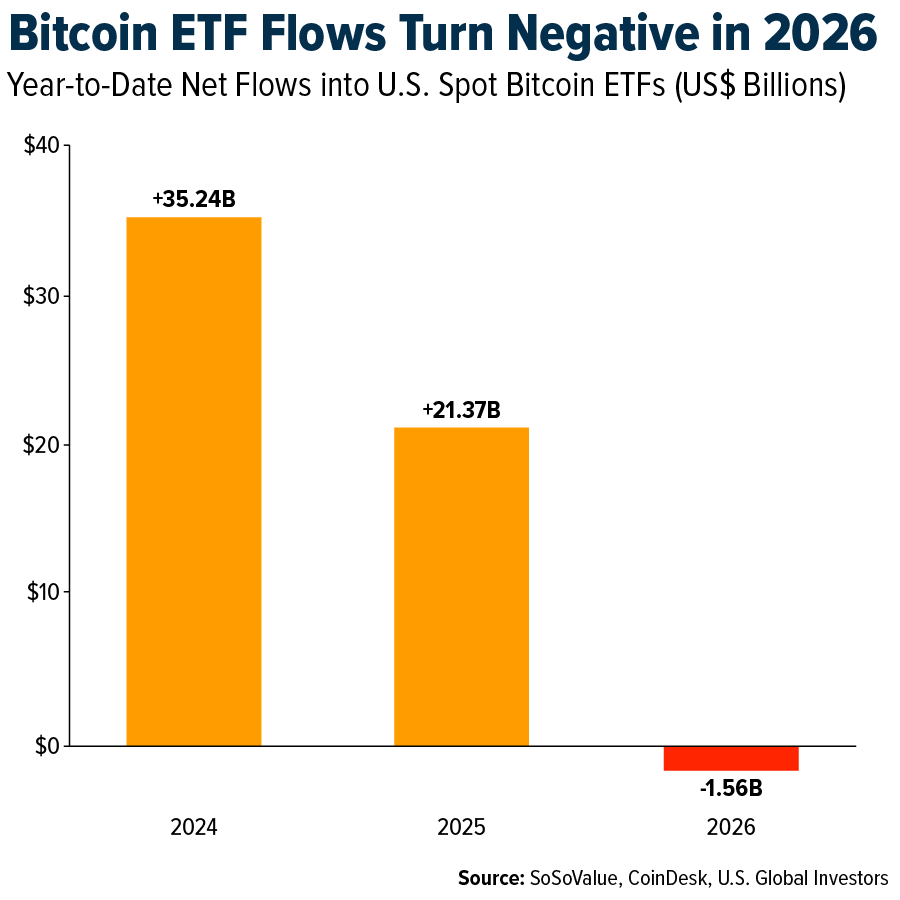
- U.S. spot Bitcoin ETFs recorded $1.56 billion in year-to-date net outflows, reversing a $1.01 billion inflow position as of October 29, according to SoSoValue. The funds lost $643.6 million this week through Thursday, following $1.28 billion in redemptions the prior week, highlighting deteriorating institutional demand as Bitcoin fell below $70,000.

- Nasdaq-listed BTCS sold Ethereum below its purchase price to manage liquidation risks tied to a $64.1 million loan on the decentralized lending platform Aave. The debt was backed by 46,676 ETH, with liquidation potentially beginning near $1,717 per token. The move highlights the risks of leveraged corporate crypto treasury strategies as digital asset prices fall.
- Nasdaq-listed trading platform eToro reported third-quarter net income of $15 million, down from $57 million a year earlier, while adjusted EBITDA fell 56% to $34 million. Crypto trading revenue declined to $1.35 billion from $3.97 billion, and October crypto transactions dropped 62% year-over-year (YoY), highlighting weaker investor activity and profitability pressures across digital asset trading platforms.
Opportunities
- U.K.-based bank Griffin raised $20 million in Series B funding, valuing the bank at more than $100 million, to expand stablecoin reserve services and blockchain-based cross-border payments. The initiative aims to integrate traditional banking infrastructure with onchain payment solutions, creating new opportunities for fintech companies seeking faster and more efficient international transactions.
- Walt, formerly Wallet in Telegram, is launching a standalone application offering cryptocurrency trading, tokenized U.S. stocks, ETFs and perpetual futures. With tens of millions of registered users, the platform aims to expand beyond Telegram and reach a broader investment audience, potentially accelerating retail access to digital assets and tokenized financial products.
- KPMG U.S. issued a clean audit opinion on TG Commodities’ 2025 financial statements, covering $2.25 billion in gold backing Tether Gold (XAUT). The independent verification could strengthen investor confidence, attract institutional capital and create new growth opportunities for gold-backed digital assets as demand for transparent, blockchain-based investment products expands.
Threats
- The U.S. Department of Justice received court authorization to seize more than $1.2 billion in cryptocurrency stolen during Binance’s October cyberattack, which exceeded $6 billion in losses. Authorities have frozen over $2.7 billion and linked the attack to North Korean hackers, underscoring persistent cybersecurity threats and the potential for large-scale losses across digital asset platforms.
- Coinbase, Kalshi and Kraken’s parent company have backed the CFTC in a legal dispute over its authority to regulate perpetual futures tied to individual stocks. Traditional financial market participants argue that these contracts fall under SEC jurisdiction, highlighting regulatory uncertainty that could delay product launches and restrict innovation in digital asset derivatives markets.
- Bitcoin dropped below $70,000 to its lowest level since August, as the U.S. Dollar Index reached a 19-month high. More than $1.3 billion in cryptocurrency futures positions were liquidated over 24 hours, including $677 million in Bitcoin positions, highlighting how tighter financial conditions and leveraged selling could amplify downside risks across digital asset markets.
Defense and Cybersecurity
Strengths
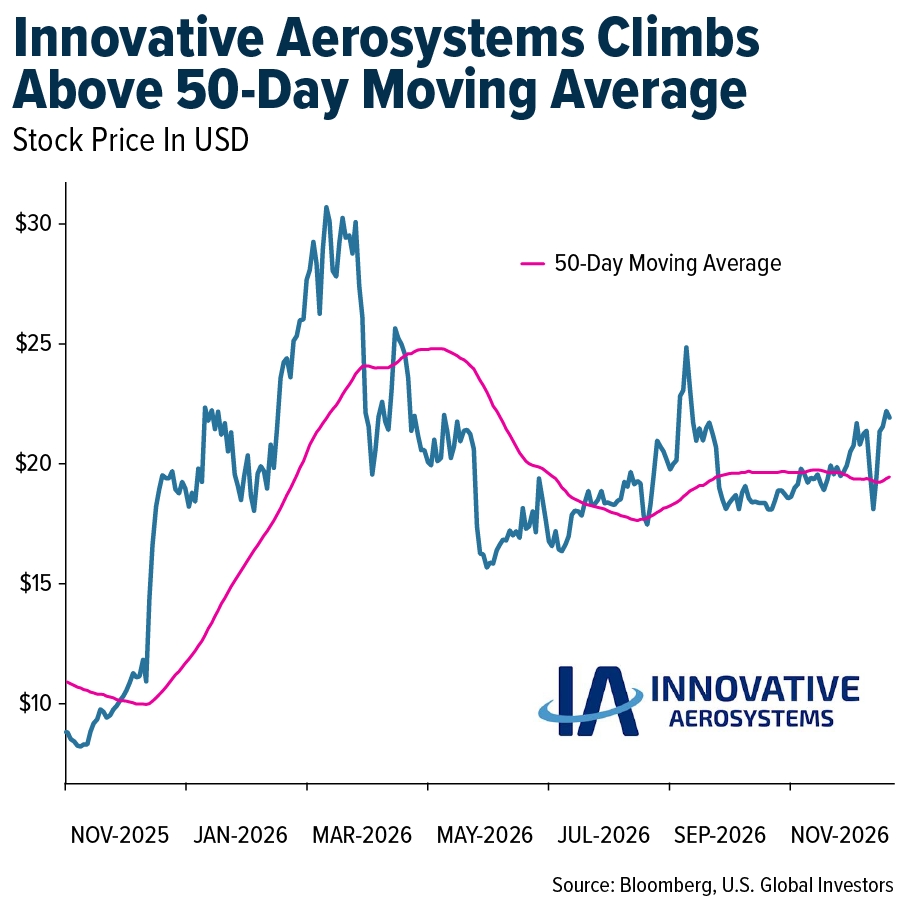
- Innovative Aerosystems has secured a major production contract with Dornier Seawings to integrate its Liberty Data Acquisition Unit into the Seastar amphibious aircraft program. Deliveries are planned for approximately 300 aircraft over the next decade. With strong fundamentals, including a gross margin above 52% and growing adoption by original equipment manufacturers (OEMs), the company continues to expand its presence in advanced aerospace avionics despite recent pullbacks across the broader technology market.
- CoreWeave’s revenue jumped 168% year-over-year (YoY) and 42% sequentially to $3.66 billion. Its GAAP net loss per share widened 477% YoY and 11% sequentially to $1.27, driven by higher interest expenses. Management said the company reached a 10% adjusted operating margin one quarter ahead of schedule, remains sold out through 2027 and has a $132.5 billion backlog. It also expects $9 billion in customer prepayments over the next three months. Strong demand led CoreWeave to raise its full-year 2026 guidance to $13.0–$13.3 billion in revenue and $37–$39 billion in capital expenditures (CapEx). The company is targeting adjusted net profitability in the first half of 2028.
- Ukrainian unmanned systems developer UFORCE closed a record $700 million Series A funding round at a $6 billion valuation. The round was led by the UK’s National Wealth Fund and Valor Equity Partners. The funding will support production of NEMESIS bomber drones, MAGURA uncrewed surface vessels and laser-based drone interceptors. Former NATO Supreme Allied Commander Europe (SACEUR) General Christopher Cavoli has also joined UFORCE’s board. The company plans to expand its manufacturing operations to locations beyond the range of Russian strikes.
Weaknesses
- Nvidia had a difficult week after CEO Jensen Huang faced allegations of personal misconduct and China-linked espionage, sending shares down roughly 13%. It was the company’s worst weekly decline since April 2025, with shares falling to their lowest levels since last summer. The news also sparked a shift across the semiconductor sector. Rivals Broadcom and AMD gained as investors considered whether AI market share could move to competitors. Meanwhile, Nvidia-linked suppliers and cloud partners, including Super Micro Computer, ASML and Nebius, fell sharply amid growing scrutiny of U.S. export controls.
- Hackers breached the internal software update server of German drone maker Quantum Systems and inserted malicious code disguised as legitimate Qbase mission-planning software updates. The breach prompted Germany’s military, the Bundeswehr, to temporarily ground its Falke and Vector drone fleets while the country’s cybersecurity agency and military counterintelligence officials investigate.
- The U.S. Department of Defense confirmed that more than $85 million worth of F-35 Lightning II avionics and spare parts had been lost or misplaced across military supply depots worldwide. The discovery prompted an immediate audit of contractor inventory management systems.
Opportunities
- The U.S. Commerce Department plans to finalize a rule this month expanding chip export controls to seven additional countries, including Malaysia, Singapore and Thailand. The goal is to prevent Chinese AI companies from accessing computing power by remotely renting space in data centers overseas. The effort gained support from OpenAI, which confirmed its backing of a bipartisan bill that would block China’s access to advanced AI chips and manufacturing equipment.
- Google unveiled two specialized eighth-generation Tensor Processing Unit (TPU) systems designed to challenge Nvidia’s dominance in AI computing. The security-focused TPU 8tx and high-density TPU 8i Max are expected to be deployed in 2027. The systems target secure enterprise computing and workloads involving large amounts of data. Google’s TPU business is estimated to reach $135 billion by 2028.
- European defense AI company Helsing unveiled Clarity, an AI-powered intelligence platform that combines satellite radar, optical imagery and live radio frequency (RF) sensor data. The system is designed to help allied military command networks identify and classify potential targets in less than 60 seconds.
Threats
- Just days after a 161 km/h speed limit was imposed on Ukraine’s Starshield terminals, more than 100 U.S. lawmakers called on the White House to lift the restriction immediately. They warn that the cap is limiting Ukraine’s ability to intercept incoming Russian drones and missiles, allowing more attacks to get through. Lawmakers are demanding answers and a quick reversal.
- Poland took its national e-government platform offline following a targeted cyberattack. Meanwhile, France summoned Iran’s ambassador, and Sweden issued a national alert after state-linked hackers reportedly compromised industrial refrigeration controllers at 700 supermarkets across Europe.
- Peace talks between Ukraine and Russia broke down after both sides rejected the proposed terms. The only outcome was another prisoner exchange, with no major progress toward ending the war. Russian President Vladimir Putin insisted that all goals of the military campaign must be achieved, while Russian negotiator Vladimir Medinsky repeated his claim that any territory where a Russian soldier sets foot belongs to Russia.
Gold Market
This week gold futures closed the week at $3,879.70, down $195.20 per ounce, or 4.79%. Gold stocks, as measured by the NYSE Arca Gold Miners Index, ended the week lower by 6.35%. The S&P/TSX Venture Index came in off 2.87%. The U.S. Trade-Weighted Dollar rose 1.09%.
Strengths
- The best-performing precious metal for the week was palladium, although it remained down 1.53%. Palladium showed relative strength across the precious metals complex, supported by supply concerns after top producer Nornickel warned that a prolonged furnace overhaul could limit production in 2027 and 2028. Prices also benefited from a wave of short-covering as institutional investors rushed to buy back bearish bets against the heavily oversold metal.
- In October 2026, the People’s Bank of China added 830,000 ounces, or roughly 25.8 metric tons, to its gold reserves. This was its largest monthly purchase since late 2023 and extended its buying streak to 24 consecutive months. Continued purchases by a major central bank support demand for physical gold and reflect the ongoing trend of diversifying reserves away from the U.S. dollar.
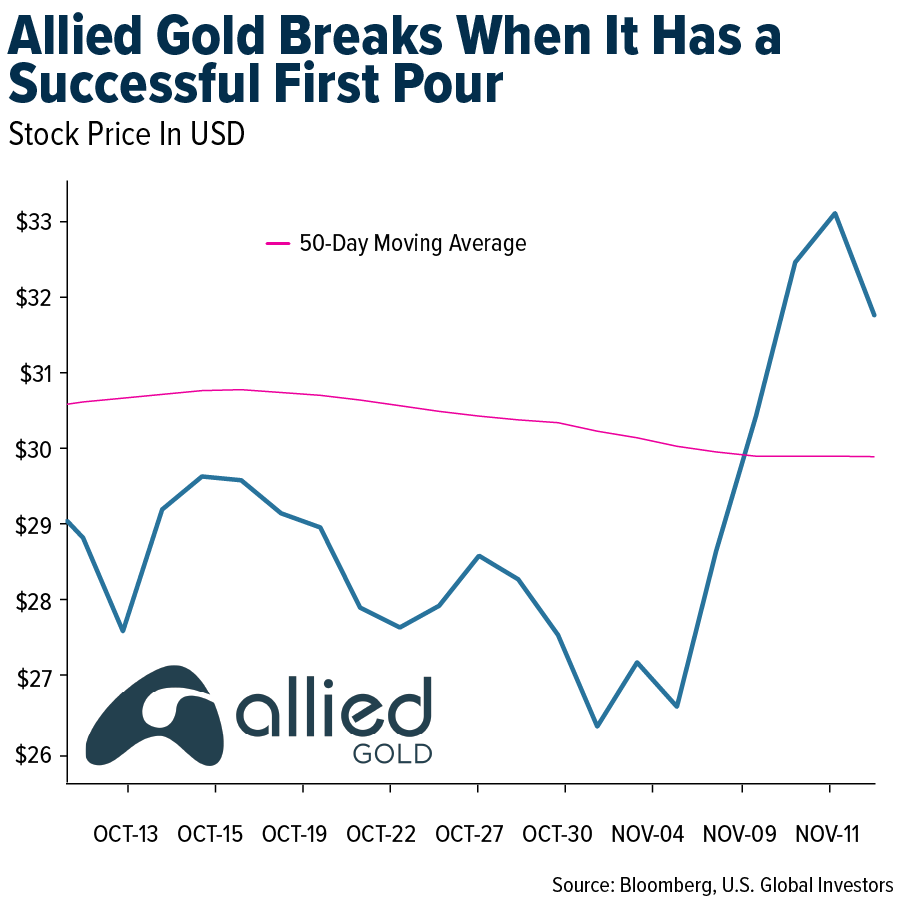
- After the market closed on November 9, Allied Gold announced that it had poured its first gold at the Kurmuk mine in Ethiopia. Allied expects the mine to reach commercial production by year-end, with the processing plant reaching its full production capacity in early 2027, according to Canaccord.
Weaknesses
- The worst-performing precious metal for the week was silver, down 6.14%. According to a new Metals Focus report, global silver demand is projected to fall 5% in 2026, driven by declining industrial use, a 22% drop in jewelry purchases and U.S. retail investment reaching its lowest level since 2010. Meanwhile, a stronger U.S. dollar and high interest rates are contributing to 45 million ounces in silver ETF outflows. These outflows, along with the release of existing stockpiles, are improving physical supply and narrowing the market deficit.
- Endeavour Mining shares came under pressure as potential disruptions at its Mana mine overshadowed stronger-than-expected third-quarter earnings before interest, taxes, depreciation and amortization (EBITDA). Despite the operational challenges, the company remains on track to meet the lower half of its production guidance. South Africa’s mining sector also showed weakness in September, with gold production falling 7.5%, compared with a 6.4% decline in August. Platinum group metal (PGM) production and overall mining output fell 9.9% and 10.7%, respectively.
- In mid-November 2026, gold suffered its worst weekly decline since June, falling to a 13-month low below $3,860 an ounce. Higher Treasury yields and a stronger U.S. dollar pressured prices following a hotter-than-expected Consumer Price Index (CPI) report. Markets were fully pricing in a 25-basis-point Federal Reserve rate hike in December, with some investors seeing a possibility of a 50-basis-point increase.
Opportunities
- The silver market is heading toward its sixth consecutive annual supply deficit in 2026. This shortfall is expected to continue even as solar panel manufacturers reduce their use of silver. Strong physical demand from other industrial manufacturers, jewelers and retail bar-and-coin investors is making up for the decline. At the same time, easing investor sell-offs are helping tighten market conditions and could put upward pressure on prices. The ongoing deficit supports silver prices, while solar demand continues to grow.
- Barrick Mining filed for a U.S. IPO to spin off its Nevada and Dominican Republic gold assets into a new company called American Barrick Gold Corp. (ticker: ABGC), while retaining voting control. Bloomberg Intelligence estimates the North American assets could be worth nearly $62 billion. Scotiabank views the spin-off as a potential catalyst for unlocking shareholder value and improving operational focus. The announcement helped lift Barrick shares in premarket trading.
- The Monetary Authority of Singapore launched a new gold vaulting service designed for foreign central banks and official institutions. The facility will initially hold up to 500 metric tons of gold, with room to expand. The move reflects growing demand from central banks and other government institutions for secure storage of physical gold outside traditional Western financial centers.
Threats
- According to BMO, silver’s biggest source of demand growth is now reversing, and the bank expects solar demand to give back roughly half of its gains by 2030. With industrial demand weakening, the silver market is becoming more dependent on investors to absorb a growing physical surplus. BMO’s price forecast of $50–$70 an ounce for the second half of this decade would require investment inflows to match the record levels seen in 2025. More bullish price scenarios would require sustained inflows well above historical levels, which the bank considers unlikely.
- Bank of America believes silver should find support if gold prices stabilize. However, weaker investor demand and softer solar demand could shift the market from an 8,600-metric-ton deficit in 2025 to a modest surplus in 2026. ETF outflows have driven much of this change, while China’s efforts to curb solar overproduction have further weakened demand. Renewed imports and future investment in power grids could provide some support. Silver demand from data centers is expected to more than double to just over 600 metric tons by 2030. However, that would represent less than 2% of global consumption, making ETFs and solar demand more important drivers of prices.
- A new November 2026 report from SWISSAID found that the UAE’s 2023 due-diligence regulations have failed to stop the flow of illicit African gold into the country. The UAE continues to import an estimated 591 metric tons annually. The report raises concerns about money laundering, environmental, social and governance (ESG) compliance risks, potential institutional boycotts and the possibility of the UAE returning to the Financial Action Task Force (FATF) grey list.
A message from Advisor Perspectives and VettaFi: Discover something new! Click here to register for our upcoming webcasts.
U.S. Global Investors, Inc. is an investment adviser registered with the Securities and Exchange Commission (“SEC”). This does not mean that we are sponsored, recommended, or approved by the SEC, or that our abilities or qualifications in any respect have been passed upon by the SEC or any officer of the SEC.
This commentary should not be considered a solicitation or offering of any investment product. Certain materials in this commentary may contain dated information. The information provided was current at the time of publication. Some links above may be directed to third-party websites. U.S. Global Investors does not endorse all information supplied by these websites and is not responsible for their content. All opinions expressed and data provided are subject to change without notice. Some of these opinions may not be appropriate to every investor.
Holdings may change daily. Holdings are reported as of the most recent quarter-end. The following securities mentioned in the article were held by one or more accounts managed by U.S. Global Investors as of (09/30/2026):
Southwest Airlines
United Airlines
Delta Air Lines
American Airlines
Embraer
Boeing Co/The
JetBlue Airways
Burberry
Hilton
Hyatt
Marriott
Accor
Tesla
Nvidia
Barrick Mining
*The above-mentioned indices are not total returns. These returns reflect simple appreciation only and do not reflect dividend reinvestment.
The Dow Jones Industrial Average is a price-weighted average of 30 blue chip stocks that are generally leaders in their industry. The S&P 500 Stock Index is a widely recognized capitalization-weighted index of 500 common stock prices in U.S. companies. The Nasdaq Composite Index is a capitalization-weighted index of all Nasdaq National Market and SmallCap stocks. The Russell 2000 Index® is a U.S. equity index measuring the performance of the 2,000 smallest companies in the Russell 3000®, a widely recognized small-cap index.
The Hang Seng Composite Index is a market capitalization-weighted index that comprises the top 200 companies listed on Stock Exchange of Hong Kong, based on average market cap for the 12 months. The Taiwan Stock Exchange Index is a capitalization-weighted index of all listed common shares traded on the Taiwan Stock Exchange. The Korea Stock Price Index is a capitalization-weighted index of all common shares and preferred shares on the Korean Stock Exchanges.
The Philadelphia Stock Exchange Gold and Silver Index (XAU) is a capitalization-weighted index that includes the leading companies involved in the mining of gold and silver. The U.S. Trade Weighted Dollar Index provides a general indication of the international value of the U.S. dollar. The S&P/TSX Canadian Gold Capped Sector Index is a modified capitalization-weighted index, whose equity weights are capped 25 percent and index constituents are derived from a subset stock pool of S&P/TSX Composite Index stocks. The NYSE Arca Gold Miners Index is a modified market capitalization weighted index comprised of publicly traded companies involved primarily in the mining for gold and silver. The S&P/TSX Venture Composite Index is a broad market indicator for the Canadian venture capital market. The index is market capitalization weighted and, at its inception, included 531 companies. A quarterly revision process is used to remove companies that comprise less than 0.05% of the weight of the index, and add companies whose weight, when included, will be greater than 0.05% of the index.
The S&P 500 Energy Index is a capitalization-weighted index that tracks the companies in the energy sector as a subset of the S&P 500. The S&P 500 Materials Index is a capitalization-weighted index that tracks the companies in the material sector as a subset of the S&P 500. The S&P 500 Financials Index is a capitalization-weighted index. The index was developed with a base level of 10 for the 1941-43 base period. The S&P 500 Industrials Index is a Materials Index is a capitalization-weighted index that tracks the companies in the industrial sector as a subset of the S&P 500. The S&P 500 Consumer Discretionary Index is a capitalization-weighted index that tracks the companies in the consumer discretionary sector as a subset of the S&P 500. The S&P 500 Information Technology Index is a capitalization-weighted index that tracks the companies in the information technology sector as a subset of the S&P 500. The S&P 500 Consumer Staples Index is a Materials Index is a capitalization-weighted index that tracks the companies in the consumer staples sector as a subset of the S&P 500. The S&P 500 Utilities Index is a capitalization-weighted index that tracks the companies in the utilities sector as a subset of the S&P 500. The S&P 500 Healthcare Index is a capitalization-weighted index that tracks the companies in the healthcare sector as a subset of the S&P 500. The S&P 500 Telecom Index is a Materials Index is a capitalization-weighted index that tracks the companies in the telecom sector as a subset of the S&P 500.
The Consumer Price Index (CPI) is one of the most widely recognized price measures for tracking the price of a market basket of goods and services purchased by individuals. The weights of components are based on consumer spending patterns. The Purchasing Manager’s Index is an indicator of the economic health of the manufacturing sector. The PMI index is based on five major indicators: new orders, inventory levels, production, supplier deliveries and the employment environment. Gross domestic product (GDP) is the monetary value of all the finished goods and services produced within a country’s borders in a specific time period, though GDP is usually calculated on an annual basis. It includes all private and public consumption, government outlays, investments and exports less imports that occur within a defined territory.
The S&P Global Luxury Index is comprised of 80 of the largest publicly traded companies engaged in the production or distribution of luxury goods or the provision of luxury services that meet specific investibility requirements.
The Baltic Dry Index tracks the cost of shipping major raw materials, such as iron ore, coal and grain, by sea around the world.
Membership required
Membership is now required to use this feature. To learn more:
View Membership BenefitsSponsored Content
Upcoming Virtual Events View All