Key takeaways
- The post-pandemic rent “catch-up” that kept U.S. shelter inflation elevated is largely over. We expect shelter inflation as measured by the Consumer Price Index (CPI) to continue moderating through 2027, settling around 3% or slightly below.
- Owners’ equivalent rent (OER), a major component of shelter inflation, may cool more gradually. It increasingly reflects single-family rents, which remain firmer than multifamily apartment rents amid high mortgage rates and limited supply.
- Shelter should remain a source of broader disinflation, but its contribution is likely to diminish. As the multifamily supply wave recedes, the scope for further declines may narrow approaching 2028.
For the past several years, shelter inflation has been one of the most persistent sources of overall U.S. inflation, and a major affordability challenge for many households. We have argued that much of that persistence reflected the unusual mechanics of the post-pandemic rental market: New-lease rents surged in COVID’s immediate aftermath, while rents for existing tenants adjusted much more gradually. That left a large gap between market rents and the average rents captured in the Consumer Price Index (CPI); the gap narrowed as lease renewal rents slowly “caught up” to market rates. (Details in the 11 February 2026 Macro Signposts.)
See more: Inside the Consumer Price Index: October 2026
In late 2026, the gap between new-lease and renewal rents has mostly normalized, and shelter CPI inflation has fallen dramatically from its 2023 peak. Adjusting for distortions related to last year’s government shutdown, shelter CPI inflation was 3.3% year-over-year in October 2026, down from more than 8% at its peak.
But the end of the rent catch-up story does not necessarily mean every category of rent is headed sharply lower from here. Owners’ equivalent rent (OER), which estimates how much homeowners could expect to be paid if they rented out their primary residence (even if they don’t actually do so), is a major component of shelter CPI calculations – and OER inflation isn’t decelerating as quickly as some other shelter inflation measures. This is largely because single-family rent growth, which is increasingly represented in OER, continues to outpace rental inflation in larger multifamily housing units as post-pandemic preferences for more space and higher mortgage rates keep would-be homeowners in the market for single-family rentals. This segmentation appears especially pronounced in large cities, where new single-family rental supply is limited.
Family preferences, along with our outlook for the Federal Reserve to keep rates higher for longer – we are expecting two or maybe three more hikes from here, followed by a prolonged pause – plus the greater supply of multifamily housing still coming to market in the Sunbelt after the post-pandemic building boom are likely to support divergent trends within rental markets and keep shelter CPI inflation around 3% or just slightly below.
The great rent catch-up
The origins of the current trends in the U.S. rental market trace back to the pandemic. COVID delivered an extraordinary shock to U.S. housing demand. Remote work and disruptions to in-person schooling increased households’ demand for space, household formation accelerated, and historically low mortgage rates and strong household balance sheets (fueled in part by government stimulus) amplified purchasing power, all while the supply of housing was slow to respond.
The result was a rapid rise in home prices – followed closely by a rise in rents – in 2021 and 2022, as more households competed for a relatively fixed stock of housing. Research from the San Francisco FedFootnote1 estimates that the shift to remote work and resulting preferences for more space alone accounted for more than half of the pandemic-era increase in house prices, with similarly large effects on rents.
The adjustment within the housing market wasn’t uniform; renters in particular felt the shock at different speeds. New tenants experienced the rent spike almost immediately. For example, Zillow’s measure of market rents rose at double-digit rates during the COVID boom, peaking at 17.2% year-over-year in February 2022; by October 2022, rents were nearly 27% above their October 2019 level.
Existing tenants experienced the shock much more gradually as leases expired over time and landlords were slow to reset rents on existing tenants. According to the U.S. Bureau of Labor Statistics (BLS), only about 20% of renters move in a typical year, while research published by the National Bureau of Economic Research (NBER)Footnote2 estimates that rents for continuing tenants close only about 20% of the remaining gap between the old rent and current market rent when leases are renewed. Because that adjustment applies to the remaining gap rather than the original gap, convergence is slow: After five years, roughly 70% of the original gap has closed.
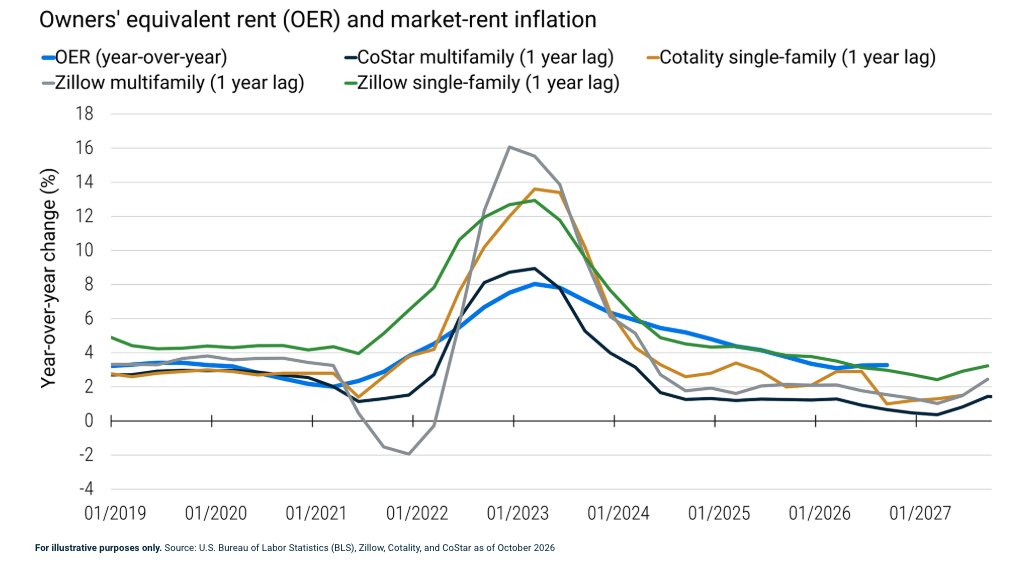
As a result of these dynamics, OER inflation lagged other U.S. market-rent measures by about one year. It recorded a lower peak in the post-pandemic era, but it also took much longer to normalize (see Figure 1).
Figure 1: Owners’ equivalent rent didn’t surge as much as other U.S. rental inflation measures, but it took longer to normalize
Now, roughly six years after the initial pandemic shock, the significant divergence between market rents and the rents paid by existing tenants has greatly diminished. For example, the gap between OER inflation and Cotality’s single-family rent index, which approached 10 percentage points in early 2022, had returned to its pre-pandemic average by late 2025. The rent gap that sustained shelter inflation for several years is therefore no longer the dominant force driving its outlook.
Which definition of market rent should OER follow?
With the post-pandemic rent catch-up largely complete, the next question is which measure of market rents OER should follow.
Not all rental markets behave alike. Research by BLS and Cleveland Fed economists finds that rent inflation for apartments and detached homes can diverge materially even within the same neighborhood, evidence that rental markets are segmented by structure type. That finding is important for OER: While OER is intended to measure the rental value of the owner-occupied housing stock, the rental sample underlying the index historically contained more apartments and fewer detached homes than would be representative of the owner-occupied housing stock.
In January 2023, BLS changed its methodology, reweighting rental observations used to calculate OER to better match the structure-type composition of the owner-occupied housing stock. This adjustment gave additional weight to detached rental homes where they were underrepresented. In January 2024 alone, the OER weight on single-family detached homes increased by roughly 5 percentage points.
More recently, market-rent measures that historically moved relatively closely together are now sending quite different signals. Zillow and Cotality’s measures of rents for single-family housing units are rising between 2% and 3% year-over-year, compared with roughly 1% to 0% increases reported by CoStar and Apartment List national rent measures, both of which primarily measure rents in multifamily units.
There are good economic reasons for this divergence to persist. Multifamily construction surged after the pandemic, particularly across Sunbelt markets, pushing apartment vacancies higher and restraining rent growth.
But newly constructed apartments are imperfect substitutes for large single-family units. A family looking for more space, a particular school district, or a suburban three-bedroom home may compete for a single-family rental even when apartment supply is abundant elsewhere. High mortgage rates reinforce that segmentation by keeping would-be homeowners in the rental market and supporting demand for properties that are closer substitutes for owner-occupied homes.
Geography compounds these differences. In markets with a large supply of multifamily units, such as Austin and Seattle, landlords tend to offer substantial concessions, while townhomes and other specialized rental products in the same cities can experience materially stronger rent growth. Large, supply-constrained cities can also look very different from markets with more space to build that experienced the largest post-pandemic construction booms.
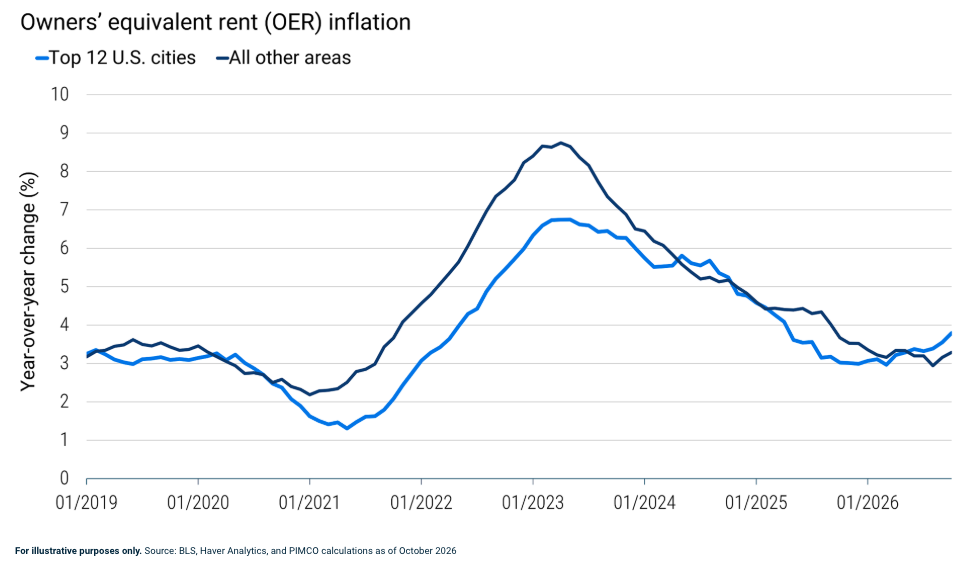
These geographic differences are increasingly apparent in the official inflation data. OER inflation in the 12 largest U.S. metropolitan areas was running at 3.5% year-over-year in October 2026, compared with 3.0% elsewhere, reversing the pattern observed as recently as mid-2025 (see Figure 2). At the same time, the multifamily supply wave itself is beginning to recede as the number of new units completed has fallen sharply from its 2024 peak.
Figure 2: Owners’ equivalent rent in the largest U.S. cities now outpaces the average elsewhere
Shelter disinflation still has further to run, but probably not forever
The implication of greater market segmentation and OER’s detached housing measurement focus is that multifamily apartment rents may no longer be the best forward indicator of OER. The end of the post-pandemic catch-up should continue to pull OER inflation lower, but there is no reason OER must converge all the way to the near-zero inflation currently reported by some multifamily rent indices. The relevant rental markets are segmented by structure type, geography, household characteristics, and affordability, and today’s data increasingly reflect those differences.
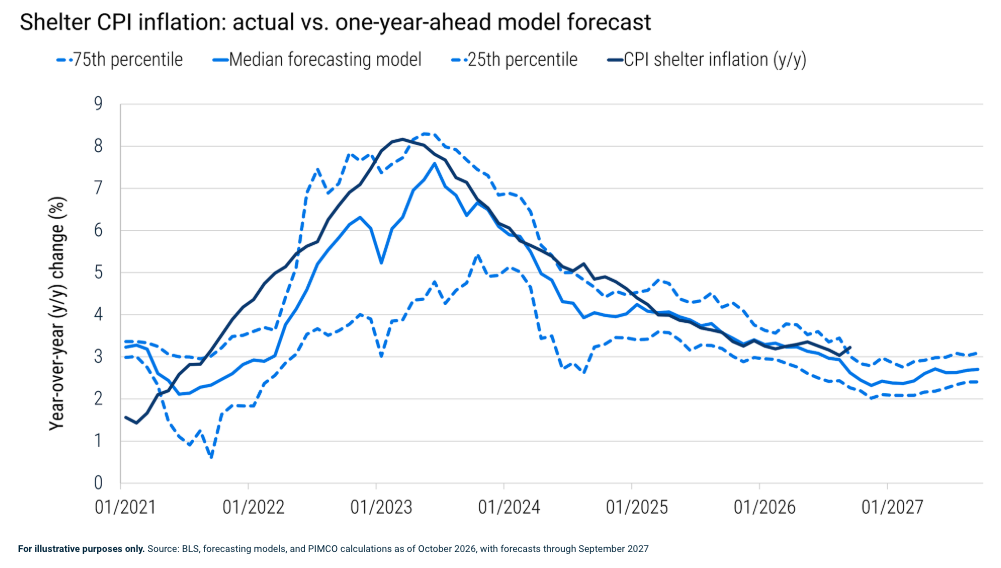
Putting these pieces together, our outlook is for U.S. OER inflation to settle around 3% (maybe a touch below) and stay there throughout 2027. Across 40 forecasting models,Footnote3 including time-series, leading-indicator, rent-gap, and structural lease-renewal approaches, the average forecast points to shelter CPI inflation moderating to slightly below 3% by the end of 2027 (see Figure 3).
Figure 3: Economic models support a forecast of gradually moderating shelter inflation
As an aside, published inflation data may temporarily obscure this underlying disinflation. Because of distortions associated with the October 2025 government shutdown, year-over-year shelter inflation could approach 3.5% over the coming months, even as the underlying pace continues to moderate. These base effects should largely unwind by April 2027.
Bottom line for inflation
In 2024 and 2025, the key question was how long OER would take to catch up to the enormous pandemic increase in market rents. Today, that adjustment is largely behind us. The question now is what inflation rate the underlying rental market will sustain.
We expect shelter inflation to continue cooling through 2027, settling just under a 3% pace and providing an important offset to inflation pressures elsewhere in the economy. But we would be cautious about extrapolating multifamily rent weakness directly into OER, or assuming shelter inflation will simply keep falling. OER increasingly reflects a single-family rental market that remains supported by expensive homeownership and constrained supply, while the enormous wave of new multifamily supply is beginning to recede. As a result, the scope for further shelter disinflation should diminish as we approach 2028.
The pandemic rent catch-up may be over, but that does not mean shelter inflation will converge to softer trends for multifamily rentals.
Footnotes:
- Kmetz, A., J. Mondragon, and J. Wieland. “Remote Work and Housing Demand.” Federal Reserve Bank of San Francisco (FRBSF) Economic Letter (2022)Return to content↩
- Ball, L. and K. W. Koh. “Market Rents and CPI Shelter Inflation.” National Bureau of Economic Research (NBER) Working Paper 34113 (2025)Return to content↩
- References for the model data in Figure 3:
Ball, L. and K. W. Koh. “Market Rents and CPI Shelter Inflation.” NBER Working Paper 34113 (2025)
Bolhuis, M., J. Cramer, and L. Summers. “The Coming Rise in Residential Inflation.” NBER Working Paper 29795 (2022)
Cotton, C. “Understanding CPI Shelter Inflation: The Importance of the New-Tenant/All-Tenant Rent Gap.” Journal of Housing Economics 71 (2026)
Cotton, C. and J. O’Shea. “Forecasting CPI Shelter under Falling Market-Rent Growth.” Boston Fed Current Policy Perspectives (2023)
Jordà, Ò. and A. Yalcin. “When Is Shelter Services Inflation Coming Down?” FRBSF Economic Letter (2024)
Kishor, N. K. “Does Zillow Rent Measure Help Predict CPI Rent Inflation?” Munich Personal RePEc Archive (MPRA) Paper 120818 (2024)
Kmetz, A., S. Louie, and J. Mondragon. “Where Is Shelter Inflation Headed?” FRBSF Economic Letter (2023)
Lansing, K., L. E. Oliveira, and A. H. Shapiro. “Will Rising Rents Push Up Future Inflation?” FRBSF Economic Letter (2022)
Loewenstein, L., J. Meyer, and R. Verbrugge. “New-Tenant Rent Passthrough and the Future of Rent Inflation.” Cleveland Fed Economic Commentary (2024)
McKay, A. and N. Mehrotra. “Despite Cooling Prices for New Leases, Overall Housing Inflation Could Remain Elevated into 2025.” Federal Reserve Bank of Minneapolis (2024)
O’Trakoun, J. “When Will a Decline in Asking Rents Be Reflected in Rent CPI?” Richmond Fed Macro Minute (2023)
Zhou, X. and J. Dolmas. “Surging House Prices Expected to Propel Rent Increases, Push Up Inflation.” Dallas Fed Economics (2021)Return to content
A message from Advisor Perspectives and VettaFi: Discover something new! Click here to register for our upcoming webcasts.
© PIMCO
More Fixed Income Topics >