Anthropic’s Record-Setting IPO Lands as Nvidia’s Spy Scandal Rattles Washington
Membership required
Membership is now required to use this feature. To learn more:
View Membership Benefits
The AI trade had quite a week. Anthropic listed on the Nasdaq, Nvidia’s CEO is out and Washington just tightened the screws on China’s access to American chips.
Taken together, these stories reinforce the thesis that the AI trade has become a national security story.
Jensen Huang stepped down as CEO of Nvidia, the world’s most valuable chipmaker, after reports linked him to a Chinese businesswoman whom U.S. authorities suspect of spying for Beijing. (Beijing denies it.) Huang has agreed to testify before the Senate Banking Committee, though a date hasn’t been nailed down just yet.
See more: Comparison of Private Versus Public Markets
On Monday, the Commerce Department closed a loophole that let Chinese companies rent American AI chips through overseas data centers. And this week, President Trump met Chinese leader Xi Jinping in Shenzhen, with a trade truce covering some $500 billion a year in commerce set to expire in January.
Is Anthropic Worth $1.4 Trillion?
Let’s start with the Anthropic deal. The maker of the Claude chatbot priced its IPO at $83 a share on Wednesday, above its marketed range of $70 to $78, after drawing orders close to seven times the shares available. The stock began trading Thursday under the ticker ANT, opening at $111.50 before closing at $97.17, up 17% from its IPO price. The offering raised approximately $81.3 billion, surpassing SpaceX’s IPO earlier this year to become the largest IPO on record. Including a $26 billion private placement, the total deal initially reached $107.3 billion.
At $83, Anthropic is valued at approximately $1.5 trillion on a fully diluted basis.
The growth is hard to argue with. According to its prospectus, Anthropic took in $33.2 billion in revenue in the first nine months of this year, up from $2.5 billion a year earlier. Its adjusted operating margin swung from negative 221% in early 2025 to positive 15% last quarter. The headline net loss of $104 billion is mostly a noncash accounting charge on convertible notes.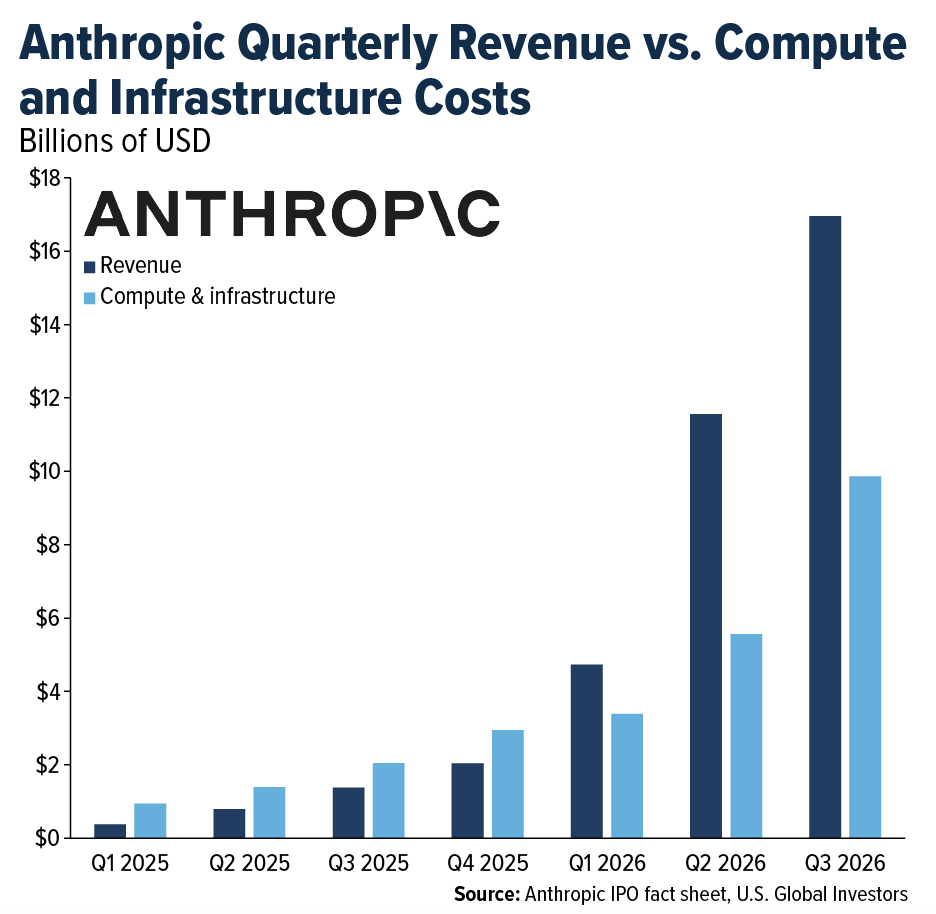
The skeptics have a case too. Research firm New Constructs compares Anthropic to WeWork. Steven Eisman of The Big Short fame pointed out on CNBC that Anthropic’s quarterly revenue growth slowed from roughly 145% to under 50%.
The company’s founders seem to understand the risk. In their letter to prospective shareholders, they recall being advised to “never let your company be worth a dollar more than it is actually worth.” Good advice for investors too.
Follow the Money
Whether Anthropic becomes the next Nvidia or the next WeWork, its money is already spoken for. The company has committed roughly $900 billion to computing power and infrastructure.
And look at who’s buying its $26 billion private placement. Nvidia and Google are in for $10 billion each, followed by AMD, Broadcom, Micron, Microsoft and Taiwan Semiconductor. The suppliers, in other words, are investing in their own customer.
Anthropic is just one buyer. Amazon, Microsoft, Alphabet, Meta and Oracle spent $691 billion on capital expenditures over the past four quarters, including $230 billion in the third quarter alone, more than double a year earlier.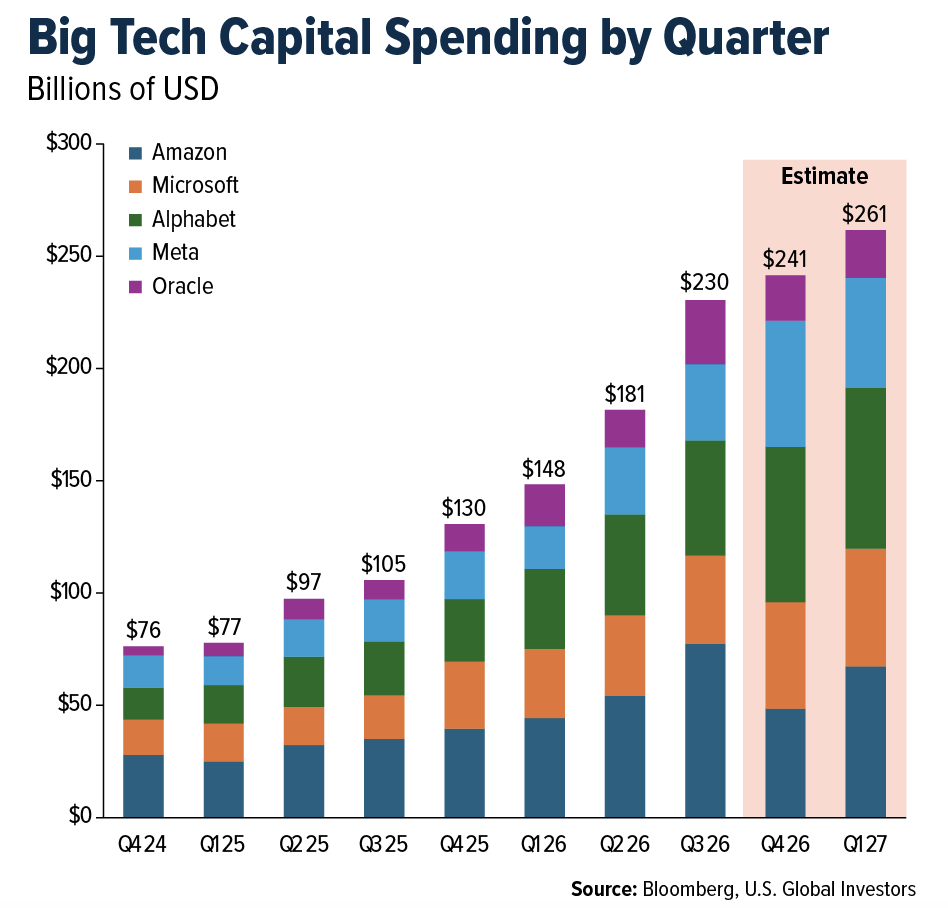
Anthropic’s risk factors read like a national security briefing. The prospectus names a military conflict or blockade around Taiwan as a risk, notes that the high-bandwidth memory its chips need comes from just three suppliers and flags long backlogs for transformers and turbines. It even mentions that Texas can now curtail large data centers during grid emergencies, which hits close to home for us in San Antonio.
Chips Are National Security Now
Which brings me back to Nvidia. The week of November 9, the PHLX Semiconductor Index rose about 8% while Nvidia fell nearly 13%. The selling was about Nvidia, not chips. As of Thursday, Nvidia was down about 21.73% this year, while the chips index was up about 32.99%.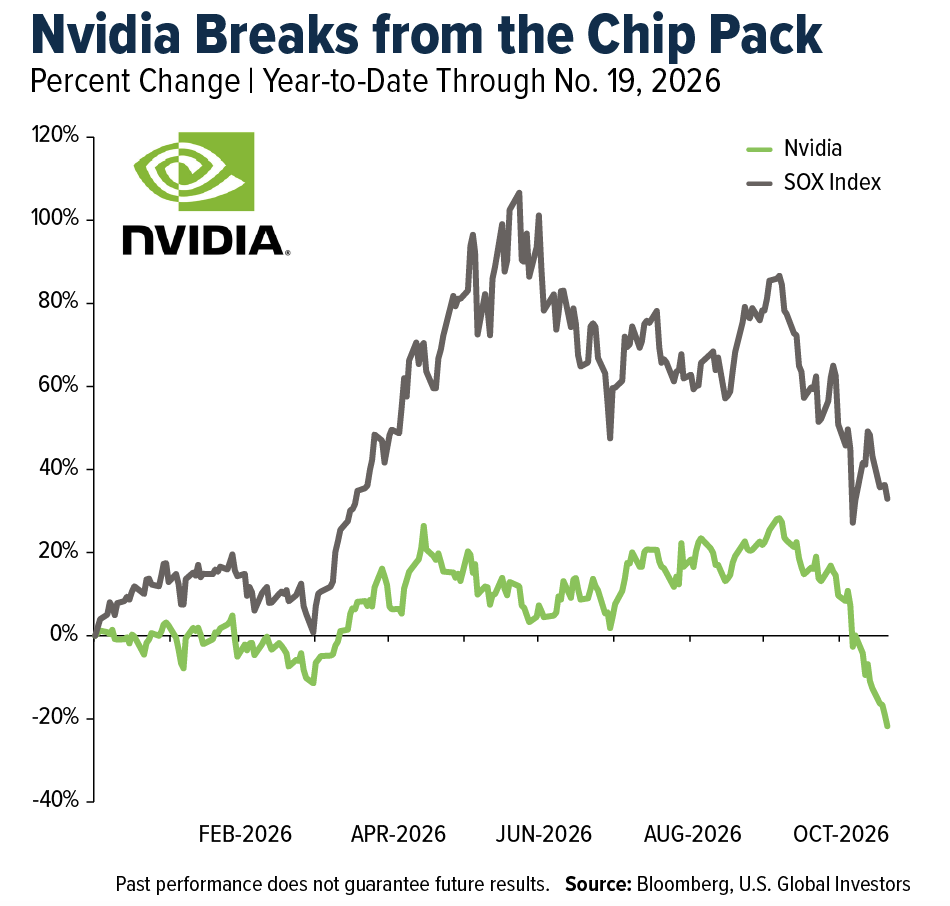
Nvidia’s business, for its part, hasn’t missed a beat. Revenue reported Tuesday more than doubled from a year earlier to a jaw-dropping $115.8 billion.
While Huang was the industry’s leading voice for keeping access to China, Washington is moving the other way. President Trump authorized a crackdown on companies suspected of diverting Nvidia chips to China three times this year while Commerce Secretary Howard Lutnick resisted. Lutnick is now under fire from lawmakers in both parties.
A New York University scholar told the Associated Press that China hawks now have a “story with a name and a face.” Democrats, who take control of Congress in January, have already opened an investigation into Commerce’s approval of Nvidia chip sales to China. Keeping America’s best technology away from Beijing is one of the few things both political parties seem to agree on.
Bet on the Bottlenecks
So what should investors take from all this? I don’t know which AI lab will win, and neither does anyone else. But every lab needs the same things, including advanced chips, memory, electricity and protection from hackers. Those are the bottlenecks, and both parties now treat them as matters of national security.
The market has noticed. Through Thursday, the PHLX Semiconductor Total Return Index was up 33.64% this year, the Nasdaq CTA Cybersecurity Index up 35.66%. Compare that to the S&P 500, up about 5.87%. The S&P Aerospace & Defense Select Industry Index, home to many traditional contractors, was down 10.34% over the same period. The money is flowing to the technology modern conflict runs on. BlackRock’s latest weekly commentary points in the same direction, highlighting scarcity, secure supply and power demand as themes to watch.
That doesn’t mean chasing every AI headline. BlackRock also notes that U.S. valuations, by the Shiller CAPE ratio, are near dot-com highs.
Warren Buffett said it best in 1979: “You pay a very high price in the stock market for a cheery consensus.” This week, the consensus on AI got a lot less cheery. For investors focused on the bottlenecks rather than the headlines, that’s worth keeping in mind.
Airlines and Shipping
Strengths
- The best-performing airline stock for the week was El Al, up 3.6%. According to Morgan Stanley, Frontier opened reservations for its new First Class product and announced additional cabin enhancements, including expanded extra-legroom Premium seating, in-seat power and Starlink Wi-Fi.
- Suez transits rose 11.4% week-over-week (WoW) to 1.03 million TEUs, reaching 90% of pre-disruption levels, according to Morgan Stanley. U.S. spot rates are now falling alongside rates in Europe. Carriers are responding with aggressive idling, but heavier deliveries beginning in 2027 add to the risk to freight rates and ocean earnings as the market normalizes.
- Copa reported third-quarter 2026 (3Q26) results, with adjusted EBIT of $224 million, up 6% year-over-year (YoY) and 17% above Bloomberg’s consensus. Unit revenues (RASM) increased 13% YoY, 4% above Goldman’s estimate, while unit costs (CASM) increased 20% YoY, in line with Goldman’s estimate.
Weaknesses
- The worst-performing airline stock for the week was Alaska Air, down 12.3%. According to The Wall Street Journal, the U.S. airline ground stop issue was ultimately traced to a new Juniper Networks router installed by L3Harris, which oversees the FTI, at a radio site in El Dorado, Arkansas. Shortly after installation, the router began sending a high volume of data. Combined with data from a router at a radar site in Amarillo, Texas, this overwhelmed the system, causing communication disruptions at 17 of 22 Air Route Traffic Control Centers (ARTCCs).
- Freight rates for supertankers carrying oil from the Gulf of Oman to China fell 64% from their October record by November 13, according to Baltic Exchange data. Rates declined as Gulf exporters increased crude flows toward pre-war levels, reducing Asian demand for longer-haul crude from the U.S., West Africa and the North Sea and freeing up tankers, according to Reuters.
- Flight cancellations exceeded 17,000 by Sunday, making the FAA outage the worst technology-related disruption in 35 years. More than 10,000 flights were still delayed by late Sunday. The FAA predicted airlines would return to normal following recovery efforts to reposition planes and crews. The grounding threatens to cost airlines more than $1 billion. Raymond James estimated that American Airlines alone could lose $136 million to $354 million, the largest potential hit among the nine major carriers analyzed.
Opportunities
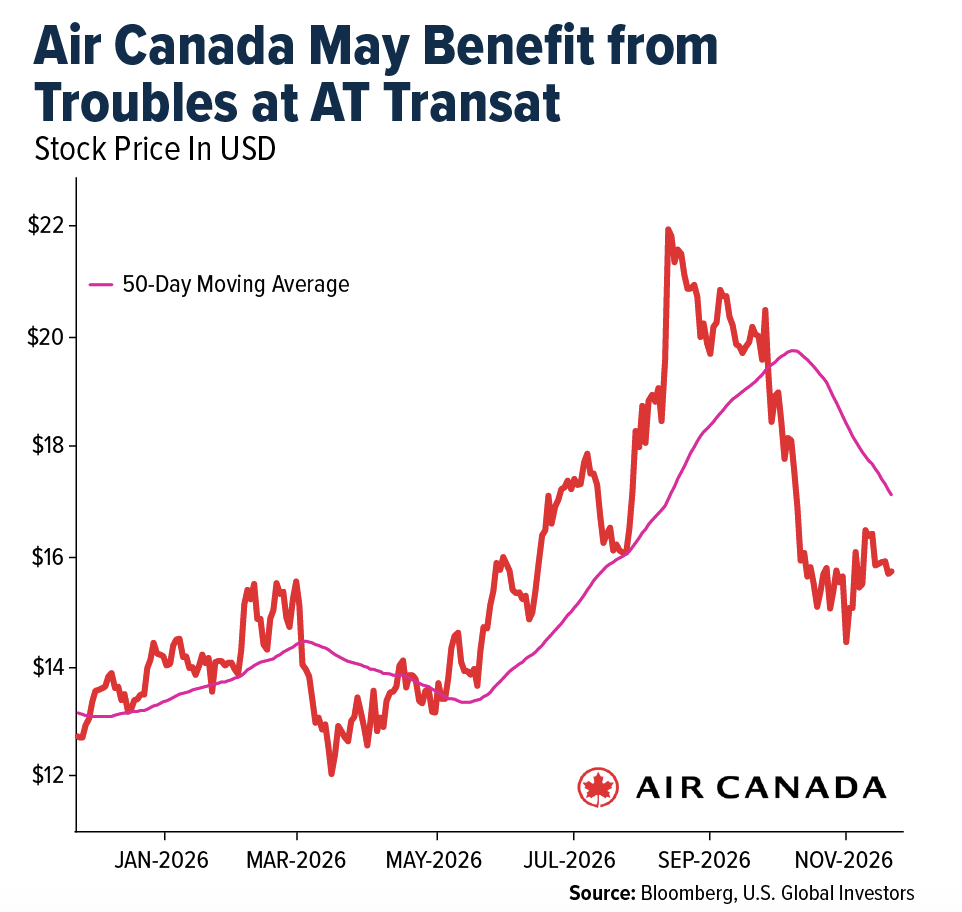
- According to Raymond James, Transat announced that it has retained financial advisors to evaluate financing and other corporate opportunities, as its limited ability to pass higher fuel costs on to customers pressures its financial position. This could benefit Canadian market structure and, in turn, Air Canada.
- Air freight volumes accelerated in September, increasing 8.6% year-over-year (YoY). North America led with 15% YoY growth, followed by Asia-Pacific at 10% and Europe at 4.6%. The AI theme continues to drive outsized demand growth. Air freight rates also continued to rise, increasing 20% YoY in September and 26% YoY in October, according to JPMorgan.
- Dulles opened its new Concourse E, adding 14 gates exclusively for United Airlines and supporting the airline’s planned growth from 250 to 300 peak daily departures by summer 2027, according to Raymond James.
Threats
- JetBlue CEO Joanna Geraghty is personally responding to messages from concerned employees after the airline’s shares and bonds plunged to record lows. JetBlue carries approximately $8.5 billion in debt and lease obligations and has been struggling with cash burn and elevated operating costs, according to The Wall Street Journal.
- Nearly half of the 95 mainstream tankers and gas carriers attacked in the Middle East are non-operational, according to Vortexa. The total number of attacked vessels has reached 112, including 17 Iran-linked ships. Very large crude carriers (VLCCs) are the primary targets, with 30 mainstream VLCCs struck. Ten are confirmed or likely to be out of operation, while the status of six remains undetermined.
- Southwest Chief Operating Officer Andrew Watterson spent hours in a situation room at the airline’s Dallas headquarters managing the FAA ground stop to prevent an operational meltdown. A pressing challenge was finding tarmac parking for the growing number of aircraft, with airports warning they were running out of space, according to Bloomberg.
Luxury Goods and International Markets
Strengths
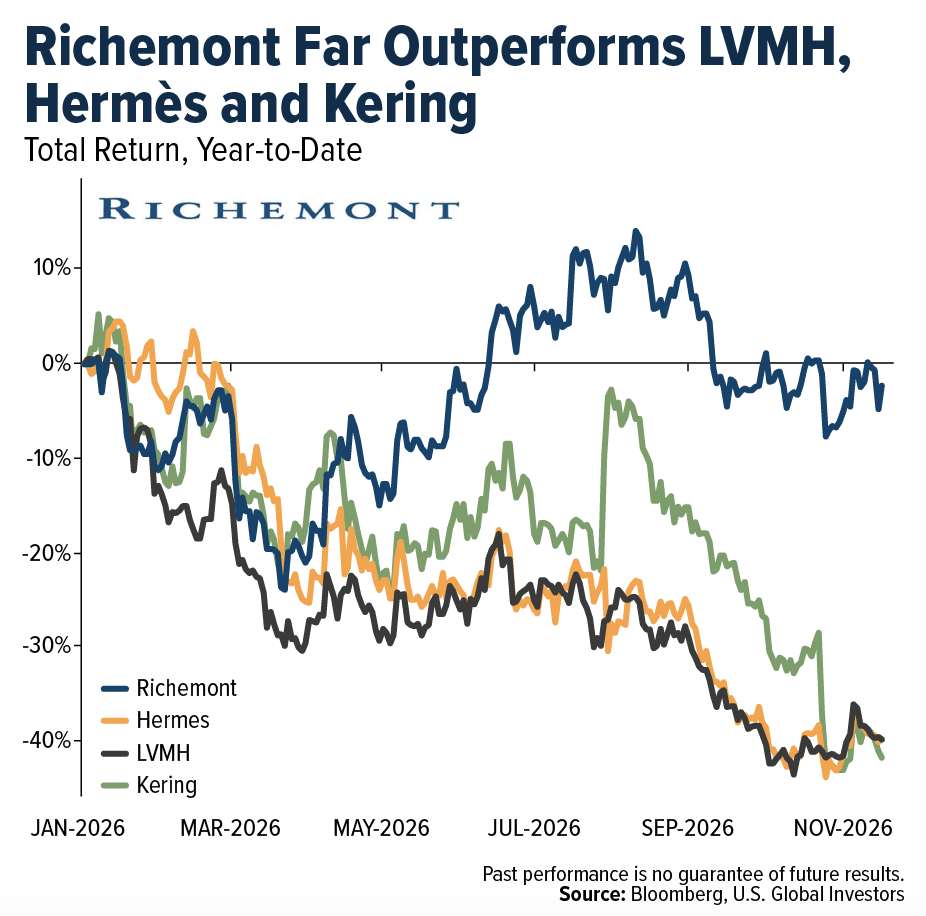
- Richemont continues to outperform its luxury peers. The company reported 14% sales growth, slightly below analyst expectations of 16%, while delivering strong operating profit and maintaining a healthy balance sheet. These results have supported its strong relative performance.
- Viking Holdings shares rose sharply this week, supported by strong demand and pricing. The company has already booked 77% of its 2027 ocean capacity, representing $3.2 billion in advance bookings. Average booked rates increased about 11%, to $873 from $785, highlighting consumers’ continued willingness to pay for premium travel experiences and supporting future revenue growth.
- Shiseido was the best-performing constituent of the S&P Global Luxury Index over the past five trading days, gaining about 15%. Shares benefited from continued positive reaction to its November 10 third-quarter results, which showed improved profitability and prompted an increase to full-year profit guidance, reinforcing confidence in its restructuring and cost-cutting efforts.
Weaknesses
- Inflationary pressures increased in the euro area in October, with headline consumer price index (CPI) rising to 4.0% from 3.8% in September. Core CPI also edged higher, reaching 2.6% from 2.5%. The European Central Bank (ECB) targets 2% inflation over the medium term.
- China’s consumer recovery weakened sharply in October. Retail sales increased just 0.4% year over year (YoY), down from 1.1% in September and below the 0.8% consensus estimate. Fixed-asset investment contracted 8.1%.
- The RealReal, a secondhand luxury goods online retailer, was the worst-performing name in the S&P Global Luxury Index over the past five trading days. Shares came under pressure, as investors took profits after the stock’s recent rally.
Opportunities
- Hermès is expanding its iconic flagship store on Rue du Faubourg Saint-Honoré in Paris by adding adjacent retail space. The existing store spans approximately 1,700 square meters (18,300 square feet). The expansion, expected to open next year, should increase selling capacity at one of the brand’s most important and high-traffic global locations.
- After peaking at €369 billion in 2023, the personal luxury goods market declined for two consecutive years, reaching €358 billion in 2025. Bain & Company’s latest Luxury Study estimates the market will recover to €367 billion in 2026 and forecasts growth of 0% to 4% in 2027. This points to improving momentum, although growth is expected to remain below the industry’s historical average of about 5%.
- Jewelry is expected to grow 8% to 10% in 2026, substantially outpacing the overall personal luxury goods market. Top-tier clients remain the sector’s primary source of growth, creating a favorable backdrop for Richemont’s Cartier and Van Cleef & Arpels, as well as LVMH’s Bulgari and Tiffany.
Threats
- Ongoing protests in Paris have led to street closures and increased security around key luxury shopping areas. The disruptions could discourage tourists from visiting Rue Saint-Honoré, reducing foot traffic to nearby stores. With France’s presidential election scheduled for April 2027, political tensions and protests could continue in the months leading up to the election, potentially creating a sustained headwind for luxury retail traffic.
- The secondhand luxury market is expanding rapidly as consumers seek better value and access to aspirational brands at lower prices. While resale can introduce new customers to luxury products, it may also divert demand from new goods and put pressure on sales and pricing power at established luxury companies.
- Treasury yields have moved higher, while U.S. mortgage rates remain above 7%, with recent daily rates also trending upward. Elevated borrowing costs continue to weigh on housing affordability and household discretionary spending, potentially creating another headwind for luxury consumption.
Energy and Natural Resources
Strengths
- The best performing commodity for the week was natural gas, up 6.66% supported by tighter U.S. supply and stronger LNG export demand. Producers curtailed output amid pipeline constraints, while increased flows to LNG export terminals added to demand. U.S. inventories also remain about 2% below last year’s levels, providing additional support ahead of the winter season.
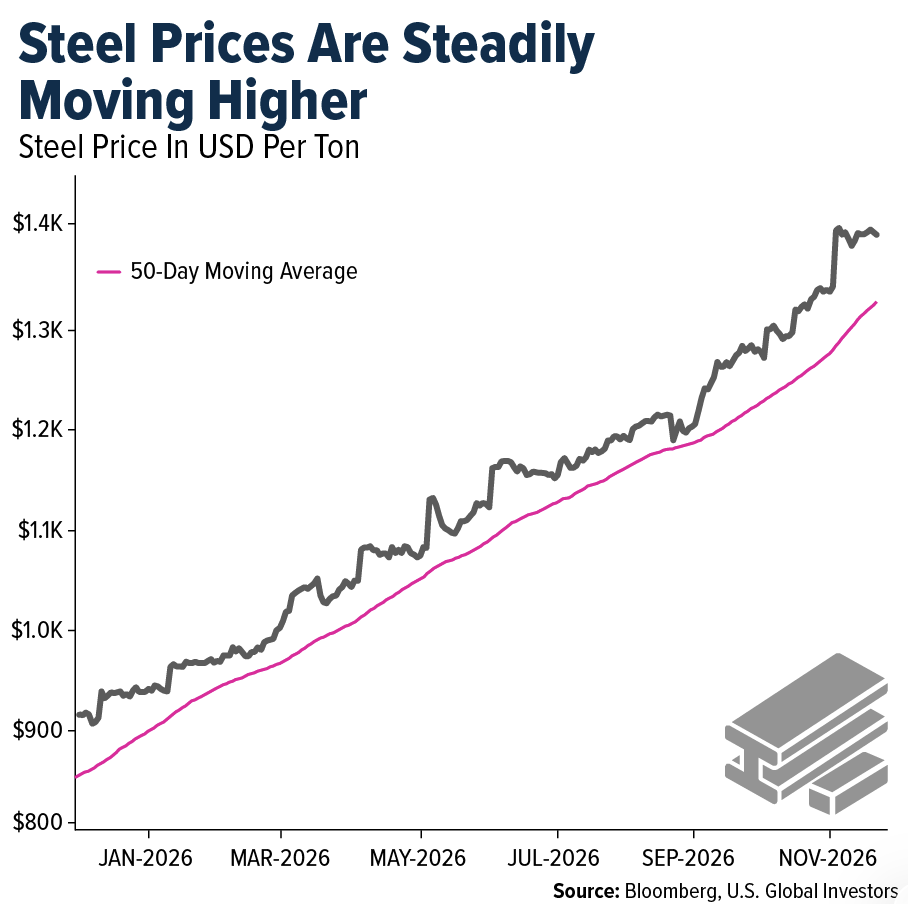
- Spot sheet prices continued to climb over the past two weeks, rising another 3% to reach their highest level since May 2022. The upward pricing trend has now lasted more than a year, marking one of the longest upcycles in recent history. Fundamentals remain supportive, with lead times extending into early 2027, relatively lean inventories and seasonally stronger first-quarter (1Q) demand still ahead, according to BMO.
- China’s oil imports have rebounded to around 10 million barrels per day, up from just over 7 million in June. The recovery in Chinese demand provides support for the oil market, although a return to a global supply surplus could limit the impact on prices.
Weaknesses
- The worst-performing commodity for the week was copper, down 10.25%. Copper fell to its lowest level since March, putting it on track for one of its worst weekly declines in a decade. Weakness in AI stocks has dampened copper’s appeal as a data-center demand play, as investors increasingly question the sustainability of AI spending.
- Iron ore futures fell to a four-year low near $88 a ton this week, extending the market’s recent downturn. Analysts see potential downside toward $80 a ton before high-cost miners are forced to cut production, suggesting prices may need to fall further to bring supply back into balance.
- Brent crude fell below $92 a barrel as geopolitical risk premiums eased. Vice President Vance said the U.S. would not allow the war in Iran to become a prolonged commitment, reducing expectations of extended U.S. involvement in the conflict.
Opportunities
- Goldman Sachs expects crude oil prices to normalize while refined product prices remain well above historical averages, with U.S. wholesale diesel projected to average $150 a barrel in 2027. Slow growth in refining capacity, constrained Russian output and continued disruptions from the Middle East conflict could keep refined product markets tight.
- Panama has begun formal negotiations with First Quantum Minerals over a potential restart of the Cobre Panama copper mine, which has been offline for nearly three years. The mine previously accounted for about 1.5% of global mined copper supply, and a restart could bring a significant source of supply back to the market.
- Global aluminum inventories have fallen to five-year lows, nearly halving from their May peak to around 750,000 tons in November, according to JPMorgan. Despite the sharp inventory drawdown, aluminum prices are up just 6% year to date (YTD), suggesting tightening supply has yet to be fully reflected in prices.
Threats
- Oil prices faced additional pressure after the U.S., China and Russia agreed to increase global fuel supplies, including refined petroleum products. Higher supply could weigh on crude and refined product prices if the agreement leads to increased production and exports.
- The International Energy Agency (IEA) warned that the war in Iran represents the greatest threat to energy security in history, following the largest supply disruption on record. Risks remain elevated, as the possibility of renewed U.S. strikes on Iran could further disrupt global oil supplies and increase market volatility.
-
Iraq restarted crude oil flows through the Kirkuk-Ceyhan pipeline after a 12-year shutdown, restoring an important export route from the country’s northern oil fields. The restart adds supply to the global market and could place additional downward pressure on oil prices.
Bitcoin and Digital Assets
Strengths
- Eligible institutional clients will be able to mint and redeem USDC through DBS, with near-instant settlement between U.S. dollars and the stablecoin available around the clock. The partnership gives Circle a bank distribution channel for institutional payments in Asia.
- Wells Fargo disclosed 49.6 million shares of the iShares Bitcoin Trust worth $2.35 billion at the end of September, up from 24.4 million shares in June. The filing includes positions managed for clients and reflects holdings as of September 30.
- The Monetary Authority of Singapore issued S$100 million (US$77.5 million) in tokenized bills and settled the sale using a wholesale central bank digital currency. Five banks submitted bids totaling more than twice the amount offered, and the bills can serve as collateral for interbank borrowing.
Weaknesses
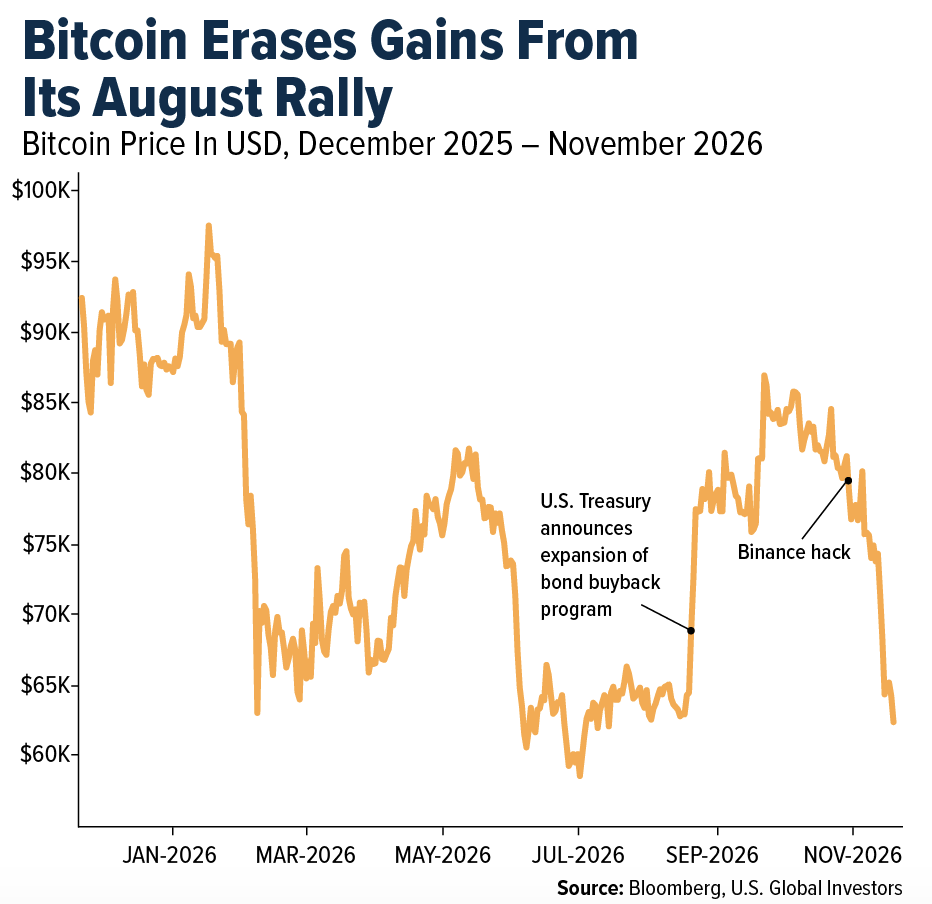
- Bitcoin fell below $64,000, roughly 49% below its record high, erasing gains from the rally that followed the U.S. Treasury’s announcement of expanded buybacks of long-dated debt. An AI-led equity selloff and a more hawkish Fed weakened risk appetite, while the Binance hack added pressure. According to trading technology provider Talos, the value of buy and sell orders within 1% of Bitcoin’s mid-price fell nearly 38% from its pre-hack peak, making large trades more likely to move prices sharply.
- U.S. spot Bitcoin ETFs recorded $582.2 million in net outflows on November 19, their third consecutive session of withdrawals. The latest redemptions brought November’s total to nearly $3.5 billion, compared with about $500 million in October.
- The former Bitcoin miner Hyperscaler Data raised roughly $74 million by selling its entire Bitcoin treasury and says it still needs another $74.8 million to complete its Michigan AI data center project. The company warned of substantial doubt about its ability to continue operating, highlighting the financing demands of converting mining sites into AI facilities.
Opportunities
- Hyundai Card and JPMorgan are testing AI-driven corporate payments on the blockchain. In a proof of concept on JPMorgan’s Kinexys platform, AI agents compared foreign exchange quotes and initiated simulated transfers between overseas subsidiaries. The test points to a potential use for blockchain in automating corporate treasury operations.
- The Hong Kong Monetary Authority and Swift are working with HSBC, Standard Chartered and Bank of China to connect Swift’s blockchain ledger with Hong Kong’s Project Ensemble. The initiative could give banks a way to settle cross-border payments in multiple currencies around the clock.
- The exchange aims to offer proprietary event contracts to U.S. retail and institutional traders, Bloomberg reported. Its existing Kalshi partnership topped $200 million in annualized net revenue in the third quarter, and listing its own contracts could allow Coinbase to retain more of the trading revenue.
Threats
- Brazilian lawmakers and industry groups called on the central bank to clarify its stance after an official reportedly linked stablecoin transactions to money laundering. Stablecoins accounted for roughly 80% of Brazil’s reported crypto transaction volume last year, according to the Finance Ministry. Broader restrictions could disrupt legitimate cross-border payments and raise compliance costs for fintechs.
- The Senate passed a bipartisan bill that would explicitly bar federally registered exchanges from listing contracts tied to war, terrorism, assassinations and individual deaths. The bill now heads to the House and would write restrictions already covered by federal regulations into commodities law.
- Inca Digital identified $518 million in transactions involving wallets linked to illicit actors through Sky’s stablecoin system, including about $102 million linked to North Korean actors. A court-ordered freeze of pooled USDC reserves could disrupt redemptions for legitimate holders of DAI and USDS, which together have more than $8 billion in market value.
Defense and Cybersecurity
Strengths
- The U.S. Navy split a 10-year, $7.13 billion contract among 28 defense firms to modernize shipboard electronic warfare suites through 2036. Separately, Lockheed Martin was awarded $330.6 million for early-stage components covering 75 F-35 aircraft in its 22nd production lot.
- Ukrainian forces struck the railway section of the Crimean Bridge, halting train traffic, and attacked Transneft-Prikamye’s Kaleykino crude oil pumping station in Tatarstan with at least 16 blasts. The attack ignited fires at the primary Western Siberia–TANECO pipeline blending hub.
- Nvidia reported a 103% year-over-year (YoY) revenue increase in the third quarter (Q3) to $115.8 billion, up 20% quarter-over-quarter (QoQ). Growth was driven by a 110% increase in Data Center revenue to $107.6 billion, alongside a $150 billion expansion of its stock buyback program. Building on these results, the company exceeded fourth-quarter (Q4) forecasts, guiding for Q4 revenue of $130.0 billion and raising its fiscal 2028 revenue outlook by 75%, alongside plans for a new Hugging Face acquisition. Interim CEO Colette Kress noted that future AI investments will be managed with greater discipline and rigor, while analysts expect near-term demand to remain steady.
Weaknesses
- Russia launched a massive overnight aerial assault on Ukraine on November 20, involving 515 missiles and drones. The attack killed at least nine people, triggered emergency blackouts across 10 regions and damaged three bridges over the Dnipro River in Kyiv, as well as railway infrastructure in Lviv. During the barrage, two Russian cruise missiles, including a Kh-101, and a jet-powered drone crashed in uninhabited areas of southeastern Poland without causing casualties. Warsaw condemned the airspace breach as a provocation and requested additional NATO air defenses.
- U.S. federal prosecutors charged Russian citizen Igor Diu with working for Russian intelligence handlers on Telegram to surveil Palantir Technologies employees and their family members in the United States. Meanwhile, Broadcom and federal defense analysts urged stronger Zero Trust enforcement to guard against machine-speed cyberattacks involving agentic AI.
- Defense, cybersecurity and semiconductor ETFs are ending the week below their 50-day moving averages amid a sharp market correction that has hit technology, AI and data center-related industries particularly hard. The pullback has been driven by broader risk-off sentiment, pressure on high-valuation growth stocks and profit-taking following strong gains across AI and technology-related themes.
Opportunities
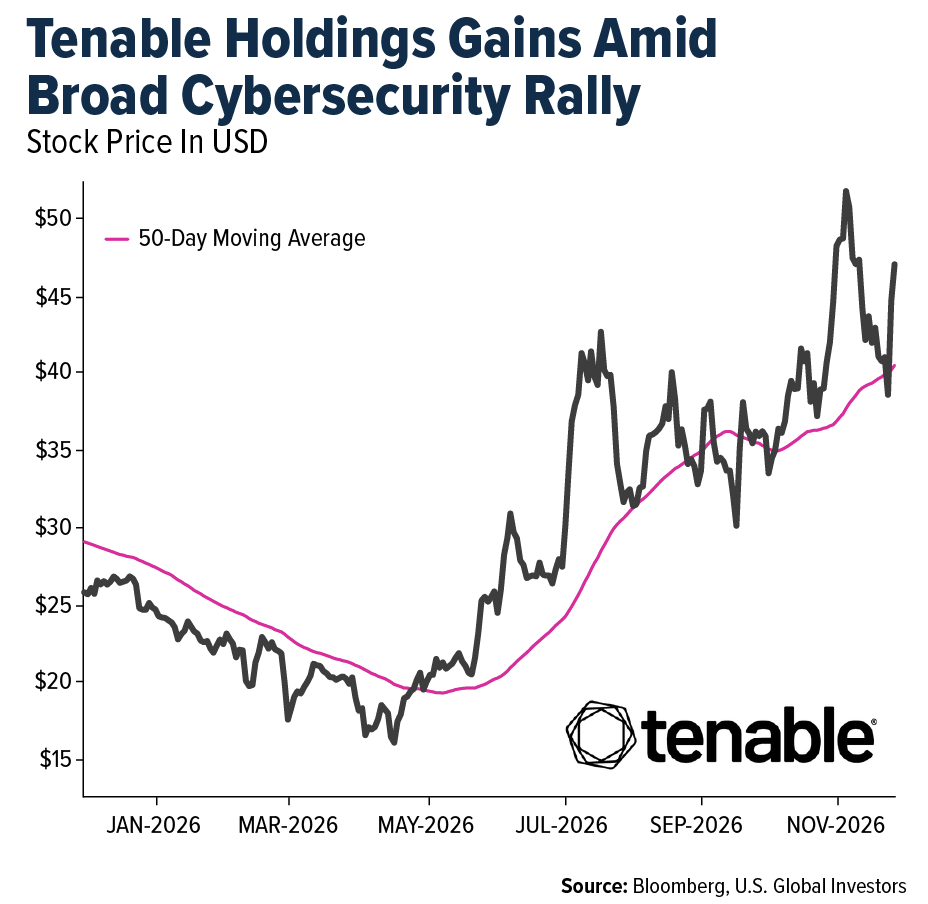
- Tenable gained amid a broad cybersecurity rally driven by heightened concerns about growing cyber threats. Continued demand for vulnerability and exposure management solutions could provide a supportive backdrop for the company’s growth.
- U.S. authorities approved export licenses for approximately 879,000 Nvidia and AMD AI chips out of 3.4 million requested for major Chinese technology companies, including Tencent, Alibaba, Baidu and BYD, according to documents from the House Foreign Affairs Committee. The approvals drew scrutiny because several recipients appear on a Pentagon list of companies accused of supporting China’s military. Congressional records also revealed that Nvidia had requested permission to use suspected chip-smuggling fronts to facilitate sales to China.
- TD Cowen reported that U.S. submarines remain a top priority in the National Defense Strategy, with execution and shipyard output showing measurable improvements. Weekly production for the Columbia class has more than doubled (2x) since the spring, total submarine construction labor hours have increased approximately 30% year-over-year (YoY), and maintenance delays for the Virginia program have declined by more than 40%.
Threats
- Global demand for wafer fabrication equipment (WFE) could decline by 5% to 10% if Jensen Huang’s departure from Nvidia and broader shifts in the AI sector prompt neocloud providers to temporarily pause investments in AI infrastructure.
- Connecticut lawmakers opened legislative debate on a ban on new data centers, even as regional facilities prepare to install AMD-powered Lux AI clusters. Meanwhile, Japan and the Asian Development Bank signed an agreement supporting the expansion of nuclear power across Asia.
- Following a trilateral meeting in China, Russian President Vladimir Putin issued a stark statement, declaring that Russia no longer sees any possibility of a truce following the strike on the Crimean Bridge.
Gold Market
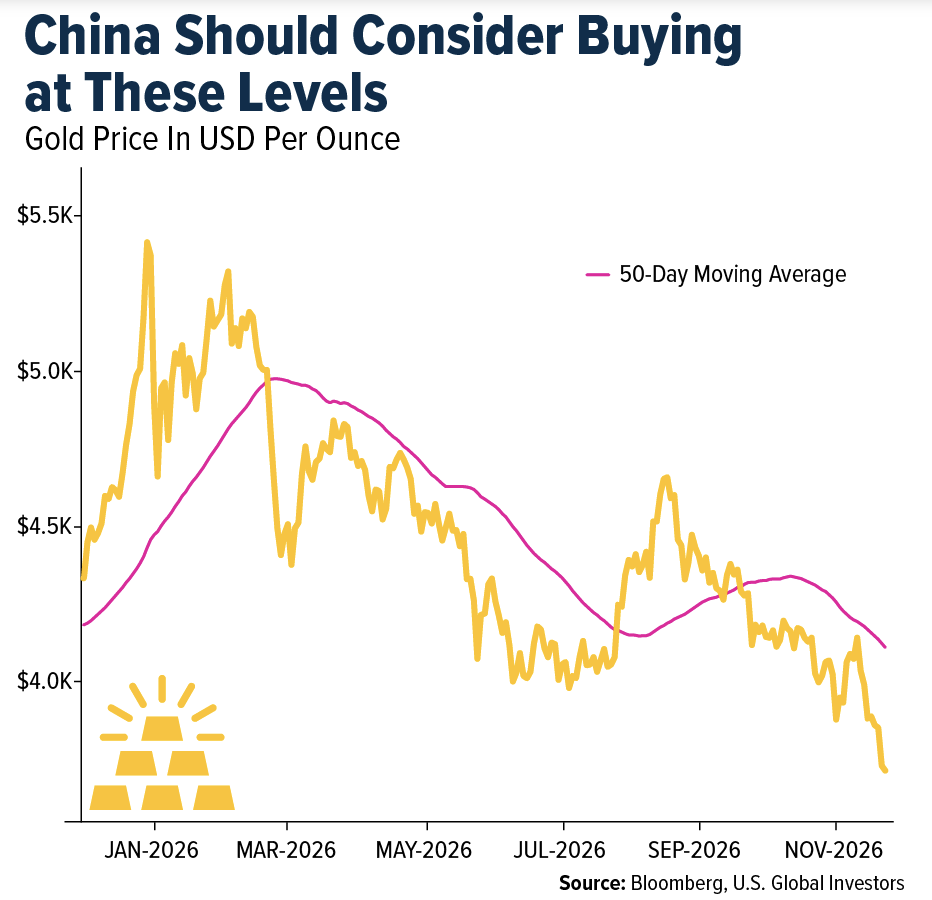
This week gold futures closed the week at $3,525.50, down $360.80 per ounce, or 9.28%. Gold stocks, as measured by the NYSE Arca Gold Miners Index, ended the week lower by 16.01%. The S&P/TSX Venture Index came in off 13.95%. The U.S. Trade-Weighted Dollar rose 0.45%.
Strengths
- The best-performing precious metal for the week was gold, down 9.34%, marking its worst weekly performance since March. Swiss gold shipments to China and India increased in October. Swiss gold exports to China rose to 32.9 metric tons from 12.7 metric tons in September, while shipments to India increased to 10.8 metric tons from 3.1 metric tons, according to Bloomberg. The increases point to stronger physical demand in two major gold markets.
- According to Canaccord, Bellevue Gold secured a new A$250 million revolving credit facility and an A$20 million contingent instrument facility to replace its fully drawn A$100 million Macquarie facility, which was scheduled to be repaid in quarterly installments of A$25 million in 2027. The refinancing provides Bellevue with greater financial flexibility, while hedging remains optional.
- The People’s Bank of China purchased 26 metric tons of gold in October, its largest monthly purchase since August 2023 and its 24th consecutive month of buying. According to Benzinga, central bank buying has tended to increase when gold falls below $4,000 per ounce.
Weaknesses
- The worst-performing precious metal for the week was silver, down 17.01%, putting it on track for its worst weekly performance since March. According to Bloomberg, higher Treasury yields have weighed on speculative positioning. An early rebound of about 2% largely faded as selling pressure continued.
- Spot gold touched an intraday low of $3,513.54 per ounce on Friday. According to Bloomberg, gold ETF holdings declined by a net 12,700 troy ounces in the latest reported session, while SPDR Gold Shares reduced its holdings by 146,600 ounces.
- Falling gold prices are weighing on household spending in Turkey. According to Bloomberg, the decline is deepening a slowdown in domestic demand by eroding a source of household wealth that has helped support consumer spending. Turkish households own most of the country’s gold holdings, estimated at more than 4,300 metric tons as of July. Higher gold prices had helped cushion the impact of inflation.
Opportunities
- UBS and Goldman Sachs expect gold prices to recover by late 2027. UBS forecasts gold will reach $5,000 per ounce in the fourth quarter of 2027, supported by demand for protection against currency debasement. Goldman Sachs projects $4,650 per ounce by year-end 2027, citing central bank buying. Bloomberg Intelligence, however, sees the potential for a 5% to 10% decline in the first half of 2027 if renewed Federal Reserve tightening pushes real yields higher.
- Bellevue Gold expects to close out its hedge book this quarter, ahead of its previous fiscal year 2027 (FY27) target, according to Bloomberg. At the end of the September 2026 quarter, the company had 57,500 ounces hedged at A$3,061 per ounce. Unwinding the hedges would allow Bellevue to sell all production from the second half of FY27 onward at spot prices, increasing its exposure to potential gains if gold prices rise.
- After receiving unsolicited, nonbinding indications of strategic interest, Asante Gold’s board approved a comprehensive review following a recommendation from management. The review will evaluate options to maximize shareholder value.
Threats
- Russia is drawing down its gold reserves at the fastest pace in at least 25 years. The Bank of Russia’s gold holdings fell to 72.85 million ounces as of November 1, the lowest level since November 2019, according to Bloomberg. Bloomberg Intelligence attributes the decline to apparent profit-taking and portfolio rebalancing.
- Further Federal Reserve rate hikes could keep gold prices under pressure. Minutes from the Fed’s October meeting showed that almost all officials believed additional rate increases could be appropriate in the coming months to bring inflation back to 2%. Higher real yields would increase the opportunity cost of holding gold, while a stronger U.S. dollar could add further pressure on bullion.
- Processing at the Mana mine will remain suspended until the second quarter of 2027, taking two quarters of production offline at a run rate of 30,000 to 40,000 ounces per quarter. J.P. Morgan estimates the sell-off effectively erased Mana’s contribution to Endeavour’s net present value, which it estimates at 5%. Shares could remain under pressure as investors await progress on remediation and the company’s January 2027 production and capital spending guidance.
U.S. Global Investors, Inc. is an investment adviser registered with the Securities and Exchange Commission (“SEC”). This does not mean that we are sponsored, recommended, or approved by the SEC, or that our abilities or qualifications in any respect have been passed upon by the SEC or any officer of the SEC.
This commentary should not be considered a solicitation or offering of any investment product. Certain materials in this commentary may contain dated information. The information provided was current at the time of publication. Some links above may be directed to third-party websites. U.S. Global Investors does not endorse all information supplied by these websites and is not responsible for their content. All opinions expressed and data provided are subject to change without notice. Some of these opinions may not be appropriate to every investor.
Holdings may change daily. Holdings are reported as of the most recent quarter-end. The following securities mentioned in the article were held by one or more accounts managed by U.S. Global Investors as of (09/30/2026):
Nvidia Corp.
Micron Technology Inc.
Frontier Group Holdings
Copa Holdings SA
American Airlines
Air Canada
United Airlines
JetBlue Airways Corp.
Southwest Airlines
Nvidia
Palantir Technologies Inc.
Tenable Holdings
Endeavour Mining
Richemont
Viking Holdings
Hermès
LVMH
*The above-mentioned indices are not total returns. These returns reflect simple appreciation only and do not reflect dividend reinvestment.
The Dow Jones Industrial Average is a price-weighted average of 30 blue chip stocks that are generally leaders in their industry. The S&P 500 Stock Index is a widely recognized capitalization-weighted index of 500 common stock prices in U.S. companies. The Nasdaq Composite Index is a capitalization-weighted index of all Nasdaq National Market and SmallCap stocks. The Russell 2000 Index® is a U.S. equity index measuring the performance of the 2,000 smallest companies in the Russell 3000®, a widely recognized small-cap index.
The Hang Seng Composite Index is a market capitalization-weighted index that comprises the top 200 companies listed on Stock Exchange of Hong Kong, based on average market cap for the 12 months. The Taiwan Stock Exchange Index is a capitalization-weighted index of all listed common shares traded on the Taiwan Stock Exchange. The Korea Stock Price Index is a capitalization-weighted index of all common shares and preferred shares on the Korean Stock Exchanges.
The Philadelphia Stock Exchange Gold and Silver Index (XAU) is a capitalization-weighted index that includes the leading companies involved in the mining of gold and silver. The U.S. Trade Weighted Dollar Index provides a general indication of the international value of the U.S. dollar. The S&P/TSX Canadian Gold Capped Sector Index is a modified capitalization-weighted index, whose equity weights are capped 25 percent and index constituents are derived from a subset stock pool of S&P/TSX Composite Index stocks. The NYSE Arca Gold Miners Index is a modified market capitalization weighted index comprised of publicly traded companies involved primarily in the mining for gold and silver. The S&P/TSX Venture Composite Index is a broad market indicator for the Canadian venture capital market. The index is market capitalization weighted and, at its inception, included 531 companies. A quarterly revision process is used to remove companies that comprise less than 0.05% of the weight of the index, and add companies whose weight, when included, will be greater than 0.05% of the index.
The S&P 500 Energy Index is a capitalization-weighted index that tracks the companies in the energy sector as a subset of the S&P 500. The S&P 500 Materials Index is a capitalization-weighted index that tracks the companies in the material sector as a subset of the S&P 500. The S&P 500 Financials Index is a capitalization-weighted index. The index was developed with a base level of 10 for the 1941-43 base period. The S&P 500 Industrials Index is a Materials Index is a capitalization-weighted index that tracks the companies in the industrial sector as a subset of the S&P 500. The S&P 500 Consumer Discretionary Index is a capitalization-weighted index that tracks the companies in the consumer discretionary sector as a subset of the S&P 500. The S&P 500 Information Technology Index is a capitalization-weighted index that tracks the companies in the information technology sector as a subset of the S&P 500. The S&P 500 Consumer Staples Index is a Materials Index is a capitalization-weighted index that tracks the companies in the consumer staples sector as a subset of the S&P 500. The S&P 500 Utilities Index is a capitalization-weighted index that tracks the companies in the utilities sector as a subset of the S&P 500. The S&P 500 Healthcare Index is a capitalization-weighted index that tracks the companies in the healthcare sector as a subset of the S&P 500. The S&P 500 Telecom Index is a Materials Index is a capitalization-weighted index that tracks the companies in the telecom sector as a subset of the S&P 500.
The Consumer Price Index (CPI) is one of the most widely recognized price measures for tracking the price of a market basket of goods and services purchased by individuals. The weights of components are based on consumer spending patterns. The Purchasing Manager’s Index is an indicator of the economic health of the manufacturing sector. The PMI index is based on five major indicators: new orders, inventory levels, production, supplier deliveries and the employment environment. Gross domestic product (GDP) is the monetary value of all the finished goods and services produced within a country’s borders in a specific time period, though GDP is usually calculated on an annual basis. It includes all private and public consumption, government outlays, investments and exports less imports that occur within a defined territory.
The S&P Global Luxury Index is comprised of 80 of the largest publicly traded companies engaged in the production or distribution of luxury goods or the provision of luxury services that meet specific investibility requirements.
The PHLX Semiconductor Sector Index (SOX) is a modified market capitalization-weighted index tracking 30 U.S.-listed companies involved in the design, distribution, manufacture, and sale of semiconductors.
The Nasdaq CTA Cybersecurity Index tracks the performance of companies in the cybersecurity segment of the technology and industrial sectors that build, implement, and manage security protocols for private and public networks, computers, and mobile devices to protect data and network operations.
The S&P Aerospace & Defense Select Industry Index is a modified equal-weighted equity benchmark that measures the performance of U.S. aerospace and defense companies drawn from the S&P Total Market Index.
The Shiller cyclically adjusted price-to-earnings (CAPE) ratio is a valuation metric that divides a stock or index’s current price by its average inflation-adjusted earnings over the past 10 years.
A message from Advisor Perspectives and VettaFi: Discover something new! Click here to register for our upcoming webcasts.
Membership required
Membership is now required to use this feature. To learn more:
View Membership BenefitsSponsored Content
Upcoming Virtual Events View All