Market Pessimism Meets Solid Fundamentals
Membership required
Membership is now required to use this feature. To learn more:
View Membership Benefits
Key takeaways
-
Investor sentiment has been bearish, with the AAII bull-bear spread at an eighth-percentile low, yet earnings have grown at a double-digit pace, and valuations are below average.
-
Policy uncertainty has been a key driver of the selloff, from chip sales policy affecting Nvidia to Fed Governor Waller's suggestion that a 50-basis-point rate hike be on the table.
-
High yield spreads have been well below the 2007 market peak before the financial crisis, and earnings have remained strong, so I believe this may be a correction, not the end of the cycle.
Concern about the AI trade has been building all year. Investors have questioned whether the enormous sums being committed to artificial intelligence (AI) infrastructure can ultimately generate sufficient returns. The list of concerns has grown. Political opposition has slowed some data center projects, while the potential for tighter restrictions on Chinese access to advanced chips has been weighing on the largest semiconductor companies.
The mood has deteriorated quickly. The AAII Investor Sentiment Survey bull-bear spread began the week at minus 21, roughly an eighth-percentile historical reading.1 That’s a high degree of pessimism for a market that has produced double-digit earnings growth,2 with valuations now below their five-year average.3
Even an initially successful Anthropic initial public offering (IPO) wasn’t enough to stem the selling.4 The S&P 500 Index has now fallen below its 200-day moving average for the fourth time since the middle of 2023.5
Corrections happen. But they have rarely come out of nowhere. In our view, periods of heightened market volatility have often been accompanied by heightened policy uncertainty. This time appears to be no different.
See more: Strong Earnings Meet Rising Stock Market Volatility
Heightened uncertainty
One source of uncertainty has been Washington's evolving approach toward Nvidia and advanced chip sales outside the US, particularly to China. Investors may have to assess what products may be permitted tomorrow, whether restrictions could broaden to additional chips or markets, and how rules could affect the size of the addressable market for US semiconductor companies.
That uncertainty could hang over the technology sector. But there is an important counterpoint. The selloff has already compressed valuations considerably for many of these companies, including Nvidia.6 Investors are being asked to pay less for businesses whose earnings, in many cases, remain strong.
The second source of policy uncertainty comes from the Federal Reserve. Governor Christopher Waller's suggestion that a 50-basis-point rate hike should be on the table,7 combined with the latest CPI report,8 momentarily made short-term interest rates meaningfully higher.9 That was enough to pressure even defensive sectors that had helped support the broader market.10
Those comments are particularly noteworthy given what has been happening beneath the inflation data. Oil and gasoline prices have been falling.11 Inflation pressures don’t appear broadly distributed across the economy.12 Perhaps most importantly, market-based measures of inflation expectations have continued to decline.13 The bond market, at least for now, hasn’t appeared to be signaling a sustained inflation problem. In fact, the 10-year US Treasury rate closed last week below 5%.14
So, is this the beginning of the end of the cycle?
I don't think so.
Correction or cycle end?
Credit markets offer one useful reality check to me. High yield spreads have widened, but they’ve remained relatively contained.15 When the stock market peaked in 2007, high yield spreads were around 450 basis points and subsequently moved above 600 basis points before the Great Financial Crisis intensified. Today they’re around 344 basis points.16 That’s higher than earlier this year, but hardly an extreme warning signal in my view.
I'd be considerably more concerned if corporate fundamentals had been confirming the market's pessimism. If earnings had been deteriorating materially, that would be a warning. Nvidia's results suggested otherwise.17 If promising AI businesses were suddenly unable to access capital, that’d be concerning. Anthropic's successful IPO suggests otherwise.18
This is a risk-off moment, which is uncomfortable. But corrections are part of investing. As earnings continued to grow strongly, and valuations became increasingly reasonable, my view is that the current bout of pessimism isn’t evidence that the cycle is ending. I think of it as potentially creating opportunities that may emerge when stock prices decline.
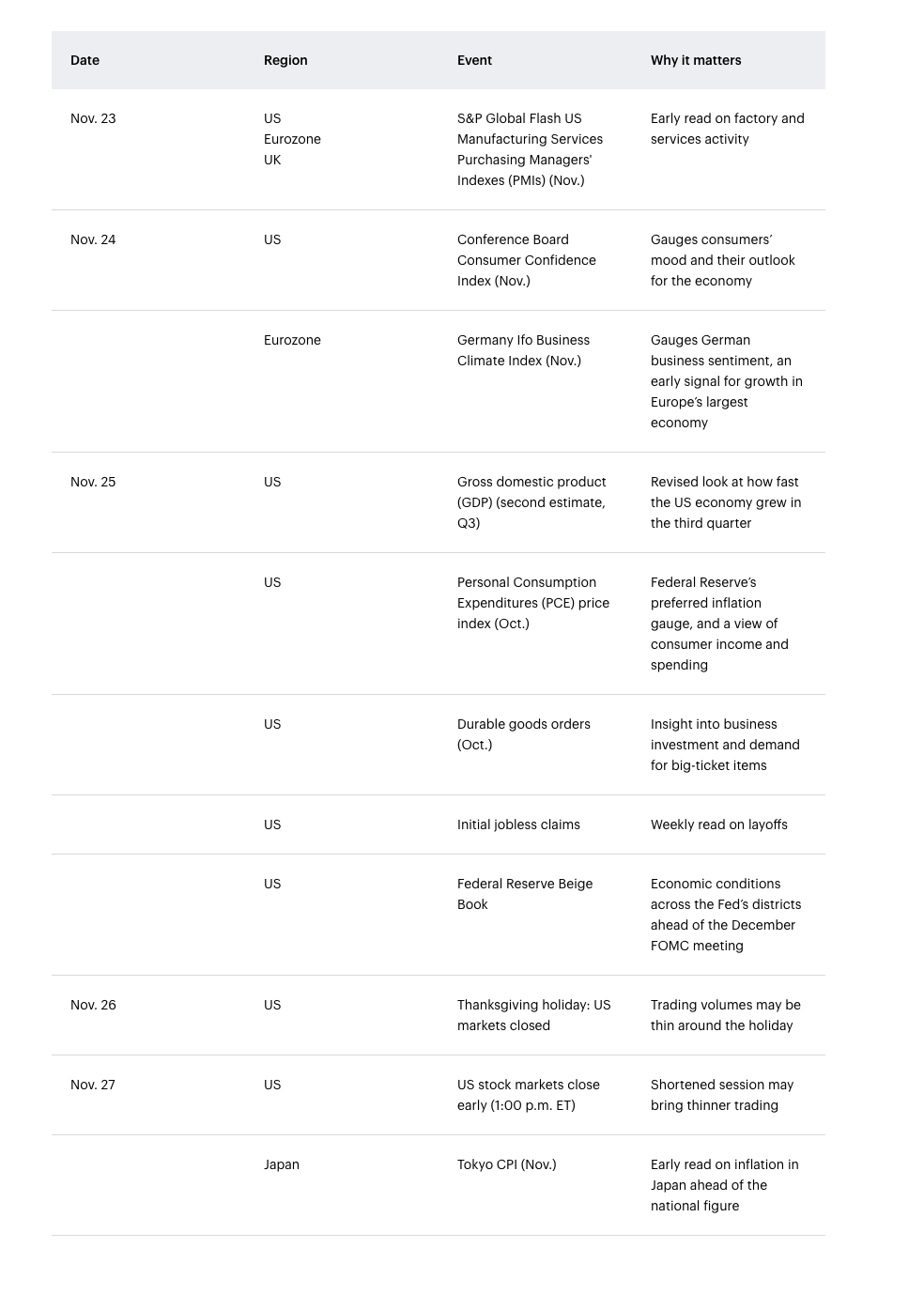
What to watch this week
Footnotes
1 Source: American Association of Individual Investors, Nov. 19, 2026. The bull-bear spread is the difference between the percentage of bullish respondents and the percentage of bearish respondents.
2 Source: Bloomberg, L.P., Sept. 30, 2026, based on the operating earnings of the companies in the S&P 500 Index.
3 Source: Bloomberg, L.P., Nov. 20, 2026, based on the price-to-forward-earnings of the companies in the S&P 500 Index.
4 Source: Bloomberg, L.P., Sept. 30, 2026
5 Source: Bloomberg, L.P., Nov. 20, 2026
6 Source: Bloomberg, L.P., Nov. 20, 2026, based on the price-to-forward-earnings of the companies in the S&P 500 Index.
7 Source: Yahoo Finance, “Fed’s Waller warns inflation is worsening, floats 50-basis-point December hike,” Nov. 18, 2026.
8 Source: US Bureau of Labor Statistics, Oct. 31, 2026
9 Source: Bloomberg, L.P., Nov. 20, 2026, based on the 2-year US Treasury rate, which climbed to 4.88% last week.
10 Source: Bloomberg, L.P., Nov. 19, 2026, based on the four-day returns of defensive sectors of the S&P 500 Index, including consumer staples (-0.35%), healthcare (-4.81%), and utilities (-1.81%).
11 Source: Bloomberg, L.P. and American Automobile Association, Nov. 19, 2026, based on US West Texas Crude and regular unleaded gasoline. West Texas Intermediate (WTI) is a type of light, sweet crude oil that comes from the US.
12 Source: US Bureau of Labor Statistics, Oct. 31, 2026
13 Source: Bloomberg, L.P., Nov. 19, 2026, based on 5-year US Treasury inflation breakeven. Breakeven inflation is the difference in yield between a nominal Treasury security and a Treasury Inflation-Protected Security of the same maturity.
14 Source: Bloomberg, L.P., Nov. 19, 2026
15 Source: Bloomberg, L.P., Nov. 19, 2026, based on 5-year US Treasury inflation breakeven.
16 Source: Bloomberg, L.P., Nov. 19, 2026, based on the Bloomberg US High Yield Corporate Bond Index.
17 Source: Investing.com, “Earnings call transcript: Nvidia tops Q3 2026 estimates and lifts outlook,” Nov. 17, 2026.
18 Source: The Motley Fool, “Here’s Why Anthropic’s IPO Was a Historic Success,” Nov. 19, 2026.
Important information
NA6137205
Image: LeoPatrizi/Getty
All investing involves risk, including the risk of loss.
Past performance does not guarantee future results.
Investments cannot be made directly in an index.
This does not constitute a recommendation of any investment strategy or product for a particular investor. Investors should consult a financial professional before making any investment decisions.
The American Association of Individual Investors’ AAII Investor Sentiment Survey offers insight into the opinions of individual investors by asking them their thoughts on where the market is heading in the next six months.
Artificial intelligence (AI) technology companies are sensitive to specific risks such as small markets, business cycle changes, economic growth, technological progress, obsolescence, and regulation. These companies may have limited products, markets, resources, or personnel, making their securities more volatile, especially for smaller start-ups. Rapid technological changes can adversely affect their results. AI companies often rely on patents, copyrights, trademarks, and trade secrets to protect their technology, but there's no guarantee these protections will be sufficient. Significant research and development (R&D) spending doesn’t ensure product or service success.
A basis point is one-hundredth of a percentage point.
A bear market is an environment in which stock prices are falling and widespread pessimism causes the stock market’s downward spiral to be self-sustaining.
The Bloomberg US Corporate Bond Index measures the investment grade, fixed-rate, taxable corporate bond market. It includes US dollar-denominated securities publicly issued by US and non-US industrial, utility, and financial issuers.
Breakeven inflation is the difference in yield between a nominal Treasury security and a Treasury Inflation-Protected Security of the same maturity.
A bull market is an environment in which stock prices are rising or are expected to rise.
The Conference Board’s Consumer Confidence Index® is published monthly, based on a survey of US consumers’ buying attitudes and buying intentions.
The Consumer Price Index (CPI) measures the change in consumer prices and is a commonly cited measure of inflation.
Credit risk is the risk of default on a debt that may arise from a borrower or issuer of bonds failing to make required payments.
Fixed income investments are subject to credit risk of the issuer and the effects of changing interest rates. Interest rate risk refers to the risk that bond prices generally fall as interest rates rise and vice versa. An issuer may be unable to meet interest and/or principal payments, thereby causing its instruments to decrease in value and lowering the issuer’s credit rating.
In general, stock values fluctuate, sometimes widely, in response to activities specific to the company as well as general market, economic, and political conditions.
Gross domestic product (GDP) is a broad indicator of a region’s economic activity, measuring the monetary value of all the finished goods and services produced in that region over a specified time period.
The German Ifo Business Climate Index assesses the current German business climate and measures expectations for the next six months, based on a survey of manufacturers, builders, wholesalers, and retailers.
Inflation is the rate at which the general price level for goods and services is increasing.
Investments focused on a particular industry or sector are subject to greater risk and can be more impacted by market volatility than more diversified investments.
The price-to-forward-earnings ratio (forward P/E) is a stock valuation metric that divides a company's current share price by its estimated future earnings per share (EPS).
Many products and services offered in technology-related industries are subject to rapid obsolescence, which may lower the value of the issuers.
Personal consumption expenditures (PCE), or the PCE Index, measures price changes in consumer goods and services. Expenditures included in the index are actual US household expenditures. Core PCE excludes food and energy prices.
Purchasing Managers’ Indexes (PMI) are based on monthly surveys of companies worldwide and gauge business conditions within the manufacturing and services sectors.
References to specific companies aren’t buy/sell recommendations and are not intended as investment advice.
Risk-off refers to price behavior driven by changes in investor risk tolerance; investors tend toward lower risk investments when they perceive risk as high.
The S&P 500® Index is an unmanaged index considered representative of the US stock market.
A spread in finance is the difference between two related values, such as prices, rates, or yields.
The Summary of Commentary on Current Economic Conditions by Federal Reserve District (the Beige Book) is published eight times per year. Each Federal Reserve Bank gathers anecdotal information on current economic conditions in its district, and the Beige Book summarizes this information by district and sector.
Tightening monetary policy includes actions by a central bank to curb inflation.
Treasury Inflation-Protected Securities (TIPS) are US Treasury securities that are indexed to inflation.
Valuation is the estimation of an asset’s value based on variables perceived to be related to future investment returns and on comparisons with similar assets.
Yield spread is the difference between yields on differing debt instruments, calculated by deducting the yield of one instrument from another.
The opinions referenced above are those of the author as of Nov. 20, 2026. These comments should not be construed as recommendations, but as an illustration of broader themes. Forward-looking statements are not guarantees of future results. They involve risks, uncertainties, and assumptions; there can be no assurance that actual results will not differ materially from expectations.
A message from Advisor Perspectives and VettaFi: Discover something new! Click here to register for our upcoming webcasts.
Membership required
Membership is now required to use this feature. To learn more:
View Membership BenefitsSponsored Content
Upcoming Virtual Events View All