LPL Research discusses technology-sector volatility and why strong AI spending, earnings growth, and reasonable valuations support a positive view.
AI headwinds push tech into bear market territory. The artificial intelligence (AI) theme has powered the current bull market since October 2022. But as of late, the potential for policy changes affecting the data center buildout, heightened spending and monetization scrutiny, and an unexpected leadership shake-up at the chipmaker at the center of it all have pushed the S&P 500 technology sector into bear market territory.
Skepticism may already be reflected in prices. While we aren't dismissing these risks, we would suggest a lot of skepticism has been priced into the sector at this point. For longer-term investors, the promise of AI seems well discounted in current market prices.
The technology selloff may not have much further to go. Here, we share some perspective on recent market volatility and some data to make the case that the technology selloff may not have much further to go.
Perspective on Recent Volatility
Before getting into the technology sector, we offer some perspective on last week's market volatility:
- Market participants are increasingly scrutinizing the massive AI capital investment and increasingly questioning the returns those investments may ultimately generate. These are worthwhile questions to ask and help create a healthy and more balanced market environment of opportunities and risks, but they do not mean the long-term AI investment story is broken.
- Riding through market volatility is never easy, but corrections are normal, even during good years. Historically, the average maximum drawdown for the S&P 500 during years when the index ultimately finishes higher is 11% (in all years it’s 14%). As of November 20, the S&P 500's largest decline this year has been 11.6%. In other words, the volatility investors have experienced, while uncomfortable, is not unusual. History shows corrections that occur in non-recessionary periods frequently offer potential for attractive buying opportunities.
- Periods like this are a good reminder that the path to successful long-term investing does not follow a straight line. Corrections shake confidence, noisy headlines — even those that don’t affect market fundamentals — amplify uncertainty, and short-term market swings can tempt investors to abandon well-designed plans at the wrong time.
- We suggest investors stay the course. Maintain an appropriate amount of diversification that you can maintain through the ups and downs. Keep portfolios aligned with long-term goals. Resist allowing short-term volatility to dictate long-term investment decisions. Enduring volatility is a fair price for investors to pay for the opportunity to pursue attractive long-term returns. We have seen signs of indiscriminate selling that may point to a downdraft that could be nearing its nadir.
AI Capital Investment Cycle May Peak Earlier Than Previously Expected, but It’s Still Massive
Jensen Huang’s departure from NVIDIA (NVDA) last week sparked a technology sector correction that reached 24% as of November 20, 2026. Semiconductors have been hit hardest, with the Philadelphia SOX Semiconductor Index down 42% from its June peak, while NVDA shares have fallen more than 47% since October 9, 2026.
The decline reflects more than NVDA’s drag on broad indexes. Under Huang, the company provided significant financing for customers and data center construction. Interim CEO Colette Kress prefers using less of the balance sheet to back data centers, which could slow deal activity.
Political headwinds from Democratic majorities in both chambers of Congress beginning in 2027 will likely slow data center construction, though probably not until 2028. Local approvals may require more incentives, while rising financing costs could hurt project feasibility and tighter scrutiny of chip sales to Asia may constrain longer-term growth.
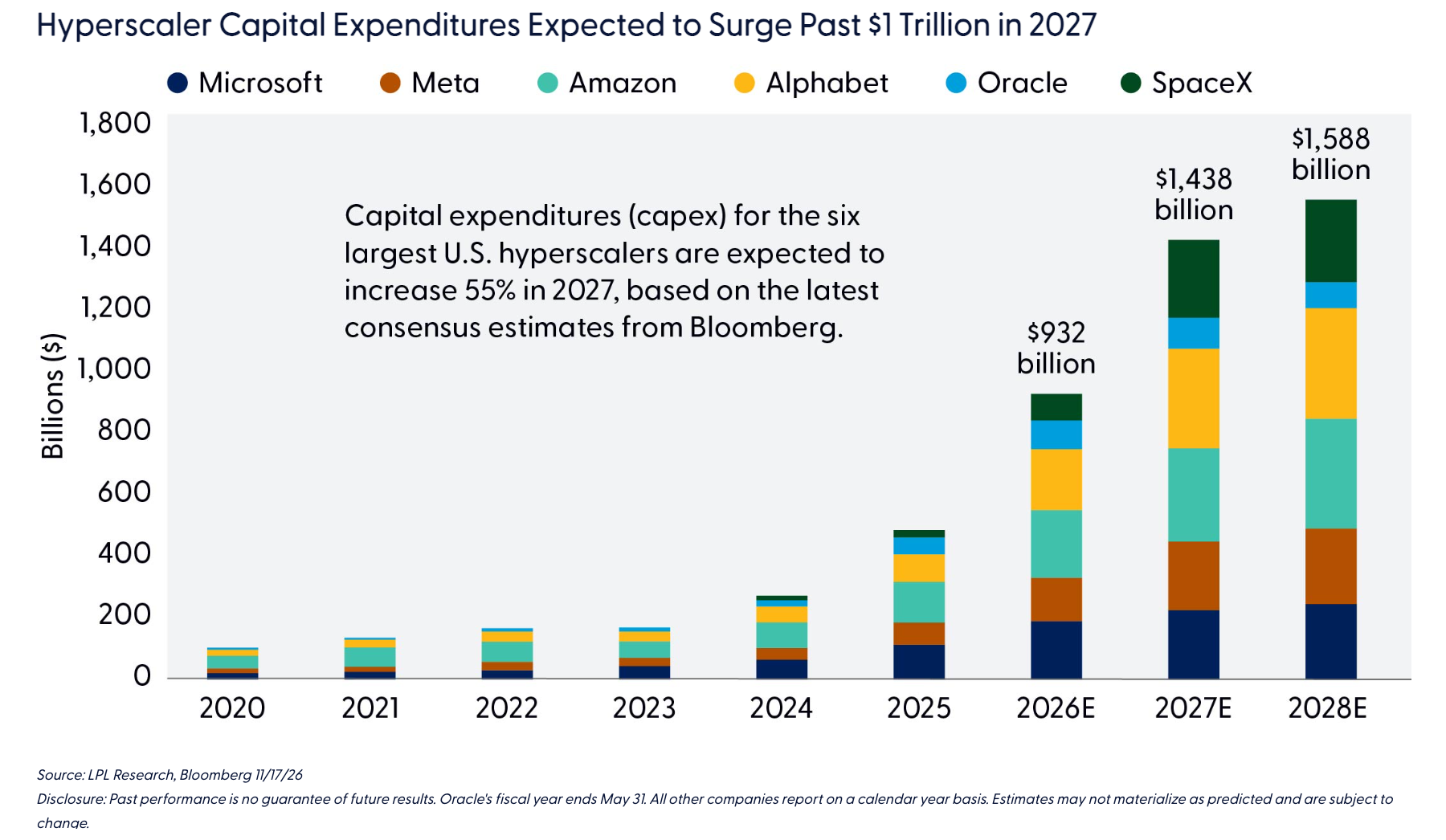
Bottom line, consensus capital investment expectations for 2028 — shown in the “Hyperscaler Capital Expenditures Expected to Surge Past $1 Trillion in 2027” chart — will likely be pulled back some. Even so, AI spending is still massive and should continue supporting economic growth and technology sector profits.
See more: Record ETF Launches Push Issuers to Rethink Fund Lineups
Sector Earnings Growth Outlook Remains Unusually Strong
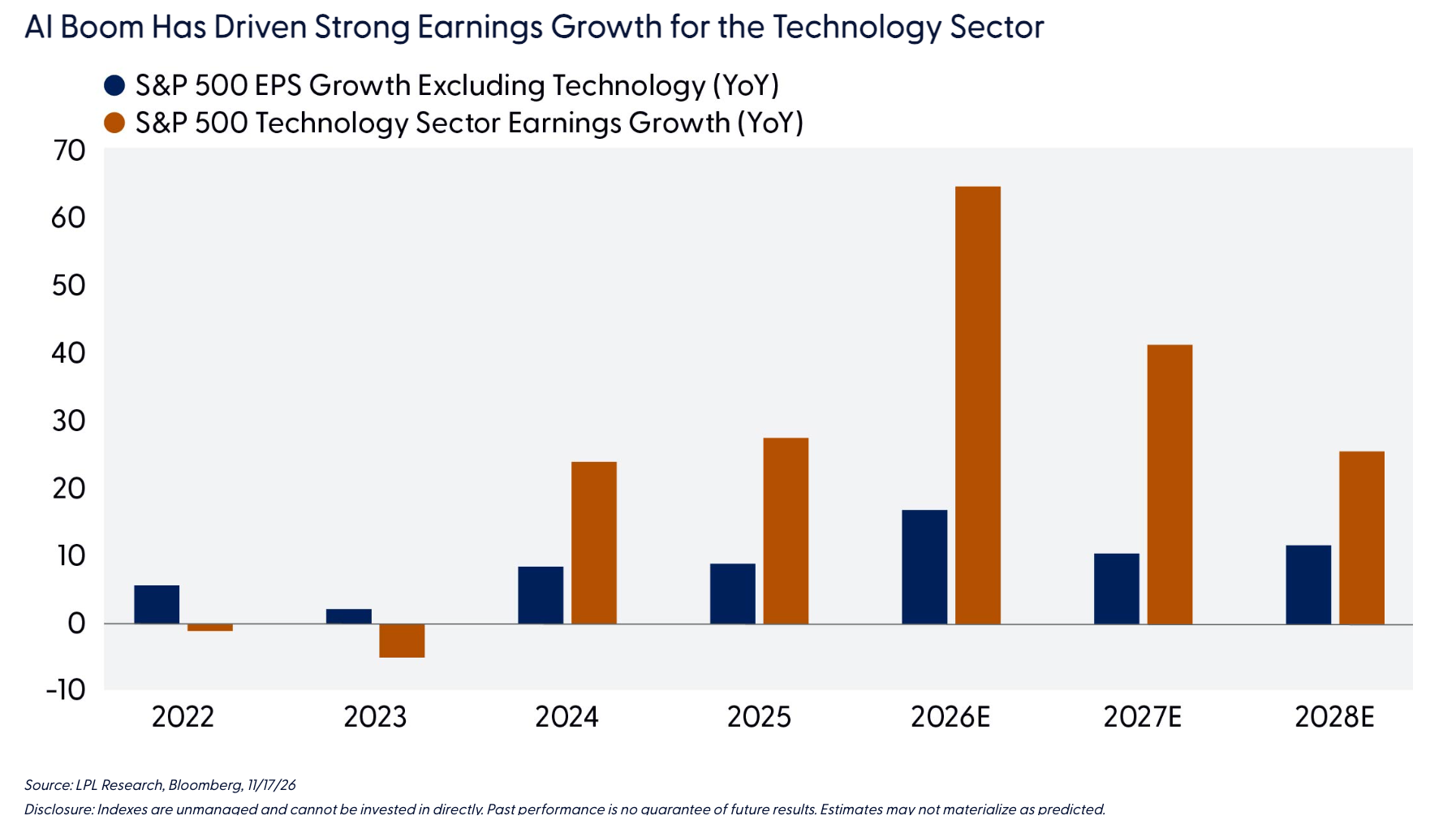
This spending — even if pulled back some — is good news because it drives earnings for some of America’s biggest companies and should help the U.S. economy skirt recession in 2027, and probably 2028. As indicated by the “AI Boom Has Driven Strong Earnings Growth for the Technology Sector” chart, technology sector earnings are expected to grow 64% in 2026, compared with 17% for the rest of the S&P 500. In 2027, technology earnings growth could quadruple the rest of the index, 41% to 10%.
Meeting these expectations will require sustained demand, of course. Risks include financing constraints, regulatory pressure, hyperscaler cash flow limitations, component shortages, potentially slower AI adoption, and lower-priced competition from open-source Chinese models. Estimates for technology earnings in 2027 may be slightly overly optimistic, but based on strong compute demand, the numbers should be in the ballpark; however, 2028 estimates for another 25% increase may be too high a bar. The good news is, at current valuations, we don't have to pay full price for those estimates.
Strong Earnings Outlook Comes at a Reasonable Price
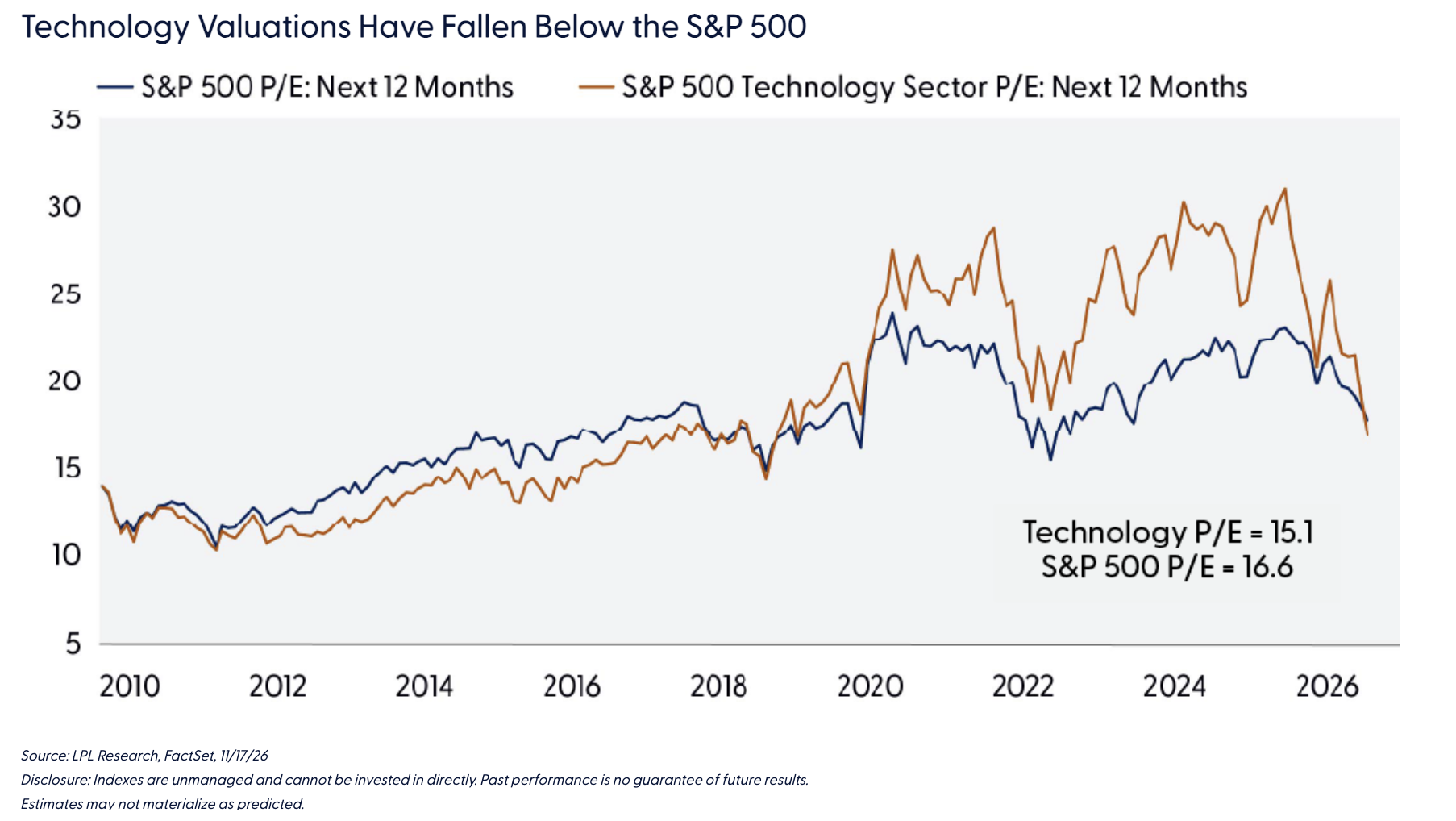
Strong growth is only one part of the puzzle for investors; the price paid for that growth also matters. The technology sector now trades at a very attractive P/E below the S&P 500, 15.1 versus 16.6 before Friday’s drop, for the first time since 2019, which was long before ChatGPT’s 2022 launch (as indicated in the “Technology Valuations Have Fallen Below the S&P 500” chart). In addition to delivering the strongest growth, the sector also has generated more than double the operating margin of the rest of the index every year since 2016, with that advantage expected to persist in 2027.
This combination of strong growth and reasonable valuations is rare, underpinning our positive view of the technology sector. However, the AI buildout has made companies more capital intensive and reliant on debt, and markets typically assign lower valuations to businesses with these characteristics, especially those with little or no free cash flow.
Skeptics Point to Cash Flow
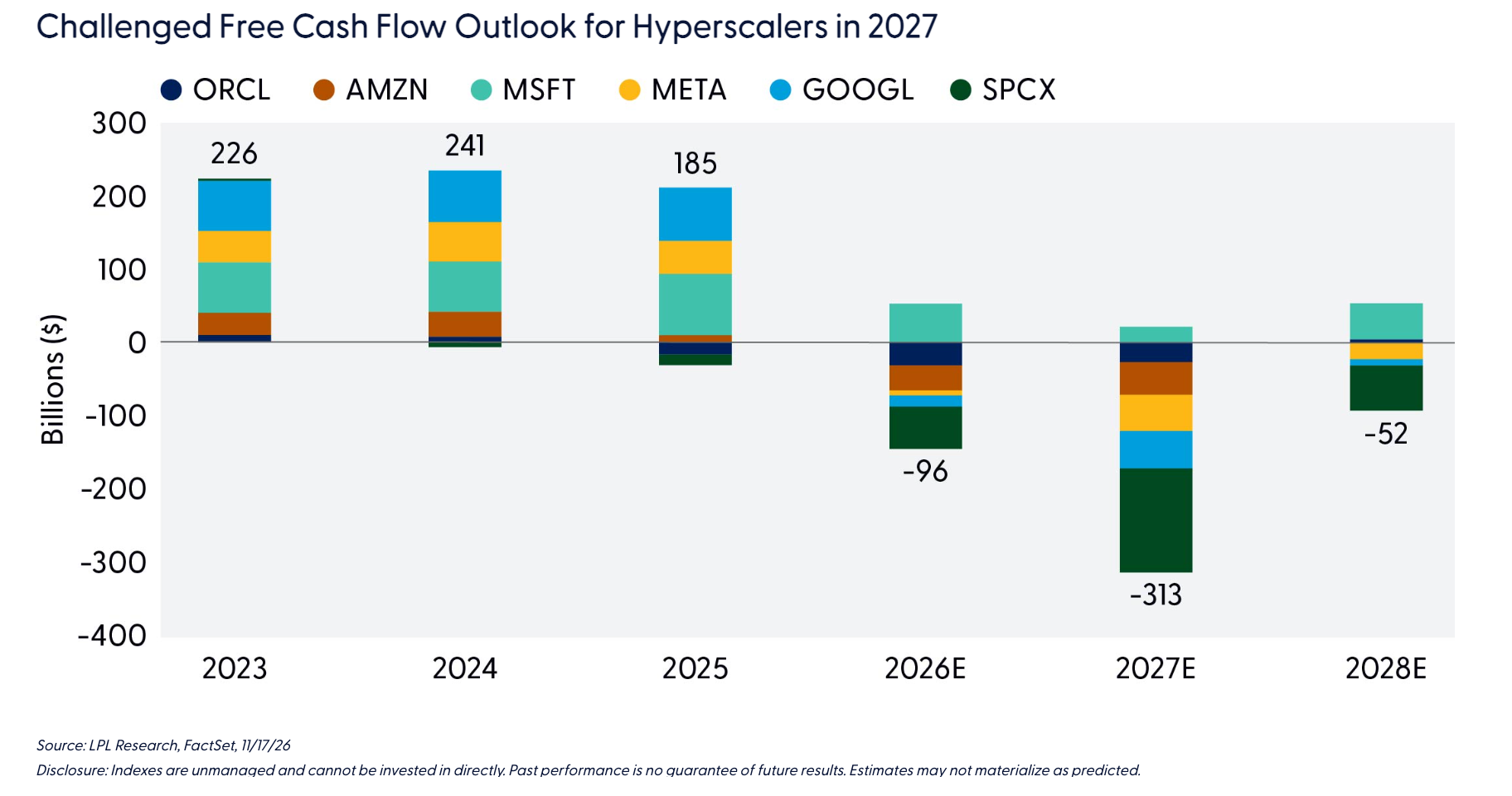
Cash flow remains the key challenge for the AI hyperscalers, even if earnings-based valuations appear attractive. That said, keep in mind that Microsoft (MSFT) is the only top four hyperscaler classified as technology by S&P; the other top hyperscalers are classified as communication services or consumer discretionary, and Oracle (ORCL) is smaller.
As shown in the “Challenged Free Cash Flow Outlook for Hyperscalers in 2027” chart, the six hyperscalers shown are expected to generate negative free cash flow in 2026 and 2027 before turning positive again in 2028. MSFT remains the strongest free cash flow generator in the group, while NVDA (not a hyperscaler) is benefiting from strong AI chip demand — they told us last week they expect 75% revenue growth for their next fiscal year ending January 2028 — and Apple (AAPL, also not a hyperscaler) has taken a capital-light approach. The broader technology sector generated $166 billion in free cash flow in the second quarter of 2026, more than twice healthcare, the next-highest sector at $79.8 billion, and more than communication services and consumer discretionary combined.
Bottom line, companies need sufficient cash and working capital to build compute. Debt and equity financing have become more expensive as interest rates have increased and credit concerns for smaller cloud computing providers have intensified. If cash flow supports continued investment, earnings should come through; if not, markets may continue to apply lower valuations to account for the greater risk of large earnings shortfalls.
Some Worrisome Technical Analysis Developments
From a technical analysis perspective, the technology sector has broken below support near the July lows, its prevailing uptrend, its 200-day moving average, and its October 2025 highs. The November 2025 lows are the next key downside support level to watch. The 14-day Relative Strength Index at 24 also signals bearish momentum and increasingly oversold conditions.
Bottom line, the technical backdrop has deteriorated following the breakdown of the sector’s longer-term uptrend. Oversold conditions could support a short-term bounce, but the sector must reclaim broken support and its 200-day moving average to rebuild technical momentum.
Conclusion
The AI capital investment cycle may peak sooner than expected, but that does not mean the buildout is ending. We still expect spending to exceed $1 trillion in 2027, supporting economic growth and corporate profits. Technology earnings growth remains very strong and valuations have become increasingly attractive following the sector’s correction.
At the same time, AI’s path forward has become more complicated. Higher financing costs, regulatory scrutiny, constrained hyperscaler free cash flow, leadership uncertainty at NVIDIA, and deteriorating technical trends may limit near-term upside and increase volatility.
The key question is whether AI investments can generate enough cash flow to justify continued spending and earnings expectations. We believe the answer generally remains yes in 2027, though estimates for 2028 and beyond may be too optimistic. Given favorable long-term fundamentals and reasonable valuations, we maintain our positive technology sector view while recognizing near-term volatility may persist.
Asset Allocation Insights
LPL’s Strategic and Tactical Asset Allocation Committee (STAAC) maintains its recommendation for a tactical equity overweight and fixed income underweight. We believe AI-driven earnings strength, prospects for an improvement in the macro backdrop, post-midterms policy clarity, negative investor sentiment, and positive seasonal trends provide a favorable risk-reward trade-off through 2026. Data center pushback and AI monetization challenges remain key risks. The Committee favors the quality factor domestically to express the tactical equity overweight, backed by resilient U.S. economic growth, AI innovation, and relative insulation from possible additional energy shocks.
The Committee holds a slight preference for the value style over its growth counterpart given cyclical tailwinds, relatively more attractive valuations, and our positive view of the energy sector. The Committee believes that technology sector valuations are attractive and that skepticism around the AI buildout has become overly pessimistic post-midterms.
Jeffrey Buchbinder, CFA, Chief Equity Strategist, LPL Financial
Brian Booe, Analyst, Research, LPL Financial
Disclosures
This material is for general information only and is not intended to provide specific advice or recommendations for any individual. There is no assurance that the views or strategies discussed are suitable for all investors or will yield positive outcomes. Investing involves risks including possible loss of principal. Any economic forecasts set forth may not develop as predicted and are subject to change.
References to markets, asset classes, and sectors are generally regarding the corresponding market index. Indexes are unmanaged statistical composites and cannot be invested into directly. Index performance is not indicative of the performance of any investment and do not reflect fees, expenses, or sales charges. All performance referenced is historical and is no guarantee of future results.
Any company names noted herein are for educational purposes only and not an indication of trading intent or a solicitation of their products or services. LPL Financial doesn’t provide research on individual equities.
All information is believed to be from reliable sources; however, LPL Financial makes no representation as to its completeness or accuracy.
All investing involves risk, including possible loss of principal.
US Treasuries may be considered “safe haven” investments but do carry some degree of risk including interest rate, credit, and market risk. Bonds are subject to market and interest rate risk if sold prior to maturity. Bond values will decline as interest rates rise and bonds are subject to availability and change in price.
The Standard & Poor’s 500 Index (S&P500) is a capitalization-weighted index of 500 stocks designed to measure performance of the broad domestic economy through changes in the aggregate market value of 500 stocks representing all major industries.
The PE ratio (price-to-earnings ratio) is a measure of the price paid for a share relative to the annual net income or profit earned by the firm per share. It is a financial ratio used for valuation: a higher PE ratio means that investors are paying more for each unit of net income, so the stock is more expensive compared to one with lower PE ratio.
Earnings per share (EPS) is the portion of a company’s profit allocated to each outstanding share of common stock. EPS serves as an indicator of a company’s profitability. Earnings per share is generally considered to be the single most important variable in determining a share’s price. It is also a major component used to calculate the price-to-earnings valuation ratio.
Asset allocation does not ensure a profit or protect against a loss.
There is no guarantee that a diversified portfolio will enhance overall returns or outperform a non-diversified portfolio. Diversification does not protect against market risk.
The hypothetical results shown were not achieved by any actual investment strategy, account, or client and should not be viewed as indicative of actual investment results.
All index data from FactSet or Bloomberg.
This research material has been prepared by LPL Financial LLC.
A message from Advisor Perspectives and VettaFi: Discover something new! Click here to register for our upcoming webcasts.
Read more commentaries by LPL Financial