
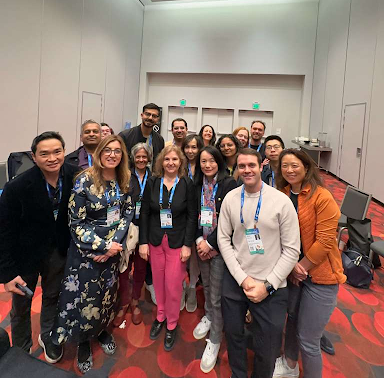
I just got back from HumanX, the enterprise AI conference held last week in San Francisco. Now in its second year, HumanX has already hit a remarkable milestone: over 6,500 attendees and hundreds of speakers, ranging from Al Gore, to Fei-Fei Li (widely known as the godmother of AI), and Daniela Rus, director of MIT’s CSAIL and strategic advisor for the ROBO Global Index suite.
The Biggest Takeaway?
That there are now two types of companies in the world. The first treats headcount AND agentic workflows + token usage/optimization as equally important inputs into how the business runs. The second is still in discovery, without a real AI strategy. The gap between them is widening by the quarter.
To leaders across the world, whether it’s executive leadership, government, academic institution, or nonprofit, it is time to lock in. Others already have.
If your AI strategy is rolling out Gemini or Copilot seats and tracking license utilization, you are measuring the wrong thing. The step change is not seat count. It is whether your organization knows how to design, deploy, and manage agentic workflows, including for roles that were previously considered “non-technical”.
Look at how Jack Dorsey is rebuilding Block (XYZ) as an AI-first company. As an internal AI agent that now handles roughly 90% of code submissions, headcount came down 40%, and guidance went up. That is what an operating model built around agents looks like, not a dashboard counting chat prompts. It is also the direction that we will eventually see the majority of companies head — industry and context depending — over the coming years.
The Big 3 Takeaways
- Trust (and budget, and access to compute) is the bottleneck, not capability. Twenty-three panels centered on the disconnect between what AI can already do and what organizations are willing to let it do. Procurement decisions worth billions are being made without adequate evaluation frameworks. Ion Stoica of the LMSYS team named it the “trust gap” on the reliability panel. Only about 40% of AI vendors are making it into production at Fortune 500 companies today. This is a governance and cultural problem, not a technical one.
- Agents crossed from demos to production. Agentic AI appeared across 79 panel-links. The production signals are concrete. Vercel reports 30% of deployments are now driven by agents with 167% year-over-year growth. Ramp’s CTO said 60% of pull requests merged in the prior week came from their coding agent. Tom Eggemeier, CEO of Zendesk, said his top customer resolves 92% of customer interactions through an AI agent. Uber’s CTO Praveen Naga pegged AI-generated code at roughly 70% of new commits. Salesforce is calling agents the “digital workforce” with intent.
- Physical AI emerged as the next wave. NVIDIA’s Jensen Huang explicitly framed physical AI as “wave three” of this cycle. Multiple panels covered world models (Runway, World Labs, Black Forest Labs), sim-to-real transfer, and autonomous systems that extend well past self-driving. Skild AI presented an omnibodied-intelligence thesis: one model, any body type. As the research lead covering Robotics and AI for the ROBO Global Robotics and Automation Index (ROBO) and the ROBO Global Artificial Intelligence Index (THNQ), I dare say this is the thread that most directly compounds the next decade.
Governance vs Speed, the P&G / Harvard Study Leaders Cannot Ignore
Seth Cohen of Procter & Gamble presented a study that P&G ran with Harvard Business School across 700 employees. Four groups (teams, teams with AI, individuals, individuals with AI) were each asked to generate new product innovation ideas, blind-judged by experts.
The teams who had access to AI performed the best. But a very close second was not one of the teams without access to AI. It was the individuals who had access to AI. The teams and individuals without AI came in a very distant third and fourth place.
Read that again. A single person with AI beat an entire team without AI.
Which is precisely why governance-as-drag is now a strategic risk. Typeface’s research, cited on the Creativity at AI Speed panel, found that 67% of marketers miss cultural moments because of slow review and approval cycles. On a separate panel, enterprise buyers described hard usage caps with approval queues attached, and the admission that “you’re punishing your performers.”
The lesson for leaders: governance is necessary, but governance that kneecaps your best individual contributors goes beyond strategic self-sabotage, to potentially existential, organizational apoptosis off the world scale.
So — what are the companies that ARE using AI worried about?
A Deeper Dive into the State of Compute
The clearest moment of the week came from Dr. Fei-Fei Li on the opening-night mainstage. Bloomberg’s Ed Ludlow asked how much of World Labs’ fresh one-billion-dollar raise went to Jensen Huang. Her answer was an instant: “And Lisa, right?”
The room laughed. It was one of the sharper two-word summaries of the compute market all week. Frontier model companies are not single-vendor buyers. NVIDIA (NVDA) and AMD (AMD) are both in every serious build order. Sumit Sadana of Micron framed it the same way on the Silicon Shift panel.
Albeit pre-recorded from a week prior, Jensen chimed in with his own take (which was also the framing of an entire panel series), which is that the industry is a five-layer stack: power, chips, infrastructure, models, applications.
Bryan Catanzaro of NVIDIA, on the “5 Layer Cake” panel, added that there are now four scaling laws driving compute demand simultaneously: pre-training, post-training, deployment-time reasoning, and agents. All four are energy-bounded.
Hunger Games for Compute
From Nebius (NBIS), a sovereign AI cloud provider and THNQ constituent that has been pulling significant hyperscaler partnership flow, to Super Micro Computer (SMCI), a THNQ holding and a key hardware partner for xAI’s Colossus build-out in Memphis, the demand curve for training and increasingly inference compute (what we can fairly call “the token economy”) was visible in every side conversation. Rodrigo Liang of SambaNova put it plainly: “hyperscalers, neoclouds, sovereign clouds, large-scale enterprises” are all running data centers for token factories now.
The Token Economics
On pricing, Sam Altman was repeatedly cited (by other speakers, on the Business Reality of AI Adoption panel among others) as the clearest voice signaling that usage-based, metered pricing is where consumer and enterprise AI is going. The economic logic is simple. Power is scarce. Flat-rate pricing in a power-scarce world is unsustainable for the provider. Enterprise sales teams at some companies are already consuming 1B tokens per month. Together AI, speaking on the open-vs-closed panel, reported growth from 10 billion tokens per day in early 2025 to over 5 trillion tokens per day now. Three orders of magnitude in roughly a year on a single platform.
Jensen put the new unit of economic output in one phrase: “tokens per watt.” Every data center has to optimize for it. Every architecture has to be co-designed for it. This also, from my perspective, expands into local, open-source AI that can run on everyday hardware, similar to how the personal AI “Openclaw economy” is taking off – I’ll go as far to say it’s a combination of the PC AND Smartphone moment for AI.
Matt Garman, CEO of AWS (AMZN), opened the agentic-inflection panel on the twentieth anniversary of AWS (Pi Day). His framing: agents are how most enterprises will capture most of their AI value, and AWS is building agent-first infrastructure accordingly.
Part II: The Agentic Economy
Beyond pure inference, a large slice of HumanX was builders focused on the agentic layer itself. Agentic harnesses, token optimization, and what one speaker called the “battlefield of the future” for enterprise workflow.
Speed matters (sub-second tool calls, inference optimized for throughput not latency, as Impala AI’s cofounder put it: “we treat it like an HPC problem, not a web service”). Databases matter (Snowflake, Datadog, and the data-plane plays). Agentic web search is a new category of its own, with Bright Data, Tavily, You.com, Brave Search, Exa, and Perplexity all competing to be the default retrieval layer for AI agents. For others, it’s not speed, but cost (especially as we see gigantic data-loads for multi-modal physical AI training).
The trust stack sits underneath all of it. Palo Alto Networks (PANW) and CrowdStrike (CRWD) for enterprise security. Cloudflare (NET) running stablecoin rails for agent-to-agent payments, which is early but real.
Bottom Line Takeaways
Jensen put the unit of economic output in one phrase: tokens per watt. Every operator in the room was already pricing around it. In a power-scarce world, metered usage is the only honest way to sell it.
In robotics and physical AI the metric expands. You still track tokens per watt, and you also have to answer for useful actions per joule, sensor fidelity per dollar, actuation cycles before drift, manipulations per fault, and uptime per operator. The same discipline, pushed through the reality of physics: friction, latency, heat, and power constraints that no model can pretend away once it is driving a body.
That is why this new cycle holds together at the index level. Digital AI and Physical AI are two substrates of the same story. ROBO and THNQ sit across the stack it runs on: the silicon and photonics that turn watts into useful cycles, the clouds and sovereign compute that meter them, the data and trust layers that keep them legible, and the agents and world models that turn capacity into outcomes.
For more news, information, and analysis, visit our Disruptive Technology Content Hub.
Disclaimers
ROBO is the underlying index for the ROBO Global Robotics & Automation ETF (ROBO), the L&G ROBO Global Robotics and Automation UCITS ETF (ROBO.LN), and the Global X ROBO Global Robotics & Automation ETF (ROBO.AU). THNQ is the underlying index for the ROBO Global Artificial Intelligence ETF (THNQ) and the L&G Artificial Intelligence UCITS ETF (AIAI.LN).
VettaFi is the index provider for ROBO ETFs, THNQ ETF, and AIAI.LN, for which it receives an index licensing fee. However, ROBO ETFs, THNQ ETF, and AIAI.LN are not issued, sponsored, endorsed, or sold by VettaFi. VettaFi and its affiliates have no obligation or liability in connection with the issuance, administration, marketing, or trading of ROBO ETFs, THNQ ETF, and AIAI.LN.

