
The healthcare sector is undergoing a profound transformation, driven by rapid technological advancements and shifting global demographics. The leaders of this transformation go far beyond the big pharmaceutical names that dominate healthcare strategies. For investors seeking targeted exposure to this evolution, the ROBO Global Healthcare Technology & Innovation Index (HTEC) provides a specialized, research-driven benchmark.
Investing in Solutions, Not Just Sectors
The index is designed to capture the entire value chain of disruptive and emerging healthcare technologies. It does this by moving away from traditional, broad sector classifications like “pharmaceuticals” or “healthcare providers,” and instead utilizing forward-looking subsegments to cover massive structural trends, from breakthroughs in new drug development to the systemic challenges of an aging population.
Ultimately, the process is a bottoms-up approach. The team identifies societal needs, determines what innovation is needed to address them, and that informs the creation of the subsegments, which are the actual fields able to provide the required solutions.
9 Key Subsegments Solving Critical Healthcare Challenges
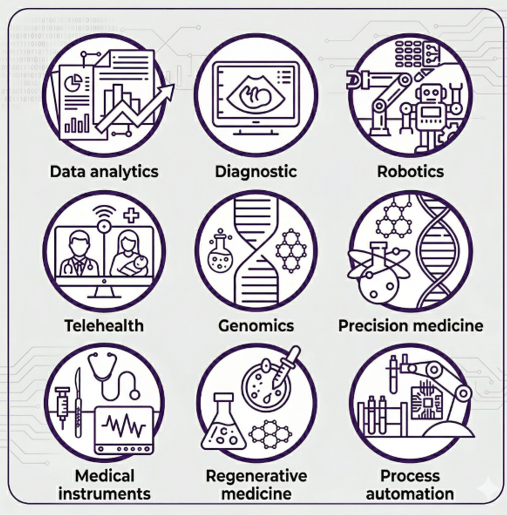
Take the aging population as an example of this methodology in action. The latest U.S. Census projects that by the mid-2030s, older adults will outnumber children for the first time in U.S. history. As the global population ages, the strain on the healthcare system increases alongside physician shortages. Notably, the AAMC projects a shortfall of up to 86,000 physicians by 2036. HTEC captures solutions to this specific structural trend by including companies in segments like Robotics (surgical robots that bring improved outcomes and shorter recovery times), Medical Instruments (devices for chronic illnesses), and Telehealth (expanding access).
Healthcare Technology: From Luxury to Necessity
There’s a realization that healthcare technology is transitioning from a luxury to an absolute necessity. Challenges like unsustainably growing healthcare costs, require technology to be properly addressed. U.S. national health expenditures are projected to reach $5.6 trillion in 2025 and $8.6 trillion by 2033, growing at nearly 5.8% annually and outpacing GDP growth. Technologies like AI diagnostics, telehealth, and robotics are uniquely positioned to solve these structural issues by increasing efficiency and drastically lowering costs.
But at the end of the day, investors care about strong balance sheets and execution. Recent years have seen a combination of important regulatory approvals in areas like precision medicine and genomics, alongside massive leaps in technology supporting AI-driven drug discovery. This, coupled with significantly reduced concerns regarding political regulations, has allowed companies to concentrate on executing their strategies and bringing treatments to the population.
However, because this space is evolving so rapidly, there is a widening gap between the true innovators and the legacy companies lagging behind. Identifying the companies with the technological edge and execution capabilities to actually deliver these treatments requires deep, specialized research. A passive approach simply won’t catch them in time.
Under the Hood: Constituent Selection and Scoring
To capitalize on these trends, a passive, set-it-and-forget-it approach is rarely enough. Healthcare innovation moves incredibly fast. For that reason, the HTEC index methodology is built specifically to stay agile, using a blend of quantitative metrics and deep qualitative research to select constituents. To be eligible for inclusion, a company must have a market cap above $200 million and a trailing 3-month average daily trading volume (ADTV) of at least $2 million.
Each company is then individually analyzed and assigned a custom score ranging from 1 to 100. This score is based on the level of revenue a company receives from innovative healthcare technologies, a qualitative and quantitative assessment of the company’s competitive positioning, technological edge, and market leadership, as well as the level of investment that the firm is actively making in its technologies, which indicates its commitment to future growth.
A company must have an aggregate score of 50 or higher to be considered for inclusion. This score also underpins the modified equal-weight model of the index. Unlike typical market-cap-weighted strategies where the weight is dictated simply by the size of the company, this model ensures that the strategy allocates more weight to the leading companies with the highest exposure to the theme.
Dynamic Weighting and Portfolio Agility
The modified equal-weighting scheme also adjusts every quarter. This means that not only is the index able to add and drop companies, but it can also adjust its exposure to reflect the constituents’ revenue purity, investment levels, and their market and technological leadership. This way, the strategy is always ensuring that it is overweighting the leading companies while rapidly absorbing new market entrants (like recent IPOs) without waiting for an annual review.
On top of that, the team is constantly updating the roadmap to make sure that the subsegments are relevant, hold the best companies, and effectively capture the entire value chain. After all, one of the key benefits of investing in a research-based strategy like this is that it’s forward-looking. So, while there is the ability to make changes often, those changes are primarily made to reflect the future of healthcare, rather than simply reacting to short-term market signals.
Conclusion
Ultimately, investing in the future of healthcare requires more than just buying the biggest legacy names in a broad sector strategy. As demographic shifts and unsustainably rising costs force the medical industry to adapt, disruptive technology is no longer just a nice-to-have, it’s the only viable path forward. By relying on a dynamic, research-driven methodology rather than a static market-cap weighting, the ROBO Global Healthcare Technology & Innovation Index (HTEC) ensures it captures the companies actively solving these systemic issues. For investors looking to gain true exposure to the innovations shaping tomorrow’s medical landscape, moving beyond traditional sector classifications is a necessity.
Related Research
An AI Fix for Healthcare’s $2 Trillion Flaw
The Brain: From Black Box to Engineering Problem
The AI Revolution in Diagnostic Imaging
Looking for reguar updates? Subscribe here for weekly insights on robotics, AI, and healthcare technology, delivered straight to your inbox.
For more news, information, and analysis, visit our Disruptive Technology Content Hub.
HTEC is the underlying index for the Robo Global Healthcare Technology & Innovation ETF (HTEC) and the L&G Healthcare Technology & Innovation UCITS ETF (DOCT.LN).
VettaFi is the index provider for HTEC ETF and DOCT.LN, for which it receives an index licensing fee. However, HTEC ETF and DOCT.LN are not issued, sponsored, endorsed, or sold by VettaFi. VettaFi and its affiliates have no obligation or liability in connection with the issuance, administration, marketing, or trading of HTEC and DOCT.LN.

