Clients no longer need to move their assets to a variable annuity with a rider to guarantee lifetime withdrawal benefits, thanks to the RetireOne stand-alone living benefit (SALB) rider from Aria Retirement Solutions, which can be applied to a portfolio of mutual funds and ETFs. Despite this enticing promise, however, the SALB may not offer as much downside protection as advisors and clients expect.
This is the first of a three-article series that will analyze the SALB. In this installment, I will focus on how the SALB works during the pre-retirement deferral phase.
Riders, such as the SALB, offer downside protection in the form of lifetime income, upside potential with step-ups based on the underlying portfolio performance, and minimal surrender penalties. Bob Veres recently wrote about RetireOne at Inside Information, examining fundamental questions about what these guarantees are designed to insure against and what role can they play in a retirement portfolio (link, requires subscription).
The RetireOne rider is backed by Transamerica, which also backs the relatively low-cost guaranteed lifetime withdrawal benefit (GLWB) rider available for Vanguard’s variable annuities.
In order to illustrate the most important lessons about RetireOne and comparable riders as they concern pre-retirement deferral, I simulated RetireOne’s hypothetical performance using historical data and compared it to comparable simulations for both unguaranteed mutual funds and a VA/GLWB. We’ll see some of those results, but first, let’s examine in a little more detail how exactly these products work.
General characteristics of both guarantee riders
Guarantee riders, which until recently were only available for deferred variable annuities, have become popular a retirement income tool. In contrast to single-premium immediate annuities (SPIAs), which provide lifetime income that is fixed in either nominal or inflation-adjusted terms, guarantee riders are designed to provide their purchasers with downside protection, upside potential, and the opportunity to have remaining assets returned.
These riders do so by guaranteeing an income for life at a fixed withdrawal percentage of the benefit base. The benefit base is the hypothetical amount used to calculate the guaranteed withdrawals and rider fees; it initially equals the contracted assets, but it may be more than the contract value of remaining assets later on. As long as the client does not take out more than the guaranteed withdrawal amounts, guaranteed withdrawals never decrease (in nominal terms), even if the account balance falls to zero. In this regard, GLWBs are similar to SPIAs, though a GLWB contract can be terminated, with remaining assets returned. Additionally, if the contract value of the underlying account increases sufficiently after accounting for any withdrawals and fees, a step-up feature may kick in to provide permanently higher guaranteed withdrawals.
The SALB guarantee riders offer only nominal protections (as opposed to the inflation-adjusted or “real” guarantees). This is one basic drawback – though the monetary value of the benefit base is guaranteed not to shrink, inflation will indeed chip away dramatically at its real purchasing power. I explored the real vs. nominal guarantee issue last year in an article discussing the income phase of a GLWB rider for a variable annuity.
Both SALB and VA/GLWB owners, meanwhile, are exposed to the credit risk of their insurers, since the rider guarantees may not be protected by state guarantee associations. Vanguard works with two insurers to provide the guarantee rider, one of which is Transamerica, the same company that backs Aria’s RetireOne guarantee.
Table 1, below, summarizes the key features for each rider.
Table 1
Contrasting the Features |
|
Vanguard's VA/GLWB |
RetireOne's SALB |
Maximum Allocation to Stocks |
70% |
80% |
Underlying Annual Account Fee |
0.59% |
Varies by investment choice. Low-cost index funds are available. Assumption used here: 0.2% |
Annual Rider Fee |
0.95% |
Relates to Percentage of Assets Held Outside the Fixed Core Category:
0 - 50%: 1%
50.1 - 60%: 1.15%
60.1 - 70%: 1.35%
70.1 - 80%: 1.75% |
Rider Applies To |
High-Watermark Benefit Base |
Remaining Contract Value of Assets |
Guaranteed Payout Rate for Singles |
Depends on Age of First Withdrawal
59 - 64: 4.5%
65-69: 5%
70-79: 5.5%
80+: 6.5% |
Depends on Age of First Withdrawal
and Current 10-Year Treasury Yield with an Age-Varying Floor and Ceiling
A Few Examples:
60: 4 - 5.5%
65: 4 - 6%
70: 4.5 - 6.5%
80: 5.5 - 7.5%
Notes: Between floor and ceiling payout rates are rounded down and when interest rates increase, the remaining account value rather than benefit base is used to assess the possibility for a step up |
Payout Rate Reduction for a Couple's Joint Guarantee |
Reduce Payout by 0.5% |
Reduce Payout by 0.5% |
Tax Treatment |
Variable annuity deferred taxation, treated as income |
Typical tax treatment for mutual funds in taxable or tax deferred accounts |
Differences between Vanguard’s GLWB and Aria’s RetireOne
In 2011, Vanguard made headlines by offering a GLWB rider that costs less than nearly all of its competitors. It has an annual fee of 0.95% of the total benefit base, on top of the 0.59% fees on the underlying assets held in the Vanguard variable annuity. Owners are allowed to choose among three variable-annuity asset allocations, which range from 40% to 70% stocks. Income may be deferred, but by purchasing the rider before income begins the user will protect the interim high-watermark for the total benefit base used to calculate the subsequent income guarantee.
The guaranteed payout rate is expressed as a percentage of the benefit base, and that rate depends on the age at which guaranteed withdrawals start. These payouts are shown in table 1, below; note, however, that for couples (joint lives) the payout rate is 0.5% less than what the table shows. Step-ups in guaranteed income take effect, on the yearly anniversaries of the policy, whenever the contract value of the remaining assets exceeds the past high watermark. (Though it should be noted that this is increasingly unlikely to happen in the years after retirement, as portfolio returns would need to be large enough to surpass both fees and income withdrawals to reach those new heights.)
The RetireOne guarantee, meanwhile, differs from the VA/GLWB in several important ways. First, of course, is the fact that an investor does not have to move his or her assets to a variable annuity in order to acquire the rider. The guarantee can be used with any portfolio that meets certain asset allocation criteria and draws from an approved list of mutual funds or ETFs from a variety of leading companies (a full prospectus can be found here). The underlying funds will each have their own fees.
One very important difference from most VA/GLWBs is RetireOne’s rider fees, which are charged on the remaining contract value of the assets, rather than the high-watermark total benefit base. When the value of remaining assets is significantly reduced, this method of calculation can mean substantial savings for owners. The cost of the rider depends on the asset allocation, with values between 1% and 1.75%.
RetireOne also allows for a stock allocation of up to 80%.
Another important difference is the way RetireOne’s guaranteed payout rate is calculated: It depends both on the age at which benefits begin and on the current yield on 10-year Treasury bonds. For a 65-year old single person who wishes to begin his or her guaranteed withdrawals, the payout rate is 4% if the Treasury yield is less than 4.5%, but it increases to 6% if the Treasury yield exceeds 7%.
After the guaranteed income begins, the benefit base no longer determines the withdrawal amount. Step-ups in withdrawals occur if the revised payout rate based on new Treasury yields multiplied by the remaining account balance exceeds the previous guaranteed withdrawal. Though this can be a difficult hurdle to pass after income-drawdown begins, rising Treasury yields do offer greater hope for a benefit increase, and benefits do not decrease after yields fall.
A final important issue to consider is taxes, even though the complications of individual clients’ cases make it difficult to generalize about outcomes. A VA/GLWB defers taxation, though all gains and income are taxed at the marginal income tax rates, while the SALB is generally taxed like a mutual fund. Joseph Tomlinson recently provided a deeper analysis of the tax concerns when comparing annuities and systematic withdrawals.
Data and modeling approach, and a caution
To simulate performance of these different approaches, I used Ibbotson Associates' Stocks, Bonds, Bills, and Inflation (SBBI) data on total returns for U.S. financial markets since 1926. I used the U.S. S&P 500 index to represent the stock market and the intermediate-term U.S. government bond index to represent the bond market. In all cases, returns were calculated on an annual basis, with withdrawals taken at the beginning of each year, fees taken at the end of each year, and annual rebalancing.
Simulations for a 10-year deferral period based on this historical data show how well these guarantees would have protected the benefit base in past markets, specifically examining rolling 10-year periods for retirement dates between 1936 and 2011. A complete collection of outcomes can be found in table 2, an appendix to this article.
Consider an investment of $100, made by a couple when both spouses are 55. The simulation shows the portfolio wealth and benefit base, in real terms, that this couple enjoys 10 years later, when both are 65 and preparing to retire. Though their initial wealth is $100, the benefit base can be less than $100, since it is expressed in real terms, while the guarantee is nominal. (Though analyzing the guaranteed income phase will be left for part 2 in this series, the guaranteed payout rates for the couple, given their decision to retire at 65, for both the VA/GLWB and RetireOne SALB are also shown in table 2.)
For the mutual funds, I assumed an annual expense ratio of 0.2% of remaining assets. For the VA/GLWB and SALB, assumptions are mostly based on the Vanguard and Aria offerings, except that I assumed an annual step-up feature for each, rather than their actual, quarterly step-up. Though this simplification could cause the benefit base to occasionally fall lower than otherwise might be possible, such differences will be consistent for the purposes of comparing the two products.
For SALB, the rider amount is calculated as a percentage of remaining assets; it is 1% for the 40/60 allocation, 1.35% for the 70/30 allocation, and 1.75% for the 80/20 allocation.
A note on historical simulations such as this one: It is important to realize that the history of the U.S. financial markets has been very kind to retirees. A new, previously unrealized worst-case scenario could well await those for whom retirement lies in the uncertain future, and – again – these guarantees depend on the insurance company’s ability to pay, which could be at risk if the overall financial landscape gets bleaker.
Another caveat to consider is that the terms of the VA/GLWB and SALB were set under current market conditions; if these products had existed in the past, they may have offered different terms than at present.
Comparing unguaranteed and guaranteed mutual funds
For the deferral period, on which we focus today, comparing the VA/GLWB to RetireOne would not be a meaningful exercise, so I’ll dispense with that aspect of the analysis quickly. The small differences between the two products seen in table 2 are attributable only to their differing fees, which mean that RetireOne can gain a slight edge in scenarios that cause the account value to trail the benefit base. The differences between these products will be more evident in the next article, which will focus on the income phase.
Rather, what is interesting now is to compare the role of a guarantee in supporting a benefit base and reducing risk for prospective retirees at a time of life when wealth accumulations may be the largest, but when they are also most sensitive to losses. This returns us to the fundamental question asked by Bob Veres: What are guarantees designed to insure against?
To study the role of the guarantee, we have to find suitable comparison groups. What asset allocation would a client use for an unguaranteed portfolio, and what would they choose for a guaranteed portfolio?
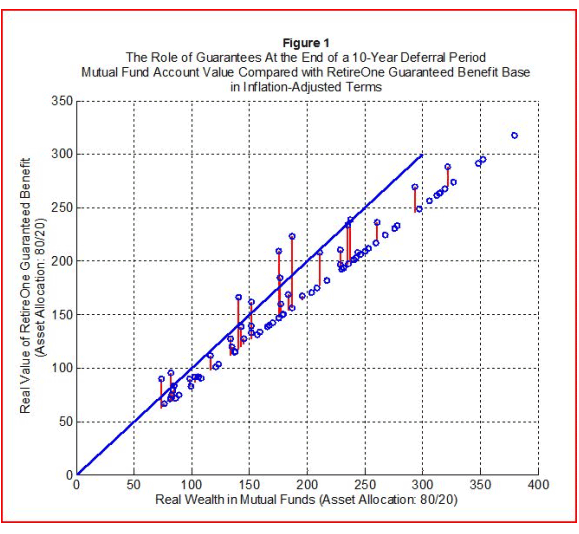
Figure 1, below, compares the performance of a mutual fund account, with 80% stocks and 20% bonds, against the performance of the RetireOne guaranteed benefit base with the same 80/20 asset allocation. (Admittedly, this may be an unlikely case, since it implies a rather aggressive allocation for the unguaranteed portfolio.)

Points above the 45-degree line indicate better performance with RetireOne, while points below the line favor the unguaranteed mutual funds. Vertical red lines show cases where RetireOne users’ account value would differ from the benefit base, and the line reaches down to the real value of remaining assets in those cases. These points show the outcomes for all the rolling historical periods.
As expected, in most cases the unguaranteed portfolio provided more wealth, given the lack of rider fees. Occasionally, however, a drop in the markets shortly before retirement did cause the guaranteed benefit base to be higher. For instance, for a deferral period ending at the start of 2009, the mutual funds provided real wealth of $82, while RetireOne supported a real benefit base of $96 and a contract value for remaining assets of $69. The $13 difference between $82 and $69 represents the cumulative impact of the rider fee. But hypothetical SALB owners might have appreciated their decision, especially if it helped them to stay the course and maintain high stock allocations going into 2009. (As a point of comparison, in nominal terms the mutual fund portfolio was $105, the RetireOne benefit base was $123, and the contract value of RetireOne was $88.)
If these were the asset allocation choices, would it be worth the expense to add the guarantee rider? There’s no clear answer, and it depends in large part on client preferences, but one important point to consider is that the downside protection is only relative. We could consider a decline in real wealth after 10 years to be a rather bad outcome, but the rider does not protect well against that outcome, as the real value of protected wealth does occasionally fall below the initial $100 at age 55.
Historically, there has never been a case in which the unguaranteed value of the mutual funds fell below $100, while the rider maintained a real benefit base above $100. And most of the bad-luck cases still favored the unguaranteed approach. Nonetheless, the rider was quite helpful in a minority of scenarios (the benefit base was larger than the mutual fund assets in eight of the 76 rolling historical periods), such as the aforementioned 2009 retiree, or a 1975 retiree, whose unguaranteed wealth would have dropped to the lowest level observed historically ($74). The rider would have supported a benefit base of $90 and a contract value of $62.
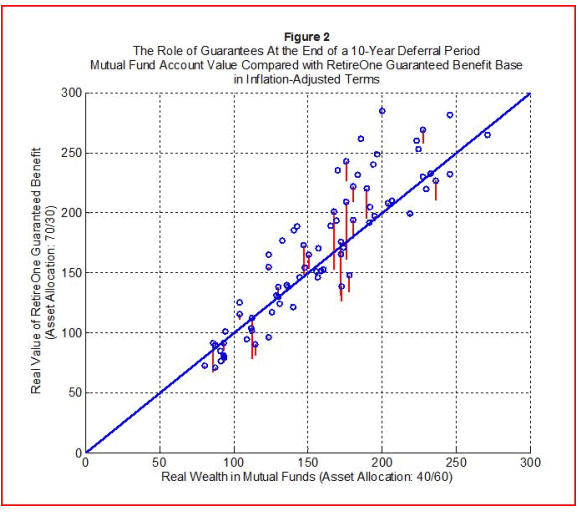
Next, consider figure 2, which may feature a more realistic example – a more conservative client, who chooses a 40/60 allocation for unguaranteed mutual funds, but who is persuaded to use a more aggressive 70/30 allocation with the RetireOne guarantee. This is a very interesting case to examine, showing how RetireOne supports greater upside while providing less impressive performance on the downside. When real wealth is less than $100, the guaranteed benefit base is slightly greater than the unguaranteed mutual fund balance in a few cases, but, generally, the more conservative asset allocation from the unguaranteed funds supports greater wealth. Based on these historical simulations, it would be difficult to justify paying the rider fees and making the asset allocation more aggressive for clients who worry more about downside protection than upside potential.
The bottom line
Unfortunately, I cannot draw any categorical conclusions for you; individual clients’ views and concerns need to be a part of deciding whether to apply RetireOne to an investment portfolio. Nonetheless, table 2 and the figures in this article illustrate the role of a rider during the deferral phase – the surprise is that riders do not typically support a higher benefit base to protect from downside risk in the historical simulations.
Clients seeking to protect against a sequence of bad returns just before retirement will find that the guarantee still leaves them worse off in inflation-adjusted terms, especially as the rider fees hamper the ability of the contracted assets to grow faster than the unguaranteed alternative.
There is much to consider when deciding whether to use RetireOne during a deferral period. In part 2, I will provide further comparisons between the VA/GLWB and RetireOne to see how they stack up in the post-retirement income phase.
Wade Pfau, Ph.D., CFA, is an associate professor of economics at the National Graduate Institute for Policy Studies (GRIPS) in Tokyo, Japan. He maintains a blog about retirement planning research at wpfau.blogspot.com
Wade wishes to thank Bob Veres and Joseph Tomlinson for providing valuable feedback and insights.
Table 2 |
Comparing Unguaranteed Mutual Funds, Variable Annuities with a GLWB Rider, and RetireOne Guarantee for Mutual Funds |
Over a 10-Year Deferral Period (At Age 55, a Same-Age Couple Invests $100 of Assets and Defers Taking Withdrawals Until Age 65) |
Real Account Contract Value and Guaranteed Benefit Base Value at the End of the 10-Year Deferral Period |
in Inflation-Adjusted Terms |
|
|
|
|
|
|
|
|
|
|
|
|
|
|
|
|
|
Mutual Funds |
Deferred Variable Annuity with Guaranteed Living Benefit Rider |
RetireOne Stand Alone Living Benefit Rider |
Year Reaching Age 65 |
80/20
Asset Alloc. |
70/30
Asset Alloc. |
40/60
Asset Alloc. |
Benefit Rate Guar. |
70/30
Asset
Allocation |
40/60
Asset
Allocation |
Benefit Rate Guar. |
80/20
Asset Allocation |
70/30
Asset Allocation |
40/60
Asset Allocation |
Real Wealth |
Real Wealth |
Real Wealth |
Real Wealth |
Benefit Base |
Real Wealth |
Benefit Base |
Real Wealth |
Benefit Base |
Real Wealth |
Benefit Base |
Real Wealth |
Benefit Base |
1936 |
238 |
241 |
236 |
4.5 |
205 |
228 |
205 |
205 |
3.5 |
199 |
239 |
210 |
227 |
213 |
213 |
1937 |
268 |
266 |
246 |
4.5 |
226 |
226 |
214 |
214 |
3.5 |
224 |
224 |
232 |
232 |
222 |
222 |
1938 |
140 |
150 |
172 |
4.5 |
127 |
171 |
149 |
175 |
3.5 |
118 |
166 |
131 |
176 |
156 |
182 |
1939 |
134 |
145 |
173 |
4.5 |
123 |
135 |
150 |
153 |
3.5 |
112 |
128 |
126 |
139 |
156 |
159 |
1940 |
143 |
154 |
178 |
4.5 |
131 |
145 |
155 |
157 |
3.5 |
120 |
139 |
134 |
148 |
161 |
161 |
1941 |
152 |
159 |
172 |
4.5 |
137 |
165 |
151 |
158 |
3.5 |
127 |
162 |
139 |
165 |
156 |
161 |
1942 |
175 |
175 |
167 |
4.5 |
152 |
202 |
147 |
164 |
3.5 |
147 |
210 |
153 |
201 |
151 |
166 |
1943 |
176 |
170 |
147 |
4.5 |
148 |
174 |
129 |
134 |
3.5 |
148 |
184 |
149 |
173 |
133 |
135 |
1944 |
145 |
143 |
131 |
4.5 |
124 |
124 |
115 |
115 |
3.5 |
122 |
128 |
124 |
124 |
118 |
118 |
1945 |
167 |
160 |
136 |
4.5 |
139 |
139 |
119 |
119 |
3.5 |
140 |
140 |
140 |
140 |
123 |
123 |
1946 |
157 |
150 |
129 |
4.5 |
130 |
130 |
113 |
113 |
3.5 |
131 |
131 |
131 |
131 |
117 |
117 |
1947 |
98 |
98 |
93 |
4.5 |
85 |
91 |
81 |
85 |
3.5 |
82 |
90 |
85 |
92 |
84 |
88 |
1948 |
135 |
127 |
104 |
4.5 |
111 |
116 |
91 |
94 |
3.5 |
113 |
120 |
111 |
116 |
94 |
96 |
1949 |
106 |
101 |
88 |
4.5 |
89 |
90 |
77 |
78 |
3.5 |
89 |
92 |
89 |
90 |
79 |
80 |
1950 |
123 |
116 |
94 |
4.5 |
101 |
101 |
83 |
83 |
3.5 |
103 |
103 |
101 |
101 |
85 |
85 |
1951 |
159 |
144 |
104 |
4.5 |
127 |
127 |
91 |
91 |
3.5 |
133 |
133 |
126 |
126 |
94 |
94 |
1952 |
217 |
189 |
124 |
4.5 |
167 |
167 |
109 |
109 |
3.5 |
182 |
182 |
165 |
165 |
112 |
112 |
1953 |
232 |
203 |
133 |
4.5 |
178 |
178 |
117 |
117 |
3.5 |
194 |
194 |
177 |
177 |
120 |
120 |
1954 |
196 |
175 |
124 |
4.5 |
154 |
156 |
108 |
108 |
3.5 |
164 |
167 |
153 |
155 |
112 |
112 |
1955 |
246 |
216 |
143 |
4.5 |
190 |
190 |
125 |
125 |
3.5 |
206 |
206 |
189 |
189 |
129 |
129 |
1956 |
242 |
213 |
141 |
4.5 |
188 |
188 |
124 |
124 |
3.5 |
203 |
203 |
186 |
186 |
127 |
127 |
1957 |
312 |
270 |
170 |
4.5 |
238 |
238 |
150 |
150 |
3.5 |
262 |
262 |
235 |
235 |
154 |
154 |
1958 |
293 |
259 |
176 |
4.5 |
229 |
245 |
154 |
156 |
3.5 |
246 |
270 |
226 |
243 |
159 |
160 |
1959 |
380 |
326 |
200 |
4.5 |
288 |
288 |
176 |
176 |
3.5 |
318 |
318 |
285 |
285 |
181 |
181 |
1960 |
348 |
300 |
186 |
4.5 |
264 |
264 |
163 |
163 |
4.0 |
292 |
292 |
262 |
262 |
168 |
168 |
1961 |
297 |
265 |
184 |
4.5 |
234 |
234 |
161 |
161 |
3.5 |
249 |
249 |
231 |
231 |
166 |
166 |
1962 |
319 |
285 |
197 |
4.5 |
251 |
251 |
173 |
173 |
3.5 |
267 |
267 |
249 |
249 |
178 |
178 |
1963 |
260 |
239 |
181 |
4.5 |
211 |
224 |
159 |
162 |
3.5 |
218 |
236 |
209 |
222 |
163 |
166 |
1964 |
306 |
275 |
194 |
4.5 |
242 |
242 |
170 |
170 |
3.5 |
256 |
256 |
240 |
240 |
175 |
175 |
1965 |
241 |
222 |
170 |
4.5 |
195 |
195 |
149 |
149 |
3.5 |
202 |
202 |
193 |
193 |
153 |
153 |
1966 |
209 |
195 |
157 |
4.5 |
172 |
172 |
138 |
138 |
4.0 |
175 |
175 |
170 |
170 |
142 |
142 |
1967 |
183 |
175 |
151 |
4.5 |
154 |
166 |
132 |
136 |
4.0 |
154 |
169 |
153 |
165 |
136 |
140 |
1968 |
235 |
217 |
166 |
4.5 |
190 |
190 |
145 |
145 |
5.0 |
197 |
197 |
189 |
189 |
150 |
150 |
1969 |
187 |
177 |
148 |
4.5 |
155 |
155 |
130 |
130 |
5.0 |
156 |
156 |
154 |
154 |
134 |
134 |
1970 |
152 |
147 |
130 |
4.5 |
129 |
139 |
114 |
121 |
5.5 |
127 |
139 |
128 |
138 |
118 |
124 |
1971 |
152 |
146 |
130 |
4.5 |
128 |
131 |
114 |
114 |
5.0 |
127 |
133 |
128 |
130 |
118 |
118 |
1972 |
137 |
135 |
126 |
4.5 |
118 |
118 |
110 |
110 |
5.0 |
115 |
115 |
117 |
117 |
114 |
114 |
1973 |
166 |
158 |
137 |
4.5 |
139 |
139 |
120 |
120 |
5.0 |
139 |
139 |
138 |
138 |
124 |
124 |
1974 |
116 |
116 |
112 |
4.5 |
101 |
113 |
98 |
103 |
5.0 |
98 |
112 |
101 |
113 |
102 |
106 |
1975 |
74 |
77 |
86 |
4.5 |
67 |
92 |
76 |
87 |
5.5 |
62 |
90 |
67 |
91 |
78 |
89 |
1976 |
84 |
86 |
93 |
4.5 |
75 |
81 |
81 |
81 |
5.5 |
70 |
79 |
75 |
81 |
84 |
84 |
1977 |
108 |
109 |
109 |
4.5 |
95 |
95 |
95 |
95 |
5.0 |
90 |
90 |
95 |
95 |
99 |
99 |
1978 |
83 |
86 |
93 |
4.5 |
74 |
79 |
82 |
85 |
5.5 |
69 |
75 |
75 |
79 |
85 |
87 |
1979 |
77 |
80 |
88 |
4.5 |
69 |
71 |
77 |
77 |
5.5 |
64 |
67 |
69 |
71 |
79 |
79 |
Read more articles by Wade Pfau