Advisor Perspectives welcomes guest contributions. The views presented here do not necessarily represent those of Advisor Perspectives.
From the great financial crisis (GFC) and the massive escalation of sovereign debt and quantitative easing (QE) to the threat of currency wars to cries from pundits to exit the dollar and buy gold, it requires a discerning advisor to sift through the din and decide whether the dollar's reserve status is slipping. Could the dollar look strong and still be in danger? Several recent books, and papers from the Bank for International Settlements (BIS), International Monetary Fund (IMF) and Federal Reserve (Fed) delineate the noise from the reality.
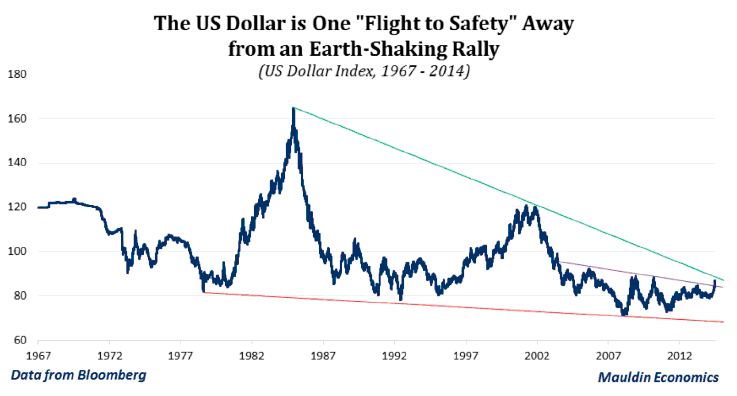
As a former regional director for a top-50 RIA now managing a family investment company, I have viewed the loss of reserve status – and a currency collapse – as a remote possibility for the next decade. Recent developments, however, have challenged my thinking. In the last ten-plus years, the global economy has undergone a remarkable transformation. Because of these transitions – in technology, finance, connectedness and geo-politics – the world will face the risk of unique shocks arriving at faster rates than we have before. The development of the internet and the metamorphosis and ubiquity of the smartphone were two of the many harbingers for this. Information makes leaps faster now, speeding up communication, accelerating actions and reactions and increasing levels of mobilization. In spite of the fact that the dollar increased 12% percent in 2014 and will likely be stronger short-term, we now have broader participation with wider risks.
Some have argued, in this context and others, that there is a greater likelihood that the dollar will collapse. Either debt and QE will cause hyperinflation, China will replace the dollar with the renminbi, the IMF will replace the dollar with the Special Drawing Right (SDR) or some other disaster will cause a crash.
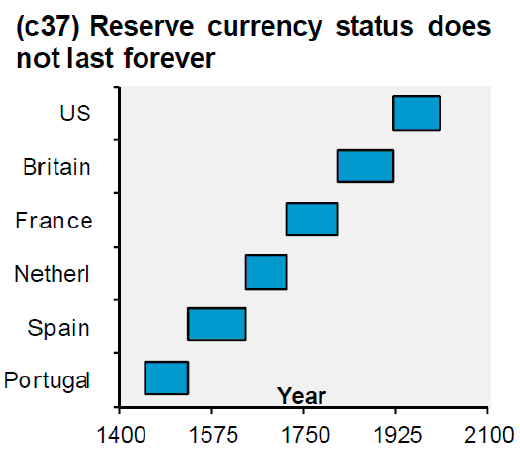
After all, the dollar has been the global reserve currency for about as long as the historical average; it seems like its time is up.
Yet, there are weaknesses in the above assertions. Is it possible the dollar could crash? Yes. Later in this article I will suggest cause and scenario. Is it probable? The real danger probably won't be imminent for years. A review of recent posts from experts explains why.
If the dollar is replaced as the global reserve currency, one argument is its devaluation will occur swiftly because at least half of all dollars, approximately $650 billion of the $1.29 trillion in circulation (as of October 2014), are held outside of the U.S. When these dollars come flooding back into the country inflation will skyrocket, the dollar will devalue and parts of the U.S. will be reduced to third-world status in a short space of time.
It is important, therefore, to understand the arguments and the probability for each predicted scenario of the dollar's demise. I will examine the likelihood of these scenarios in the context of some recent books and research papers.
Is the dollar in danger?
According to “The International Monetary System: Where Are We and Where Do We Need to Go?”, an IMF working paper, though the dollar has maintained its dominance in spite of the GFC, developments since then continue to challenge its pre-eminence. The authors argue, “Any disruption of confidence in the sustainability of the U.S. economy would make it difficult for the dollar to play its role as the international reserve currency.” The paper reflects a developing market perspective, but also concludes that, apart from another U.S. crisis, internationalization of another currency will be difficult.
Still, a paper from the BIS, “The international monetary and financial system: its Achilles heel and what to do about it,” highlighted the weaknesses of the international monetary system (IMS) and made recommendations for reform, also pointing to replacement of the dollar as reserve. According to the conclusion, the risks of inaction on monetary reform should not be underestimated, and include returning to divisive, global currency wars and, ultimately, "triggering an epoch-defining seismic rupture in policy regimes."
The above papers and others examined specific scenarios relative to international currency reform. It is clear that the dollar is not favored like it once was. Currency Wars and The Death of Money, two books by James Rickards, and The Dollar Trapby Eswar S. Prasad, which stands in opposition, examined the issue of a dollar crash comprehensively. Rickards is an industry executive and Department of Defense consultant on financial dangers. Prasad is an influential academic who has worked for the IMF.

I will focus on those books, although there are others who warn that a crash is imminent – a tangential body of theories in the ether.
Prasad's book is an erudite and academic treatment that describes intricately balanced global forces not only holding back a dollar collapse, but also preventing it. Prasad offers only two "tipping points." Rickards' books are the Trap's potential foil; where Prasad is logical and measured, Rickards is passionate and apocalyptic, certain that a dollar collapse is coming and eager to explain why.
A simple reading of Prasad's arguments is that emerging markets' desire to increase exports and self-insure are pushing capital flows in need of safe assets increasingly towards supporting the dollar. There is a paradoxical, uphill capital flow from poorer countries to the U.S. This is the dollar trap: volatility created by U.S. central bank easing creates the need for emerging market reserves. Since there are so few large, liquid, safe bond markets, investments must flow towards the U.S. Ironically, this will likely prop up the dollar for years.
Rickard's approach in Money, and especially the earlier Wars, is more alarmist. His basic thesis is that in spite of all sane attempts to the contrary, the global system will come unglued and a crisis will bring down the dollar. He focuses on high sovereign debt and central bank liability, the interconnectedness of bank derivatives, currency wars, correlations and complexity theory relative to the global financial system to make his points. According to the theory of self-organized criticality, it only takes one snowflake to start an avalanche in a complex system.
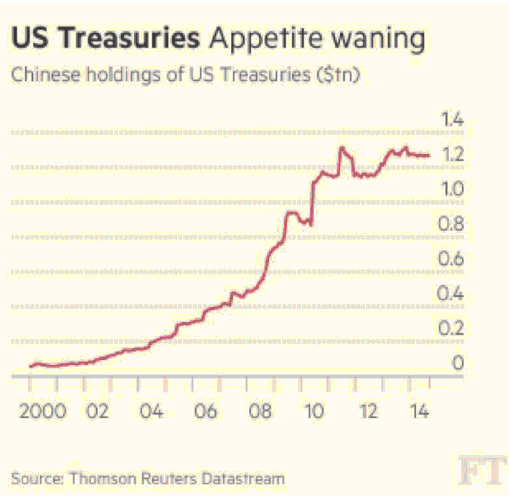
What is worrisome is that even the more measured Prasad concedes to the sentiment expressed by the IMF paper noted above: any disruption of confidence in the U.S. economy could be disastrous. For example, Prasad asserts that his story is not an encouraging one and that the world sits in a fragile equilibrium that could lead to greater financial instability. There are many shocks that could cause the IMS to come apart. According to him, debt leaves a country vulnerable. In one of his two tipping points, increasing inflation causes foreign investors to dump Treasury securities and flee, leading to rising rates and economic death, one of many scenarios that can happen abruptly.
A legitimate read of Prasad is that the very phenomenon of the dollar trap increases the risk that everyone will need to draw on the same risk pool at the same time. All that is required is an external or internal event that fractures trust in the U.S. government or financial system. The crux of Prasad's argument is that as long as the world stays approximately the way it is now, nations are more or less stuck in the trap of continued dollar investment. The crux of Rickards' argument is that the world is not likely to stay the way it is now for long – the dollar is in danger.
Academics and pundits posit fiveprimary scenarios relative to the danger of a dollar collapse:
-
Treasury debt and Federal Reserve liability will overwhelm the U.S. economy and the dollar, creating hyperinflation.
-
The petrodollar, assumed as linchpin of dollar reserve status, will be replaced with gold or other currencies, resulting in the dollar's collapse.
The yuan/renminbi will replace the dollar, and the Chinese are building the global infrastructure to facilitate this soon.
In a reserve transition phase, either a modified SDR, or a supra-national currency including the yuan, will replace the dollar.
-
Something else will happen – a Black Swan.
Occasionally, two or more of the scenarios are combined, and each of the scenarios are sometimes combined with a cyber-attack by China or Russia that seeks to collapse the dollar.
What about the Chinese Yuan/Renminbi?
One possible scenario that could lead to a dollar crash is the renminbi replacing it as global reserve. Prasad suggests China's abandonment of Treasury securities as his second tipping point, but concludes that such an act would be self-defeating. Rickards' counter is that successful financial war results in greater gain for China. But, various sources agree with Prasad that there are obstacles to this scenario: incomplete Chinese capital market mechanisms, a five to seven-year challenge of transition to domestic consumption and Chinese dependence on the U.S. consumer market. A stronger renminbi in the face of a weaker dollar would make each of these obstacles more difficult and perhaps insurmountable, weakening China overall.
Another recent BIS paper, “One Currency, two markets: the renminbi’s growing influence in Asia-Pacific," traced the growing internationalization of the renminbi and developing global structures for its rise. The authors noted that the renminbi’s influence is rising and it is the dominant currency in some cases, including for a number of key emerging market economies such as Chile and South Africa. The BIS’s 2013 Triennial Central Bank Survey now ranks the renminbi the ninth most traded currency in the world, and the most traded in Asia. According to Deutsche Bank, in one month in 2013 renminbi use rose 15% globally.
Of course, as one writer pointed out, China must change its relationship with the world before the renminbi can become the global reserve. Their recent $30 billion currency swap agreement with Brazil is only equal to the average amount transacted on global exchange markets in eleven minutes. And, as an article in The Economist explained, it is difficult to make a new currency the center of international exchange. According to the Deutsche study above, the renminbi will not have full exchange convertibility until 2020. Others say dollar replacement will take approximately a decade. Regardless, transactional volume is only one aspect of the criteria for a reserve currency.
Prasad lists five criteria for global reserve currency status: economic size, open capital account, flexible exchange rate, macroeconomic policy and financial market development. He evaluates China as fulfilling one, progressing steadily in three and disqualified in only one. In that last criterion, financial market development, he only rules out China catching up over the next few years. To these five criteria he later adds confidence of investors. What one can surmise from Prasad's analysis is that the Chinese have put in place a system and structure that could quickly develop into reserve currency status – with or without the IMF and the SDR – were another crisis of any kind to rock confidence in U.S. economic integrity.
What about the SDR as the new reserve?
In another scenario, perhaps it won't be the renminbi, but the SDR that replaces the dollar initially. According to another recent paper, “Enhancing International Monetary Stability—A Role for the SDR?,” the IMF is within the same timeframe as China to replace the dollar. Though according to Rickards, it would take five years to implement the IMF-SDR plan, and U.S. voting rights would be an obstacle. In Money, Rickards also documented a 2011 IMF study suggesting that another financial or other crisis could motivate expedition.
A recent BIS paper, “Reforming the international monetary system in the 1970s and 2000s: would an SDR substitution account have worked?,” highlighted the challenges and failures of an SDR substitution account during the 1980's but noted the attempt and acknowledged that structures have long been in place. But, even Rickards, along with Prasad and Ye, believes that no currency will come close to replacing the U.S. dollar as global reserve within the next 10 years.
With that concession, Rickards also makes clear that he believes that a catalyst will bring down the dollar long before a decade passes. According to him, the most likely scenario for SDRs to replace the dollar is when derivatives exposure and bank interconnectedness trigger a global liquidity crisis worse than 1998 or 2008. He predicts that this financial crisis will happen within several years.
What about debt-driven hyperinflation or the war on the petrodollar?
Instead, will the catalyst that brings down the dollar be a debt-hyperinflation scenario or the war on the petrodollar? I will address several aspects of hyperinflation first.
There have been at least 56 world hyperinflations since the late 18th century. Following Phillip Cagan, hyperinflation is defined as beginning in a month where price rises are over 50%. As James Montier of GMO pointed out, it is an incessantly repeated myth, or "false memory," that central bank money printing alone causes hyperinflation. According to Reinhart and Savastano, hyperinflation in the modern era has not appeared suddenly and was usually preceded by a sustained period of high inflation.
Lastly, hyperinflation has had several causes, and as Montier points out, it is caused by longer-term issues: supply disruptions (like war, drought, sanctions and political mismanagement), high foreign debt (or reparations) and transmission mechanisms (like over-regulation). Montier believes the process causing hyperinflation to be endogenous. Others either waver or take a contrary view. To these causes, add from Bernholz a deficit-expenditure ratio over 20% and monetizing resulting in increased money supply and velocity.
From its founding in 1980, Zimbabwe, where the first hyperinflation of the 21st century occurred, was a nation about the size of California and considered to be the breadbasket of Africa. But beginning in 1997, a war against affluent white farmers and transfer of farmlands to untrained recipients resulted in a wealth spiral that led to unbudgeted expenditures and monetization. Then a major drought exacerbated an existing supply shock and began a cycle of money printing, debt to the IMF, political mismanagement, high inflation and emigration. In 2007 this plunged the nation into an inflationary collapse.
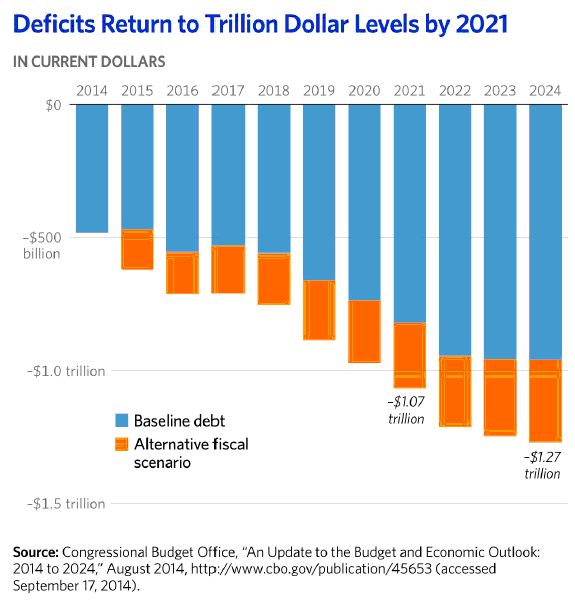
How does the U.S. hold up in a survey of these causal symptoms? According to a recent JP Morgan presentation, net U.S. debt is presently around 75% of GDP, a non-critical level. Foreign officials hold 32% of this debt, and the Fed holds 19%. Both are significant but not excessive. And, as Prasad and Ye note, debt cements the U.S. dollar role as global reserve – as long as it is not unsustainable. On this front, the U.S. does not have enough reserves to cover its short-term debt, but the Guidotti-Greenspan rule may not apply to advanced economies. And, as long as 10-year yields, currently about 2.25%, stay below 7%, global bond investors tend not to panic, especially when the U.S. is the best of a bad lot. The U.S. deficits-to-expenditures ratio is marginal, at about 18%. But the deficit is decreasing, though it could become worrisome within a decade.
Federal Reserve liabilities are also high, about $4.5 trillion. According to Guggenheim, the Federal Reserve's debt-to-equity ratio was 51:1 in July 2012, more than double its 2008 value, and almost double that of institutions that failed. But central banks are judged differently, as Japan's experience implies thus far.
Printing money or QE is not necessarily the same as monetizing the debt. Inflation and velocity remain low. Reinhart and Rogoff were no doubt right about the rampant denial afflicting advanced nations relative to future sub-par growth, QE, debt-restructuring, and coming high inflation, but a crisis appears years away.
However, there are still too many lingering questions raised by the core literature on hyperinflation to arrive at an absolute conclusion. That said, until the U.S. experiences an increase in causal symptoms, hyperinflation is not a worry. Replacing the dollar as the global reserve might be a fast track to U.S. hyperinflation, but were this to happen some of the above symptoms would likely appear in the extreme first.
As to war on the practice of pricing oil in dollars (the petrodollar), China, Russia, Iran, and others are conspiring to omit the dollar from natural gas and oil deals. But it is a misconception of a loosely knit cabal that the petrodollar is the linchpin in the global reserve currency system. Perhaps it was for a short time after Nixon took the U.S. off gold in 1971 (around the time of Kissinger's 1974 deal with the Saudis). But the amount of petrodollars relative to total global trade is low. Inferring from Prasad, regardless of the transaction-based currency, profit from nationalized oil trade goes into individual country reserves that are still mostly invested in Treasury securities (about 60% of global reserves). In other words, the dollar's role as a medium of exchange may decrease, but not its role as a store of value. With the Eurozone and Japan experiencing their own problems, the dollar’s role as a store of value is likely to continue indefinitely.
So, conflating and translating Prasad, Rickards and various papers, there are two primary current linchpins for a nation's reserve status: the confidence of global investors and well-developed financial markets. This leads to the next section. If these are the two linchpins of the dollar as global reserve, anything that threatens them is a danger.
What about black swans?
Unfortunately, considering the fragile nature of the world today, many incidents could come out of nowhere and result in weakened trust in the U.S. or damage to its financial infrastructure. One of the prominent possibilities is a successful cyber-attack on a major financial institution or the U.S., especially the nation's power grid. JP Morgan's, NASDAQ's and Sony's recent experience serve as examples, and with increasing tensions with Russia and China this area will continue to be a challenge. The director of the NSA recently warned that a cyber-attack will cause a major systems collapse within a decade unless the U.S. develops counter-strategy immediately.
Though the U.S. has largely avoided catastrophe in the past, there is also the possibility that it will experience more natural disasters in the future. Remember Zimbabwe? About 19% of the U.S. is presently in severe or extreme drought, 29% in moderate to extreme conditions and around 40% in abnormal dryness or greater, with California the worst.
In the last decade, globally, there has been an apparent increase in natural disasters around the globe. A few randomly picked data points serve as examples,recognizing that Mark Twain (to whom I happen to be related) said, "There are three kinds of lies: lies, damn lies and statistics." According to the New England Journal of Medicine in 2013, there were three times as many natural disasters from 2000 to 2009 compared to 1980 to 1989. According to The Borgen Project, natural disasters affect 217 million people globally each year and have increased four times since 1970. According to The International Disaster Database, the 10 most economically costly disasters since 1900 have all occurred after 1992; eight of the 10 after 2004. And, according to at least one account, it was the 1906 San Francisco earthquake and fire that led directly to the financial panic of 1907.
What is the bottom line?
The risk of the dollar losing reserve status is much like the theory of avalanches: many of the items are already in place, and all that is needed is the right trigger. Whether it comes next year or 10 years from now is impossible to predict. Prasad consistently argues that the intricate nature of global mechanisms will keep the dollar in play indefinitely – apart from some tipping points. Rickards insists that the complexity of global financial interactions and their tipping points will soon bring the dollar down. Who is right?
Unless the U.S. experiences a crisis greater than 911 or the GFC, a dollar collapse is not likely for at least the next three to five years. But, a black swan could bring the dollar down eventually. What if a crisis, or series of crises, led to a degenerative process? Indulge me in a scenario considered fantastical before the latest news cycles.
A perfect storm engulfs America: The Eurozone descends into recession and breaks apart and the resulting malaise spreads to the global economy. In the U.S., the current drought increases and food supply is cut in half. Prices rise. The Fed’s printing presses finally result in high inflation. Destruction from an earthquake and/or a volcanic eruption destroys a key city, close to the time that the next major terrorist attack hits the country. These events exacerbate the drought, destroy infrastructure, disrupt distribution and kill leaders. Disunity disintegrates into political civil war and panic incites unrest, resulting in martial law. America descends into an inflationary depression and developing nations decouple, leading to the dollar's fall.
It took a decade for a similar process to unfold in Zimbabwe, but it can occur faster. Compared with the rest of the world, the U.S. has seemingly been protected by a hedge when it comes to disaster. But, events like Katrina, flooding, national drought and even 911 and Ebola hint at a new era. Whether a single event or a perfect storm, there is more than one route to an avalanche these days. The above scenario, or a similar one, could rupture confidence in the U.S. and bring a currency crisis, leading to a new global reserve currency.
Though none of the previously mentioned scenarios is likely imminent, current events make engaging in these "what ifs?" constructive. PIMCO provides a much longer, ranked list of volatility triggers here, though the list is a work in progress.
What does this mean for portfolio strategy and allocations?
Unfortunately, within the complexity of choices between absolute and relative opportunities and alpha versus beta allocations, the illusion of portfolio security is often exchanged for annual losses. The fact that the dollar is likely to be stronger apart from any big U.S. crisis only makes the portfolio choices more difficult. Yet, in the world in which we live it is wise to embrace Prasad's view without ignoring his tipping points or Rickard's warnings.
Although in recent history the dollar has strengthened in crisis, most flight to safety studies do not consider a dollar crash as a stressor much less the cause. Therefore, it is prudent to have portfolio allocations in hard assets and some ready routes to foreign securities and currency.
Below are five tips that take into account the dichotomy of the above conclusions relative to the dollar. Allocations can start small and increase as events on the ground change:
Be ready beforehand and protect what you have: Diversify globally, with select private equity, if qualified. Consistently reassess disaster bond holdings (reinsurance). Hold real estate.
-
Establish an international account. Set up expeditious mechanisms to transfer funds into foreign currency accounts and international currencies with a flexible strategy for transference of at least some assets in the event of escalating volatility, major U.S. weakness or black swans.
-
Allocate significantly to alternative funds and hedge-fund-like strategies. If qualified, allocate to hedge funds with a global macro and/or event-driven focus.
-
Invest in natural resources-, agriculture- and commodities-based funds, especially now when commodities overall, including oil, have corrected and mining is near an historically low cost point. Remember that water is liquid gold and may be scarcer in the future.
-
It is controversial, but physical gold and silver is money. Even Greenspan affirmed this recently. The average central bank holding of physical gold is about 3-4% of assets, a good minimum goal for a HNW investor. Non-HNW investors should target a minimum 10%.
Some crisis beyond the scale of the GFC or 911 or a crisis plus a degenerative process will be needed to counter current global trends that point to the continued preeminence of the dollar. But, it is never out of touch with reality to engage in the "what ifs?" It is a necessity. As Rickards says in The Death of Money, "The key to wealth preservation is to understand the complex processes and to seek shelter from the cascade."
Seaborn Hall has been involved in the investment arena for over 30 years. He has a degree in management from Georgia Tech, two masters degrees in theology and has studied at the doctoral level. Until recently he was a regional director at a national top-50 RIA, headquartered in California. He now focuses on managing a family investment company.
Read more articles by Seaborn Hall