After last week’s wipeout in chips and the broader selloff in technology stocks, pressure is building for the biggest spenders on artificial intelligence to justify their expenditures to beleaguered traders with increasingly itchy fingers hovering over their sell buttons.
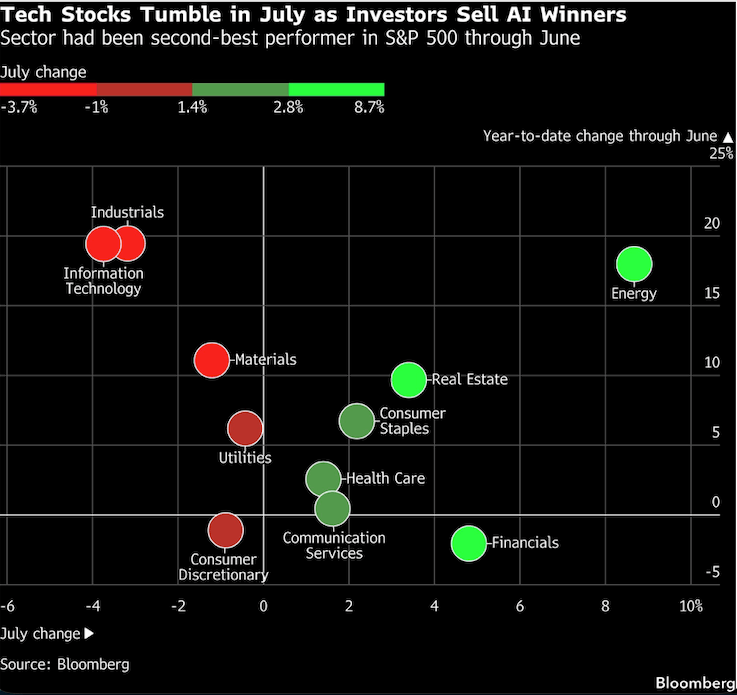
The AI euphoria that drove the stock market to all-time highs just a month ago is clearly waning. Information technology was the worst performing group in the S&P 500 Index last week, which slid 1.6% while the tech-heavy Nasdaq 100 Index lost 4.1%. Chip stocks were the main culprit, with the Philadelphia Stock Exchange Semiconductor Index sinking 10% for its worst week since April 2025.
Even Elon Musk’s dream factory SpaceX is taking a hit, plunging 15% last week after dropping 10% the week before, tumbling below its initial public offering price and erasing $1 trillion of market value from its peak.
“Investors are getting to the point where they’re uncomfortable with how much money is being spent and they’re worried about a bubble,” said Jake Seltz, portfolio manager at Allspring Global Investments. “Ultimately, we need to see a re-acceleration in revenue.”

With skepticism mounting about the hundreds of billions of dollars being poured into data center development, earnings reports over the next two weeks from the biggest spenders will be scoured for evidence that the investments are generating bigger returns. Tesla Inc. and Alphabet Inc. kick off Big Tech’s reporting season on Wednesday. Then Microsoft Corp., Meta Platforms Inc., Apple Inc. and Amazon.com Inc. hit the following week. Together, the six stocks account for a quarter of the market capitalization-weighted S&P 500. Nvidia Corp. reports later next month.
The stakes are high. An index tracking the Magnificent Seven tech giants is lagging the S&P 500 this year, a rarity for the group that has led the market higher for most of the past four years. At the same time, concerns about spending are hitting semiconductor stocks, which have benefited most from the outlays and are leading contributors to the benchmark’s 8.9% gain this year.
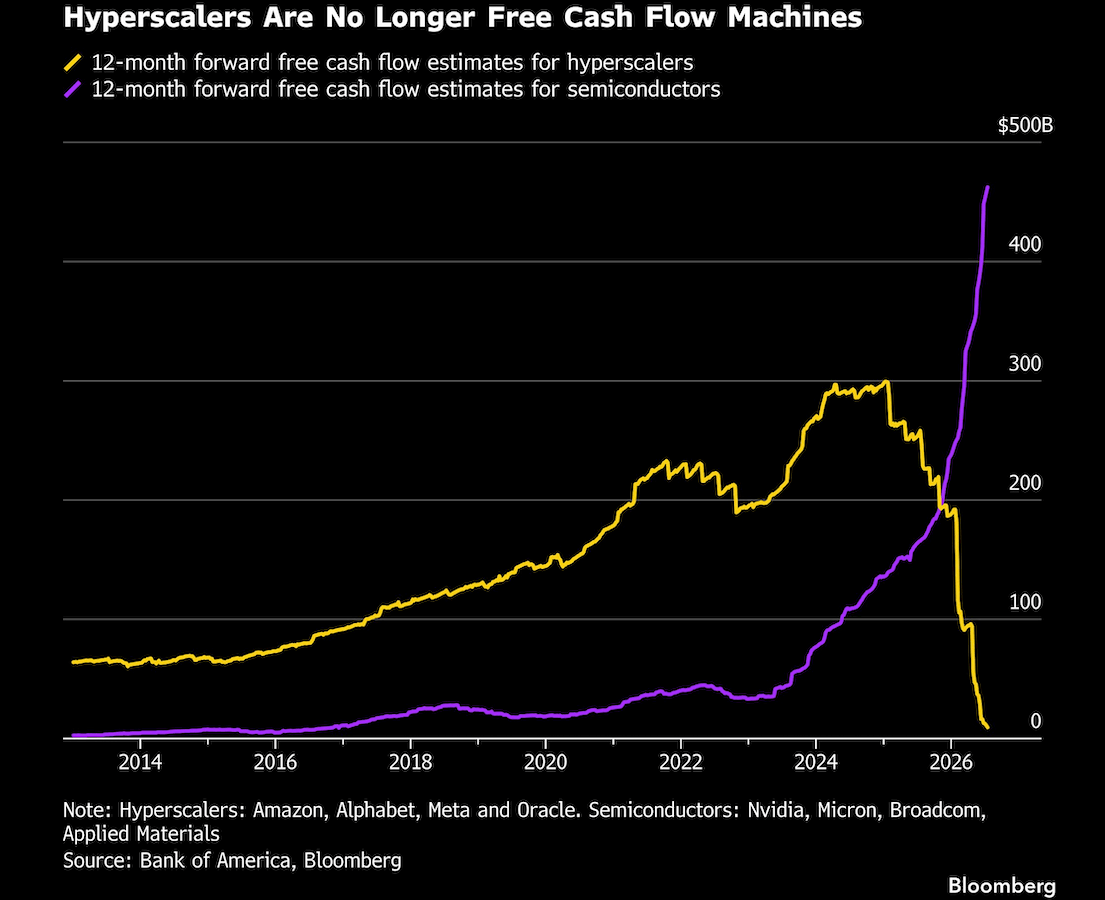
Most of the focus this week will be on Alphabet. The Google parent is widely seen as an AI winner owing to the popularity of its Gemini chatbot, homegrown data center chips and expansion in its cloud-computing business. But growth in those areas has come at a big cost. Alphabet’s capital spending is projected to more than double this year to $187 billion, and like many of its peers it’s increasingly turning to debt and equity markets to fund it.
That’s making investors uneasy. Alphabet shares fell 6.5% over the past two sessions as the company is reportedly months behind schedule on delivering Gemini 3.5 Pro, its most powerful flagship AI model. While the stock remains up 11% this year, it has fallen 14% from a May peak.
Sentiment is bleaker among the other megacaps. Microsoft is coming off of its worst month since 2000 and has lost 19% this year. Meta Platforms is down slightly in 2026 despite a July rebound amid optimism about efforts to potentially rent computing capacity. Amazon has climbed 7.1% for the year and Nvidia has gained 8.8%, both underperforming the Nasdaq 100.
“At some point, earnings are being questioned so much that you can’t put as a high of a multiple” on these stocks, said Todd Ahlsten, chief investment officer at Parnassus Investments. “There’s going to be a lot more focus on cloud gross margins, pricing, what kind of AI revenue is being generated per dollar of compute.”
Indeed, valuations for tech giants have come down across the board. The Bloomberg Magnificent 7 Index is priced at 24 times profits expected over the next 12 months, down from 33 in October and 29 to start the year. The Nasdaq 100 trades at 22 times.
That has shifted the risk to other areas of the stock market that have seen massive run ups, like chipmakers, according to Ahlsten, whose firm has $45 billion in assets under management.
The Philadelphia semiconductor index, or SOX, has soared this year because much of the spending on AI infrastructure is flowing to its constituents. The benchmark of 30 chip-related companies is up 65% in 2026, with only one member in the red. But it has tumbled 20% since hitting a record last month, reaching the technical threshold for a bear market, and volatility has soared. In the past four weeks, the index has seen moves of more than 2% in all but two sessions.
‘Be More Careful’
Even positive signals from earnings reports have failed to halt the SOX’s slide. Taiwan Semiconductor Manufacturing Co., the world’s biggest contract chip manufacturer, and ASML Holding NV, which makes machines used to produce semiconductors, both raised revenue forecasts for the year. Meanwhile, results from International Business Machines Corp. showed that customers are prioritizing spending on servers and semiconductors over mainframes and software.
“I’d be more careful going into this period on account of these issues,” Ahlsten said. “Some of the stocks, especially on the infrastructure side, look a bit toppy, potentially. They’ve gotten a high multiple for accelerating growth that may not ultimately be as accelerated as some people were thinking.”
Of the top 10 point contributors to the S&P 500’s rise this year, seven are chip-related companies. Micron, Nvidia, Advanced Micro Devices Inc., Intel Corp., Applied Materials Inc., Lam Research Corp. and Sandisk Corp. account for nearly half of the benchmark’s advance.
But Wall Street appears to have started questioning the durability of gains in memory and storage shares, which are dominating the S&P 500’s leader board this year as relentless demand from data center developers creates shortages and sends prices soaring. Sandisk, the best performing stock in the benchmark in 2026, dropped 29% last week, while Micron Technology Inc., the third best performer, sank 13%.
In a sign of how wary investors are of heavy spending on AI, Apple, which has avoided big capital expenditures in favor of partnering with model providers to power its AI services, is by far the best performer among the Magnificent Seven this year with a 23% gain.
“We’re in a period of heightened market anxiety, and the hyperscalers haven’t been the darlings of this trade,” said Brock Campbell, head of research at BNY Investments Newton. “The key debate is on the duration and magnitude of AI spending.”
Alphabet, Microsoft, Amazon and Meta have forecast as much as $725 billion in capital expenditures this calendar year, and Wall Street expects that figure to climb to nearly $900 billion in 2027, according to the average of analyst estimates compiled by Bloomberg.
Still, despite all the concerns about these gargantuan outlays, Allspring’s Seltz is betting the spending will continue to rise as demand for cloud computing services outstrips supply, supporting revenue growth for tech giants and, in turn, driving AI infrastructure stocks higher.
“It hasn’t been uncommon to see some of these stocks sell off over a period of weeks or months and then come back,” he said. “I would use any weakness as an opportunity to add to positions. The cycle isn’t over yet. I think there are a couple more years of great returns, but there will be volatility that will spook the market from time to time.”
A message from Advisor Perspectives and VettaFi: Discover something new! Click here to register for our upcoming webcasts.
Bloomberg News provided this article. For more articles like this please visit
bloomberg.com.
More Smart Beta Topics >