A recent plunge in US labor force participation has sparked competing theories about whether persistent drivers — like aging and immigration — or more temporary seasonal shifts are to blame. Any evidence in upcoming jobs reports could reshape how policymakers view the labor market.
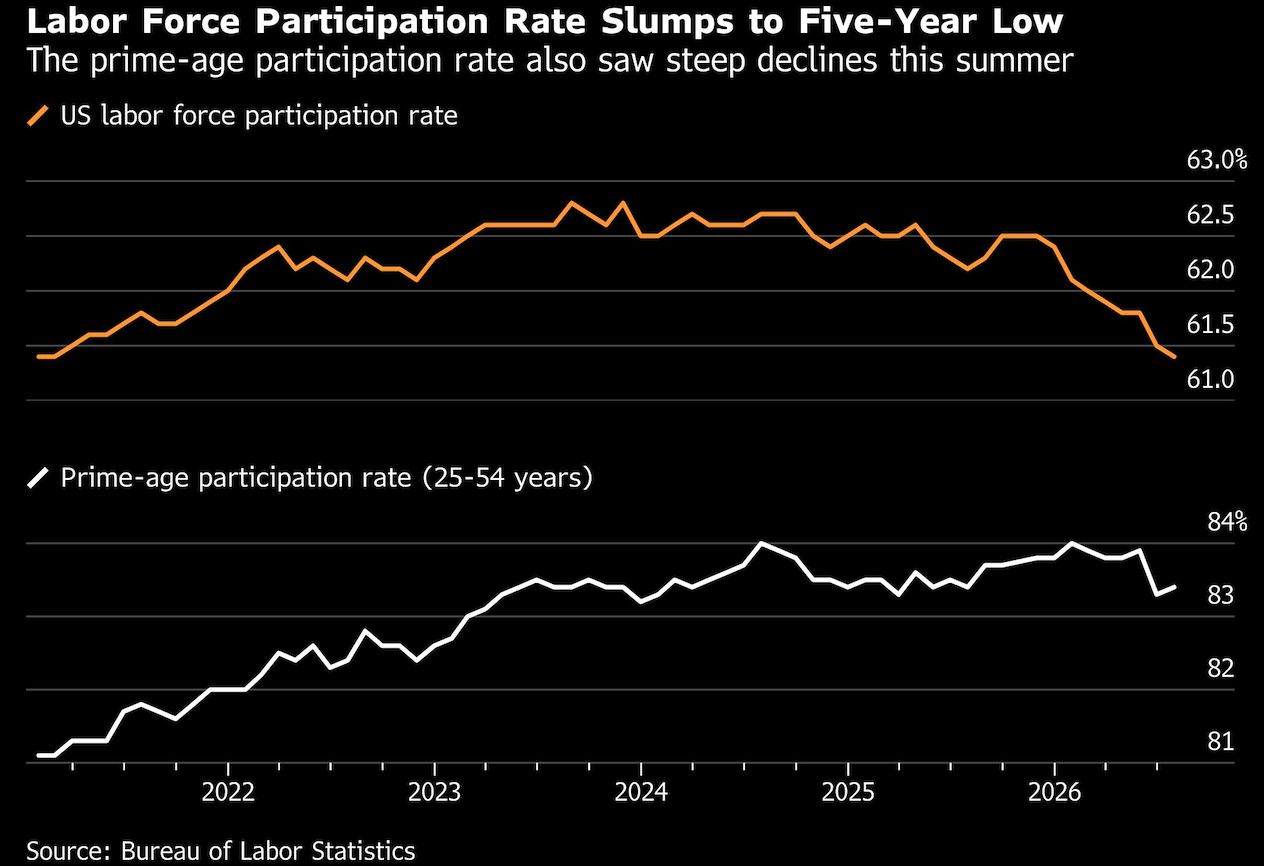
The decline in the share of Americans who are working or looking for work over the last six months has been among the fastest recorded in nearly eight decades of data. That’s helped pull the unemployment rate down as well: At 4.1% in July, it was the lowest in more than a year.

If the drop in participation is primarily due to persistent factors like aging and shifts in immigration policy, measured unemployment could stay low even without much job growth, according to Michael Gapen, the chief US economist at Morgan Stanley.
But if shorter-term factors like seasonal swings or a weak spell for hiring are more to blame, the unemployment rate could rise in the months ahead, potentially influencing the Federal Reserve’s coming interest-rate decisions.
“If we’re right that the participation rate can move higher off of some of these statistical aberrations, then there’s upside risk to the unemployment rate heading into year-end,” Gapen said. “And on the margin, it may make the Fed less willing to tighten.”
Friday’s jobs report will offer fresh insights into the debate. Here are some of the potential factors at play:
See more: We’re Asking the Wrong Question About the Great Wealth Transfer
Retirement Wave
One of the clearest forces pushing participation lower is the aging of the US workforce. The BLS implemented a hefty downward adjustment to January’s participation reading as part of an annual update to underlying population estimates, which incorporated more women ages 65 and over and fewer men between the ages of 25 and 54.
But the 0.7 percentage-point decline in the participation rate since then is the part that’s harder to explain. Aging should subtract more like 0.2 percentage point each year as millions of Baby Boomers come of retirement age, according to Morgan Stanley estimates.
Some economists see signs that retirements may be accelerating in 2026, especially with a booming stock market lifting investment portfolios.
“We think this is related to the 35%+ increase in the S&P 500 over the last two years,” economists at Bank of America Corp. said in a recent report. “The resulting surge in wealth has likely made retirement an easier choice for many.”
Immigration Crackdown
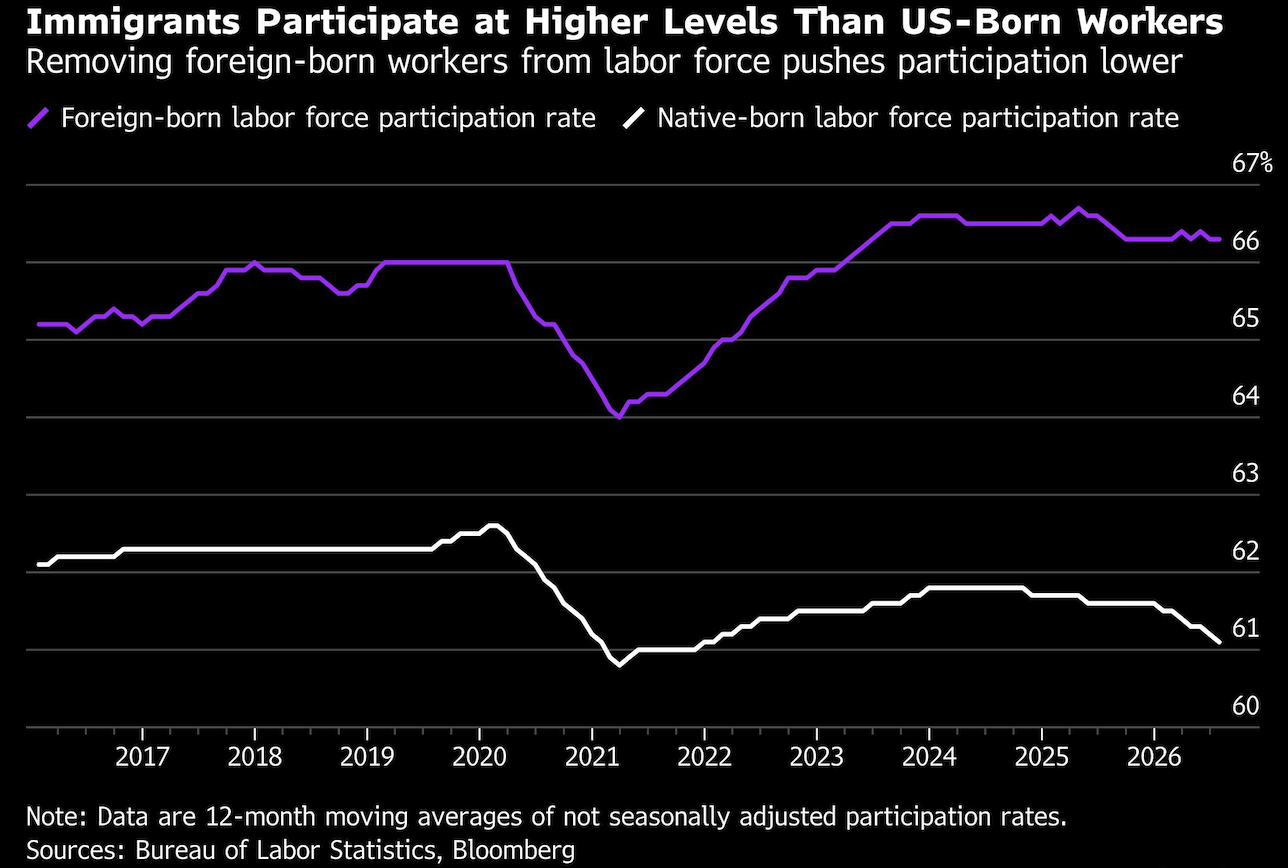
Another factor is the Trump administration’s immigration crackdown, which is likely weighing on the participation rate by changing the composition of the workforce.
Foreign-born workers have a higher participation rate than native-born workers — around 66% versus 61% — so ratcheting up deportations or allowing fewer entries has a small mechanical impact on labor force participation by reducing the average participation rate.
If immigrants are leaving the labor force but remaining in the country, however, that would create a bigger drag on the participation rate.
“It’s not all the slowing immigration,” Veronica Clark, an economist at Citigroup Inc., said of the recent declines in participation. But “those are people that are entering the economy who have a higher average participation rate, and so when those people are not entering, that just lowers the average,” she said.
Seasonal Noise
The BLS adjusts its data each month to smooth through swings that tend to happen at the same time every year, like the timing of the school year and young adults entering and exiting the workforce for temporary summer jobs. Last summer, though, the participation rate weakened unexpectedly before rebounding in the fall despite seasonal adjustments.
Some see that as a potential problem this year as well. The participation rate fell by 0.4 percentage point from May to July, accounting for more than half of the entire decline in the last six months of data. If faulty seasonal adjustments were to blame, the unemployment rate could rise over the next few months as the effect unwinds, even without a wave of layoffs.
“You can get some of these weird dynamics at the start of the summer,” Clark said. “The pattern has been that that kind of reverses later in the year.”
But seasonality probably isn’t the biggest culprit, at least when it comes to younger workers: Economists at Goldman Sachs Group Inc. estimate that distortions in the data for those between the ages of 16 and 24 accounted for only 0.1 or 0.2 percentage point of the 0.7-point slide in overall participation since January.
Weak Demand
A final possibility is that weak hiring is sidelining some potential workers who would otherwise be searching for work. A better hiring environment could actually boost the unemployment rate if it brings more people into active job searches, adding them to the official count of the unemployed.
This is especially relevant for the prime working-age population between the ages of 25 and 54, whose participation rate fell 0.6 percentage point in June — the most since April 2020 — and rebounded by only 0.1 percentage point in July.
On the other hand, only a small fraction of the rise in those not in the labor force since January has been among people who say they want a job.
“Cyclical labor-market weakness in addition to immigration restrictions could be a part of the story,” said Shruti Mishra, an economist at Bank of America. “Do I think it’s the biggest part of the story right now? Probably not.”
A message from Advisor Perspectives and VettaFi: Discover something new! Click here to register ofr our upcoming webcasts.
Bloomberg News provided this article. For more articles like this please visit
bloomberg.com.
Read more articles by Julia Fanzeres