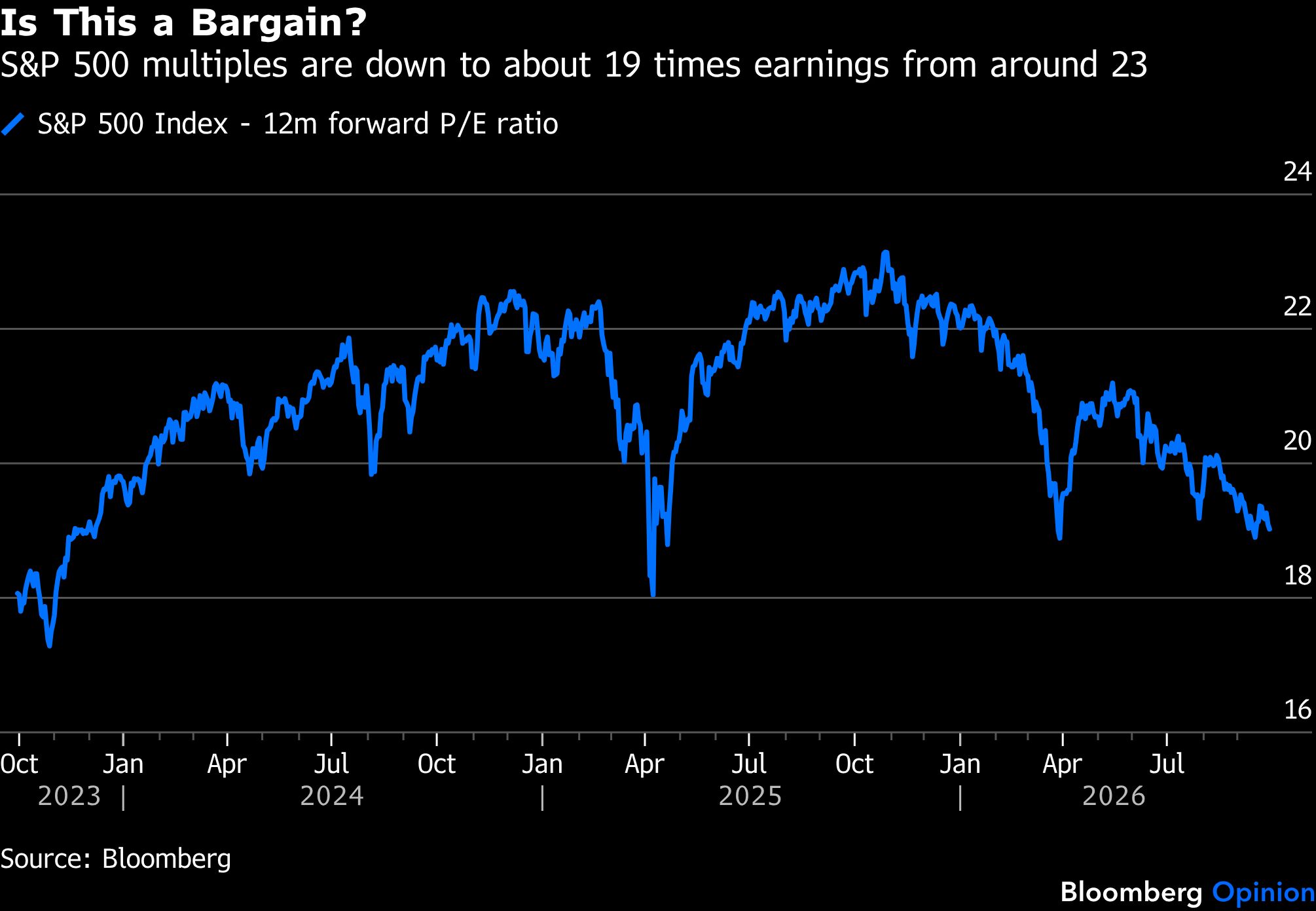
Has the stock market bubble quietly burst already? Even though the S&P 500 Index has mostly treaded water for the past four months, Wall Street analysts have continued to boost their earnings estimates. This has left the benchmark trading at some its cheapest levels of recent years based on the so-called forward price-earnings, or P/E, ratio. And yet, it’s hard to call stocks a bargain, mostly because it’s “E” and not the “P” that looks increasingly unsustainable.

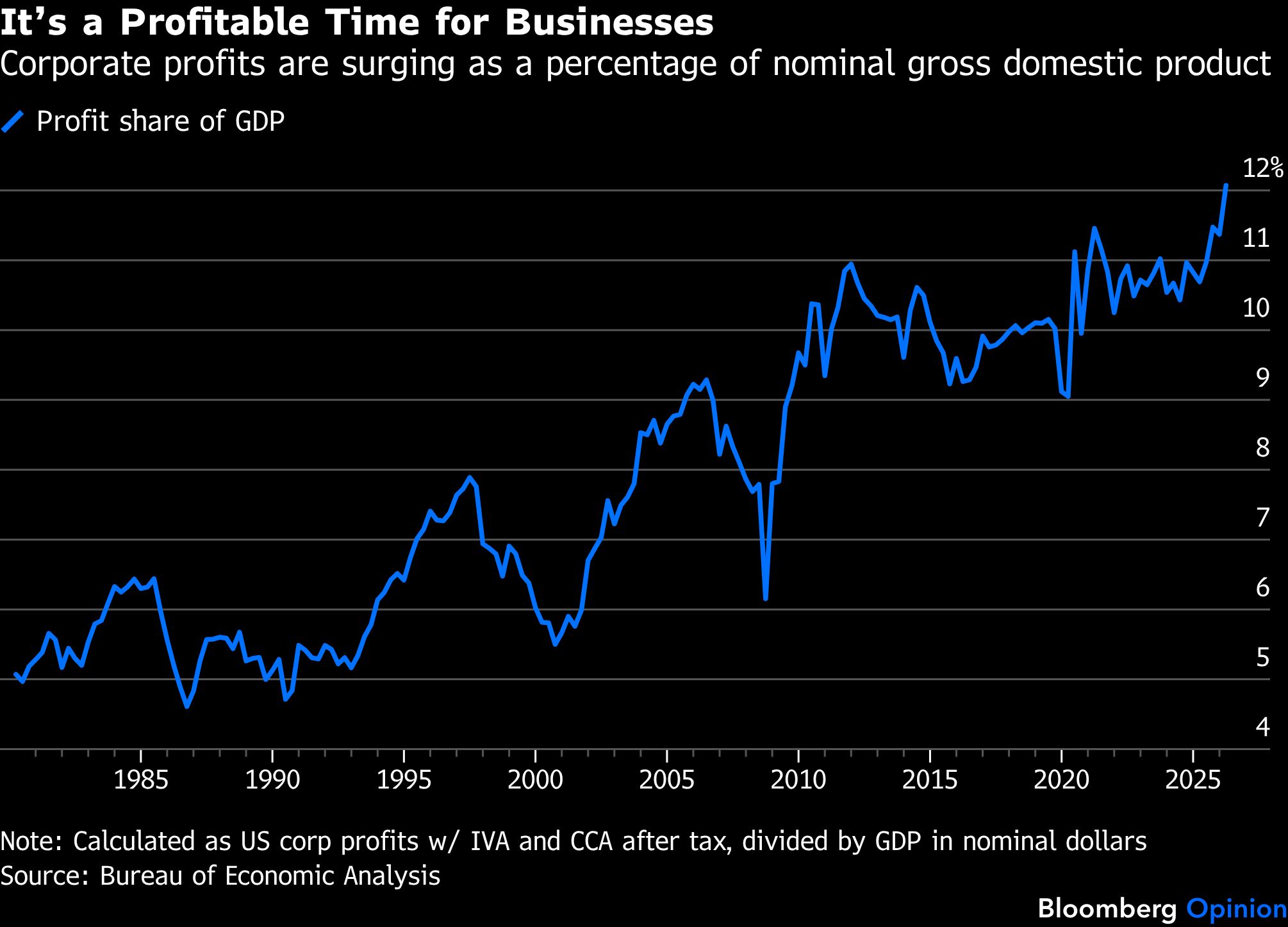
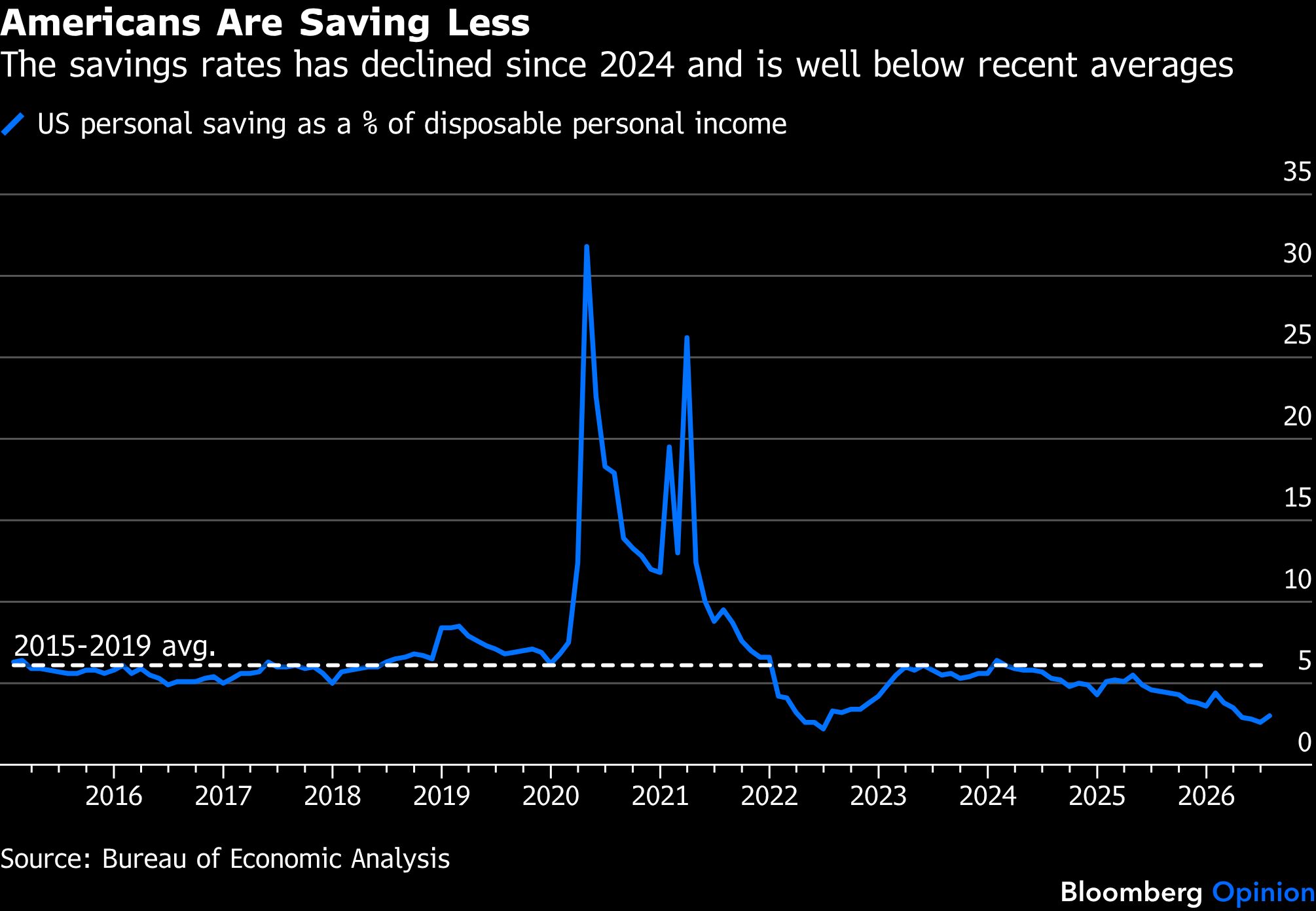
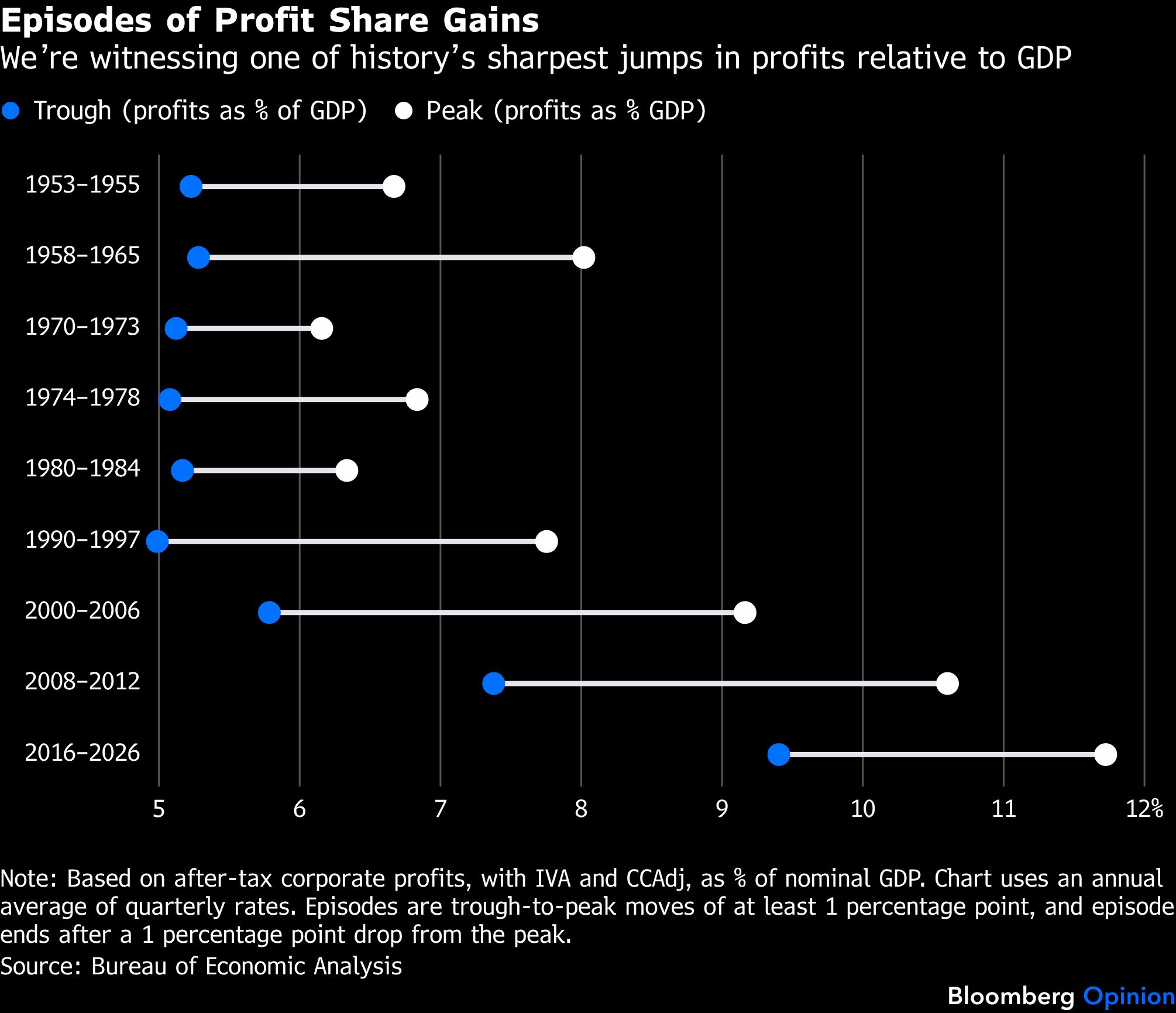
Consider corporate profits as a share of the economy, a metric legendary investor Warren Buffett famously used to spot the dot-com bubble. Relative to nominal GDP, profits swelled to an all-time high of 12.1% in the second quarter, sustained by capital spending to finance the artificial intelligence boom, fiscal stimulus in the form of a 6% budget deficit and households dipping into savings to maintain the level of spending to which they have become accustomed — none of which can go on in perpetuity.
Here’s what Buffett said in Fortune in 1999:
If corporate investors, in aggregate, are going to eat an ever-growing portion of the American economic pie, some other group will have to settle for a smaller portion. That would justifiably raise political problems—and in my view a major reslicing of the pie just isn’t going to happen.
See more: Living With the Realities of a Flat Economy
I agree with the Oracle of Omaha.
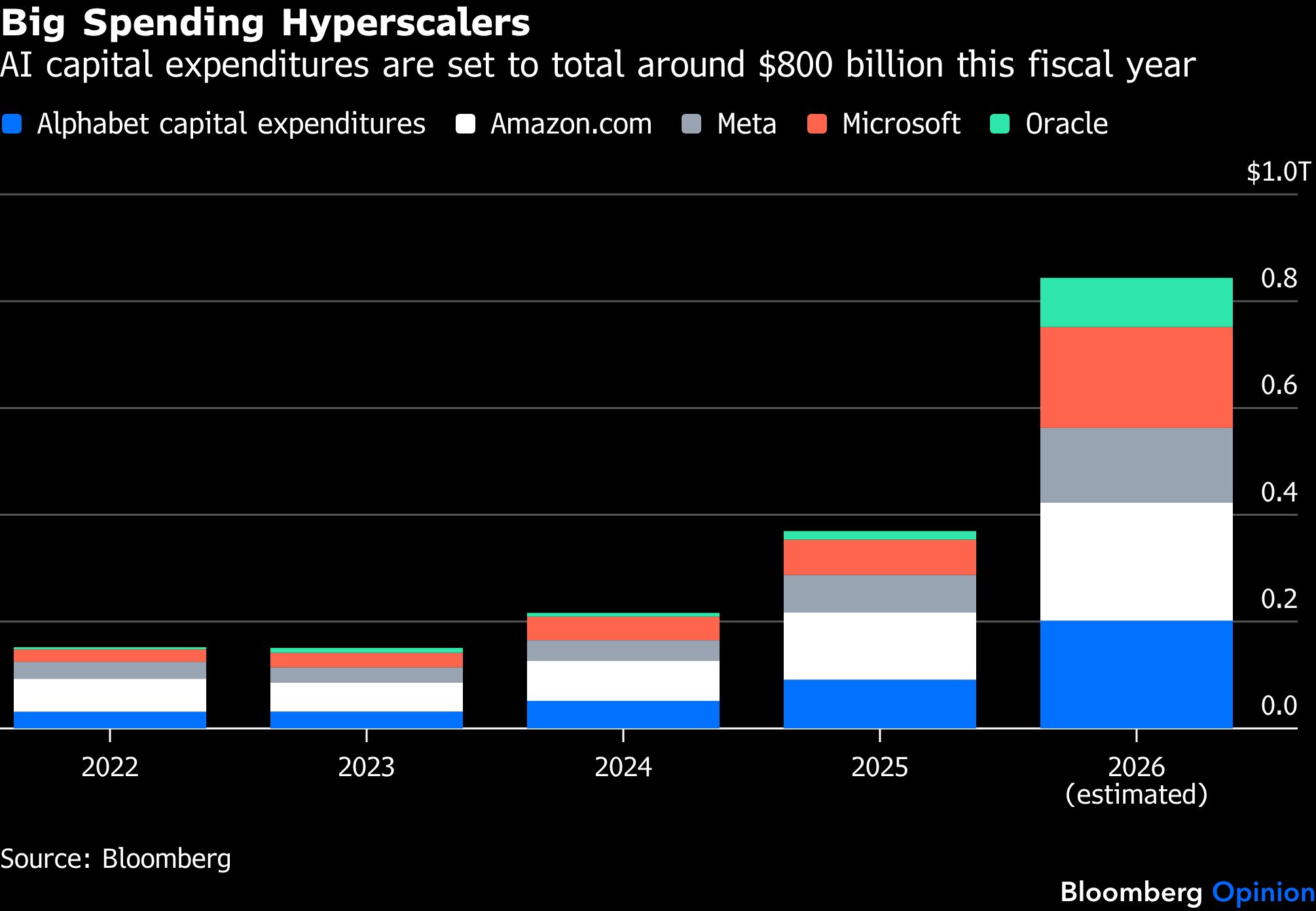
The roughly $800 billion that firms including Amazon.com Inc., Microsoft Corp., Alphabet Inc., Meta Platforms Inc. and Oracle Corp. are spending to build AI data centers is responsible for almost half the expected growth in earnings for members of the S&P 500, according to Goldman Sachs Group Inc. strategists led by Ben Snider.
In the immediate term, that spending is revenue for semiconductor companies (Nvidia Corp., Broadcom Inc., Advanced Micro Devices Inc., etc.) and others providing components, infrastructure and power for data centers (Arista Networks Inc., Vertiv Holdings Co., GE Vernova Inc., etc.) Yet there’s an accounting mismatch: Revenue and profit windfalls are recorded currently, while capital expenditures, or capex, are depreciated over time. Making the boom in capital spending all the more impactful are supply shortages in many of the AI components, which is giving revenues an added boost via price increases. Those have given supply companies extraordinary pricing power and fat profit margins — for now.
The budget deficit is the second big reason why earnings may not be sustainable. With the massive Baby Boomer generation retiring, soaring Social Security outlays are buttressing consumption throughout the economy. Similarly, swelling Medicare benefit payments go straight into the profits of private Medicare Advantage providers and drug companies. Interest payments — another form of transfer from the government to the public — constitute a third form of stimulus to businesses and households, and lately it’s the top contributor to the exploding deficit.
Yet it’s still a fairly challenging time to be a worker in the US. Inflation-adjusted wages are roughly flat, even as corporate America profits soar. Households have reduced their saving rates to prolong consumption habits. Wage growth must accelerate or else consumption growth will eventually sputter — further weighing on consumer sentiment, which the Conference Board said Tuesday fell in September to the lowest since 2014. If that doesn’t happen organically, the public will demand it.
I believe this contrast between surging corporate earnings and stagnant wage growth is what Buffett had in mind in 1999 when he talked about potential “political problems” emerging in the wake of a rapid expansion in the profit share of GDP. If the profit share doesn’t revert to the mean of around 6% sometime soon, we’re bound to see more calls for unionization and lifting the minimum wage, as well as political backlash against corporations in the form of higher corporate taxes and antitrust measures. AI may temporarily shift power dynamics in the labor market, but the chatbots don’t vote — people do.
Although stocks crashed months after Buffett’s published dot-com era comments, it’s worth noting what he got wrong. He thought the profit share would return to around 6%. It did, but only for a couple years. He misjudged the forces of globalization (an increasing share of profits from abroad) and reduced taxes (sophisticated offshore structures helped companies cut their effective tax rates). But one of those factors is already moving in the opposite direction, and fiscal realities suggest taxes will eventually follow.
Also worth considering is the magnitude of the rise in the profit share of GDP, above and beyond the percentage itself. I count four other episodes of jumping profit shares since 1980, and they were all associated with some sort of backlash, however temporary. The expansion in profit share in the 1980s gave us the Tax Reform Act of 1986, which meaningfully increased effective corporate tax rates. The 1990s gave us the antitrust case against Microsoft. And the 2008-2012 period gave us Occupy Wall Street, the Dodd-Frank financial regulation overhaul and, arguably, the right wing economic populism that helped fuel Donald Trump’s political rise (such as pushback against free trade.)
So is the stock market attractively valued? Doubtful, and only then if earnings growth proves sustainable. Capital expenditures, deficit spending and declining saving rates seem to be deferring the reckoning. But as Buffett put it, the only way corporate profits can continue to balloon is for workers to accept a smaller piece of the pie. Human nature says that won’t happen, and that the modest reduction in stocks’ price-earnings multiples is paltry compensation for the potential volatility ahead.
A message from Advisor Perspectives and VettaFi: Discover something new! Click here to register for our upcoming webcasts.
Bloomberg News provided this article. For more articles like this please visit
bloomberg.com.
Read more articles by Jonathan Levin