Remember when near-zero interest rates squeezed retirees on fixed incomes and left pensions with huge shortfalls? I suspect they’re happy to see US interest rates returning to normal.
Yes, balance is being restored to bond markets after an unusually long period of unusually low interest rates. Short-term rates, which are mainly an inflation gauge, are only slightly elevated because inflation is running a bit hot. Long-term rates, which build on short-term rates, are also roughly where they ought to be.
The bond markets have an elegant order. Inflation, which is usually expected to hover around 2% to 3% over time, is the anchor. Short-term rates add a percentage point to inflation on average to encourage spenders to save. Long-term yields add another percentage point to motivate investors to lend for longer. The result is an average 10-year Treasury yield of 4% to 5%, slightly less than the current one.
See more: Muni Managers Tout Equity-Like Returns After Historic Selloff
Bond markets have a knack for finding equilibrium when yields drift, even if it takes some time. Higher rates attract bond buyers, which pushes them down, and lower rates entice investors to seek higher returns elsewhere, lifting them up. The same seesaw applies to prices of things purchased with borrowed money, such as homes, college tuition or stakes in private companies. Lower rates make them more desirable and expensive, while higher rates curb demand and soften prices. With rates returning to more normal levels, signs are already emerging that the housing market is slowing, expensive universities are struggling to fill seats, and private equity firms can’t sell their businesses.
There is nothing remotely unusual about rates today. Bond markets have a keen eye for trouble. They ring the alarm by going to extremes, and there’s no mistaking it when it happens. Short-term Treasury yields bottomed when the market feared deflation leading up to the 2008 financial crisis and stayed there for several years. They soared to double digits when the market braced for runaway inflation in the late 1970s. Current yields should be comforting by comparison.
There’s also no pushing the bond market around. Numerous presidents have tried to co-opt the Federal Reserve in the mistaken belief that the central bank controls rates. In reality, the Fed takes its cue from short-term Treasury yields more than the other way around. Just in recent years, short-term yields beat the Fed lower during the Covid-19 pandemic and higher when inflation began to rise soon afterward. You can pretty much tell what the Fed will do, if not exactly when, by watching the two-year Treasury yield.
It happened again in May when the two-year rate broke higher than the federal funds rate, signaling that the central bank would have to raise its benchmark rate to tamp down inflation, never mind jawboning by the White House for lower rates. Year-over-year increases in core personal consumption expenditures, the Fed’s preferred inflation gauge, have been persistently above 3% since spring and remain there. The Fed raised its benchmark rate in September. The market wins again.
And the market is not yet satisfied. The two-year rate is up to 4.9%, a percentage point higher than the fed funds rate and half a percentage point higher than its long-term average. That sounds about right, given where inflation is relative to expectations. If the Trump administration wants lower rates, it should focus on actions it can control to curb inflation, such as cutting deficits and getting oil flowing again. The bond market will let it know how it’s doing.
Treasury Secretary Scott Bessent won’t have any luck moving yields, either. Bessent has been buying Treasuries to push down long-term rates. It might work around the edges, but long-term rates are guided by the short end, plus or minus depending on the strength of the economy and to a lesser extent how the market feels about the level of government debt.

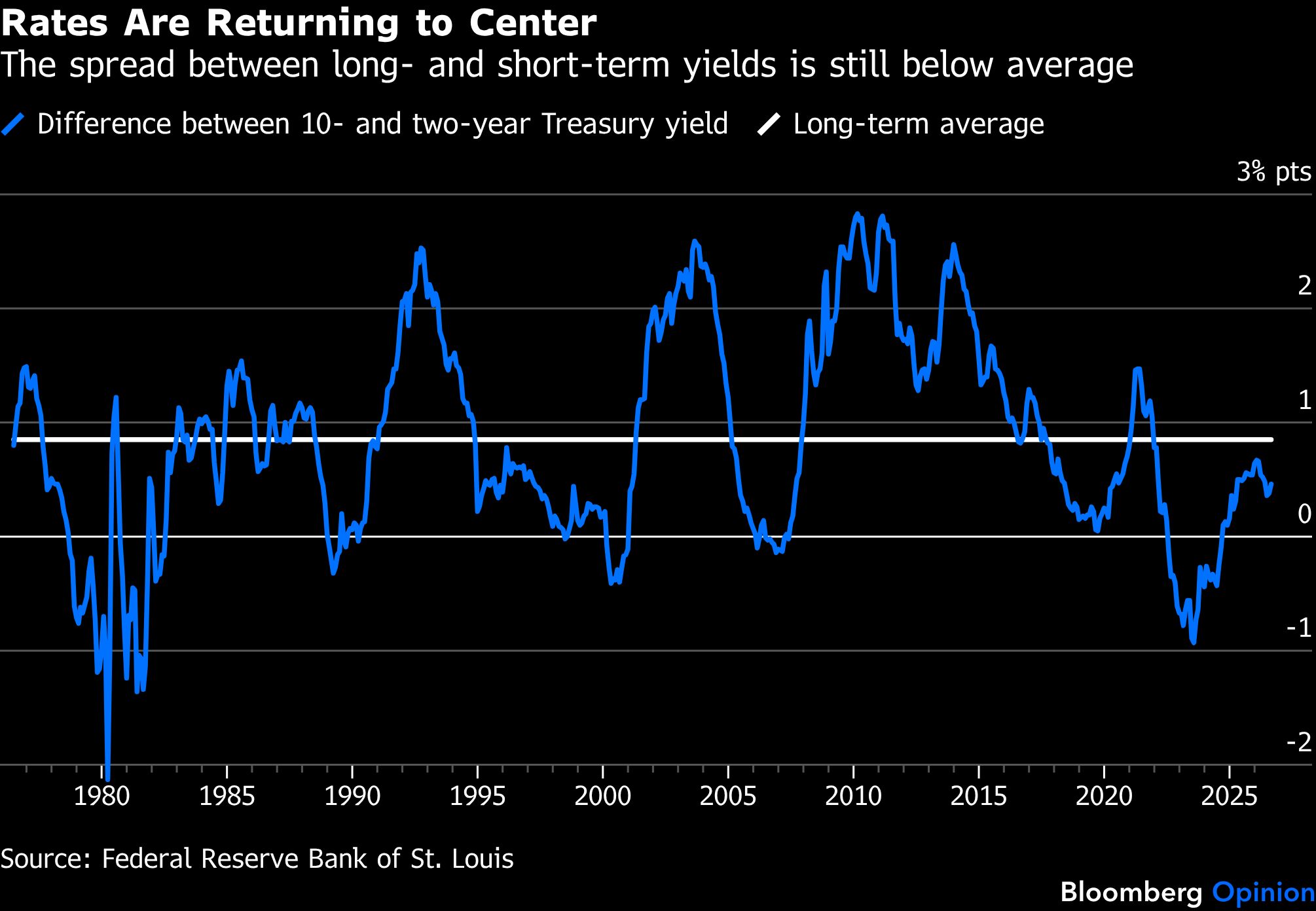
Long-term yields typically offer a premium in a growing economy. If anything, they’re too low now given the pace of growth. The 10-year Treasury yield has exceeded the two-year yield by an average of 0.9 percentage points since the 1970s. The spread is half that today. The premium on 30-year Treasuries relative to the two-year is also lower than average.
Those modest spreads may signal that the economy is slowing, but they don’t suggest the market is worried about excessive government debt. If it were, spreads would be higher than average and probably much higher than they are. As things stand, with the two-year yield near 5%, longer-term rates could hit 6% and still be within normal range.
Why, then, are so many people worried about interest rates? One reason is that rates were low for so long that people forgot what normal looks like. Also, for every retiree and pension cheering higher rates, an aspiring homeowner or college student faces steeper costs until prices adjust.
Still, a well-balanced bond market is something to cheer, not fear.
A message from Advisor Perspectives and VettaFi: Discover something new! Click here to register for our upcoming webcasts.
Bloomberg News provided this article. For more articles like this please visit
bloomberg.com.
Read more articles by Nir Kaissar