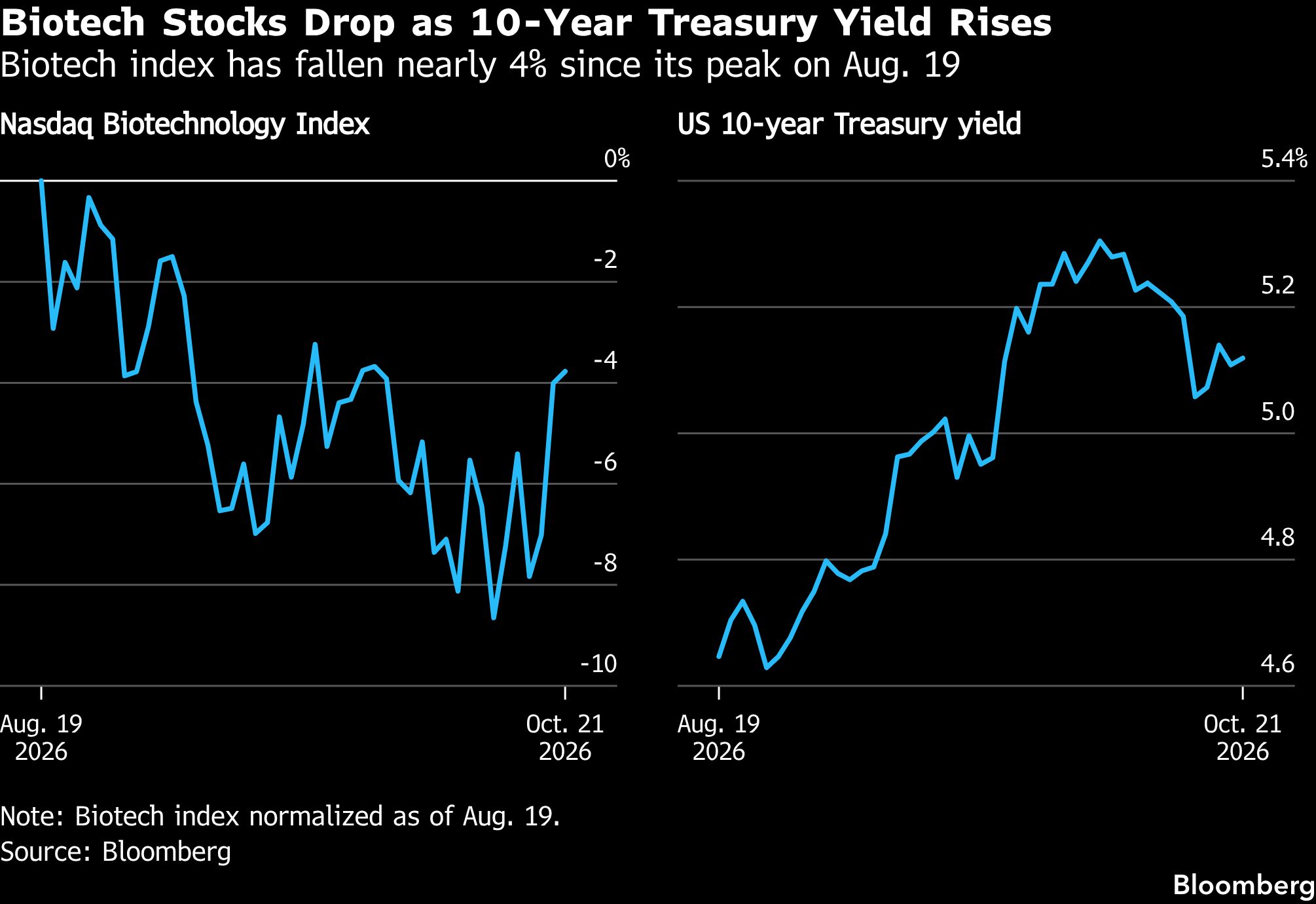
Investors are beginning to turn cautious on biotechnology stocks as a rapid rise in Treasury yields dents the appeal for shares of companies that are often viewed as risky all-or-nothing bets on breakthrough medical treatments.
The Nasdaq Biotech Index has slumped 3.8% since its Aug. 19 peak while the US 10-year yield jumped nearly half a percentage point since then and briefly hit 5.34%, its highest level since 2002. The gauge, which tracks nearly 250 biotech companies, is still up roughly 25% this year, but the latest pullback is a sign that soaring yields are spooking equity investors.
Biotech stocks are uniquely vulnerable to the impact of rising rates, especially when it comes to risk appetite. The stocks are often seen as lottery ticket-type investments, which could either turn into massive windfalls, or on the flip side, end up being worth next to nothing. With investors now able to get heftier compensation for even the safest bonds, demand for riskier niches of the stock market is starting to wane.
See more: What’s Really Driving the Rise in Treasury Yields?
“The value proposition for early-stage biotechs becomes more challenging because investors now have a much higher risk-free alternative,” said William Soliman, founder and chief investment officer of White Manna Capital.

US Treasury yields have climbed briskly this year, driven by soaring energy prices and companies borrowing aggressively to fund their AI endeavors. The pace of the 10-year government-bond rate’s ascent above 5% highlights investors’ concerns about inflation remaining persistent, even as the Federal Reserve vows to tamp down on price pressures.
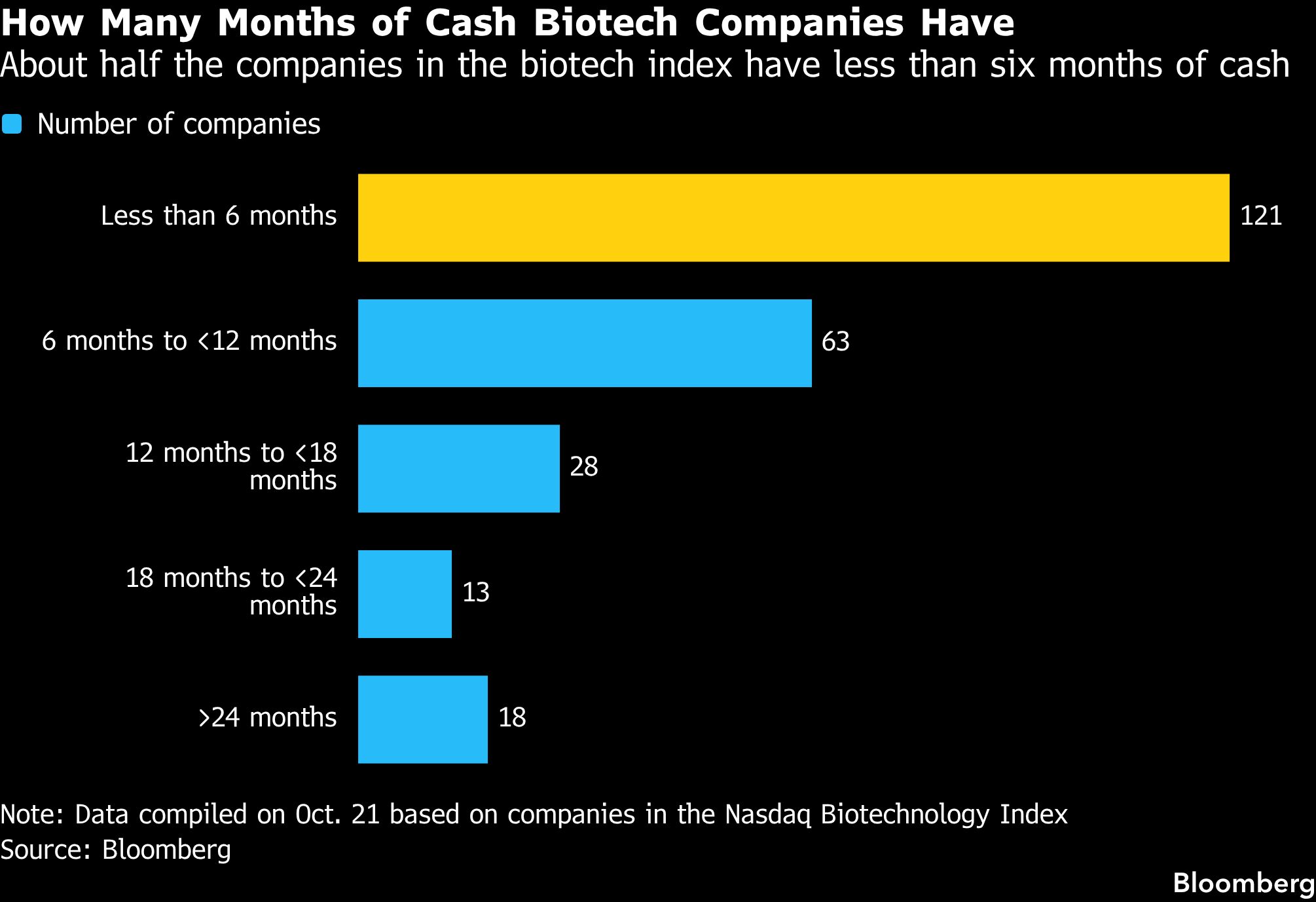
That complicates the backdrop for already cash-strapped biotech companies. Less than a quarter of Nasdaq Biotech Index stocks have been profitable over the past year and about half have fewer than six months of cash on hand needed to cover their ongoing expenses, according to data compiled by Bloomberg.
In a higher rate environment, investors in the biotech sector will want to be compensated more to take on the clinical, regulatory and financing risk of a company that may be years away from generating revenue, Soliman added.
Even so, some long-term investors like Elena Meng, a portfolio manager at Gabelli, remain bullish on the biotech sector.
“We have always been very valuation conscious in biotech, so the moving rates doesn’t fundamentally change how we invest in the sector,” she said.
There have been some bright spots for the sector this year. Positive trial data from Moderna Inc. and Merck & Co., which raised expectations for treating the deadliest form of skin cancer, has pushed the former’s stock more than 700% higher so far in 2026, after four consecutive full years of declines. Revolution Medicines Inc. winning US approval for a pill that lengthens the lives of patients with advanced pancreatic cancer has driven gains of more than 140% in its shares this year.
While higher rates impact biotech companies’ cost of capital, cash runway and their financing risk, Gabelli’s underwriting process takes these factors into account, Meng said.
RBC Capital Markets analysts are also positive on biotech stocks, expecting them to benefit from a rotation out of tech, should the artificial intelligence trade fade.
However, since the sector’s performance is tied to clinical-trial outcomes, any bad news from a few big names would dampen enthusiasm for the stocks, said Mike Perrone, a healthcare specialist at Baird.
There have been some signs of stress. Caribou Biosciences Inc., which specializes in genome-editing, said earlier this month that it plans to discontinue two of its therapy programs and is exploring strategic alternatives, including a potential merger or acquisition. It’s also planning workforce and cost reductions. The company’s shares have declined more than 60% this year.
Many investors “have totally de-prioritized new investments in this space because there is other exciting stuff where there’s a lot of deal flow,” Caribou’s Chief Executive Officer Rachel Haurwitz said.
For now, the rate environment will make it difficult for biotech stocks to lure non-specialist investors who put their money across sectors, Perrone said. Concerns about rising interest rates are already pushing Wall Street investors out of equity funds and into safety assets. Despite major US stock indexes hitting fresh records earlier this month, some argue that the resilience is limited to a few dozen stocks.
“It’s going to be a headwind for generalist investors coming back because they look at more macro factors as far as when to rotate into biotech,” Perrone said. “When you have a very known negative factor like higher interest rates, it’s going to give them additional pause.”
A message from Advisor Perspectives and VettaFi: Discover something new! Click here to register for our upcoming webcasts.
Bloomberg News provided this article. For more articles like this please visit
bloomberg.com.
More ETF Topics >