Are Bonds Pricing In a Fed Policy Mistake?
Membership required
Membership is now required to use this feature. To learn more:
View Membership Benefits Advisor Perspectives welcomes guest contributions. The views presented here do not necessarily represent those of Advisor Perspectives.
Imagine someone looking into a crystal ball on October 1 and telling you what was about to happen: September CPI data would come in higher than expected, PPI would rise 1.3% (well above the 0.5% forecast), and crude oil would climb $10 in the next two weeks alone.
Based on that, where would you guess the 10-year Treasury yield was headed? On October 1, it was flirting with 5.25%. Given that barrage of hot inflation news, most professional bond traders would have bet on 5.50% or higher.
On October 14, the 10-year Treasury yield surged after the CPI report, hitting 5.33% minutes after the release. A few days later, it fell to 5.03%. The 30-year yield fell by a similar amount. Bonds rallied into the teeth of the bad inflation data.
Mohamed El-Erian, former CEO of PIMCO and a renowned bond expert, asked the obvious question on X: “Why are U.S. government bond yields falling despite hotter-than-expected CPI and PPI inflation prints?”
He offered two valid rationalizations. In this article, I walk through his AI-related explanations and add two of my own. Importantly, I emphasize the one I think matters most: The bond market may be starting to price in the risk that the Fed is being pushed into a policy mistake.
Explanation 1: A Flight to Quality out of Tech
El-Erian's first driver is a flight to quality "out of formerly high-flying tech stocks that are now coming under pressure."
Many semiconductor stocks have been under pressure. The SOX semiconductor index fell almost 20% between October 1 and the PPI release on October 15.
The Nasdaq, with a large semiconductor weighting, fell in sympathy. Foreign markets, including the tech-heavy Korea's KOSPI and Japan’s Nikkei, were also down sharply.
As I show below, healthcare (XLV), consumer staples (XLP), and other beaten-up value sectors have rallied since October 1, while technology (XLK) moved in the opposite direction. This rotation was primarily a flight to quality within the equity market, but El-Erian thinks it may have also sparked some bond buying.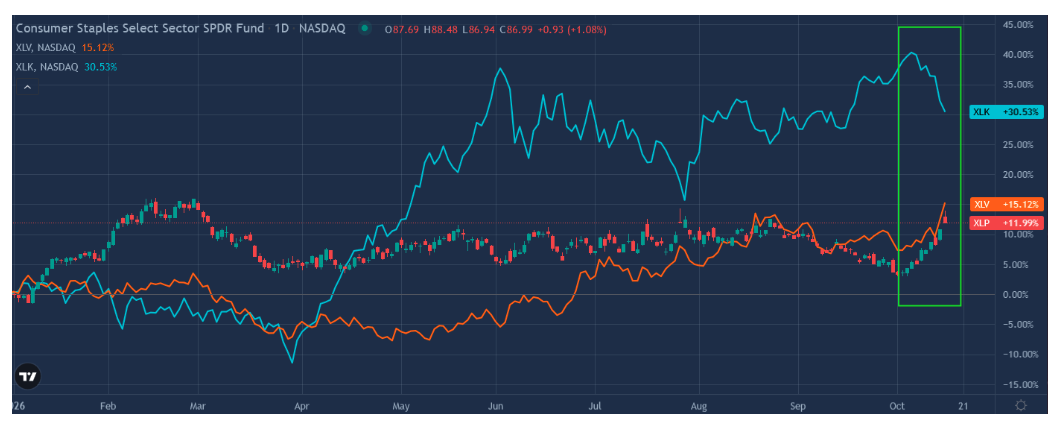
Additionally, El-Erian notes that there are "emerging pockets of credit stress in the most vulnerable segments." To his point, CoreWeave, a large data center provider, saw yields on its debt rise from 9% to 15%. Because investors are demanding such high yields for CoreWeave’s debt and that of some of its competitors, there is a growing concern that CoreWeave might be the AI trade's canary in the coal mine.
Credit-related issues, such as those noted, often lead to a flight to quality from corporate bonds to U.S. Treasuries.
Explanation 2: Is Tech Still a Growth Engine?
El-Erian's second driver carries broader macroeconomic implications. AI-related capital spending has been a primary engine of economic growth. If investors are less willing to fund the AI build-out, and if firms can't afford to fund it, does the economic growth outlook dim?
Saxo's Charu Chanana noted: “Investors are becoming less willing to finance AI infrastructure growth at any cost.”
With 10-year yields above 5% and some AI-related credit spreads at junk bond levels, the cost of financing data centers has risen sharply. Less AI capex means less GDP growth, and lower expected growth argues for lower inflation, which results in lower long-term yields.
Explanation 3: Short Covering & Signs of Significant Demand
My first addition to El-Erian’s list is short covering. The bond market entered October leaning heavily toward higher yields.
To wit, CFTC data showed that asset managers added more than 100,000 contracts to their short 10-year Treasury futures exposure in the week ending September 22, one of the largest weekly additions since 2023, according to Bloomberg.
Furthermore, open interest in 10-year futures rose in 13 of 14 sessions through late September, and in five-year futures in 11 of 12 sessions. Those changes are consistent with new short positions being added as yields rose.
The 10- and 30-year Treasury auctions on October 7 and October 8 appear to have foreshadowed the reversal. Many investors expected weak demand for the new supply of debt. They got the opposite. Per the RIA Advisors team’s commentary piece, “ Bond Auctions: You Never Hear About The Good Ones”:The 10-year note auction on Wednesday sold $39 billion at a 5.300% high yield. It stopped 1.7 basis points through the when-issued level, meaning it cleared much better than the market expected. Thursday’s 30-year $22.5 billion bond auction was similar.
[Primary] dealers took a mere 2.5% of the 10-year, their lowest share on record for the tenor, and 6.8% of the 30-year. Indirect bidders, largely foreign central banks and domestic institutions, took 80.3% and 72.3%, both far above their averages.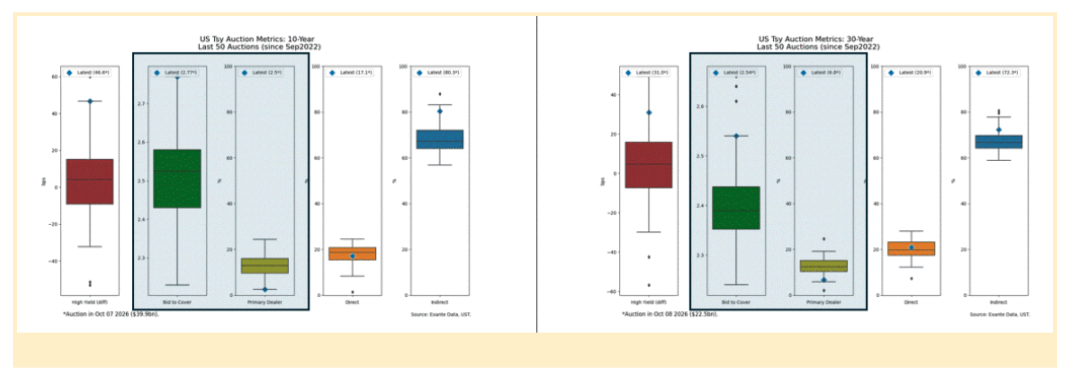
When dealers are left buying little at Treasury auctions, as we saw, it means real- money buyers are absorbing supply at these yields. While the bond market didn’t rally on the strong auctions, it certainly put short sellers on notice that demand was robust at yields above 5%.
The rising demand may have prompted Treasury-bond buying to cover short positions. Given how offside the market was, the buying created a circular effect, forcing more short sellers to cover.
Explanation 4: The Bond Market Smells a Policy Mistake
The bond market may be beginning to believe that this month's hot inflation data will force the Fed’s hand toward more, not fewer, rate hikes, ultimately resulting in a policy error.
The yield curve's changing shape over the past two weeks supports our view. The 2-year and 10-year yield curve was 57 basis points on October 7th. Following the CPI and PPI reports, it flattened to 32 basis points. That's a relatively large 25-basis-point decline in two weeks, with most of it occurring on the days of the inflation data.
When all yields decline but long-end yields fall more than short-term yields, it is called a bull flattener. A market that expects the Fed to tighten into a weakening economy buys long bonds and flattens the curve. A market fearing runaway inflation should produce a bear-steepener reaction.
The front end of the yield curve prices the odds of Fed rate hikes. The long end is pricing the consequences.
Reasons to Fret About a Policy Mistake
There are a few reasons I think the bond market should worry about the Fed.
First, the recent increase in inflation is largely a supply shock. Gasoline and diesel prices are rising because of the conflict with Iran, not because consumers are overheating. The Fed can’t produce oil, but it can reduce demand for everything else.
Second, the labor market is weak. September payrolls rose just 29,000 and prior months were revised down by 60,000. Furthermore, the unemployment rate ticked up to 4.2% and real earnings are flat to slightly negative, leaving little evidence of an inflationary wage-price spiral.
Consumers are being squeezed. The most recent retail sales beat estimates at 0.8%, but gasoline sales drove most of the gain. For example, the Control Group, which the BEA uses in its GDP calculation, rose only 0.1. Essentially, higher gas prices are crowding out other spending.
Fed policy is already restrictive by the Fed's own math. The September rate hike raised Fed Funds to 3.75% to 4.00%, above the Fed’s own estimate of the longer-run neutral rate at 3.20%. The median dot plots in the latest Fed Economic Projections (SEP), along with commentary from some Fed members, suggest another rate hike or two is quite possible.
Financial conditions are tightening. The 10-year yield above 5%, 30-year mortgage rates near 7.50%, an 18-month high in the dollar, and widening credit spreads are all doing the Fed's work. Fed Funds rate hikes make financial conditions even more restrictive.
The Hawks’ Case
To be fair, Fed hawks have a rational case for raising rates further. The recent CPI report showed broader price increases across many goods and services, core PCE running near 3%, and, probably more importantly, inflation has been above the Fed's target for more than five years. The Fed is rightly concerned about inflation expectations becoming unanchored.
But the bond market is not voting on whether inflation is too high or what it has been. It is voting on where inflation will be and whether the Fed’s inflation cure will not only heal the patient of its inflation problem but also bring on recessionary side effects.
Summary
Falling bond yields amid hot inflation data are not a paradox. They reflect a flight to quality out of tech, doubts about AI as a growth engine, the unwinding of crowded short positions, and strong demand.
Most importantly, in my view, they signal concern that the Fed is responding to an energy-driven inflation shock and that inflation has been too high for too long, tightening into a slowing economy. The shape of the yield curve and the direction of long-end yields offer a good road map for what may happen next.
A message from Advisor Perspectives and VettaFi: Discover something new! Click here to register for our upcoming webcasts.
Read more by Michael Lebowitz:
- Think Rates Are Peaking? Consider Mortgage-Backed Securities
- Worried Consumers Keep Spending: Here's Why
- From TINA To TIGA: Diversification Pays Again
Michael Lebowitz is a portfolio manager with RIA Advisors and author for Real Investment Advice. For more information, contact him at [email protected] or 301.466.1204.
Join RIA Advisors and elevate your career within a deeply experienced team focused on innovation. Our collaborative environment is built on a foundation of advanced technology and effective investment models, designed to enhance your ability to serve clients and grow your practice. Benefit from a supportive culture that encourages professional development and fosters a forward-thinking approach. By joining our team, you’ll be part of a group dedicated to excellence and continuous improvement, empowering you to focus on building meaningful client relationships and pursuing your business ambitions. Discover the advantages of working with our accomplished advisory team by starting your conversation today.
Membership required
Membership is now required to use this feature. To learn more:
View Membership BenefitsSponsored Content
Upcoming Virtual Events View All