Microsoft and Alphabet Earnings Put Focus on AI Cash Flow Drain
Microsoft Corp. and Alphabet Inc. shares have gone separate ways since the companies’ last earnings reports as Wall Street increasingly digs in on the way heavy artificial intelligence spending is weighing on corporate bottom lines.
With the two technology giants and major AI players poised to post their results after the bell Wednesday, recent stock market trading indicates that investors give Microsoft an edge. Its shares have soared 36% since the company’s July 29 earnings report showed the fastest cloud growth in four years, sparking their best day since 2008.
See more: AI: Where Will the Money Come From?
Alphabet, meanwhile, has lost 5% since its July 22 results showed free cash flow turned negative due to a substantial increase in AI capital expenditure. Google’s parent is projected to have negative free cash flow in 2026 and 2027, while Microsoft’s is expected to decline in its current fiscal year, which ends in June, and then rise for the foreseeable future.
“The companies that can show they are producing cash for shareholders are more in the driver’s seat in this market than companies that aren’t,” said Luke O’Neill, portfolio manager of the Catalyst Dynamic Alpha Fund. “That’s why Microsoft has been doing better than the other hyperscalers over the past few months. It is showing an ability to navigate this spending and returns environment better.”
Alphabet was up 1.1% on Tuesday morning, while Microsoft rose 0.4%.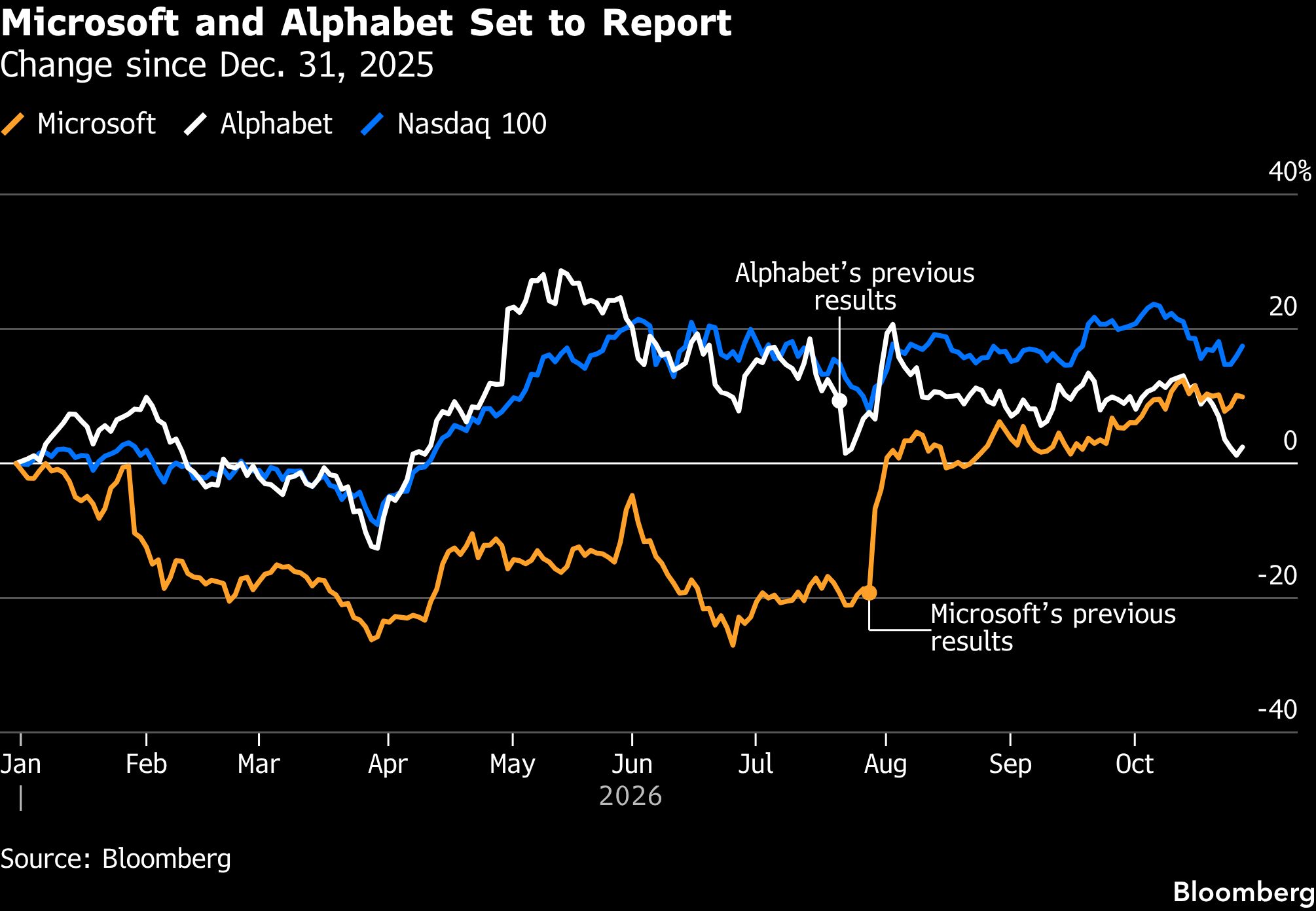
Traders are looking for protection in case all that spending doesn’t pan out. The price of Alphabet’s five-year credit default swaps hit a record on Friday and is up 16% this month. Microsoft’s five-year CDS also hit a record on Friday and is up almost 9% in October, putting the securities on track for a fifth straight monthly increase, which would be their longest streak on record.
Both stocks are underperforming for the year, with Microsoft climbing 9.7% and Alphabet gaining 3.8%, compared with the 13% rise in the S&P 500 Index and 18% advance in the tech-heavy Nasdaq 100 Index.
Investors will be looking at growth in the companies’ cloud-computing businesses, which is often seen as a proxy for AI-related demand, when judging their spending.
“It would be very reassuring to see a further acceleration in cloud growth, because that would give investors greater conviction in their AI investments,” said Ted Parrish, chief investment officer of Parrish Capital, who owns Microsoft and is looking to increase his position.
Earlier this week, Anthropic PBC’s initial public offering filing underscored how the AI giant is relying more on the cloud titans. Anthropic has committed to spending at least $114 billion with Google over the coming years and roughly $45 billion with Microsoft, whether or not it uses the computing capacity. It also has commitments to spend $110 billion through 2036 with Amazon.com Inc., which reports earnings on Thursday.
Microsoft’s Azure cloud business is expected to show 45% growth in constant-currency terms, according to Bloomberg consensus estimates. And there’s potential for a “higher than normal beat on Azure” this quarter as third-party data for it “screened strongest in history,” TD Cowen analyst Derrick Wood wrote in an Oct. 14 note.
For Alphabet, Google Cloud is expected to generate revenue of about $29 billion in the third quarter, up 91% from roughly $15 billion a year ago and an acceleration from the second-quarter’s 81% pace.
“The monetization part of the equation is becoming clearer,” said Dan Sheehan, director of portfolio management at Telos Wealth Advisors. “We’re starting to see incremental returns, though it isn’t lightening up their balance sheets.”
If the companies disappoint on cloud growth or otherwise fail to make the case that their spending is paying off, their shares could get hit like Meta Platforms Inc. did after reporting earnings last week. While Meta showed a number of encouraging trends, they were overshadowed by its plans to raise future spending commitments by $125 billion to $825 billion, sending the stock tumbling 7% the next day.
“Right now the fear gauge is clearly on high alert about all this spending and ROI question,” Catalyst’s O’Neill said. Microsoft “is getting a benefit because it has an eye toward that discipline.”
Microsoft’s capital expenditure is expected by analysts to exceed $190 billion in its 2027 fiscal year, up 65% from the roughly $116 billion it spent last year. Its free cash flow is estimated at less than $32 billion in fiscal 2027, down from the $67 billion it generated last year, before rising to $47 billion in fiscal 2028 and $87 billion in fiscal 2029.
Alphabet’s capex is seen more than doubling to $202 billion in 2026 from $91 billion last year, according to the consensus estimate. As a result, the company is expected to generate negative free cash flow of $3.6 billion this year and $30 billion in 2027 before turning positive in 2028. It had positive free cash flow of $73 billion in 2025.
“I’m not worried about Alphabet having negative free cash flow,” said Sheehan, who views these megacap tech companies as safe havens within the market given their durable growth. “If it wants to, it can turn off spending somewhere and suddenly the cash flow is back.”
Tech Chart of the Day

A message from Advisor Perspectives and VettaFi: Discover something new! Click here to register for our upcoming webcasts.
Bloomberg News provided this article. For more articles like this please visit bloomberg.com.