 Advisor Perspectives welcomes guest contributions. The views presented here do not necessarily represent those of Advisor Perspectives.
Key Takeaways
- Morningstar reports projected retirement wealth advantages of 5.9% for managed accounts over target date funds (TDFs) and 9.8% on average in adverse market conditions.
- Morningstar’s studies conflate engaged, actually managed accounts (AMAs), like those provided by services like Guided Choice and Financial Engines, with automated qualified default managed accounts (QMAs), thus documenting the value of human advice rather than default account superiority.
- Since AMAs are not QDIAs, the comparion to TDFs is wrong. The more apprpriate comparison is between QMAs and TDFs, but that’s not in these studies.
- Near-retirement defaulted participants should exit the default and move to safety, potentially with AMA guidance; fiduciaries need not replace TDFs with QMAs.
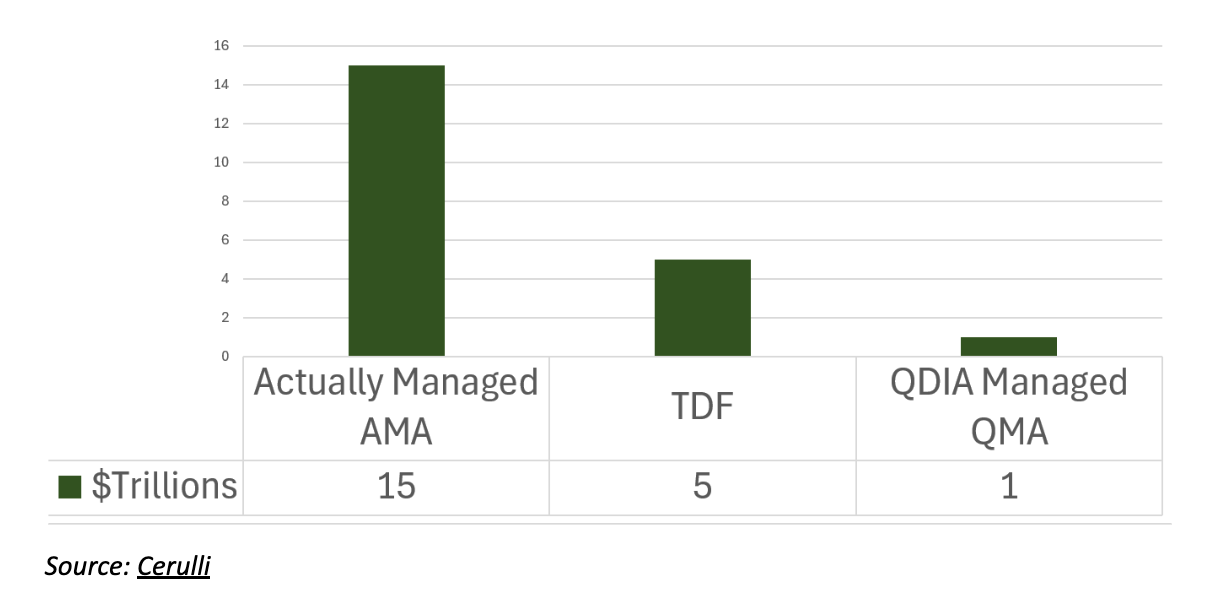
At $5 trillion and growing, target date funds (TDFs) are by far the most popular choice of qualified default investment alternative (QDIA) in defined contribution savings plans. Managed accounts (MAs) are a far distant second among QDIAs, with less than $1 trillion in assets.
Yet Morningstar recently published a series of studies reporting that MAs outperform TDFs, prompting some to question whether fiduciaries have made a mistake by favoring TDFs:
- "Analyzing the Value of Managed Accounts" analyzes more than 3 million participants and finds a 5.9% improvement in projected retirement wealth for TDF investors adopting managed accounts.
- "Managed Accounts Under Adverse Market Scenarios" examines the value of personalization during difficult markets and reports a 9.8% average projected wealth advantage over TDFs.
- "What Participants Value From Their Managed Account Provider" reports that participants want human-led advice. This most recent report provides the clue as to why MAs outperform.
The projected wealth advantages are not observed investment returns. They reflect both savings rates and asset allocation, with higher contributions identified as the primary driver. The analyses assume an annual managed-account fee of 0.40%.
Data-driven automated MAs cannot motivate higher contributions because they do not talk to participants. Motivation needs to come from interaction with an advisor in an actually managed account. There are two distinct types of managed accounts that are easily conflated, as discussed in the next section.
Morningstar’s Conflation Mistake
There are two distinct types of managed accounts that Morningstar mistakenly conflates:
- AMAs are actually managed accounts that are not QDIAs, because investors actively engage with an advisor. Most assets in managed accounts are AMAs, which is why it’s easy to conflate them with QMAs. Wealthy people hire professionals to manage their assets.
- QMAs are QDIA managed accounts that are electronically “managed” by computer with no participant engagement. I consider them unmanaged, despite the name and the fact that the law allows them to be called managed. They are completely different from AMAs, because participants do not engage in QMAs.
- The comparison of AMAs to TDFs is wrong because AMAs are not QDIAs. QMAs and TDFs are QDIAs that do not interact with participants, so they are comparable to one another. Importantly, AMAs integrate risk tolerance into the investment decision, while QDIAs do not.
Integrating Risk Capacity With Risk Tolerance in AMAs But Not QMAs
PIMCO summarizes the recordkeeper data used in QMAs as follows:
-
- Age (which determines the time horizon to expected retirement, confirming the use of a glidepath); and
- Wealth, the sum of:
- Current account balance;
- Salary;
- Contribution rate; and
- Employer match.
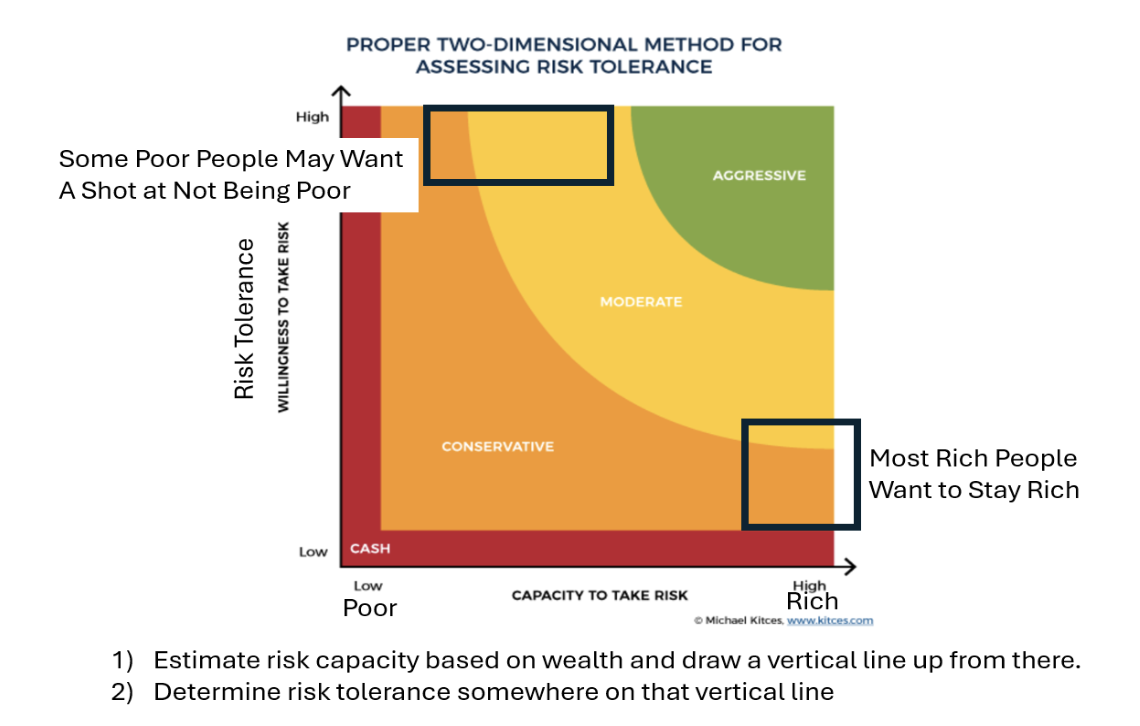
These risk capacity inputs are useful, but they do not reveal a participant’s complete financial circumstances or willingness to accept investment losses. Specifically, risk capacity needs to be integrated with risk tolerance (the willingness to take risk) as shown in the following graphic: